Introduction: Corrugated Steel Panel Manufacturing
The global shipping container industry is booming as the international trade, logistics infrastructure, and domestic freight networks continue to increase in size. While most entrepreneurs are focussed on the manufacture of whole containers, little awareness exists of the vast business potential lurking in the component of containers – particularly corrugated steel panels.
Corrugated panels make up the structural backbone of every single ISO container. They offer strength, durability and resistance to harsh maritime conditions. Since every container needs multiple panels, the manufacturers heavily depend on specialized suppliers to keep production flowing. This is creating a scalable and less capital intensive opportunity for MSMEs as well as first generation industrial entrepreneurs.
In India, where manufacturing eco-systems are gaining strength and supply chains are becoming more localized, corrugated steel panel production is a niche but powerful entry point into industries linked to exports.
Read More: The Complete Technology Book on Hot Rolling of Steel (2nd Edition)
Why Corrugated Steel Panels are Crucial
Corrugation is not only an aesthetic design-it is an engineering necessity. The wave shape profile enhances structural rigidity but cuts down weight of the material. The design of shipping containers enables them to endure stacking loads and withstand crane operations and complete ocean transport without losing their structural integrity.
In business terms, this dependency leads to steady demand. Container assemblers sometimes prefer to outsource for the manufacture of the panels to specialized vendors rather than build their own production lines. This provides opportunities for component makers who can provide consistently good quality and timely supply.
In addition, panels are needed not only for the manufacturing of new containers but also for repair and refurbishment projects. As circulation of containers around the globe increases, the replacement of panels grows steadily.
Market Trends Supporting the Manufacturing of Components
India’s industrial strategy is slowly moving towards strengthening its domestic manufacturing ecosystems rather than on finished goods. Policies to encourage localization, logistics infrastructure development, and MSME participation in global supply chains have changed the face of container manufacturing.
For corrugated panel manufacturers, these trends provide a number of benefits:
- Stable institutional demand from container assembly plants
- Shorter payment cycles as compared to full container exports
- Lower certification requirements than finished containers
- Ability to increase production capacity step by step
- Indirect Participation in export markets through domestic buyers
These factors decrease operational risk without decreasing growth potential.
Read more: Manufacturing Business of Steel Container (Cargo Container)
Manufacturing Process Overview
Corrugated steel panel production is a process-driven manufacturing activity in which consistency and exactness are the keys to profitability. The standard operations work through these established steps:
- Raw Material Preparation
The manufacturing process creates high-strength steel coils and plates which manufacturers use to produce containers and which include weather-resistant materials. The accuracy of material quality affects both the precision of forming processes and the time span for which products remain intact.
- Corrugation Forming
Steel sheets undergo a wave profile transformation through hydraulic or roll forming presses which use hydraulic and roll forming technologies. The company uses precise tooling to determine both panel strength values and panel suitability for international container standards.
- Cutting and Edge Finishing
CNC shears and plasma cutters are used to cut panels into dimensions that meet ISO standards. Edge finishing is used to improve welding compatibility in container assembly.
- Surface Treatment
The process uses shot blasting or chemical cleaning to remove scale which prepares surfaces for protective coating application. The proper surface preparation method increases corrosion resistance which results in longer product lifespan.
- Quality Control and Packaging
Dimensional checks, thickness measurement and profile inspection help ensure consistency of the products that are then dispatched to customers.
This process enables MSMEs to be efficient with a moderate level of automation and manpower.
Read More: Start Manufacturing of Steel Containers (Cargo Containers)
Requirements of Machinery and Capital Intensity
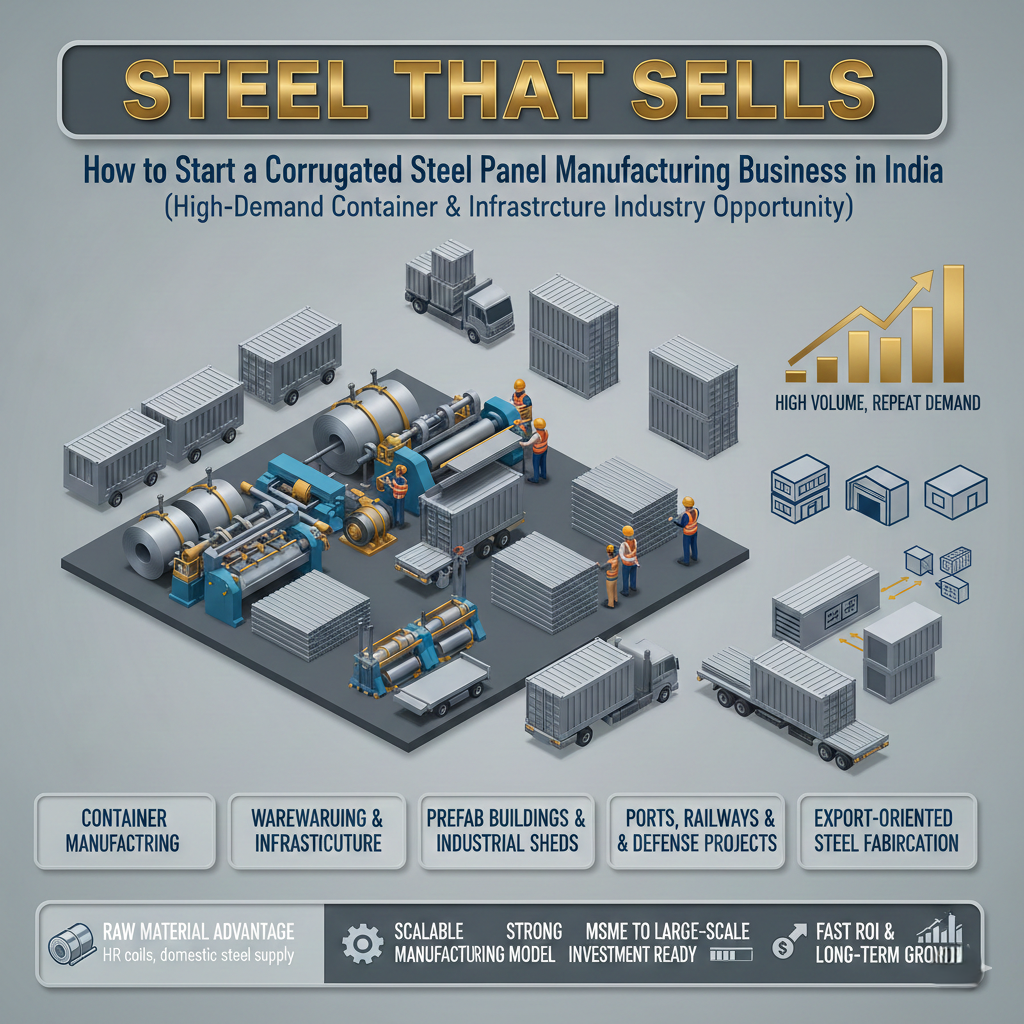
One of the greatest benefits of corrugated panel production is that it has a manageable capital requirement in comparison to full container production plants. A typical setup includes:
- Decoilers, sheet straightening machine
- Roll-forming corrugation presses or hydraulic corrugation presses
- CNC shearing machine or plasma cutting machine
- Shot blasting, surface treatment units
- Material handling systems, such as cranes and forklifts
The operational setup of these units differs from container assembly facilities because they do not require extensive welding lines or testing yards which results in simpler operations and lower capital expenses.(Corrugated Steel Panel Manufacturing)
Financial Logic and Profit Drivers
The financial viability of a corrugated panel manufacturing unit is not dependent on high per-unit margins so much as on high throughput and efficiency of operation. Some major financial benefits are:
Throughput-Driven Economics
High machine utilization has the effect of spreading fixed costs, which improves profitability even at moderate margins.
Reduction in Working Capital Requirement
Panels are usually delivered in bulk to homeowners, so there’s less waiting time to receive the panels.
Read More: A $60,000 crore Steel Import Gap: new Startup Ideas to lower India trade deficit (Citing import value 61,171 crore data on the ministry of steel website)
Incremental Expansion
Manufacturers can add more lines of corrugation as the need grows, reducing the initial risk.
Export Exposure without Export Burden
Even on a domestic sale, panels frequently end up in export containers – making indirect participation in world trade possible.
Opportunities in the Market in India and Beyond
Corrugated steel panel manufacturers can serve various segments of customers:
- Domestic container assembly plants
- Manufacturing units that are export oriented
- Container repair and refurbishment yards
- Inland container depots, logistics companies
- Coastal shipping operators
As India develops freight corridors, inland waterways, and port infrastructure, movement of containers will be able to increase-and so will new manufacturing and maintenance need increase.(Corrugated Steel Panel Manufacturing)
Strategic Lessons of the Industrial Leaders in India
The leading industrial groups in India show the strength of component specialization. Companies such as Tata Steel, JSW Group and different manufacturers of automotive components built solid bases by concentrating on fundamental procedures and supply chain integration, in contrast to the instant production of ultimate goods.(Corrugated Steel Panel Manufacturing)
For corrugated panel entrepreneurs, the most important lesson is obvious: being an indispensable element supplier often means more stable growth possibilities than participation in highly visible but capital-intensive finished product markets.
Potential Project Segments
Entrepreneurs who enter this sector can consider the following lines of products:
Side-Wall Corrugated Panels
High volume products that have standardized specifications, which are suitable for steady production
Roof Panels for High Cube Containers
Require higher quality control and provide greater margins because of precision requirements.
End-Wall Panels
Reduced production volume, but with a more complex design, product diversification possible.
A phased approach – beginning with side-wall panels and progressively growing – is a way of managing risk effectively.
Read More: 10 High-Demand Downstream Steel Product Manufacturing Ideas in India
Risks and Challenges to Consider
While this is promising, it is a business that needs careful planning. Major risks include:
- Steel price fluctuations on margins
- Reducing profile accuracy of tool wear
- Dependence on a limited number of buyers
- Logistics coordination with the manufacturers of containers –
Entrepreneurs can reduce these risks by diversifying their customer base, long-term supply contracts, and feasibility studies from professionals.
Conclusion
The process of manufacturing corrugated steel panels from startup concepts lacks glamour but it provides manufacturers with a practical and scalable industrial opportunity. This sector provides MSMEs and first-generation entrepreneurs with an appealing business opportunity because it has continuous demand and requires minimal capital investment while being tightly connected to worldwide trade logistics..
The combination of process discipline and quality control with operational efficiency allows manufacturers to create a sustainable business which benefits from the growth of India’s logistics and manufacturing industries.
Frequently Asked Questions (FAQs)
- Is corrugated panel manufacturing suitable for beginners in manufacturing?
Yes. With proper feasibility planning and technical support, it is a manageable entry into industrial production. - How much automation is required?
Partial automation improves consistency, but full automation is not necessary for small or medium-scale units. - What drives profitability in this business?
High production volume, machine utilization, and efficient raw material procurement are key profit drivers. - Is this business dependent on export markets?
Indirectly. Many domestic buyers produce export containers, offering exposure to global demand without export logistics complexities. - Can this business expand into full container manufacturing later?
Yes. Many entrepreneurs use panel manufacturing as a first phase before expanding into full container assembly. - What are the main customers for corrugated panels?
Container manufacturers, repair yards, logistics operators, and export-oriented manufacturing units.