
The Budget 2026 MSME opportunities are creating a roadmap for startups and small businesses in India. Every year, the Union Budget of India makes headlines for changes to taxes, allocations, and economic policies, but for MSMEs, it is much more than numbers—it highlights how the government is reducing operational friction, de-risking business, and enabling real growth. These opportunities are especially relevant for manufacturing, industrial services, and export-oriented MSMEs.
The Union Budget 2026 presents three main priorities through its dedicated assistance for MSMEs and its focus on export development and its funding for logistics and industrial corridor development. Entrepreneurs can navigate their initial cash flow difficulties by building their business through the proper understanding of these signals.
Read More: Profitable Small Scale Industries- Money making Business Ideas for Startup (when you don’t know what industry to start)-2nd Revised Edition
Reading the Budget Like a Feasibility Consultant
Intelligent founders examine Budget provisions because they want to understand their impacts on cash flow and operational efficiency and market opportunities. Key questions to ask include:
- Where will working capital become cheaper or faster?
- Which sectors benefit from infrastructure and corridor development?
- Which imports are targeted for substitution or incentives?
- Which industries gain export competitiveness through simplified compliance and logistics?
Answering these questions helps turn the Budget from a financial statement to a blueprint for success of startups.
MSME Support: Capital, Liquidity and Corporate Readiness
MSMEs tend to struggle with three major problems: lack of equity, delayed receivables and compliance fatigue. The 2026 Budget is addressing all three:
1. Structured Equity Support
The SME Growth Fund of $10,000 Crore rewards measurable performance, clean books and scalable unit economics. This program is focused on developing “champion SMEs”, which can compete at a global level.
For micro-enterprises, a top-up of the Self-Reliant India Fund of 2000 crores is provided for additional support to the capital.
2. Liquidity Improvements
The Trade Receivables Discounting System (TReDS) platform enables businesses to convert their pending receivables into cash rather than having these receivables create financial problems. Businesses that sell to large buyers now have access to working capital through improved financial arrangements that decrease their financial risks.(Budget 2026 MSME opportunities)
3. Corporate Readiness Programs
The Corporate Mitras initiative makes it simple for the GST, payroll and export documentation especially in non-metro regions. Startups that implement these systems can scale without too many administrative costs, providing a competitive advantage over their peers.
Read More: Business Ideas for Startup in Drugs & Pharmaceutical Industry with Project Profiles (3rd Edition)
Export-First Budget: Why It Is Important
The government has focused on exports and has targeted sectors such as electronics, semiconductors, rare earths, chemicals, textiles, footwear, and sports goods.
For startups, a mindset of being export ready from the start, even in the process of serving domestic markets, offers:
- Higher pricing power by quality production
- Process maturity and repeatable operations-
- Increased confidence of investors
Infrastructure initiatives such as SEZ flexibility and duty/logistics trust systems make export linked manufacturing possible and scalable.
Logistics and Industrial Corridors: The Hidden Opportunities
The Budget highlights freight corridors, more waterways and coast cargo initiatives. These lower the cost of shipping and increase the reliability of delivery, thereby opening up entrepreneurial opportunities in:
- Fabrication of container sub-parts
- Material handling systems – Storage systems
- Maintenance services on the sides of industrial corridors
Improved logistics not only benefits large manufactures but also pulls the entire MSME ecosystem in the new direction, opening new layers of opportunities for startups.
Read More: Biofertilizer from Birds Excreta – Manufacturing Plant, Detailed Project Report, Profile, Business Plan, Industry Trends, Market Research, Survey, Manufacturing Process, Machinery, Raw Materials, Feasibility Study, Investment Opportunities, Cost & Revenue
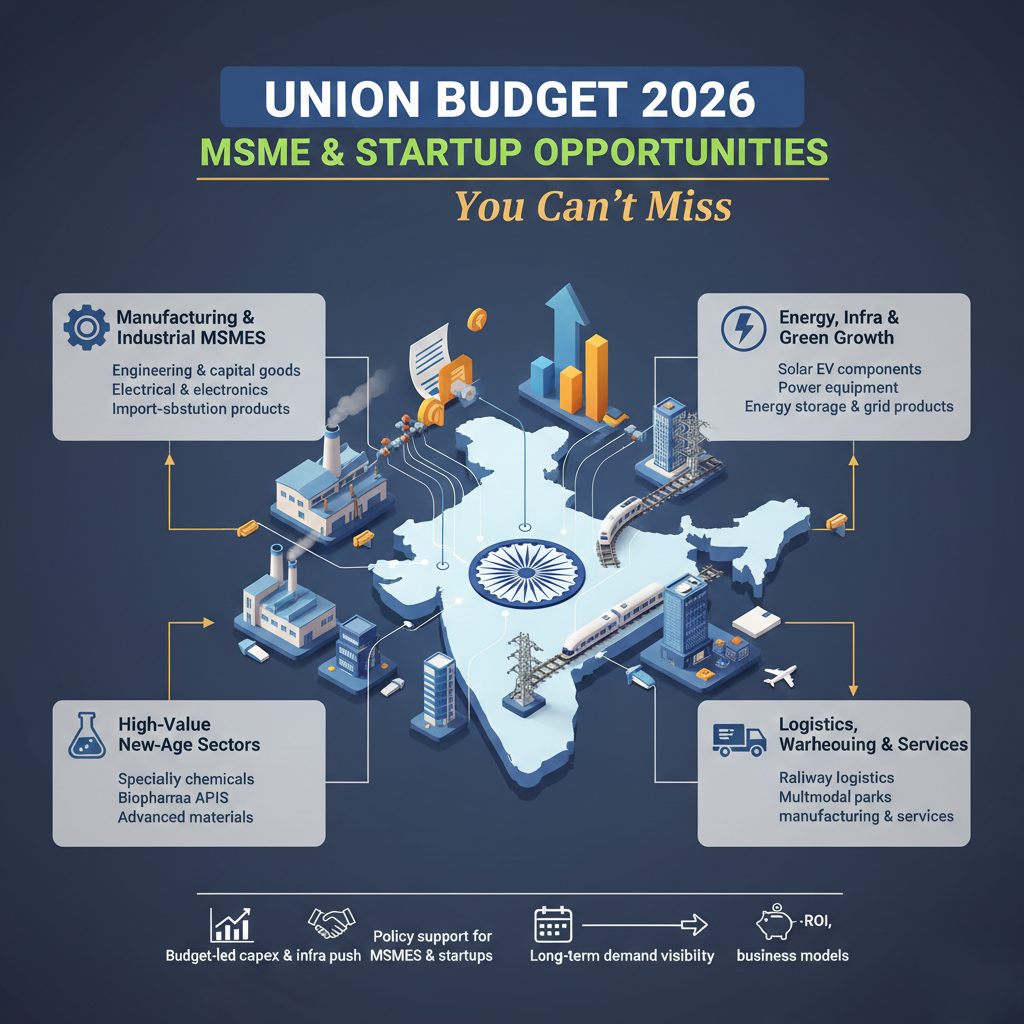
Startup Opportunities Highlighted in the Budget
Based on Budget signals, the founders can explore the following sectors:
1. Electronics Components and Bonded Zone Supply Chains
Opportunities include precision parts, micro-tooling and compliant component handling. High repeat business and switching costs makes this hugely profitable.
2. Rare Earth and Critical Mineral Processing
Startups can work on filtration media, storage solutions, and plant fabrication, servicing the ecosystem, not owning mines.
3. Speciality Chemicals and Import Substitution
The production of intermediates such as industrial solvents, textile inputs and additives guarantees stable demand at domestic level with optionality for export.
4. Sports Goods and Technical Textiles
Startups can achieve export-ready operations through their use of engineered fabrics and composite materials and their adoption of specialty packaging solutions.
5. Logistics-Linked Manufacturing
Container sub-parts, modular storage systems and dock-side handling components benefit from being close to industrial corridors.
6. CCUS Ecosystem Vendors
Carbon capture projects provide demand for skids, piping modules, instrumentation and maintenance services – providing specialised opportunities for MSMEs.
Read More: Startup Opportunities in Processing Fruits, Pulses, Spices, and Dairy
Lessons from India’s Best Companies
Successful Indian companies have practical lessons:
- Bharat Forge: Compete on capability and certifications and not just on cost.
- Sun Pharma: Organizations should maintain process discipline because it needs to protect critical business operations from complex elements.
- Zydus Lifesciences: The establishment of backward integration through tooling and testing and automation solutions enables businesses to maintain their profit margins while reducing their need for external vendors.
Startups can use these models to develop operational systems that provide both resilience and growth potential.(Budget 2026 MSME opportunities)
How NPCS Supports Founders
The Budget creates new opportunities for businesses which will face more challenging conditions because of increased competition. Niir Project Consultancy Services (NPCS) assists entrepreneurs to assess feasibility, profitability and scalability through:
- Detailed project report (DPRs)
- Market surveys
- Manufacturing processes, capacity planning
- Financial and risk analysis
This helps founders avoid making mistakes like misjudging the product, not having enough working capital, or building plants that are not scalable.
Read More: 10 New Manufacturing Business Opportunities in India for Startups and MSMEs
Conclusion
Union budget 2026 is more than a financial statement. For startups and MSMEs, it is a strategic signal with the convergence of equity, liquidity, logistics and export support.
Founders that read the Budget like a feasibility consultant; who focus on the economics of risk and who take action on ecosystem opportunities, can not only survive the early cash-flow challenges but also build investable, scalable and export-ready businesses.(Budget 2026 MSME opportunities)
With the right planning, sector focus, and implementation, the 2026 Budget could very well be the impetus for a new wave of MSME and startup growth in India.
Founder-Focused FAQs
- What measure/ measures in the Budget help MSME survive the most?
Structured growing equity mixed with improvement in receivables liquidity Cash flow is the actual measure of survival.
- Should first generation founders enter deep tech manufacturing now?
Start with the ecosystem opportunities – tooling, components, consumables and compliant warehousing – before tackling complex end-products.
- What is the best “smart export” strategy for a small manufacturer?
From the first day of operations, businesses should create their export readiness plan through establishing quality systems and packaging compliance and building their stable supplier networks.
- How can founders shortlist products that don’t fall for the hype?
The team should select products based on their capacity to deal with three specific criteria which include continuous product demand and existing product import restrictions and their ability to handle compliance requirements and their financial track record.
- Are cluster and corridor pushes relevant outside of metros?
Yes. Operating costs are lower and the government is actively building ecosystems in such areas.