Introduction: Biopharma and AYUSH Manufacturing India
The life sciences industry in India undergoes its most significant transformation since the 2026-27 Union Budget. The nation which previously excelled in exporting pharmaceuticals and scientific expertise now develops a healthcare system based on manufacturing. The recent policy direction has given a thrust to biopharma and AYUSH manufacture not just as healthcare segments, but as strategic industrial growth engines.
For start-ups and MSME entrepreneurs, therefore, this policy shift stands for something more than just temporary incentives. It represents a long-term commitment to infrastructure development, clarity of regulation, export competitiveness and innovation-to-manufacturing integration. As a result, barriers that previously challenged small and mid-scale founders such as compliance complexity, funding challenges, and lack of institutional support are being reduced gradually.
With growing domestic demand, global supply chain diversification and government-initiated manufacturing efforts, the biopharma and AYUSH production sectors are coming out as very viable startup opportunities in India’s evolving industrial landscape.
Read More: PHARMACEUTICAL UNIT (Automatic Plant of Tablet and Capsule) – Manufacturing Plant, Detailed Project Report, Profile, Business Plan, Industry Trends, Market Research, Survey, Manufacturing Process, Machinery, Raw Materials, Feasibility Study
Why Biopharma and AYUSH Manufacturing are Strategic Priorities
The government has made life sciences manufacturing an economic planning priority because it seeks to achieve self-reliant healthcare systems which enable global competitiveness. India wants to lessen its import dependence on some of the key pharmaceutical ingredients and grow exports of value-added health products.
Biopharma manufacturing plays its role in advanced therapeutics, biosimilars, fermentation-based products and high-value intermediates. At the same time, AYUSH manufacturing builds on India’s tradition of medicine to develop standardized formulations of herbal medicines that can be sold in the international markets.
For entrepreneurs, this is translated into the strategic emphasis of:
- The national industrial policy of the country establishes various sectors that venture capital and institutional investors will invest in.
- The establishment of improved regulatory predictability occurs when organizations identify clear policy signals which establish licensing and compliance pathways.
- The standardization initiatives together with export infrastructure development provide businesses with access to regulated international markets.
The integration of modern biotechnology with traditional health systems creates a manufacturing ecosystem which produces goods for both domestic and international markets.
Biopharma SHAKTI: Innovation and Manufacturing
One of the most significant initiatives to aid this transformation is the Biopharma SHAKTI program. This program emphasizes commercial development and production capacity building more than previous programs which supported academic research.
Read More: Handbook on Ayurvedic and Unani Medicines With Formulae, Process & Their Uses
Key Advantages for Startups
- Phased Capital Investment
Using pilot production plants entrepreneurs can establish their businesses before advancing to commercial production. The staged growth model enables founders to confirm their process methods before expanding their operational activities while protecting them from high initial capital expenditures.
- Focus on Technical Depth
Investors prefer to fund startups which possess deep knowledge about multiple difficult products instead of companies which lack specific product expertise. Startups can achieve technical expertise through programs that assist them with process development and validation.
- Improved Bankability
The initiative helps startups establish better credibility when they need to work with banks and investors because it assists their transition from laboratory research to large-scale production.
The framework enables technically skilled founders to enter regulated manufacturing environments while it supports the development of businesses that rely on innovation.
Strengthening AYUSH Manufacturing through Institutional Expansion
The growth of Ayurveda institutes and research infrastructure is playing an important role in evolution of AYUSH sector. The sector now progresses from its previous state which had small producers who used minimal standards toward a model that employs scientific validation and industrial-level production methods.
Read More: Handbook on Unani Medicines with Formulae, Processes, Uses and Analysis (2nd Edition)
Benefits for Startups
- Access to research-backed formulations and clinical validation.
- Availability of competent professionals who are trained in modern quality systems.
- Documentation and testing standards were improved and meet global requirements.
These developments help in building credibility of AYUSH products in the international markets particularly in nutraceutical, wellness and preventive healthcare sectors. Startups that are able to merge traditional knowledge with modern manufacturing practices can achieve a considerable competitive advantage.
Upgraded Drug Testing Laboratories: From Compliance Burden to Strategic Asset
Quality testing has always been a challenge for life sciences startups, with high costs, delays in approval and the need for limited third-party labs. The investments made by the government in the improvement of the drug testing infrastructure has the potential to change this area.(Biopharma and AYUSH Manufacturing India)
Business Impact
- Faster batch release cycles and faster entry to markets.
- when New Zealand growers were on the brink of entering into a new export trade with China, the red imported fire ant was identified as a possible threat to the export.
- Savings in costs of external services for testing, and
- Improved working capital efficiency by reduced approval time lines.
For early-stage manufacturers, developing processes that are in line with modern testing standards can help improve both regulatory compliance and credibility in the market.
Read More: Setting Up an AYUSH‑Licensed Ayurvedic Business
Export-Oriented Manufacturing: Scaling Up From Domestic Demand
While India’s domestic healthcare market has the potential to offer stability, export-oriented manufacturing promises scalability and higher margins. The Union Budget’s focus on enhancing logistics, facilitating trade and infrastructure will boost India’s status as a global manufacturing hub.
High Growth Segments for Entrepreneurs
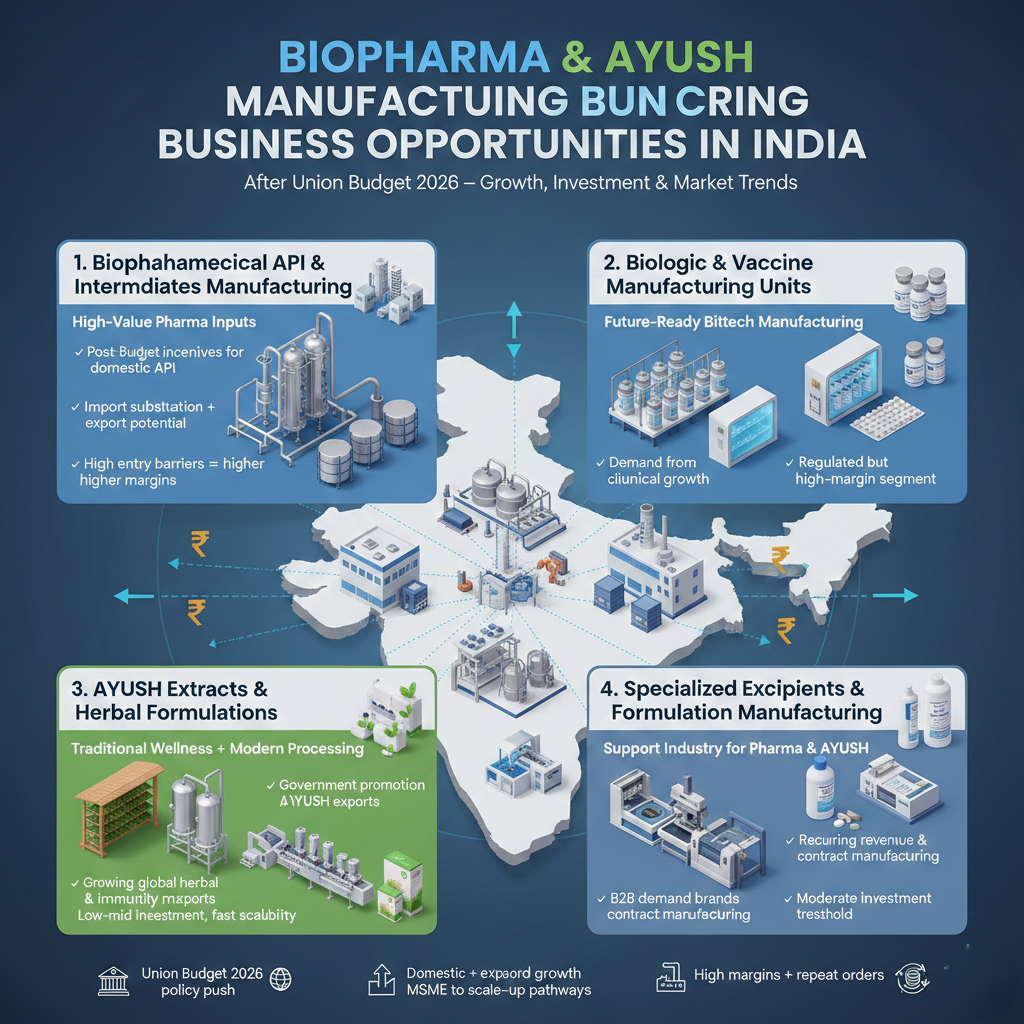
API and Advanced Intermediate Manufacturing
Selective high-demand molecules offer the opportunity for import substitution and long-term supply contracts.
Products from Fermentation: Biopharma
Products such as enzymes, probiotics, amino acids and biosimilars have high entry barriers and increased global demand.
Standardized Ayurvedic Extracts & Nutraceuticals
Validated herbal extract with a consistent manufacturing process are gaining fast acceptance in wellness markets overseas.
Diagnostics and Medical Consumables
Compared to traditional pharmaceuticals, these products often have less regulatory pathways and great export potential.
Entrepreneurs that plan facilities out with export compliance in mind from the outset are more likely to enjoy sustainable growth.
Lessons From Effective Indian Life Sciences Entrepreneurs
India’s top pharmaceutical business entrepreneurs show that long distance running in life sciences manufacturing is a matter of technical mastery and regulatory discipline.
- Dilip Shanghvi (Sun Pharma): Sachs and Xanax: Developed competitive strength via complex generics and operational efficiency.
- Global regulatory compliance and having a strong interest in fermentation science, Mazumdar-Shaw (Biocon) put India on the map of having credibility in the field of biotechnology.
A theme that is common to successful founders is a focus on depth, not rapid diversification. Startups entering into biopharma or AYUSH manufacturing must focus on specialized capabilities, robust quality system and scale up production process.(Biopharma and AYUSH Manufacturing India)
Read More: Handbook on Herbal Medicines (Ayurveda Cream, Oil, Pain Balm, Tablet, Herbal Capsules, Churna, Syrup, Medicines with Composition, Rasa Preparations with Production Process, Machinery, Equipment Details and Factory Layout) 2nd edition
Feasibility Planning and Importance of Professional Feasibility Planning
Life sciences manufacturing is capital intensive and highly regulated. Small planning mistakes in yield assumptions, validation timelines or compliance requirements can have a huge impact on profitability.
A good feasibility study should include:
- Details Market Demand Analysis and competitive benchmarking
- Process design & plant layout optimization.
- Model for each: – Machinery selection – Automation strategy.
- Raw material sourcing/supply chain risk assessment.
- Financial modeling (including regulatory and certification costs)
- Risk mitigation strategies and scalability planning.
Professional planning, in addition to mitigating operational risk, enhances investor confidence and project sustainability.
Conclusion: High Confidence Opportunity for Prepared Entrepreneurs
The Union Budget 2026-27 marks a structural shift to manufacturing led healthcare growth in India. By bolstering biopharma innovation pipelines, developing more AYUSH research institutions, and upgrading testing infrastructure, the government has developed a more supportive ecosystem for life sciences manufacturing startups.
However, in this sector, it is not just policy support that is needed for success. Entrepreneurs must integrate technical technical know-how with focused financial planning, regulatory awareness, and product focus. Export readiness, process excellence and long-term vision are key to developing competitive manufacturing businesses.(Biopharma and AYUSH Manufacturing India)
For founders who are ready to look at the industry seriously, with strategic planning, biopharma manufacturing as well as ayurveda manufacturing (AYUSH) are no more experimental ventures, they are scalable, future-ready opportunities aligned with the industrial and healthcare priorities of India.
Frequently Asked Questions (FAQs)
Is biopharma manufacturing for new entrepreneurs?
Yes, especially for founders with excellent technological backgrounds and realistic project planning.
Has AYUSH manufacturing become a more credible international?
Improved research, standardization and testing infrastructure have greatly helped in the improved global acceptance.
Do startups need to think of exports from day one?
Exports are not mandatory but usually help to increase the scalability and the profitability.
Why is Testing Laboratory Important in Project Planning?
They impact compliance time, product approval time and buyer trust in foreign markets.
What is the biggest challenge of life sciences manufacturing start-ups?
Underestimating the timelines of regulation and technical validation is a common problem.
What segments are currently most promising?
Fermentation based bio pharma, standardized ayurveda and unani extracts, and diagnostics manufacturing is showing good interest among investors.