

Introduction: Ganga Expressway Industrial Corridor MSME opportunities
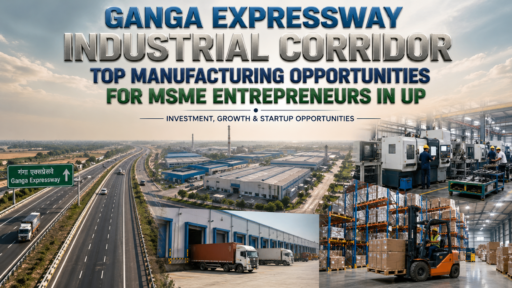
India stands at the threshold of a new age of industrial economy driven by infrastructure and the expresses ways will drive this new economy. Gang Expressway industrial corridor, which runs through Uttar Pradesh, is another expressway that is quickly emerging as a lucrative option for MSME investors, manufacturers and entrepreneurs.
The expressway, far beyond a simple transporter artery, runs for almost 594 km across Uttar Pradesh, acting as an industrial corridor. It’s fast transforming into an industrial corridor with assured investments of more than Rs 46,000 crore in a range of sectors such as manufacturing, logistics, warehousing and agro-processing.
This opportunity for entrepreneurs is in the early stages of development when land is still relatively cheap, incentives are on and industrial clusters are just emerging.
Find high-growth industries before others do
Why the Ganga Expressway Is a Game-Changer for MSMEs
There is a typical pattern of development for industrial corridors. It starts with the infrastructure, establishment of large anchor industries and then MSMEs which will serve as supply chain of the industry. The Ganga Expressway is at this crucial juncture.
The corridor traverses districts such as Meerut, Amroha, Budaun, Shahjahanpur, Unnao and Prayagraj. These areas are currently agrarian, but are in the process of becoming industrial supporting regions.(Ganga Expressway Industrial Corridor)
The core strengths of the industrial corridor include:
- Cheaper industrial land than NCR and Lucknow
- Access to quality agricultural raw materials locally
- Ample availability of semi-skilled workforce at low cost
- Better accessibility with expressway
- Government industrial incentives through multiple schemes
This places it as a lucrative choice for MSME manufacturing units.
Investment Momentum: Why This Corridor Is Already Active
The ₹46,000+ crore investment pipeline is real – it’s industrial commitment. This transforms the opportunity from “future” to “present”.
Once anchor industries start, MSMEs automatically get a boost because of supply chain development. This creates opportunities in packaging, transportation, components, consumables and raw material processing.
Put simply, anchor industries create ecosystems and MSMEs are the backbone of those ecosystems.

Top Manufacturing Opportunities Along the Ganga Expressway
1. Food Processing and Agro-Based Industries
Food processing is the best opportunity in this belt as Uttar Pradesh is a major agricultural state. Local availability of raw materials (wheat, potato, sugarcane, mustard and vegetables) helps keep transportation costs low and margins high.
The kind of businesses available include spices grinding, flour mills, potato chips, fruit pulp, packaged foods, etc.
The investment in a medium sized unit ranges from ₹1.5 crore to ₹4 crore, with a projected margin of 15-28% depending on the product and market.
Food processing also has schemes like PMEGP and PLI, which help MSMEs to establish their businesses.
Get Detailed Insights from This Book: Handbook on Fruits, Vegetables & Food Processing with Canning & Preservation (3rd Edition)
2. Technical Textiles and Geofabric Manufacturing
India’s technical textiles sector is rapidly growing. They are used in the construction, irrigation, agricultural and medical fields.(Ganga Expressway Industrial Corridor)
These include nonwoven, geotextiles and agricultural nets.
Key highlights of this sector:
- Large government infrastructure market
- Import substitution opportunity
- Long-term institutional contracts
Capital investment is between ₹3-6 crore and the return on investment is between 18% and 24%.
Related Article: Technical Textile Business Ideas in India: Profitable Manufacturing Opportunities for Entrepreneurs
3. Precision Engineering and Light Manufacturing
With big industries establishing manufacturing along the corridor, the need for components, machinery parts and fabrication will increase. Early entry MSMEs can become Tier-1 or Tier-2 suppliers.
Common enterprises include CNC machining, sheet metal fabrication, automobile components and manufacturing of industrial tools.
Capital requirement is between ₹2-5 crore with a return on investment between 12% and 22%, depending on market.
4. Cold Storage and Agri-Logistics Units
Cold storage is a highly secure MSME model in rural areas. It aids in minimising losses and improving supply chain management.
This is particularly important in rural districts such as Budaun, Shahjahanpur and Unnao.
Key advantages include:
- Good uptake in agricultural areas
- High demand from traders and FMCG companies
- Subsidies from government for capital cost
Capital investment is between ₹80 lakh and ₹1.8 crore, with profits of 18-26% at 80% capacity.
5. Industrial Packaging and Consumables
Industrial packaging is in demand in every industry, and is thus naturally correlated to industrial growth.
These include suppliers of corrugated cartons, plastic packaging, labels and industrial packaging.
This is a sector where capital investment is relatively low at ₹1 crore to ₹3 crore, having stable margins of 14% to 20%.
Access Complete Business Plan: Packaging, Holograms, Printing, Publishing, Screen Printing and DTP Projects
Why Early Entry Matters in This Corridor
As in all infrastructure markets, time is critical to success. The opportunity to invest early in the Ganga Expressway corridor offers:
- Lower land acquisition costs
- Increased access to government support
- Less competition in target markets
- Improved access to new supply chains
With faster industrialisation, land costs will increase and competition will increase. This will limit margin leverage for late entrants.
Government Incentives Supporting MSMEs
Both the state government of Uttar Pradesh and the central government provide a range of financial incentives for the manufacturing MSMEs.
These include:
- PMEGP subsidy for new enterprises
- CGTMSE collateral-free loans
- PLI for some manufacturing industries
- ODOP district-level incentives
- NABARD/NHB support for agriculture-based industries
These schemes help in reducing the risk and increasing the feasibility of the project.
Role of NPCS in Manufacturing Setup
Planning is key before setting up a manufacturing business. And this is where Niir Project Consultancy Services (NPCS) comes in.
NPCS is a prominent industrial consultancy in India, which assists entrepreneurs to establish manufacturing ventures. It offers market analysis and surveys, Detailed Project Reports (DPR), project feasibility reports, machinery advice and full project planning.
For micro, small, and medium enterprises (MSMEs) and new entrepreneurs, NPCS mitigates risk by helping to ensure that the proposed venture is economically and technically feasible.
Strategic Entry Plan for Entrepreneurs
This corridor demands a systematic approach. The best entry plan is to choose a product on the basis of demand and availability of raw materials, to develop a feasibility report, to get finance from the banks or subsidies and to buy land in the early stages of development.
Once the machinery is installed and production starts, business is established.
Future Outlook of the Ganga Expressway Corridor
In the coming decade, the Ganga Expressway is likely to transform into a full-fledged industrial hub with manufacturing clusters, transport hubs, agro-processing and export-oriented manufacturing units.
With better infrastructure and industrial growth, the demand for MSMEs will automatically increase in various sectors such as packaging, components, food processing and logistics services.
Thus, it is a long-term industrial corridor with great potential in North India.
Frequently Asked Questions (FAQ)
How much capital do you need to start a unit?
MSME units can be set up with a typical investment of between ₹80 lakh and ₹5 crore depending on the sector.
Which is the most lucrative sector along the expressway?
The most popular sectors are food processing, cold storage, technical textiles, light engineering and packaging.
When is reach break-even?
The breakeven of most MSME manufacturing unit ranges from 18 to 30 months depending on operational scale and market forces.
Are government subsidies available?
Yes, through programs like PMEGP, CGTMSE, PLI and ODOP.
Why is NPCS important?
NPCS can help an entrepreneur with feasibility reports, project reports and business plans thus limiting risk and increasing success chances.
Conclusion
The Ganga Expressway Industrial Corridor is a unique combination of infrastructure development, agricultural potential and government policies for industrialisation. It presents a unique opportunity for MSME entrepreneurs to set up manufacturing at the early stage of costs before full-scale industrialisation takes place.
The key to success in this corridor is early action, the right product choice and planning with professional feasibility studies.
Early entrants are likely to reap the benefits of the next industrial boom in Uttar Pradesh.