

BHAVYA Rasayan Scheme
A consultant’s reading of what the new chemical parks scheme actually changes for a first-time promoter.
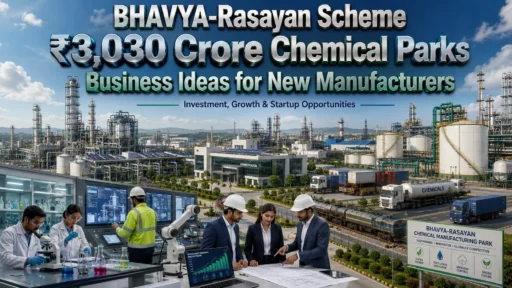
The vast majority of industrial schemes sound like big schemes but do little on the ground. This one’s special. The Union Cabinet has given approval to the BHAVYA-Rasayan scheme worth of Rs 3,030 crore for setting up three dedicated chemical parks. If you’re looking for some solid manufacturing business ideas, this is the choice to make. It doesn’t give money to promoters. Rather, it takes away the biggest barrier preventing small players in chemical manufacturing: the infrastructure cost.
The name of the scheme is Bharat Audyogik Vikas Yojana Rasayan. In the official Cabinet release, government has earmarked ₹30 crore for administration and ₹3,000 crores for common infrastructure and basic utilities within the parks. The scheme is a five-year scheme. The Centre will provide up to ₹1,000 crore each to the parks, with the state government contributing at least ₹500 crore.
So, the question for a founder is straight forward. So what does this cash pay for and how to take it and turn it into a working business? Let’s dissect it, as a project consultant does.
What the BHAVYA-Rasayan Scheme Actually Approves
The Money and the Structure
The scheme only finances 3 parks, not 30. That scarcity matters. States must bid for these projects on the Challenge Route as their name indicates. The Centre will select winners according to the quality of the proposals from each of the states, in other words. The size of each qualifying park should be a minimum of 8 square kilometres, or 2,000 acres of free land. That condition of land will be the key to determining which states will be included.
What Plug-and-Play Really Means Here
It is used freely, read the list. This scheme will involve each park supplying:
- Common Effluent Treatment Plant (CETP) for collective wastewater treatment.
- Hazardous waste treatment, storage and disposal facility (TSDF).
- Water supply and distribution systems throughout the park.
- Solvent recovery and distillation plants.
- Steam generation and a distribution network.
- A network of pipelines connected to each other between units.
- Logistics and warehousing facilities.
Read that list again from the cost sheet perspective, not the policy note perspective. All of these items are typically included in a promoter’s own capital budget. In this model, each is a shared service and charged for usage.
The Scale the Government Expects
Officials have said that this investment in each park can be expected to reach up to ₹20,000 crore to ₹50,000 crore in the future. It’s a scheme that is being described as a multiplier and that’s correct. The Centre does not fund factories. It’s paying for the soil the factories will be built on. Thus, the actual investment will be from private promoters, big and small.(BHAVYA Rasayan Scheme)
Why This Scheme Helps Small Units More Than Large Ones
It Attacks the Cost Heads That Kill Small Projects
Effluent plants, boilers and tank farms already exist in the country, owned by large chemical companies. They distributed these costs over vast numbers. A small unit cannot… Effluent treatment, utilities and safety infrastructure require 20-30 per cent of total capital in a standalone project. It is that single number that most first-time promoters give up on a chemical project at the feasibility stage. Shared infrastructure alters the numbers in the arithmetic.
Clearances Move Faster Inside a Notified Park
The environmental clearance is typically the slowest step in the chemical project process. Much of the work is already completed in a planned park. The park is approved for effluent capacity and hazardous waste handling and land use. So, an individual unit is not expected to begin from scratch, but rather within a defined framework. Typically, six to twelve months of time can be saved to the advantage of the founders; time save is interest save!
The Cluster Effect Is Underrated
Chemical clusters generate an economy of their own. Behind the anchor plants are equipment manufacturers, instrument companies, testing laboratories, transporters and experienced operators. Consequently, the small unit within a mature park is hired within weeks, not months, of a qualified shift chemist. Dahej and Jhagadia were just like that. Moreover, buyers favor suppliers in established clusters, as a visit to the buyer’s premises is easier.(BHAVYA Rasayan Scheme)
Your Neighbour Becomes Your Customer
This is where new promoters go wrong. Waste from one plant within a chemical park can often be the raw material for another. All spent solvent, steam condensate, off-spec acids and by-products are sold locally. Those transfers are inexpensive because of interconnected pipelines. So a good little deal can fill up its entire order list inside the park before it ever attempts to pursue an outside customer.
Where BHAVYA-Rasayan Sits in the Wider Policy Picture
It Is One Vertical of a Larger Industrial Push
BHAVYA-Rasayan is a part of a larger outlay Bharat Audyogik Vikas Yojana for approximately 100 plug and play industrial parks across the country. The chemicals vertical will be the driver of the Department of Chemicals and Petrochemicals. Meanwhile, all the old instruments, like the PCPIR policy, plastic parks and bulk drug parks are still working. A founder should therefore look at locations throughout all these (not just the three new parks).
Stack the MSME Benefits on Top
Park benefits and MSME benefits don’t contradict each other. Register your company first and foremost, as greater than 90% of schemes are based on this. The Ministry of MSME conducts credit support programmes, cluster support programmes and technology support programmes. Also, bank loans can be availed without any collateral under CGTMSE with guarantee cover up to ₹10 crore. For smaller ventures, the margin money subsidy is available under PMEGP and for quality and productivity enhancement the subsidy is available under ZED and RAMP programmes.
Do Not Ignore Product-Linked Schemes
There are products to choose from that give additional cash. PLI for bulk drugs, key starting materials and drug intermediates celebrates and encourages import substitution in pharma chemistry. The Advanced Chemistry Cell batteries draw in electrolyte and high purity materials demand from PLI. The National Green Hydrogen Mission creates an opportunity in green ammonia and green methanol. Minimum investment thresholds exist for each scheme, be sure to check who is eligible before freezing capacity.(BHAVYA Rasayan Scheme)
State Packages Often Decide the Final Numbers
Capital subsidy, interest subvention, SGST reimbursement, stamp duty waiver and power tariff relief are common state industrial policies. These can be used to cover 15-25 per cent of the project’s cost. Now each state is bidding for these parks, the winning states will further sweeten the packages. Invest India provides guidance to investors sector-wise, and monitors incentives by state.
Business Ideas That Fit Best Inside a BHAVYA-Rasayan Chemical Park
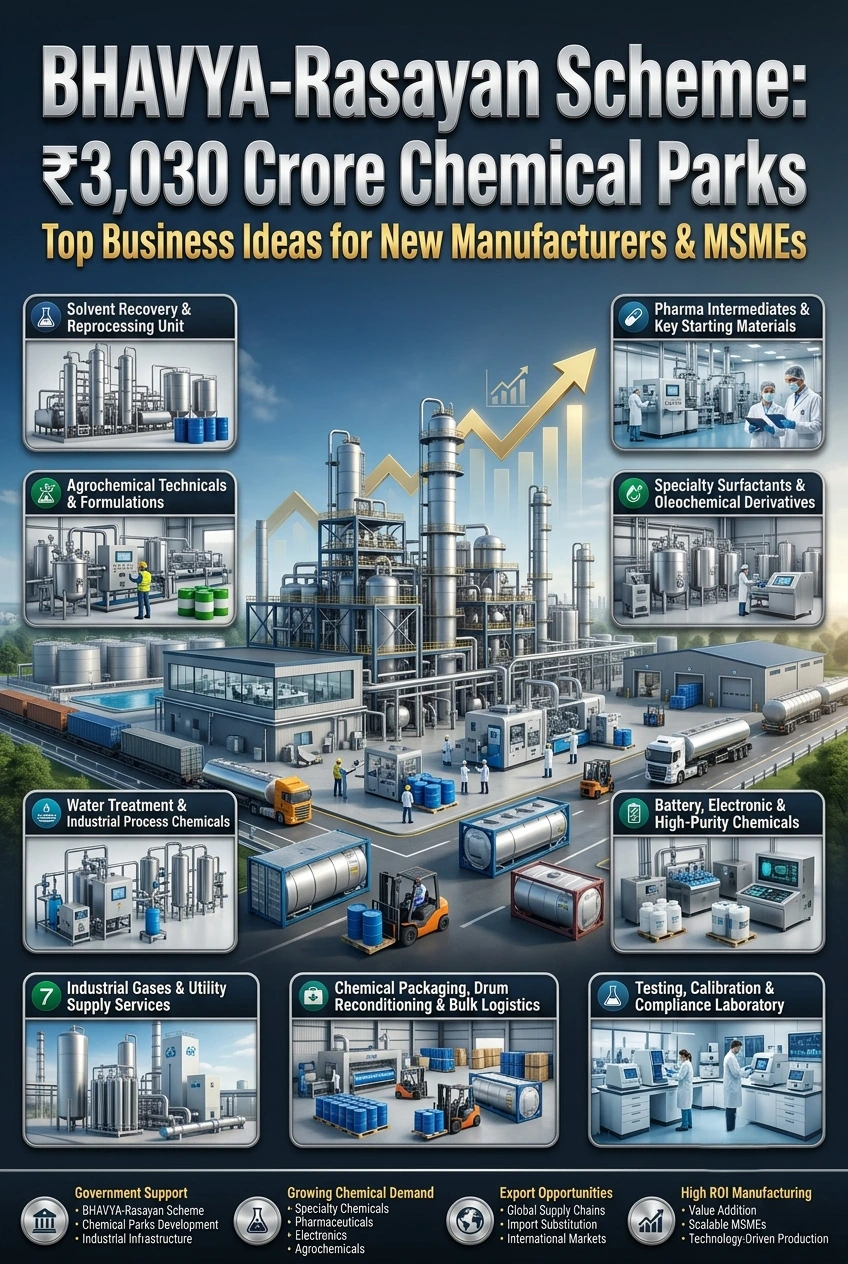
Not all chemical companies can benefit equally from a park. The following ones are selected for their shared utilities, pipelines and waste infrastructure’s direct contribution to their economics. Observe that three of them will not involve creating a molecule.
1. Solvent Recovery and Reprocessing Unit
This is the most natural of all park businesses. Large volumes of spent solvents are produced by the pharma, agrochemical and paint industries, and they need to dispose of them at an expense. That stream is captured in a recovery unit, distilled, and returned to the park as a purified solvent. The operator thus receives twice the reward – first for taking away the waste and second for the recovered product. The scheme itself provides funding for common solvent recovery and distillation facilities, so a private unit can site its equipment next to or after these facilities. The primary investment is in distillation columns, storage tanks and safety equipment. Appreciate the approvals, and of course, they should be. However, this combination of low entry costs and a captive market is scarce in few models.(BHAVYA Rasayan Scheme)
2. Pharma Intermediates and Key Starting Materials
The Indian country still relies heavily on foreign imports of its essential raw materials, and policy is actively working to remedy that. Two to three orders per unit for domestic API manufacturers is enough to create a satisfactory order book for a unit that makes these intermediates. Customers in this class are willing to pay a high price, but require evidence, purity profile, and audit certification from the first shipment. So, plan accordingly for a good control lab and knowledgeable chemists, and not only reactors. The park setting is helpful here as steam, chilled water and effluent capacity is already available. It is best filled by the promoter who has a technical background, or one who works with a veteran process chemist.
Get Detailed Insights from This Book: Biotech & Pharmaceutical Handbook
3. Agrochemical Technicals and Formulations
The agrochemicals are suitable for park applications because they require secure effluent disposal and storage. There are two ways that a founder can enter. Formulation is the process of transforming technical grade material into emulsifiable concentrate, suspension concentrate, granules and requires moderate capital investment. The technical molecule requires much more to be produced, but the margins are much better, as is the ability to command export orders. It takes time to register an insecticide under the Insecticides Act, and this is why these registrants are protected. On the other hand, biopesticides and bio-stimulants are rapidly developing and gaining significance amongst global buyers who are looking for residue-free produce. This can be scaled steadily by a promoter having rural distribution strength or having a tie-up from overseas.
Explore This Book: Complete Guide to Agrochemicals Manufacturing
4. Specialty Surfactants and Oleochemical Derivatives
Surfactants are used in all detergents, shampoos and cleaners, and demand is related to the level of household income. That means that revenue is quite steady. Ethoxylates, sulphonated acids, amine oxides and betaines are used by multinational FMCG buyers and by fast growing regional brands. The processes are steam intensive—just why a park with a common steam network would bring a better cost structure. You can get into the contract manufacturing business without risk. Many of the surfactant providers started as job-work providers, acquired the quality skill and then later started to produce their own range of institutional cleaning products with much superior profits.
5. Water Treatment and Industrial Process Chemicals
This is the least risky among the options. Municipal bodies, textile mills, power plants, and industrial estates buy products such as polyaluminium chloride, ferric chloride, antiscalants, and boiler chemicals. Demand is not cyclical as all factories have to treat their effluent. Even better, a park itself is a big captive customer as the CETP requires treatment chemicals on a continuous basis. The process technology is simple and machine is self-made. The primary concern is logistics, since the value of these products is low tonne value. Thus, it is best to have buyers within a short distance of a plant, in this case a few hundred kilometres.(BHAVYA Rasayan Scheme)
Related Article: Water Treatment Chemical Manufacturing Business in India: Profitable MSME Opportunities in Power & Industrial Sector
6. Battery, Electronic and High-Purity Chemicals
The demand curve for EVs plus electronics manufacturing is an emerging one that didn’t really exist a couple of years ago. High-purity solvents, electrolyte salts, binders and cleaning chemicals are still largely imported. This concept is appropriate to the promoters who have the risk appetite for investing in purification technology and serious analytical instruments. Specifications are important and rejection is painful. The supplier base is still limited though however; incentive schemes are actively attracting customers. In brief, this is a longer wager accompanied with a better payout trend. The founders must think of a longer qualification period and have sufficient working capital to cover that qualification period.
Get Detailed Project Report (DPR): Complete Guide to Battery Projects & Manufacturing
7. Industrial Gases and Utility Supply Services
This is the first idea that isn’t related to creating a chemical that can be sold outside the park. All plants require nitrogen, oxygen, compressed air, chilled water or extra steam within. One can sell generation to all of the units with long-term contracts, instead of each unit constructing their own generation. Revenue turns into annuity and becomes more predictable. Furthermore, the customer base is located physically next door, thus distribution cost is negligible. Promoters do not invest capital in reactors; they invest it in generation equipment and pipelines. This makes the park model one of the most underappreciated opportunities for promoters who prefer a fixed income stream without product-market risk.
8. Chemical Packaging, Drum Reconditioning and Bulk Logistics
Chemicals are transported inside drums, carboys, IBC tanks and tankers. All of those needs have to do with supply, cleaning, testing and certification. A reconditioning unit picks up used drums and IBCs, cleans them to standard and then puts them back in circulation. Demand rises automatically as the park fills up. Also, the captive base is the same for tanker fleets and bonded warehousing. This business requires discipline on safety and traceability, not a vast amount of chemistry knowledge. It’s ideal for promoting anyone with a logistics or engineering background who does not wish to take the risk of the process on day one.(BHAVYA Rasayan Scheme)
9. Testing, Calibration and Compliance Laboratory
All units within a park should perform raw materials, finished goods, effluent and emission testing. A complete analytical lab is not a feasible option for small units. Therefore, the demand of a Third-party Laboratory that is NABL accredited is steady from the first year itself. The services include instrument calibration, safety data sheet preparation, export documentation and regulatory filing. The investment is in instruments and qualified analysts and not in land and machinery. This business takes root and flourishes as the regulation gets tighter and tighter. It is still one of the best places to get into the venture for a technically savvy entrepreneur who has limited funds.
Import and Export Opportunity Analysis
Import Substitution Is the Fastest Route to Revenue
India is a net importer of chemistry. The nation is estimated to be near 14th place in the world in terms of chemical export and near 8th place in chemical import. Well, that is an easy sell map for a new promoter. Once a product is known to have arrived at an Indian port at a known price, then there is proof that the demand exists. You are not creating a market; you’re just switching the source. According to industry data compiled by IBEF, the domestic chemical market is already in excess of US$ 250 billion and is poised to grow robustly in the specialty segments.
Exports Improve Once You Sit Inside a Park
Prior to ordering, overseas buyers conduct audits on suppliers. A park address with effluent treatment and hazardous waste handling documentation greatly simplifies the audit process. On the incentive side, RoDTEP refunds embedded taxes, Advance Authorisation provides duty free import of inputs for export production and EPCG provides 0% duty machinery import against export obligations. These are attached with the Directorate General of Foreign Trade. Further, CHEMEXCIL provides funding for Member Exporters to conduct product registration and market studies. In addition, CHEMEXCIL provides funding for Buyer meets and to conduct product registration and market studies for Member Exporters.(BHAVYA Rasayan Scheme)
What Buyers Check Before Price
The price filter is not the first one. Consistency, safety record, documentation and delivery reliability are checked by buyers. REACH registration is important for Europe. Wherever you go, ISO systems, safety data sheets and a clean pollution record are important. Smaller units can try to meet these expectations through Responsible Care and process safety programmes, led by the Indian Chemical Council. Those who invest in this discipline when they are still young, will benefit from winning the bids, which are offers that will fall away for those who do not.
Indian MSME Success Stories Worth Learning From
Deepak Nitrite — Deepak C. Mehta
Deepak Nitrite started its operations as a small plant manufacturing sodium nitrite and allied products in Gujarat. In the absence of random diversification, the company continued to integrate its own value chain by the leadership of Deepak C. Mehta. It took one bold step to construct a large complex for phenol and acetone at Dahej which was a product that India had been importing in bulk previously. This one decision made a market that was dependent on imports a domestic market. The lesson for a new promoter is simple. Research about your country’s imports and work backward from them. Scale can be added later.
Balaji Amines — A. Prathap Reddy
Balaji Amines began in the small town of Solapur, that was not known for its chemical reputation back then. The promoters selected a limited number of competitors, the aliphatic amines and their derivatives. They then studied that chemistry further each year, and introduced different derivatives and captive intermediates, not searching for other products. The company currently holds the market leadership for a number of amine categories in India. This is significant to MSME entrepreneurs. No need to have an industrial address. A defensive product and patience to learn it.
Galaxy Surfactants — U. Shekhar and G. Ramakrishnan
Galaxy Surfactants was not established by an industrial family, but by professionals. The promoters emphasized on surfactant and specialty ingredients for personal care and invested heavily in application research. That research enabled them not only to sell solutions, but also commodities. As a result, they became a long-term supplier to the world’s leading brands and established good export volumes throughout Africa and the Middle East. The focus is on take away. Technical service add stickiness and sticky customers make better margins than low pricing.(BHAVYA Rasayan Scheme)
Identify high-growth industries before others do
The Common Thread
All of these founders were not started big. They each chose a narrow-minded chemistry, developed process expertise, and put money back into capacity. In addition, all three treated safety and compliance as an asset of their businesses not an expense. That’s repeatable and it’s still the best formula for anyone who’s just starting out in this space right now.
Test the Project on Paper Before You Commit Capital
Chemical projects are typically doomed because of planning, not chemistry. Promoters underestimate utility load, guess the amount of effluent, or over-size a plant for a need that does not exist yet. These issues are captured in a proper techno-economic study, which is an inexpensive solution for these issues. It also indicates if you really do improve your numbers in a park location.
We at Niir Project Consultancy Services (NPCS) offer professional Market Survey cum Detailed Techno-Economic Feasibility Reports preparation for entrepreneur starting a new industry or business. Our reports provide information about manufacturing process, market research and demand analysis, process flow diagrams, product mix and capacity planning, details of the machinery, raw materials, and project financials with profitability analysis. Its aim is simple. We assist business owners in determining viability, profitability, and sustainability of their enterprises before they invest.
These reports are closely watched by banks and State industrial agencies. Thus, the idea of a well-built report is to do two things simultaneously. It shields the promoter from making an expensive error and, it simplifies the funding dialogue.
BHAVYA-Rasayan Scheme at a Glance
The table below converts the scheme provisions into what they mean for someone planning a unit.
| Scheme Parameter | Provision | What It Means for a New Unit |
| Total outlay | ₹3,030 crore | ₹3,000 crore for common infrastructure, ₹30 crore for administration |
| Central grant per park | Up to ₹1,000 crore | Funds shared utilities you would otherwise build yourself |
| State contribution | Minimum ₹500 crore | States will compete, so expect stronger local incentive packages |
| Number of parks | Three | Limited supply, so early plot booking carries real advantage |
| Selection method | Challenge Route | Locations decided competitively on proposal strength |
| Minimum land per park | 8 sq km (2,000 acres) | Large enough to host anchor plants plus ancillary units |
| Duration | Five years | Plan project timelines around construction and allotment windows |
| Core facilities | CETP, TSDF, water, steam, solvent recovery, pipelines, warehousing | Converts heavy capital items into usage-based operating cost |
Standalone Unit Versus a Unit Inside a Chemical Park
This comparison uses indicative planning figures for a mid-sized specialty chemical project. Actual numbers shift with product, capacity and location.
| Cost Head | Standalone Unit | Inside a Park | Practical Impact |
| Effluent treatment plant | ₹1.5 – 3 crore capital | Usage charge only | Frees early capital |
| Boiler and steam system | ₹1 – 2 crore capital | Metered supply | Lower fixed cost |
| Hazardous waste disposal | Contracted, uncertain | On-site TSDF | Compliance risk drops |
| Environmental clearance | 9 – 18 months | Faster within framework | Interest cost saved |
| Land development | Promoter’s burden | Park-developed | Faster commissioning |
| Logistics and warehousing | Built or rented outside | Shared inside park | Lower freight cost |
| Total project cost | ₹12 crore (indicative) | ₹8.5 – 9.5 crore | Roughly 20 – 28% lower |
| Payback period | 4 – 5 years | 3 – 4 years | Improved return profile |
Indicative Investment Bands for Park-Fit Business Ideas
| Business Idea | Indicative Investment | Gross Margin Band | Entry Difficulty |
| Solvent recovery and reprocessing | ₹3 – 15 crores | 30% – 45% | Medium |
| Pharma intermediates and KSM | ₹15 – 60 crores | 25% – 38% | High |
| Agrochemical formulation | ₹3 – 12 crores | 22% – 32% | Medium |
| Specialty surfactants | ₹5 – 20 crores | 20% – 30% | Medium |
| Water treatment chemicals | ₹1 – 5 crores | 20% – 28% | Low |
| Battery and electronic chemicals | ₹20 – 80 crores | 28% – 40% | High |
| Industrial gases and utility supply | ₹8 – 30 crores | 25% – 35% | Medium |
| Drum reconditioning and bulk logistics | ₹1 – 6 crores | 18% – 28% | Low |
| Testing and calibration laboratory | ₹1 – 4 crores | 35% – 50% | Low to Medium |
Treat these as planning bands used in early feasibility discussions, not as guaranteed outcomes. Raw materials, cost of power, product-mix moves result in the company.
Frequently Asked Questions
Which states are likely to get the three BHAVYA-Rasayan parks?
The Centre has not named locations, because selection happens through the Challenge Route. The states would need to provide 2000 acres of contiguous, unencumbered land to the chosen developer and commit Rs 500 crore to the project. In actual terms, it’s the states with coastlines, available government land and chemical hubs already developed that are likely to hold an edge- Gujarat, Andhra Pradesh, Tamil Nadu, Odisha and Maharashtra. Track state industrial department announcements closely.
Does the scheme give money directly to entrepreneurs?
No, and this is the most common misunderstanding. The grant goes to state governments for building shared infrastructure inside the parks. Individual promoters benefit indirectly through lower capital cost, cheaper utilities and faster clearances. For direct financial support, look at MSME schemes, PLI programmes and state incentive packages, which you can claim alongside a park location.
How small can a unit inside a chemical park realistically be?
Smaller than most people assume. Ancillary businesses such as testing laboratories, drum reconditioning or packaging can start under ₹5 crore. A basic water treatment chemicals unit sits in a similar range. Synthesis-based plants naturally need more. The park model exists precisely to let smaller units operate without building their own utility infrastructure.
When should a founder start planning for this?
Now, not after the parks are announced. Land allocation and plot booking can start way before construction is completed. Meanwhile product selection, market research, technology ties and fund sanctions typically take a year or more separately. The founding team that concludes their feasibility work first ends up buying suitable plot for affordable cost.
What licences will a chemical unit still need inside a park?
Park infrastructure does not replace unit-level compliance. You still need registration of Udyam, GST, Factory License, and consent to establish and consent to operate from the State pollution control board. Hazardous or flammable materials require PESO approval. Agrochemical work needs registration under the Insecticides Act. The park simply makes these applications faster and better supported.
Is it wise to enter chemicals without a technical background?
Yes, provided you build the right team. Many successful promoters came from trading, engineering or finance backgrounds. What they shared was a strong technical partner or a senior plant chemist hired early. Safety and process control cannot be learned on the job here. Treat that first technical hire as a core part of the project cost, never as an optional extra.
Final Word: A Window, Not a Guarantee
BHAVYA-Rasayan does not make anyone rich by itself. What it does is remove a barrier that kept small promoters out of chemical manufacturing for decades. Shared effluent treatment, steam, pipelines and waste infrastructure change the entry cost from prohibitive to manageable.
Still, the path stays specific. Pick a narrow product where import data proves demand. Compare state incentive packages before choosing a site. Build a full feasibility model with honest numbers. Then hire technical strength before you order machinery.(BHAVYA Rasayan Scheme)
Only three parks will be built, and plots will fill fast. Consequently, the founders who prepare early will get the good positions. The rest will read about it later and wonder why they waited.