Introduction: Best MSME Manufacturing Business Ideas
India’s manufacturing sector is in a process of structural change as a result of sustainability, urban consumption patterns and the adoption of renewable energy. For MSMEs and first generation entrepreneurs, opportunities are spreading beyond the traditional industries to sectors that go along with modern consumer behavior and the aspirations of the environment.
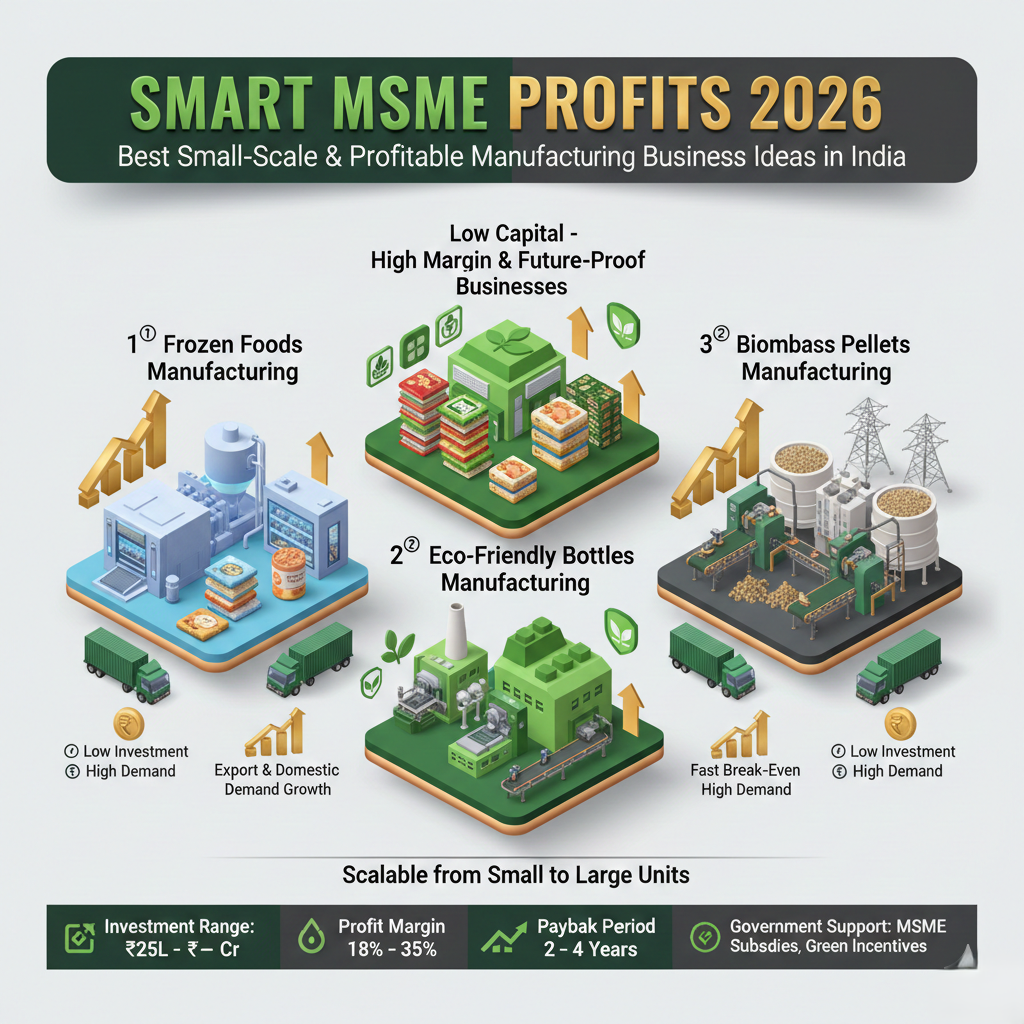
Three manufacturing segments that show good growth potential are frozen snack production, the biodegradable bottled water manufacturing and rice husk biomass pellet production. Each of the three options provides distinct benefits because it enables businesses to expand their customer base while operating production facilities in multiple locations and receiving assistance from government policies.
Companies are implementing new production methods because urbanization and rising disposable incomes and stricter environmental laws force them to find ways that generate profit while achieving sustainable outcomes. The article examines three high-potential MSME manufacturing solutions through a business study that evaluates their production methods and investment information and demand drivers and profitability assessment.
Read More: Manufacture of Food & Beverages with Project Profiles (3rd Edn.)
1. Frozen Foods Manufacturing: Aloo Tikki, French Fries & Cheese Nuggets
Market Opportunity
Frozen foods have gone from being premium urban foods to daily household and institutional staples. The operations of Quick Service Restaurants (QSRs) and cloud kitchens and catering companies and retail chains rely heavily on standardized frozen snacks to achieve operational efficiency and maintain product consistency.
Indian manufacturers who serve the local market have an excellent opportunity to grow their business because India’s frozen snack market penetration remains below developed market levels.
Manufacturing Process
There are various controlled and standardized stages in the production process:
- Sorting and grading of potatoes
- Washing, peeling and cutting or shaping
- Blanching and partially frying
- Individual Quick Frozen (IQF)
- Hygienic packaging & cold storage
The product quality and shelf life of products depends on the ability to control moisture levels and freezing speed and oil absorption levels. Efficient cold chain management enables frozen snacks to maintain their market presence for 12 months.
Raw Materials and Infrastructure
- High dry-matter potatoes
- Edible oils and coatings
- Cheese compounds and stabilizers are used to protect the cheese.
- food-grade packaging materials”
- Reliable cold storage and continuous electricity
Many a successful MSMEs have entered into partnerships with contract farmers to stabilize the supply of raw materials and curb price volatility.
Read More: Paper Water Bottles – The Future of Sustainable Packaging Business
Demand Drivers
- Expansion of food delivery platforms
- Growth of institutional catering and QSR chains
- Increasing dual-income households
- Increasing use of home freezers
Profitability Outlook
Frozen snack manufacturing can achieve operating margins between 18 – 28% after stable capacity utilization. Regional manufacturers often realize faster cash flow stability with institutional contracts as opposed to retail branding alone.
2. Biodegradable Bottled Water Manufacturing: Luxury Sustainable Packaging
Market Opportunity
The bottled water industry is undergoing transformation because of increased environmental awareness and government restrictions on single-use plastics. Businesses in hospitality, aviation, corporate events, and high-end retail sectors are all making a strong effort to find eco-friendly packaging solutions.(Best MSME Manufacturing Business Ideas)
Biodegradable bottles from plant-based polymers or paper composites are a way for manufacturers to target a premium and sustainable market.
Manufacturing Process
The process of water purification is similar to the conventional process of producing mineral water:
- Multi-stage filtration andReverse osmosis
- Ultraviolet sterilization and ozonation
- Automated hygienic filling and sealing
The important difference is in the integration of packaging. Biodegradable containers have special handling requirements, compatibility testing and storage conditions for shelf stability.
Read More: Wood Pellets Production from Sawdust
Raw Materials and Infrastructure
- Groundwater or surface water meeting regulatory standards
- Bottles or preforms that are certified biodegradable
- Food-grade caps and environmentally friendly labels
- Temperature controlled storage facilities
There are specific food safety and packaging regulations that must be adhered to to ensure credibility in the market by the manufacturers.
Demand Drivers
- Government initiatives on reduction of plastic waste
- Sustainability commitments by corporations
- Premium tourism and hospitality industries
- Environmentally conscious consumers
Profitability Outlook
Although the manufacturing of biodegradable packaging is more expensive, the potential for premium pricing and institutional contracts provides for operating margins of 15-22%. Early market entrants have the advantage of good brand differentiation and niche position.
3. Rice Husk Biomass Pellets: Renewable Energy from Agricultural Waste
Market Opportunity
India produces huge amounts of agricultural residue which is either left unused or contributes to environmental pollution. The rice husk biomass pellets are used to convert the agricultural wastes into renewable industrial fuel for use in boilers, brick kilns, and thermal co-firing applications.
With an increasing cost of fossil fuels and strict norms on carbon emissions, industrial buyers are increasingly looking towards biomass energy sources.
Read More: Emerging Global Markets for Indian Spices, Dairy, and Processed Foods
Manufacturing Process
Biomass pellet production is relatively simple:
- Drying of raw rice husk
- Grinding, particle size reduction
- High-pressure pelletizing
- Cooling, packaging and dispatching
Compared to the manufacturing of food, the manufacturing of pellets is much easier in terms of equipment and technical level, which in turn makes it suitable for first-time entrepreneurs.
Raw Materials and Equipment
- The facility uses rice husk which it obtains from local rice mills.
- The facility has an option to blend agricultural waste into its production process.
- The facility uses hammer mills and dryers and pellet presses and conveyors for its operations.
Building production plants close to rice fields allows businesses to cut down on transportation costs while they maintain access to essential raw materials.
Demand Drivers
- Industrial decarbonisation initiatives
- Government renewable energy targets
- Increasing coal and furnace oil prices
- Waste-to-energy policy incentives are available, including
Profitability Outlook
Biomass pellet plants that operate effectively report EBITDA margins between 20 and 30 percent because their industrial clients maintain ongoing supply agreements.
Read More: How to Start Paper Water Bottles Manufacturing Business
Comparing the Three Manufacturing Opportunities
The business model of each manufacturing concept leads to distinct results because of its different risk reward structures:
- Frozen Foods: Consumers show strong demand for retail and institutional products However the market requires businesses to establish cold chain systems which maintain precise product quality standards.
- Biodegradable Bottled Water: Entrepreneurs who want to build their brand through B2B partnerships should choose premium positioning because sustainable demand for their products will increase.
- Rice Husk Biomass Pellets: The system operates with basic functions while it maintains high industrial demand through established policies and it can expand its operations at a fast rate.
The choice to make is based on availability of capital, availability of raw materials, operational know-how and target market links.
Strategic Lessons to be Learned from Indian successful MSMEs
Successful manufacturing MSMEs are more concerned with operational discipline than with rapid growth. Frozen food manufacturers are often stable because they are backward integrated with farmers. Sustainable packaging companies achieve success through securing extended corporate agreements while biomass pellet producers thrive by establishing local supply chains and industrial collaborations.
Key success factors include:
- Consistent product quality
- Efficient supply chain management
- Good regulatory compliance
- Long-term customer relationships
- Scalable production planning
Businesses that want to grow sustainably should invest in process optimization and run their operations through dependable resource acquisition.
Conclusion: Building Future-Ready Manufacturing Businesses in India
The three MSME opportunities which use frozen snack production and biodegradable bottled water manufacturing and rice husk biomass pellet production create promising business prospects which match India’s economic development and environmental protection efforts.(Best MSME Manufacturing Business Ideas)
Frozen foods provide products which meet urban needs and support food service industry growth. Biodegradable bottled water products enable companies to serve sustainability-oriented customers. Biomass pellets create renewable energy resources by converting agricultural waste into useful biomass materials.
The manufacturing sectors provide entrepreneurs who want to achieve operational excellence through quality assurance and business development solutions which help them establish successful manufacturing enterprises in India’s changing industrial environment.(Best MSME Manufacturing Business Ideas)
Frequently Asked Questions (FAQ)
- Which MSME manufacturing idea requires the lowest technical expertise?
Rice husk biomass pellet manufacturing generally requires less technical complexity compared to food processing or beverage packaging.
- Is cold chain infrastructure mandatory for frozen food manufacturing?
Yes. Without reliable refrigeration during storage and transportation, product quality and shelf life will suffer significantly.
- Are biodegradable water bottles legally approved in India?
Yes, provided the materials meet food safety regulations and labeling requirements set by authorities.
- Which business has the fastest scalability potential?
Biomass pellet manufacturing typically scales quickly because of simpler production processes and strong industrial demand.
- What is the biggest challenge in frozen food manufacturing?
Maintaining consistent raw potato quality and managing energy costs associated with refrigeration.