Beer Industry Manufacturing Opportunities
India’s beer market just made headlines. India’s beer industry is expanding at a near 20 per cent rate, United Breweries Limited (UBL) MD and CEO Vivek Gupta said in a recent Economic Times report. The positive movement is being pushed by favourable state-level excise reforms in Karnataka and Maharashtra along with favourable weather conditions. This is a big market indication — far beyond the beer shelf at your local store.
There is, though, the part that seldom makes the news: Beer sales are booming, but beer profit margins are extremely challenged. Expenses for raw materials, including glass bottles and aluminium cans, imported barley and packaging materials, are squeezing profit. The pressure has been further exacerbated by global geopolitical tensions and an unfavourable exchange rate between the rupee and dollar.
This isn’t bad news to a sharp entrepreneur or MSME manufacturer. This is an opportunity that’s staring you in the face. The increasing demand for beer coupled with the high cost of inputs, components and allied products from the supply side is creating a need for a local supply of raw materials and intermediate goods to meet the demand. Economic Times has grabbed the headlines. Let’s now dissect its meaning to your next manufacturing idea.
What Recent Economic Times Reporting Means for Founders
The Economic Times report does a great job of summarizing a structural issue within an expanding sector. UBL’s CEO identified three waste areas— glass bottles, aluminium cans and imported materials—as the main cost pressures. He also mentioned exchange rate volatility as another hurdle. The sheer size of the Indian biggest beer company, which accounts for about 55% of the market share, and is operating under the global umbrella of Heineken, is a clear indication for the manufacturing entrepreneurs in India regarding Make in India.
Earlier also, Economic Times reported that UBL plans to invest ₹750 crore in a greenfield brewery in Uttar Pradesh, which will increase its capacity by 1-2 million hectolitres by FY27. Beverly is expanding along with Carlsberg and AB InBev. The top-tier area of the industry has increased by 46% in just one quarter. The Make in India is an active attempt to nurture manufacturing startups to fill the exact same gaps. The message is straight: “There is a demand; there is a capacity growth but there is a domestic input supply which is seriously lagging behind.”
Get Detailed Project Report (DPR): Beer and Wine Projects
Why India’s Beer Industry Is Growing — The Structural Story
State-Level Reforms Are Unlocking Demand
Karnataka and Maharashtra have relaxed their excise regime on the beer market. The two states account for a significant portion of the organised alcohol consumption in India. Lowering regulation at the state level leads to wider distribution, more bar and restaurant channels and higher per capita consumption, which all result in more beer sales.
Premiumisation Is Accelerating
UBL’s high-end brands – Kingfisher Ultra, Kingfisher Ultra Max and Heineken Silver – surged by 46% in their June quarter of FY26. This is no coincidence. India’s urban middle class and Gen Z consumers are on the hunt to upgrade. They seek better quality, world-class brands of beer. Therefore, premium beer must have premium packaging, superior glass, specialty aluminium cans and premium labels, that are all manufacturing opportunities.
The Younger Consumer Is Driving Volumes
Kids are in for a treat as beer is being embraced by the young generation of India, which are fonder of the drinks than spirits. The social drinking culture in Tier 1 and Tier 2 cities is changing. Its relatively low alcohol content and the image that beer is a casual social beverage is gaining converts. This demographic tailwind equates to structural growth, not seasonal.
Government Policies and Incentives for Allied Beer Industry Manufacturing
The policy framework of the government is very supportive of manufacturing entrepreneurs in the beer input & allied products. The Government of India Ministry of MSME provides coverage under the Credit Guarantee Fund Trust (CGTMSE) for manufacturing startups for loan amount up to ₹2 crore without any collateral. The Production Linked Incentive (PLI) scheme includes food processing and packing materials, which are directly associated with glass and aluminium business ventures.
DPIIT recognition is offered on the Startup India platform, which also guarantees tax exemptions for three years and fast-track patent processing, which can benefit any entrepreneur who’s innovating in bottle design, biodegradable packaging, or cooling technology. The government has also announced that glass and packaging industry are to be treated as a priority area under Atmanirbhar Bharat and will be easier to finance and more predictable to be licensed by the new players.(Beer Industry Manufacturing Opportunities)
Identify high-growth industries before others do
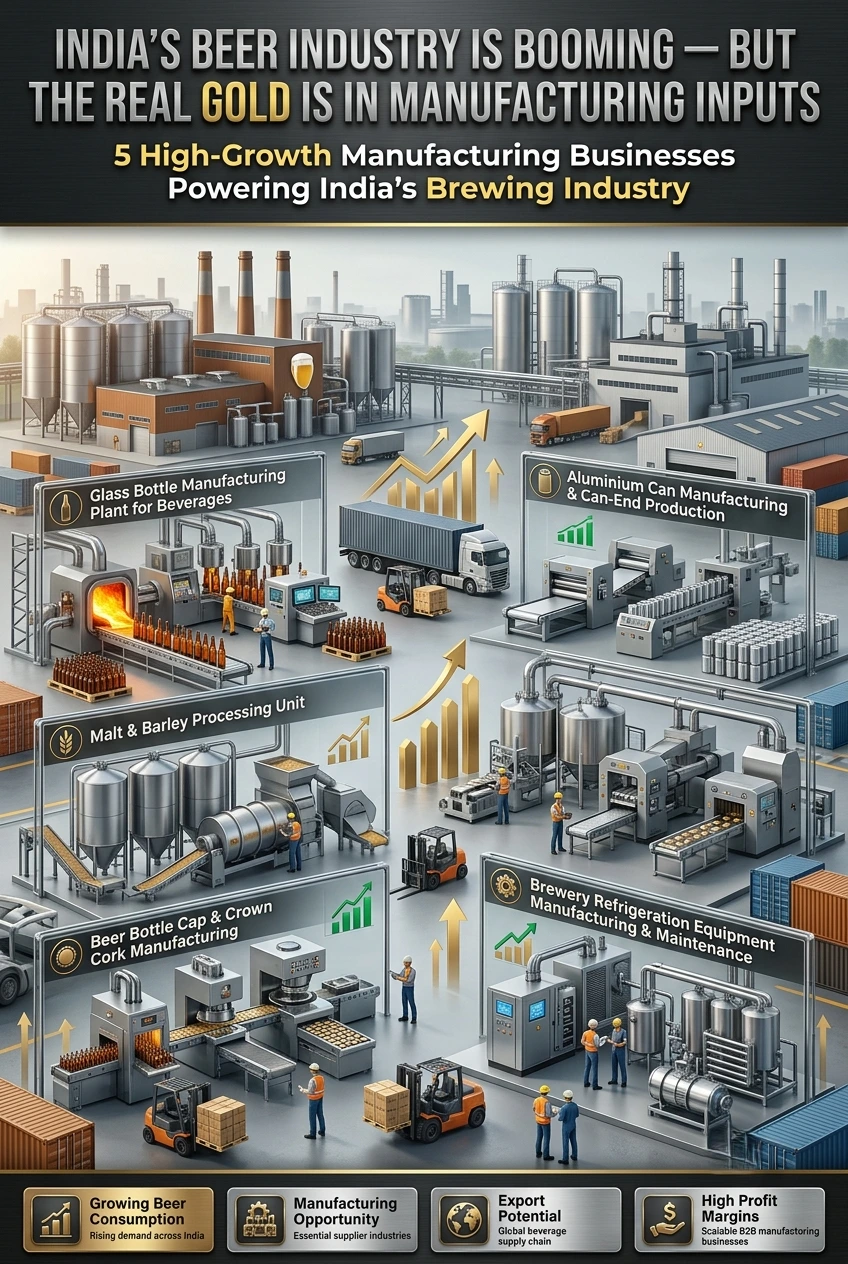
5 Manufacturing Business Ideas Emerging Directly from This News
1. Glass Bottle Manufacturing Plant for Beverages
UBL’s CEO identified glass bottles as a “key cost driver”. Each year, hundreds of millions of bottles of beer are consumed in India’s organised segment. Most of the special glass is either imported or provided by a few big local manufacturers, which creates a huge opportunity for the mid-scale regional glass manufacturers. A glass bottle plant that produces 15,000–30,000 tonnes of beverage glass bottles in a year can be used by several breweries, carbonated drink manufacturers and spirits makers. Investment Time: 6–12 months. Time to invest: depends on scale and technology sourcing – Rs. 8-25 crores.
2. Aluminium Can Manufacturing and Can-End Production
In the interview, the CEO of UBL actually talked about the issue of lack of cans in India as a key concern. The higher price level beer category is undergoing a quick transformation to canned formats, which are lighter, more portable and more recyclable than glass. In India, a high percentage of aluminium sheet is being imported for making cans. The opportunity of an aluminium can make plant or can end manufacturing plant for breweries and soft drink manufacturers is a high demand and low competition area. Investment Range – ₹5-18 crore for small to mid-scale plant.
3. Malt and Barley Processing Unit
A major use of barley is for brewing. The state of Rajasthan, Uttar Pradesh and Madhya Pradesh are the major barley producing regions in India with only a few malt-grade barley processing units. Malt production involving processing raw barley into brewer’s malt, and selling to local breweries, can dampen imports dependency to a great extent. The government provides support to agro-processing activities under the PMFME scheme and PLI for food processing. Investment cost is in the range of ₹3-12 crore for medium scale malt processing unit.(Beer Industry Manufacturing Opportunities)
4. Beer Bottle Cap and Crown Cork Manufacturing
Crown cork seals are necessary on each glass beer bottle. Millions of crown corks are used in India annually in the beverage industry. Large players are supplied by organised players while regional and craft breweries may experience supply chain issues, especially in Tier 2 cities. Breweries, water bottle manufacturers, soft drink producers, and juice companies benefit from a crown cork stamping and lining unit, which brings revenue diversification from the get-go. The investment size for the small-scale unit is between ₹60 lakh and ₹3 crore.
Related Article: How to Start a Beer Manufacturing Business in India: Cost, Profit & Opportunities
5. Brewery Refrigeration Equipment Manufacturing and Maintenance
UBL has declared cold beer availability as a strategic priority. The company is aggressively investing in cooler placement and cold chain in retail touch points. This makes immediate need for commercial refrigeration unit, beer tap system, cold storage equipment for the purpose of brewery and retail. The refrigeration engineering or industrial cooling background entrepreneurs can harvest this demand by OEM supply or white-label manufacturing agreement. Investment range: depends on product range, between ₹2cr to ₹10cr.
Import–Export Opportunity Analysis
Beer input manufacturing gap is also another export opportunity that India is creating. The Southeast Asian and Middle Eastern markets, such as Vietnam, Bangladesh, UAE and Saudi Arabia (in the non-alcoholic beer market), are growing and developing their beverage production industry. People here would be willing to purchase Indian-made glass bottles, aluminium cans and crown corks at competitive prices. Directly, export promotion support is available to the manufacturers of inputs for packaging and beverages under the RoDTEP (Remission of Duties and Taxes on Exported Products) scheme offered by the Directorate General of Foreign Trade (DGFT).
The opportunity of exporting beer is also coming to the fore. India is presently exporting beer to the UK, USA, Canada, Australia and the Gulf countries. UBL brand Kingfisher has a worldwide footprint. Contract manufacturing for export, especially organic or craft beer, is a viable long-term option for those who build certifications, quality marks and build them a reputation early on in the premium beer segment.
View Full Project Details: India Beer Market- Industry Size, Share, Drivers, Trends, Analysis and Forecasts
Indian MSME Success Stories in the Beer Allied Sector
There are a few MSMEs in India that have successfully created a lucrative business without braclting the spotlight. A few MSMEs have started highly profitable businesses without flaring the red lights in the beer and beverage industry’s supply chain. Established as a medium scale glass company in Gujarat, Piramal Glass emerged as one of the top glass suppliers for beverages in India, focusing on both pharmaceutical and FMCG customers, as well as beer producers regularly. They were early to invest in high-quality glass forming technologies, giving them a strong competitive moat.(Beer Industry Manufacturing Opportunities)
Likewise, Manjushree Technopack in Bangalore created a PET & plastic packaging business worth of ₹1,500 crore by servicing the beverage company in the early stage and growing with them. Kabra Extrusiontechnik has made substantial revenues from the beverage closure market in the crown cork segment. These are not the exceptions. They have come out of smart entrepreneurs reading early signals in the industry – the kind Economic Times has just surfaced with the report on the UBL beer industry.
About NPCS — Niir Project Consultancy Services
If you are a business person who is already ready to seize this opportunity, it’s time to do detailed feasibility planning. NPCS (Niir Project Consultancy Services) is the premier industrial project consultancy firm of India with more than 30 years of experience in preparing feasibility reports, project profiles and business plan for various manufacturing projects. From a glass bottle plant to a malt processing unit to an aluminium can processing plant, NPCS can help you with technology selection advice, plant layout recommendations, raw material sourcing strategies, regulatory compliance road maps and financial projections – all in one integrated report. They have profiles of their projects that serve as reference materials for MSME owners, banks and venture funds in India as valuable tools for informed manufacturing investments.
Get Detailed Insights from This Book: The Complete Technology Book on Alcoholic and Non-Alcoholic Beverages
Key Data: India Beer Industry — Manufacturing Opportunity at a Glance
| Business Idea | Est. Investment | Key Market | Growth Signal |
| Glass Bottle Plant | ₹8–25 Crore | Breweries, Spirits, FMCG | Critical shortage; UBL flagged directly |
| Aluminium Can Unit | ₹5–18 Crore | Premium Beer Brands | Can shortage confirmed by UBL CEO |
| Malt Processing Unit | ₹3–12 Crore | All Indian Breweries | Import reduction target; PLI support |
| Crown Cork Manufacturing | ₹60L–3 Crore | Beer, Water, Soft Drinks | Billions consumed annually |
| Refrigeration Equipment | ₹2–10 Crore | Breweries, Retail Outlets | Cold beer: UBL’s strategic priority |
FAQs: Beer Industry Manufacturing Opportunities — Founder’s Edition
Q1. Do I require a liquor licence to produce beer components, such as glass bottles, crown corks etc.?
No. There is no liquor licence required to manufacture beer packaging components (glass bottles, aluminium cans, crown corks, labels, and refrigeration equipment). These are normal manufacturing processes regulated by the Factories Act and the norms laid down by the pollution control board as well as GST registration. Beer is the only type of alcohol which requires excise licensing for brewing and selling.
Q2. Which schemes are being provided by the government in favor of all-star beer manufacturing by MSMEs?
Several schemes apply in their own right. The DPIIT and Startup India platform recognizes and grants tax exemption and ease in regulatory clearance. The MSME Ministry’s CGTMSE takes care of collateral-free credit guarantees of up to ₹2 crore. Malt and barley processing is included in the PLI for food processing. SIDBI also disburses equipment procurement loans, which are direct loans, in eligible manufacturing categories.
Q3. What will be the lowest amount of money required to begin a crown cork manufacturing facility?
The basic cost of setting up a crown cork stamping unit is around ₹60-80 lakhs comprising of land lease, machinery, and working capital. The cost of scaling up to a full production facility using multiple stamping presses along with an in-house lining unit is ₹2-3 crore. It is sold to breweries, water bottle makers, and soft drink makers thus generating multi-sector revenues from day one.
Q4. Will there be opportunities for being an exporter of India-made beer packaging?
Yes. The beverage glass and aluminium cans market is expected to witness a steady rise in export volume to Southeast Asia, Middle East and Africa. Indian manufacturers also have manufacturing cost advantage, the better logistics infrastructure and export promotion schemes provided by DGFT such as RoDTEP. The markets can be accessed by the early movers in 18-24 months after they have started production, once they have been ISO certified and certified as BIS compliant.
Q5. What does the Economic Times beer industry report do for the manufacturing entrepreneurs?
The ET report allows for three things to be confirmed at the same time: strong demand growth (nearly double-digit), very significant input cost pressure, and explicit shortage of domestic packaging components. This is an unusual trifecta which could indicate an unmet market with existing demand. If the CEO of India’s biggest brewer’s company recognises that there is a shortfall in the domestic supply, it’s the best market validation for a manufacturing entrepreneur without having to shell out a penny to buy any market research report.
Q6. What certifications do I need to supply glass bottles or cans to Indian breweries?
Primarily, Bureau of Indian Standards (BIS) certification for glass containers under IS 2668 is required. For aluminium packaging, relevant BIS and FSSAI compliance may apply depending on product specifications. Brewery-grade glass also requires specific thermal shock and internal pressure resistance standards. Most major breweries conduct their own quality audits of supplier facilities before onboarding, so a clean factory setup and documented quality control system are essential.
Conclusion: The Clock Is Ticking — Act Before the Supply Gap Closes
Economic Times has surfaced a structural shift in India’s beer industry that goes well beyond the beer aisle. Near double-digit sales growth, premium segment acceleration, ₹750 crore brewery expansions, and CEO-level confirmation of packaging input shortages — this is a multi-layered manufacturing opportunity unfolding in real time. The Invest India platform and MSME Ministry are actively supporting domestic manufacturing in exactly these categories.
The window for early movers is open — but it will not stay open indefinitely. As UBL, Carlsberg, and AB InBev expand brewery capacity across India, they will lock in their supplier ecosystem over the next 12–18 months. The entrepreneurs who enter glass bottle manufacturing, aluminium can production, malt processing, and refrigeration equipment now will be signing long-term supply agreements at the same time the big players are commissioning their new capacity.
The beer market is booming. But the real business opportunity right now is not in brewing — it is in building the supply chain that powers the brew. This is the moment Economic Times’ market signal was pointing toward. Move early, move smart, and build for the decade ahead.