Bakery products manufacturing is one of the most accessible and consistently rewarding business opportunities in India’s MSME sector. Its appeal extends beyond ease of entry. From breakfast tables and rural kirana stores to premium city patisseries and highway dhabas, bakery products have become an essential part of daily consumption across income groups and regions.
Despite its widespread presence, the sector is often underestimated in terms of its commercial potential. The Indian bakery industry is no longer a cottage-based activity. It has evolved into a dynamic and organized manufacturing sector with multiple investment levels, strong growth prospects, and increasing opportunities in domestic and export markets.
The industry is also supported by government policies that encourage MSME investment and entrepreneurship. As a result, bakery manufacturing has emerged as an attractive option for first-generation entrepreneurs and MSME investors seeking a scalable and profitable manufacturing venture.
Get Detailed Insights from This Book: Bakery Products Manufacturing Guide
Why the Bakery Sector Deserves Serious Attention
Over the last decade, the bakery sector in India has changed from local oven businesses to a well-organised production chain. The addressable market has grown significantly over the past few years, driven by urbanisation, growth of modern retail and quick commerce, changing eating habits and a sudden surge in the consumption of on-the-go food. The increase in disposable income in Tier 2 and Tier 3 cities has created new demand zones where branded baked foods are taking the place of locally produced, unpackaged baked foods.(Bakery Products Manufacturing)
Baked goods’ domestic market is estimated to be worth more than ₹45,000 crore and growing at around 9–11 percent CAGR, one of the healthiest growth rates in the packaged foods market. The Ministry of Food Processing Industries (MoFPI) has revealed that food processing is one of the priority areas for investment facilitation and the baked and confectionery goods are part of the processed food ecosystem. The sector enjoys relatively stable raw material supplies, such as wheat flour, sugar, vegetable fats and eggs, as well as the comparatively predictable consumer demand trends. The risk of having a large pile of inventory, which has been an issue in many manufacturing sectors, is not so prevalent in bakery as a product has a short shelf life and is sold to retail stores and institutions on a daily basis.
The organized segment that makes up about 35 percent of the total bakery production is expanding at a faster pace than the unorganized segment. This is due to consumer preference for packaged products which are certified as hygienic and also through the growth of modern retail formats that demand regular supply from registered, compliant manufacturers. The market is actively driving the production capacity from informal to organized SME manufacturing, which is a strong tailwind for a new entrant.(Bakery Products Manufacturing
Government Policies and Incentives That Favour Entry
The food processing and bakery manufacturing sector in India is more business friendly in the policy arena. Under the Production Linked Incentive (PLI) Scheme for Food Processing, Ministry of Food Processing Industries can avail of the available benefits of up to 10 percent on incremental sales in the base year for 6-years. The scheme is pitched at the top end of investment, but SME friendly categories within the scheme make it possible for mid-scale bakery producers to access the scheme.
Under the CMSME Ministry’s Credit Guarantee Fund Trust for Micro and Small Enterprises (CGTMSE), the sector is now able to avail of collateral-free credit of up to ₹2 crore for eligible MSMEs, significantly reducing the cost of financing for small bakery manufacturers. Project loans with subsidy at 15-35% of project cost are available for food manufacturing units under the Prime Minister’s Employment Generation Programme (PMEGP) which is especially pertinent to bakery businesses that cater to the rural and semi-urban markets.
All food manufacturing units are required to be registered by FSSAI and the Food Safety and Standards Authority of India (FSSAI) has introduced a simplified licensing procedure for small food businesses with an annual turnover of less than ₹12 lakh (basic registration) and a separate category of medium food manufacturers. The Udyam Registration portal under the Ministry of MSME gives the entrepreneurs an option to register their enterprise within a matter of seconds, gaining access to such benefits as Priority Sector Lending, Government Preference for procurement and support for participation in trade fairs. Support from Make in India and Startup India initiatives also augments the policy landscape and puts value infrastructure and market access in place.
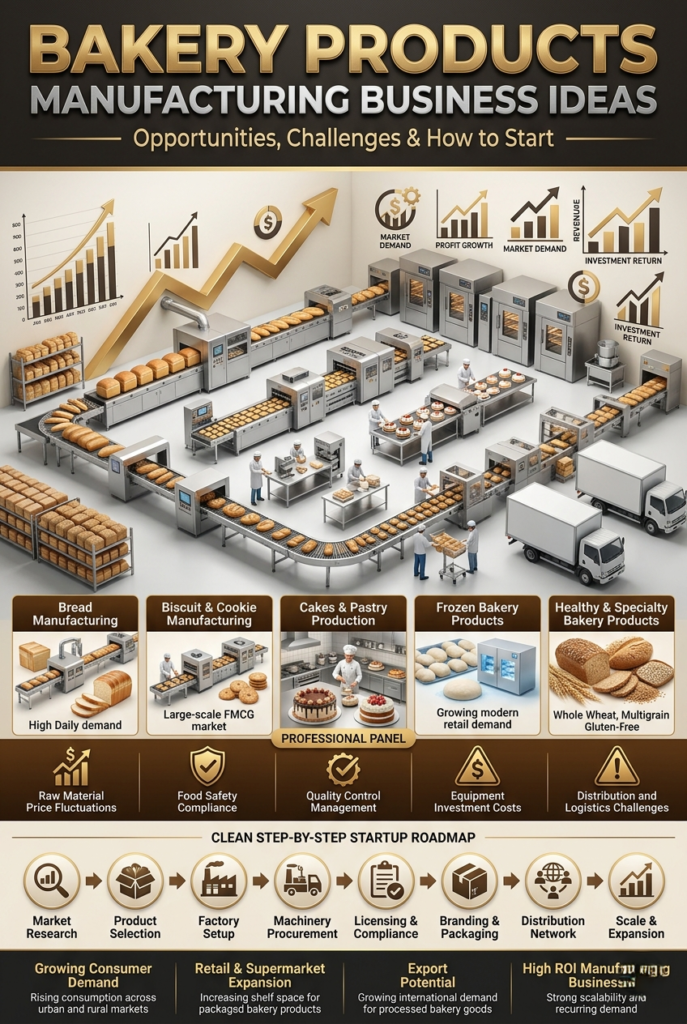
Multiple Business Ideas for Startup Entrepreneurs in Bakery Manufacturing
1. Commercial Bread and Bun Manufacturing Unit
Bread remains India’s largest bakery product segment, with growing demand for sliced, packaged, and shelf-stable bread. For the first-generation entrepreneur, a commercial baking establishment of 500-2000kg per day can be considered. This includes dough mix, proofing and baking in tunnel or rack ovens, and automatic slicing and packaging. The capital investment for a small- to medium-sized unit ranges from ₹25 lakh to ₹70 lakh. The exact amount depends on the plant size and level of automation. One of the most important commercial benefits is institutional supply. Hospitals, canteens, school meal programmed, quick-service restaurants, and modern retail chains require high daily throughput. Entrepreneurs who secure partnerships with two or three anchor institutions before launch can break even much faster than those who rely only on spot retail sales.(Bakery Products Manufacturing)
2. Biscuit and Cookie Manufacturing
Biscuits are the most widely consumed bakery product in India. They are especially popular in rural and semi-urban areas as a staple snack and teatime item. The cost of starting a small to medium scale biscuit business is between ₹35 lakh to ₹80 lakh with a production capacity of 200-500 kg per shift. The biscuit formulation can include cream-filled biscuits, digestive biscuits, glucose biscuits, butter biscuits, oats-based biscuits, multigrain biscuit and value-added biscuits that cater to health-conscious urban population. The margin that biscuits can achieve is better than bread when they have private label contracts with regional retailers or direct-to-consumer outlets. The cookie vertical has seen a lot of premiumization, especially with the artisanal and clean-label cookie products from small bakeries gaining a lot of traction in the e-commerce and gifting sectors, which is a viable space for premium premium positioning.
Get Detailed Project Report (DPR): Bakery and Confectionery Products
3. Cake and Pastry Production Unit
Consumers no longer eat cakes and pastries only during celebrations. The product range now includes everyday indulgences such as Swiss rolls, muffins, brownies, and individually wrapped cake slices, which commonly appear in modern retail impulse aisles.
Setting up a plant for producing shelf-stable, individually wrapped cakes typically requires a capital investment of ₹30–60 lakhs. A facility of this scale can generally achieve a production capacity of 100–300 kg per day. One of the key technical challenges in this industry is maintaining product moisture and shelf life without compromising taste. This can be addressed through appropriate product formulation and packaging solutions.
Investors with access to cold-chain facilities may also target the premium fresh-cake segment. Revenue can be further increased by distributing products through hotels, cafés, and food delivery services.
4. Rusk and Toast Manufacturing
Twice-baked bread slices (rusks) have found a niche in the Indian market. All income groups consume them. Manufacturers produce them from basic agricultural raw materials that are readily available through regular agricultural supply chains. Their low moisture content facilitates storage and transport, and they have a relatively long shelf life of 60–90 days. A 150 to 400 kg per day sized rusk unit comes with an investment ranging from ₹20 lakh to ₹45 lakh, making it one of the lower-end investment opportunities for bakery ventures. The product specifically targets Tier 2 and Tier 3 markets that lack adequate refrigeration infrastructure. The growing demand for flavored rusks, such as cardamom, jeera, and milk, provides manufacturers with an opportunity to create differentiated SKUs with limited additional investment in plant and machinery.
5. Speciality and Functional Baked Goods
An emerging, yet exhilarating segment in bakery manufacturing is functional and speciality baked goods. These items are created for health reasons or specific dietary requirement. They are inclusive of; wheat-free bread for wheat intolerant consumers, protein rich biscuits for the health enthusiast, sugar-free biscuits for the diabetic and supplemented bakery items for vitamin/mineral content enhancement. Urban, educated and ‘tech-savvy’ consumers are the target customers. The willingness to purchase for 30-80% more compared to a ‘normal’ bakery product can be estimated. A full-fledged bakery unit would cost approximately 40-90 lakh to set up. Profitability in this segment is enormous, however. FSSAI health-claim compliance, in the form of an independent third-party testing facility should be made a priority very early on. All labelling and nutrition claims must be accurate to build consumer confidence and a healthy food perception.
Import–Export Opportunity Analysis
The export market for bakery products has yet to tap the potential of India’s bakery production and its capabilities. The major markets for Indian baked goods are the markets in the Gulf Cooperation Council (GCC) countries, Southeast Asian countries and the Indian diaspora in United Kingdom (UK), Canada and Australia. These markets have a history of demand for products like rusk, glucose biscuits, ethnic baked snacks and other types of cookies. The Agricultural & Processed Food Products Export Development Authority (APEDA) under the Ministry of Commerce is assisting exporters in various ways, including market development assistance, issuing quality certificates and organizing participation in international trade fairs.
The APEDA-registered exporter framework and the Export Promotion Capital Goods (EPCG) scheme allow bakery manufacturers to import production machinery at concessional duty in exchange for export commitments. These measures particularly benefit small bakery manufacturers by facilitating machinery upgrades and quality improvement while reducing initial investment costs. Furthermore In terms of imports, some specialty ingredients like malt extracts, emulsifiers and high-quality cocoa derivatives are imported from abroad. Entrepreneurs who have a premium or export product line should develop strong relationships with their foreign suppliers and consider the forex risk in their pricing strategies.(Bakery Products Manufacturing)
According to statistics from DGCIS the process food, and in specific, bakery items have maintained growth year on year. Furthermore, For goods that adhere to standards like BRC, ISO 22000, and HACCP when exporting, it’s possible to charge a 20-35% higher price on top of usual market price i.e. 20-35% premium on the same.
Discover business ideas that actually make money
Indian MSME Success Stories in Bakery Manufacturing
Britannia Industries – The Benchmark of Scale from Modest Origins
Another brilliant case of a bakery business turning into a national giant from a regional manufacturer is the case of Britannia Industries. The company was under the Wadia Group for quite a few years and was effectively run by Vinita Bali. Less understood is that Britannia was, for many years, a middle market biscuit company. Its growth really began to rocket when it found the right combination of distribution, new products and nutritional perception. Product quality is not the only deciding factor for the market size for the budding entrepreneur. The distribution channels play a critical role. Like Britannia with their focus on rural distribution networks and effective channel management and penetrating deep into rural kirana networks, local bakeries with a 5 crore turnover could take a leaf out of.(Bakery Products Manufacturing)
Cremica Food Industries – Punjab’s Export-Oriented Bakery Model
The company was promoted by Akshay Kumar Bector and is based in Punjab. Initially, Cremica started as a small biscuit-manufacturing unit and later diversified into sauces, condiments, and institutional food supplies. Moreover, One of its most notable achievements is supplying buns to McDonald’s India.
Two key business lessons emerge from Cremica’s growth story. First, institutional supply contracts can provide a stable and predictable revenue stream, supporting the expansion of branded products. Second, access to raw materials can create a sustainable cost advantage for a business.
Cremica benefited significantly from Punjab’s strong wheat production, which helped reduce input costs and supported long-term growth. Similarly, bakery entrepreneurs can lower production costs by locating operations in major wheat-producing regions. This explains why many bakeries have been established in wheat-surplus states such as Haryana, Madhya Pradesh, and Rajasthan.
Mangini’s: The Franchise-led bakery expansion model
Mumbai-based Mangini diversified the network of cake and bakery retail outlets in India not as conventional franchise business. The business model was manufacturing franchise, in which the franchisee manages a retail outlet, whereas goods are manufactured in central or semi central manufacturing facilities. As a result, This asset-light logic of growth took Mangini’s to hundreds of cities, without having to bear the capital cost for owning all outlets. So, What does it mean for the MSME bakery entrepreneur? This is crucial: if manufacturing capability exists, supply to retail (or white labelling) becomes scalable without needing company-owned outlets. Furthermore, Establishing a regional manufacturing hub and supplying to cafe owners, hotel chains or cloud kitchen outlets is today a derivative.(Bakery Products Manufacturing
How NPCS Helps Bakery Entrepreneurs
NPCS (Niir Project Consultancy Services) render consultancy services in the preparation of the Market Survey Report & Detailed Techno-Economic Feasibility Reports (DPRs) for new projects and business ideas. In case of bakery project it will also covers production method, market, and demand analysis and process flow diagrams. Furthermore, Bread, biscuit, cake, rusk etc products are covered under bakery projects. It also includes capacity planning based on the proposed investment, details of machinery and suppliers, and comprehensive financial projections. Moreover, These projections cover project costs, working capital requirements, and profitability analysis under both optimistic and pessimistic scenarios. Therefore, We make entrepreneurs realize the viability and profitability of the venture before the investment of the funds.
Related Article: Top 25 Bakery Business Ideas
Bakery Industry – Key Market and Financial Indicators
| Parameter | Details |
| Indian Bakery Market Size | ₹45,000+ Crore (estimated domestic market) |
| Annual Growth Rate | ~9–11% CAGR |
| Organised Sector Share | ~35% and growing |
| Key Product Categories | Breads, Biscuits, Cakes, Pastries, Rusks, Cookies |
| Export Potential (Baked Goods) | Strong demand in Middle East, Southeast Asia, UK |
| Minimum Plant Investment (Small Unit) | ₹25–50 Lakh |
| Typical EBITDA Margin (Organised SME) | 12–20% |
| PLI Scheme Benefit (Food Processing) | Up to 10% on incremental sales |
| Key Raw Materials | Wheat Flour, Sugar, Vegetable Fat, Eggs, Additives |
Data compiled from industry sources including IBEF (India Brand Equity Foundation) and Ministry of Food Processing Industries. Figures are indicative and should be validated through project-specific feasibility assessment.
Frequent Questions Asked:
1. What is the investment needed to set up a bakery manufacturing business in India?
A small bakery manufacturing unit needs 20 Lakh to 50 Lakh depending upon the type of product to be manufactured and capacity.
2. Do I need FSSAI registration for the bakery business?
Yes. Any bakery manufacturing unit must procure the appropriate FSSAI registration or license prior to its commencement.
3. What is the most profitable bakery product?
Specialty bakery products like gluten-free bread, protein cookies, premium biscuits are highly profitable than the standard bakery products.
4. Can I export bakery products from India?
Yes. Bakery products like biscuits, cookies, cakes, rusks etc. Have high potential in the global market and there is huge demand in the global market. GCC countries, the UK, Canada, and Australia also show strong export demand.
5. What are the major raw materials for bakery manufacturing?
The major raw materials required are Wheat Flour, Sugar, Edible Oils, Vegetable Fat, Eggs, Milk Products, Yeast, food additives etc.
6. What is the profit margin I can expect in a bakery manufacturing unit?
A bakery manufacturing unit usually achieve the EBITDA margins ranging from 12 to 20 percent. However, it depends on the product mix and efficiency of operations in case of organized bakeries.
7. Which government scheme can I avail for a bakery startup?
Useful government schemes include PMEGP, CGTMSE, MSME schemes, Food Processing incentives and state industrial subsidies.
8. How can I get buyers for bakery products?
Distributors, Supermarkets, Kirana stores, institutional buyers, hotels, restaurants, online marketplaces and exports are some of the channels to get buyers.
9. Is bakery manufacturing the best option for a first-time entrepreneur?
Yes, bakery manufacturing is one of the easily adaptable food processing businesses owing to its stable demand and scalability options in investment.
10. Which bakery segment has highest growth?
Health oriented bakery products, premium cookies, protein snacks, gluten-free products and packaged cakes currently represent a high growth.