Essential Oil Extraction Business Plan in India
A Business Idea Rooted in Nature and Profit
Firstly, The essential oil extraction business is one of the business ideas which marries elegantly with the heritage craftsmanship and modern market demand. Moreover, India lies at a one-of-a-kind crossroads where natural raw material is plentiful, traditional knowledge is deep and time-honored, and the global wellness economy is increasingly prioritizing natural ingredients. From a first-generation entrepreneur to an MSME investor seeking a niche for manufacturing, the essential oil industry has ample profit potential and low entry costs. In excess of USD 11 billion with CAGR more than 8%, the global essential oils market is expanding on account of aromatherapy, personal care, food flavouring and pharmaceutical applications. It is the ideal time to develop a proper business plan in the essential oil segment as India is one of the top five exporters of essential oils in the world.
Why the Essential Oil Extraction Sector Deserves Attention Right Now
The reasoning in going into this business is simple. There has been a definitive trend towards products that are made from plants and chemical free. This is not some fleeting health craze, but the inevitable consequence of regulatory changes, consumer awareness about ingredients and increased earning by both urban and rural Indians. Demand for lavender, peppermint, eucalyptus, lemongrass, rose, sandalwood and vetiver essential oils are increasing in both cosmetic and pharmaceutical applications; food processing and in home care.
The domestic producers enjoy a ‘raw materials’ advantage for their products, thanks to India’s agro-climatic diversity that European or American producers can’t match. States such as Jammu & Kashmir (lavender), Tamil Nadu (vetiver), Uttarakhand (lemongrass), and Karnataka (sandalwood) produce botanical feedstock of internationally benchmarked quality. Lavender, vetiver, lemongrass, and sandalwood are all agricultural crops. India’s export of essential oils and aromatic chemicals has witnessed consistent growth and according to data published by APEDA (Agricultural and Processed Food Products Export Development Authority), the country exported 1,33,000 tonnes of these products during the last ten years. In addition, there is a growing trend of domestic consumption, which is on the rise due to the reformulation of Indian FMCG products with natural fragrances to suit the consumer’s expectations.
The profit from the production of essential oils is significantly better than those from regular agricultural processing. The oil obtained through steam distillation of lemongrass has a value that is 30–50 times higher than the cost of the lemongrass used as raw material. This results in a value multiplication that makes even small-scale distillation units economically viable. We can sell the residues (hydrosols—floral waters—and spent biomass) as additional products, which improves the unit economics.
Get Detailed Insights from This Book: Modern Technology Of Perfumes, Flavours And Essential Oils (2nd Edition)
Government Policies and Incentives Supporting This Business
There are a number of government initiatives that directly benefit essential oil manufacturing entrepreneurs. The Ministry of MSME has introduced a collateral-free credit scheme called Credit Guarantee Fund Trust for Micro and Small Enterprises (CGTMSE) particularly for financing the distillation units. The PMEGP (Prime Minister’s Employment Generation Programme) provides subsidy of 15-35% on the project cost depending on the category and geographical area is substantial when the price of the plant ranges from ₹10 lakh to ₹30 lakh.
DPIIT has identified essential oil processing as one among the manufacturing verticals eligible for tax holiday and other incentives under Startup India scheme in the form of fast-tracking and incubation. DPIIT (Department for Promotion of Industry and Internal Trade) has other PLI related schemes for specialty chemical and fragrance industries. APEDA offers export market development help, representation at overseas trade fairs and promotional support to export-oriented companies. The Khadi and Village Industries Commission (KVIC) operates grants and subsidy for aromatic plant cultivation, distillation units in cluster of rural areas.
Moreover, the CSIR-CIMAP (Central Institute of Medicinal and Aromatic Plants), a government research institute provides technical training, certified planting material and process consultation particularly for essential oil entrepreneurs. Such institutional support is not found in manufacturing, and provides a first entry advantage.
Multiple Business Ideas Within Essential Oil Extraction
1. Steam Distillation Unit for Lemongrass and Eucalyptus Oil
For high volume oils steam distillation is the most commercially adopted method of extraction. The cost of setting up a lemongrass and eucalyptus distillation unit with a capacity of 500–1000 kg biomass per batch is approximately ₹15–25 lakh. This estimate covers land development, a distillation vessel and condenser, a separator, and utility connections. The price range of Lemongrass oil is ₹1200–1800 kg and Eucalyptus oil is ₹400–700 kg in domestic bulk market.
Lemongrass oil is extracted from 100 kg of the plant with an approximate yield of 0.5–0.8%, that is, 500–800g of oil is extracted. The business of bulk contract supply for cosmetic formulating companies, insect repellent producers, and pharmaceutical compounders offers a reliable income stream. It is suitable for entrepreneurs in Andhra Pradesh, Telangana and Maharashtra where there is an established lemongrass cultivation industry with a developed raw material logistics.(Essential Oil Extraction Business Plan in India)
Access Complete Business Plan: Essential Oils, Phytochemicals, Aromatic Chemicals, Aromatic Compounds, Spice Oils and Oleoresins Projects
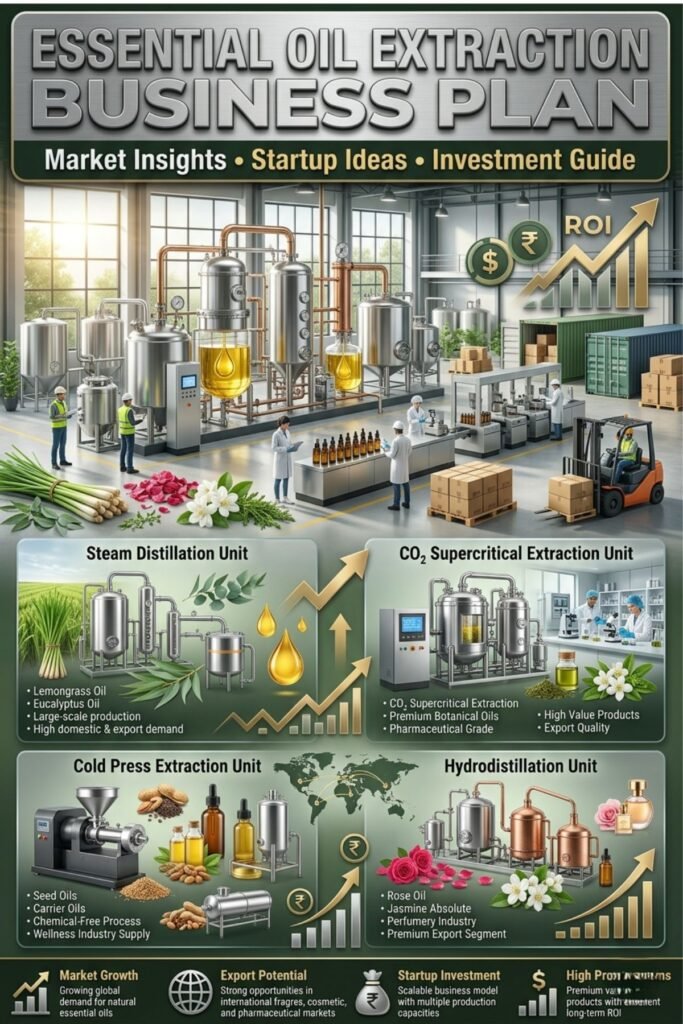
2. CO2 Supercritical Extraction Unit for Premium Botanical Oils
Firstly, Producers may use steam distillation for some specialty oils such as cardamom, black pepper, turmeric, ginger, and frankincense, but they reserve this method only for high-value oils because heat can destroy or remove heat-sensitive active compounds during the process. Moreover, The investment is higher (at around ₹50 – 1.5 crores per kg, depending on unit capacity) but the realised price per kg is far better. Consequently, Flavour houses, food companies, and similar buyers purchase CO₂-extracted cardamom oil at ₹15,000–25,000 per kg. Therefore, Ideal for B2B supply deals with high quality fragrance, nutraceutical or Ayurvedic product manufacturers. Furthermore, Spice producers from the Kerala, Karnataka or Gujarat can get to the roots of the supply chain to further extend the profit margin as entrepreneurs. In addition, Local manufacturers face very limited competition because there is no domestic capacity to extract CO₂.
3. Cold-Press Extraction for Seed and Carrier Oils
Cold pressing is a simpler, low-energy process that extracts carrier oils such as argan, jojoba, rosehip, moringa, sesame, and neem. The oils are not ‘essential oils’ but they occupy the same distribution system and frequently are used in personal care products with essential oils. The investment in a cold-press unit of 100-200 kg per day will range between ₹8 lakh and ₹18 lakh. This is an opportunity to create and market a branded line of carrier oils that cosmetic, wellness, and soap companies can purchase. These companies often lack their own sourcing capabilities, so they rely on external suppliers for raw materials.
Domestic e-commerce platforms have reduced the cost and ease of engaging in direct consumer sales, meaning that extraction entrepreneurs can achieve a 3–4x higher realisation than from bulk wholesale. For example, a branded Moringa seed oil costs ₹1200–1800 per 100 ml at retail, while bulk pricing ranges from ₹900–1200 per kg.
4. Hydrodistillation Unit for Rose and Jasmine Absolute
Rose water and jasmine absolute are the highest priced items in the Indian fragrances market. Hydrodistillation is a special distillation method in which we place plant material in water before distillation. This method works especially well for fragrant flowers because steam pressure would reduce their aroma. If a hydrodistillation unit is established closer to the rose clusters in the villages of Pushkar (Rajasthan) or Mysore (Karnataka) it will yield direct access to the seasonal availability of roses.
Rose absolute sells in the international market at ₹80,000–₹1,20,000 per kg, and even a limited annual production of a few thousand kilograms still makes it highly profitable. Working capital planning is critical for the seasonal production model, however, the margin structure favors it. Many successful units also generate a co-product called rose hydrosol (rose water) for use in skincare and in food processing, which gives an additional source of cash flow throughout the year, in addition to the oil harvest.
Find the most profitable startup for your investment range
Import–Export Opportunity Analysis for Essential Oil Startups
It is well proven that the export market exists for essential oils. India trades with more than 90 countries, the biggest of which are the United States, the United Kingdom, Germany, France and the UAE. The competitiveness of price and diversity of botanicals is driving buyers to look to Indian suppliers in these geographies. The Spices Board of India offers export registration assistance and market linkages to all the export players, including essential oil exporters especially for essential oils that are extracted from spice crops.
There is also huge potential on the import side for processing imported botanical raw materials such as frankincense resin from Oman, ylang-ylang from Madagascar and patchouli from Indonesia and re-exporting value added oils with Indian processing and blending know-how. This tolling and processing model requires less land for agriculture, but requires more quality control management. International buyers usually require FSSAI certification and ISO 9001 accreditation, so you should consider obtaining these certifications at the start of your business plan.
FIEO (Federation of Indian Export Organisations) and the Confederation of Indian Industry (CII) are both export advisory bodies which assist new exporters of essential oils in the documentation, quality certification and buyer introduction procedures. Extra customs duty exemption and GST advantage are applicable for entrepreneurs in the SEZ and export-oriented units which enhances landed cost competitiveness in export markets.
Indian MSME Success Stories in Essential Oil Extraction
There are several wonderful success stories among the MSMEs in India’s essential oil sector from which new businesses can draw inspiration.
The Vora family launched Keva Fragrances Pvt. Ltd., a small aroma chemical trading unit, in Mumbai which has since become one of India’s largest aroma and essential oil manufacturers. Their move into backward integration (acquisition of distillation facilities, instead of relying on third-party suppliers) afforded them the margin control to cater for big FMCG customers. The message for new entrepreneurs is simple; margins are not as valuable as processing ownership in the long term.
The other fragrance company in Mumbai, S.H. Kelkar & Company, has been earning significant revenues by opting for a blend of custom-made essential oils and innovative procurement from local aromatic plant farmers. They have always invested in R&D and quality lab and that has been the reason they are winning the international buyers who would have gone for European suppliers. This shows that the use of technology, even at MSME level, directly contributes to achieving export eligibility.
Along with being a retail brand, Kama Ayurveda has developed a robust sourcing network with MSME distillers in Rajasthan and Karnataka at a smaller scale, which is more replicable. These supplier-MSMEs have been able to grow in a sustainable manner by focussing on purity certification and regularity of yields, which has enabled them to establish long term supply contracts valued at crores per annum based on quality-first operating philosophy.
Related Article: The $323 Million Opportunity: How Indian Exporters Can Dominate the Essential Oils Market
How NPCS Can Help You Build This Business
Niir Project Consultancy Services (NPCS), specializes in providing professional consulting services for the preparation of Market Survey cum Detailed Techno-Economic Feasibility Reports (DPRs) for setting up essential oil extraction units and related agro-processing industry. We provide reports that include all aspects of project planning from detailed manufacturing processes, market research and demand analysis, process flow diagrams, product mix and capacity planning, machinery information and raw material information, to complete project financials with profitability analysis. We want to enable entrepreneurs to assess their feasibility, profits and future growth before investing. Whether you’re looking at a small lemongrass distillation unit or a more extensive CO₂ extraction system, our team of experts can provide the technical expertise and market knowledge to help you make informed decisions about your investment.
Essential Oil Business: Investment and Revenue Overview
The table below provides indicative project parameters across different essential oil extraction models:
| Business Model | Approx. Investment (₹) | Key Output | Est. Revenue/Year (₹) | Target Markets |
| Steam Distillation (Lemongrass/Eucalyptus) | 15–25 Lakh | Lemongrass Oil / Eucalyptus Oil | 30–55 Lakh | Cosmetics, Pharma, Insect Repellents |
| CO2 Supercritical Extraction (Spices) | 50 Lakh – 1.5 Cr | Cardamom / Black Pepper Oil | 1.5–4 Cr | Flavour Houses, Nutraceuticals, Export |
| Cold-Press (Carrier Oils – Moringa, Neem) | 8–18 Lakh | Moringa Oil / Neem Oil | 20–45 Lakh | Skincare Brands, E-commerce, Export |
| Hydrodistillation (Rose / Jasmine) | 20–40 Lakh | Rose Absolute, Rose Water | 40–90 Lakh (seasonal) | Perfumery, Luxury Cosmetics, Export |
Note: Figures are indicative and based on industry benchmarks. Actual results depend on capacity utilisation, oil prices, and market linkages.
Frequent Questions (FAQs)
Q1. What is the initial investment requirement for starting an essential oil extraction business in India?
A basic steam distillation unit that produces lemongrass or eucalyptus oils can be set up for ₹10–20 lakh. This cost includes the distillation vessel, condenser, separator, utilities, and the working capital required for the first batch. For carrier oil cold pressing, it could be around Rs 8-12 lakh and the most sophisticated CO2 supercritical extraction technology would require Rs 50 lakh upwards.
Q2. Do I need to obtain any licenses to start a business dealing with essential oil extraction?
Yes, there would be different licenses and registrations; such as;MSME Udyam registration, GST registration, Factory license (under factories act) andif the oils are of food grade or for pharmaceutical purpose, then food grade certification from FSSAI. For some oils, depending upon the grade and the ultimate market, registration with APEDA and Spices Board would be required, for export. While this process may be expedited with the DPIIT’s Startup India recognition.
Q3. Which essential oil offers the best margin in India?
Rose absolute and jasmine absolute produce the highest realisation of per kg – often Rs 80,000-Rs 1,20,000 per kg internationally – making them the most margin intensive. However, these also require the highest capital investment and are season-dependent. If lower risk consistent margins are what you require, lemongrass and eucalyptus oils should yield consistent returns due to their production cycle and availability throughout the year, whereas CO2 extracted spice oils such as cardamom might form a strong middle ground.
Q4. Is it possible for an Indian essential oil business to export, and what is the approach for finding buyers?
Absolutely; India is one of the largest producers and exporters of essential oils globally. Online platforms like Alibaba, TradeIndia, and IndiaMART often serve as the first point of contact between buyers and suppliers. However, businesses usually build long-term relationships at trade shows such as the World Perfumery Congress and In-Cosmetics, at buyer–seller meets organized by APEDA, and through export promotion activities conducted by CII. Consistently acquiring quality certification (ISO 9001, any applicable organic certifications, and detailed Gas Chromatography reports) are the best tool for attracting buyers.
Q5. What quantity of raw material would be required to produce 1 kg of essential oil?
The quantity varies from botanical to botanical. Lemongrass oil extraction gives an estimated yield of 0.5–0.8%, meaning it requires 100–160 kg of biomass to produce oil. In contrast, rose petals produce an extremely low yield, where 3,000–5,000 kg of petals produce only 1 kg of rose absolute. Because of this highly cost-intensive process, rose absolute generates a very high profit margin per kilogram. Eucalyptus oil yield could be between 0.8-1.2%.
Q6. What is the role of CIMAP in essential oil business?
CSIR-CIMAP (Central Institute of Medicinal and Aromatic Plants), Lucknow is arguably the most crucial government institution for essential oil entrepreneurs in the country. It provides certified, high-yield planting material for aromatic crops such as lemongrass and menthe, conducts training on the best extraction methods and can also provide essential services such as GC analysis for quality assurance and assistance in linking businesses with markets. Entrepreneurs can refer to the www.cimap.res.in for details. Early interaction with CIMAP can lead to significantly reduce yield losses and errors in production.
Conclusion: Sustainable Essential Oil Business in India.
The business of essential oil extraction is an amalgamation of India’s agricultural strength, manufacturing cost advantage and consumer consciousness concerning natural ingredients. The opportunity is genuine, the government support is genuine and the technology, from steam distillation to CO2 extraction, is available at several levels of investment. But, like all business endeavors, it is important to have a plan. Key success factors are understanding yield ratios, early building quality certification, finding the correct product-market fit, and getting institutional support from CIMAP, MSME, APEDA and DPIIT.
If you’re beyond the ideation stage, a well-crafted feasibility report and detailed project report (DPR) can help your business make investment decisions, secure bank funding, and give potential buyers and investors the analytical data they will need. NPCS is well positioned to help make this journey from concept to commissioning happen.