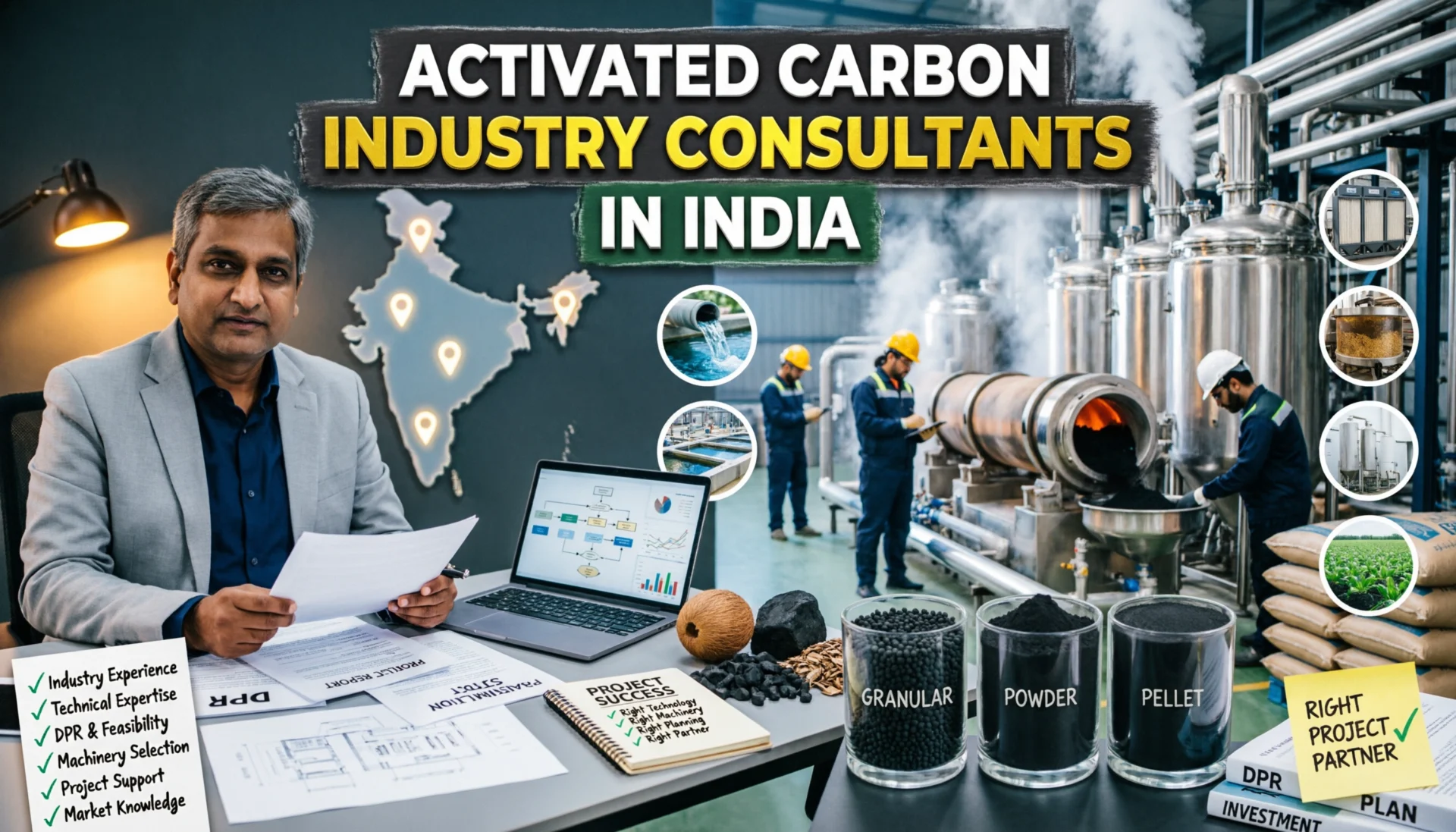

Precision is the key to success in India’s changing manufacturing sector. That precision starts with the correct consultant on your side for the entrepreneurs who are new to the activated carbon industry. The need for activated carbon industry consultants in India is on a sharp upswing for the past few years — and there’s a reason. Guided by experts, planning a coconut shell based granular activated carbon (GAC) plant in Tamil Nadu or a coal based powdered activated carbon (PAC) plant in Jharkhand, or a specialty impregnated carbon plant for defence or gold recovery would make all the difference in the success of the project long before the first brick was laid.
India is the second largest producer and third largest consumer of activated carbon in the world today. The regional level of domestic production is above 436,000 metric tonnes per year and domestic consumption is estimated at approximately 283,000 metric tonnes per year, resulting in a significant export surplus that is expected to increase. The Indian activated carbon market will more than double in the next few years, bolstered by the strictening of environmental regulations, growth of the pharmaceutical industry, and a surge in demand for water and air purifiers. In this regard, the best activated carbon industry consultants in India aren’t just a choice; they’re an asset.
This guide takes you through what an activated carbon plant consultant is, how India has become a powerhouse when it comes to active carbon consultants, and how the founders and investors can pick the right and best active carbon plant consultant in India for their needs.
Get Detailed Project Report (DPR): Activated Carbon Manufacturing Project Report
What Activated Carbon Industry Consultants in India Actually Do
The first-generation entrepreneur, often times, believes that a consultant is just another individual providing you with a report. Actually, the situation is much more complex. The most competent activated carbon industry consultants in India are project partners from end-to-end — with a technical understanding of adsorption technology, financial model, knowledge of regulations, and insight into the market.
Feasibility Studies and Techno-Economic Analysis
Prior to investing in an activated carbon plant, a detailed feasibility study should be carried out to confirm an opportunity. A qualified activated carbon consultant reviews raw material sources (coconut shell, coal, or wood-based feedstock), activation technique (steam or chemical), planned capacity (MT/TPD), desired product grades (iodine number, surface area, particle size distribution) and expected demand in various end-user industries. The consultant prepares a comprehensive techno-economic model (in ₹ crore), operating cost, revenue estimates, breakeven analysis and sensitivity analysis. This isn’t a cut-and-cut- Paste job, but rather a domain fluency in adsorption technology and the Indian market!
Detailed Project Reports (DPRs)
Any discussion of a manufacturing project financing will be built upon a Detailed Project Report (DPR). DRP is essential for all the financial institutions including banks, NBFCs, MSME development corporations, and State Government agencies before they disburse project loans or approve project subsidies for MSMEs. An experienced activated carbon plant consultant prepares DPRs that include descriptions of the manufacturing process (rotary kiln or multiple-hearth furnace), raw material specifications and sourcing strategy, list of machinery and equipment with references from suppliers, plant layout and utilities, quality control procedures, as well as detailed financial projections comprising profitability analysis and IRR. An inadequate DPR will lead to a delay in funding and loss of investor confidence.
EPC and Process Engineering Support
A few project consultancies are capable of providing Engineering, Procurement and Construction (EPC) services in addition to advisory services. Process plant consultants and EPC consultants in this segment assist the clients in configuring the specification of the kiln, design the flue gas treatment systems, plan the activated carbon handling/packaging line and incorporate the pollution control equipment as required by the State Pollution Control Board. This end-to-end process engineering capability is the difference between full-service consultancies and report-only vendors.
Compliance and Regulatory Guidance
The carbonisation and activation processes used in the manufacture of activated carbon are emission intensive. Domestic sales need to be compliant with the Bureau of Indian Standards (BIS) specifications, IS 2752 (granular activated carbon) and IS 8366 (powdered activated carbon) and export credibility also has to pass BIS compliance. Besides, manufacturers have to meet requirements with the State Pollution Control Board (SPCB) as per the Environment Protection Act, Factory Act licence, GST registration and export units should be registered with CAPEXIL (Chemical and Allied Export Promotion Council of India). A good industry consultant in Delhi or anywhere else for the activated carbon industry can make sure that the client can go through these obligations from the beginning, and hence save on expensive retrofits in the future.
Why India Has Become a Hub for Activated Carbon Consulting
India is becoming an even more appealing market not only for activated carbon production, but also for the consultants assisting investment decisions in new plants, because of three converging forces.
Raw Material Advantage and Export Competitiveness
India is endowed with coconut shell, which is a prime source of high grade and high adsorption capacity activated carbon in the world. The main support of this is provided by the south Indian states of Tamil Nadu and Kerala. India’s coconut shell based activated carbon producers are in a unique situation as the demand for activated carbon from coconut shell is increasing worldwide, owing to its uses in water treatment, gold recovery and pharmaceutical purification. India’s chemicals industry is expected to expand at around 10% CAGR to USD 383 billion by 2030, with specialty chemicals such as activated carbon forming an important part of it says IBEF.
Read the Complete Book Here: Our Books
Government Policy Tailwinds
The Department of Chemicals and Petrochemicals of the Ministry of Chemicals and Fertilizers actively encourages investment in specialty chemicals in the form of Petroleum, Chemical and Petrochemical Investment Regions (PCPIRs) and through 100% FDI under automatic approval. Import Substitution with the Make in India initiative and China-plus-one strategy prevalent in global value chains has emerged as a viable business opportunity for both MSMEs and large investors, particularly for specialty filtration materials like activated carbon.
Environmental Regulation Driving Demand
The shifting environmental norms like upgraded Bharat Stage (BS-VI) emission norms, the Jal Jeevan Mission on safe drinking water and pharmaceutical GMP upgrades are all generating structural demand for activated carbon products in India. Invest India has pointed to the chemicals industry as a key investment area for the Indian industry. This regulatory impetus is leading to plant capacity additions, paving the way for the demand for expert consultants in activated carbon plants and process engineering consultants all over the country.
How to Evaluate and Shortlist the Best Activated Carbon Industry Consultants in India
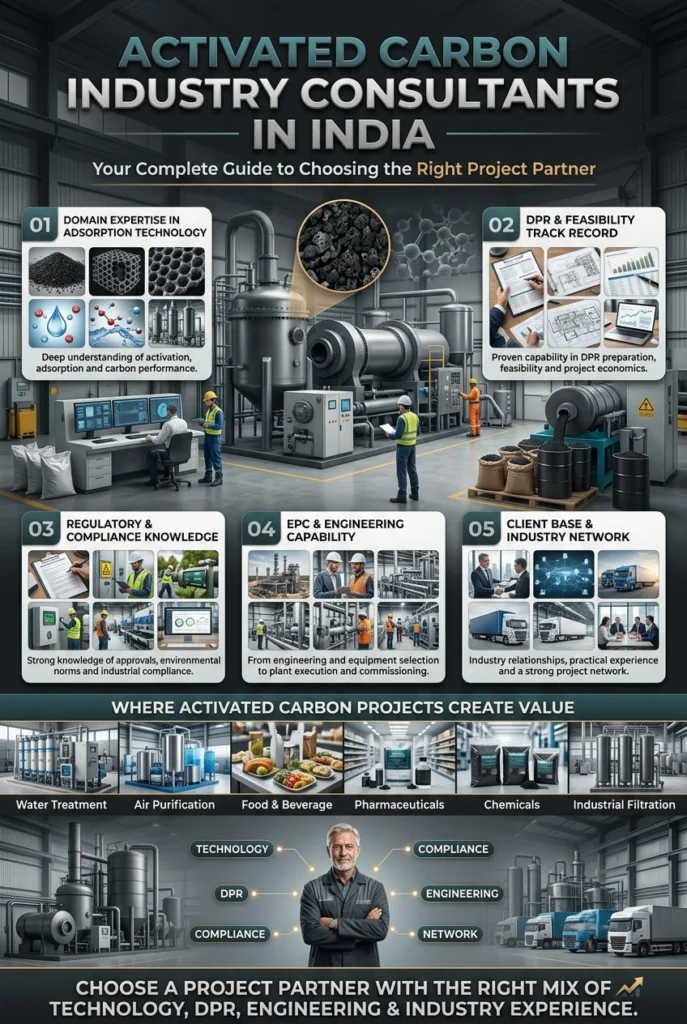
There is a need for a structured evaluation framework to select the right consultancy from the Indian consultancy landscape. Not all companies with a nice-sounding activated carbon expertise have been able to provide projects in this field. For serious investors and MSME founders, here are some tips on how they should go about their selection process.
1. Domain Expertise in Adsorption Technology
The activated carbon industry is a highly chemical-specific industry. The consultant’s experience and understanding of the technology must be proven in the deployment of adsorption technology including adsorption number specification, BET surface area, pore size distribution, activation kinetics and the differences between physical (steam) and chemical (phosphoric acid/zinc chloride) activation. Request proof of previous work: DPRs created, Plants visited, and Number of clients served in the activated carbon or allied specialty chemicals. Without experience in adsorption technology, the generalist process plant consultant will overlook important details.
2. DPR and Feasibility Track Record
The best way to assess a consultant’s ability is by their portfolio of Detailed Project Reports. A good activated carbon industry consultant in India should be able to provide the same with anonymized DPR samples, mention specific projects, and clarify how their financial models have worked out in reality. Seek out reports beyond traditional DPRs — DPRs that take into account fluctuations in feedstock prices, seasonal changes in the supply of coconut shells and international prices for activated carbon.
Related Article: How to Start an Activated Carbon Manufacturing Business?
3. Regulatory and Compliance Knowledge
The top activated carbon consultancy services in India are aware of the technical and compliance aspects of the project. This includes up to date knowledge of BIS standards (IS 2752 and IS 8366), SPCB consent to establish and the requirements of the Factory Act and export compliance under CAPEXIL. If the activated carbon is used in pharmaceutical applications, further compliance to the CDSCO requirements may be applicable. The regulatory needs or the ideology of using old guidelines can introduce a liability for the owner of a new plant that can be very costly.
5. EPC and Engineering Capability
If investors are looking for a one-stop solution from concept to commissioning, they should consider engaging providers who have proven expertise in EPC, or a proven track record of collaboration with process engineering providers. Process engineering consultants working for activated carbon plants need to have an understanding of the design of a rotary kiln, gas treatment systems, bulk material handling, and the planning of utilities. Be plain: does the company provide engineering design services or just preparation of reports? The solution determines the amount of extra coordination that the investor has to do on his own.
6. Client Base and Industry Network
A consultant with active linkages within the Indian Chemical Council (ICC), CPMA (Chemicals & Petrochemicals Manufacturers’ Association) and export organisations carries with him a rich network for new projects. These connections provide the ability to benchmark, source equipment leads, potential off-take introductions and gain insight into competitive pricing, which a newer or isolated consultancy can’t replicate.
Role of NPCS in Activated Carbon Project Consultancy
New Delhi-based Niir Project Consultancy Services (NPCS) has established a proven record in the activated carbon and specialty chemicals segment amongst the established project consultancy firms in India since 1994. NPCS (niir.org) has been developing Detailed Project Reports and techno-economic feasibility studies for entrepreneurs from 85 countries during its three decades of existence, and delivered more than 150,000 Successful Detailed Project Reports across various manufacturing categories.
NPCS provides project reports for the entrepreneurs in the Activated Carbon Sector, which include all aspects of planning. Each DPR developed by NPCS has a complete description of the manufacturing process (raw material treatment, carbonisation, activation and finishing), required machinery and raw material requirements with indicative supplier information, process flow diagrams, plant layout recommendations, market research and demand analysis for the product, and complete financial projections comprising of a profitability analysis, a payback period and IRR. These deliverables are designed based on the needs of banks, MSME development corporations and schemes of the state governments.
Smart entrepreneurs start here—find your perfect venture
The uniqueness of NPCS in the top activated carbon industry consultants in India is that it has a wide range of project ideas in this sector. Entrepreneurs who are not yet sure which type of activated carbon – granular, powdered, extruded or impregnated – to produce can look through the activated carbon project profiles catalog provided by NPCS and find a suitable product-market fit before deciding on a specific project. For activated carbon businesses at any stage of project planning, NPCS is a practical resource to identify and validate projects and prepare a DPR, and is a library of project profiles.
NPCS’ approach is not as an external vendor, but as a project partner that helps founders prepare for the pre-investment intelligence stage and into detailed engineering preparation. This holistic integration minimizes the risk of mismatched parameters of the project at the initial stage for first generation entrepreneurs looking at bank financing for the first time, or for NRI investors assessing manufacturing possibilities in India.
Best Activated Carbon Industry Consultants in Delhi and the India Consultancy Landscape
Delhi and NCR continue to be the base of industry project consultants for the pan-India and export markets. The best activated carbon industry consultants in Delhi possess the added advantages of being close to the central government ministries like the Department of Chemicals and Petrochemicals and the Ministry of MSME in addition to having a strong network of chemical industry bodies, financial institutions and engineering service providers.
Apart from Delhi, important consulting clusters are also found in Chennai and Coimbatore. These cities are closely connected to the coconut shell activated carbon industry. Mumbai and Pune have strong expertise in pharma and specialty chemicals. Hyderabad is also an important hub for bulk chemicals and pharma-grade activated carbon projects.
Many boutique management consulting firms specializing in specialty chemicals have emerged in these cities. They offer niche expertise and complement the services provided by larger organizations such as NPCS.
The Department of Chemicals and Petrochemicals portal provides useful information on policy incentives across different states. This helps investors identify opportunities in a particular region. Invest India also offers sector-specific investment facilitation support. These resources can help investors choose the right location for a new activated carbon plant.
Activated Carbon Consulting Services: A Comparison of Types and Deliverables
| Consulting Service Type | Core Focus | Key Deliverables | Best-Fit Client |
| Techno-Economic Feasibility Study | Project viability assessment | Market demand, cost-revenue model, IRR, payback analysis | Pre-investment decision stage |
| Detailed Project Report (DPR) | Full project documentation for financing | Process description, machinery list, financials, plant layout | Bank loan & MSME subsidy applicants |
| Process Engineering Consultancy | Technical plant design | Process flow diagrams, kiln specs, utility planning, PFD/P&ID | Greenfield plant developers |
| EPC Consultancy | End-to-end project delivery | Engineering + procurement + construction management | Investors wanting turnkey solutions |
| Regulatory Compliance Advisory | Licences & statutory approvals | BIS compliance, SPCB NOC, Factory Act, CAPEXIL registration | All manufacturing unit operators |
| Market Research & Product Mix Advisory | Commercial strategy | Demand segmentation, export market mapping, product grade selection | Entrepreneurs still selecting product type |
| MSME & Export Scheme Advisory | Incentive maximisation | Scheme eligibility mapping, subsidy applications, CAPEXIL membership | MSME-scale activated carbon producers |
Conclusion: Practical Next Steps for Activated Carbon Entrepreneurs
India’s activated carbon industry sits at an inflection point — rich in raw material advantage, supported by regulatory tailwinds, and driven by growing global demand from water treatment, pharmaceuticals, gold recovery, and pollution control applications. However, translating this opportunity into a successful manufacturing project requires far more than enthusiasm. It requires the structured guidance of experienced activated carbon industry consultants in India who understand both the technical depth of adsorption technology and the commercial realities of Indian manufacturing.
For founders at the project identification stage, start by exploring the range of activated carbon variants and their applications. NPCS’s activated carbon project profiles page offers a practical starting point for comparing product types, capacity options, and investment parameters. For investors who have identified their product, the next step is commissioning a rigorous techno-economic feasibility study from a consultant with a verifiable DPR track record in the sector.
Engage with industry bodies such as the Indian Chemical Council and CAPEXIL early. They provide export intelligence, networking opportunities, and regulatory guidance for new market entrants.
Monitor policy developments through the Department of Chemicals and Petrochemicals and Invest India. These platforms regularly update information on incentive schemes and investment facilitation resources.
Above all, resist the temptation to cut corners on the consulting phase. The activated carbon manufacturing business rewards technical precision, market intelligence, and regulatory compliance. A well-chosen project consultant does more than prepare a report. They help build a strong business case for bankers, regulators, and customers. India has a genuine global competitive advantage in this sector. The right advisory partner can make a significant difference. They can help prevent delays at the financing stage and support a smoother path to commercial production.