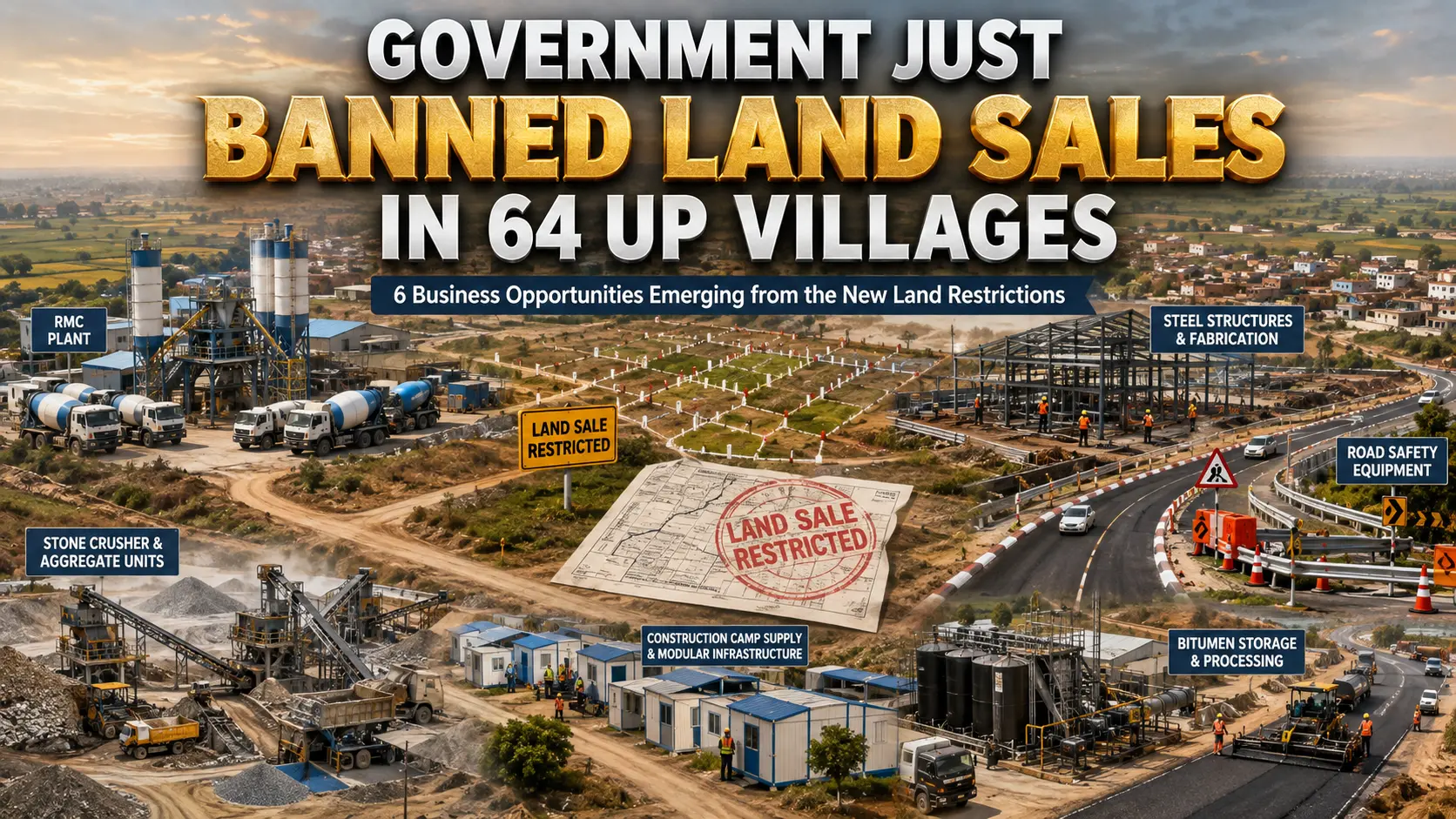

Here’s what it means for entrepreneurs.
The Uttar Pradesh government has officially initiated the process of land acquisition under the ambitious Shamli-Gorakhpur Expressway and as part of the process, it has also prohibited land sale and purchase transactions in a total of 64 villages lying on the proposed route of the expressway. The administration has taken prompt steps to block the sale of land to curb speculation and to ensure the farmers and landowners are compensated justly, Live Hindustan reported. This is not just a step in the bureaucratic process; it’s the first shot fired for one of the most pivotal infrastructure projects between the east and west of Uttar Pradesh.
The Shamli–Gorakhpur Expressway is a part of a larger mega greenfield highway project – Bareilly–Ludhiana Economic Corridor (BLEC) – spanning 22 districts and 37 tehsils of Uttar Pradesh. The 742 km long corridor, which will be a 6-lane (expandable to 8-lane) access-controlled expressway, will drastically reduce the time taken to cross from Delhi NCR to Sonauli border of Nepal, from 20 hours to nearly 8 hours.
It is a once-in-a-lifetime opportunity for entrepreneurs, manufacturers, MSMEs, logistics players, real estate developers and suppliers of infrastructure. These expressways are all of scale, which brings a 5–7-year economic boom to the expressway corridor. This is the beginning of that boom.
Related Article: Top 10 Industrialists of Uttar Pradesh: Success Stories, Business Ideas, and Future Vision
What Live Hindustan’s Reporting Means for Business
The recent Live Hindustan report stated that the land acquisition work for the Shamli-Gorakhpur Expressway officially commenced. The district administration has issued a ban on land sales and purchase in 64 villages that lie on the path of the project, a regular though critical move that shows the project is about to start implementation.
This is important because of three reasons:
- The project has obtained the internal approvals, indicating a successful progress towards on-ground execution, as indicated by the project certainty from the land acquisition ban under the Right to Fair Compensation and Transparency in Land Acquisition Act.
- Agricultural areas, small industrial towns and under-served hinterlands are traversed from western UP (Shamli) to eastern UP (Gorakhpur) via the Corridor economics.
- Time sensitive entry: Early-mover entrepreneurs are able to buy land, create supply chain businesses and launch operations at lower cost during the window of land acquisition to construction commencement.
For the entrepreneurs and MSMEs, the Live Hindustan coverage validates the momentum: this is NOT a project on paper. It is in execution.
Why This Industry Is Growing: The UP Expressway Boom
The Uttar Pradesh government has already opened the Purvanchal Expressway and the Bundelkhand Expressway as well as Phase 1 of the Ganga Expressway. As a result, All these projects had a cascading effect of industrialization along the corridors, ranging from cement and RMC plants, petrol stations and motels, cold storage units and logistics hubs.
Meanwhile, The Shamli-Gorakhpur Expressway is the next big thing. It passes through some of the most fertile areas of UP such as Shamli, Muzaffarnagar adjoining areas and finally the region of Gorakhpur. As a result, The corridor will “unlock”:
- First, Over the years, new industrial complexes have been created by the UPEIDA and UP government gazette land banks near the interchange areas.
- Furthermore, More logistics, warehousing needs due to swift freight movement between DNC and eastern UP/Nepal.
- In addition, Demand from the fertile belt that runs through the expressway for agricultural processing and cold chain.
- As the Nepal corridor is opened for commercial use in road transport, tourism and hospitality infrastructure are needed.
The National Infrastructure Pipeline (NIPL) is expected to drive ₹111 lakh crore of investment in India’s infrastructure sector over the next decade. One of the more predictable beneficiaries is expressway-related manufacturing.
Government Policies and Incentives
Businesses interested in capitalising on this corridor are supported by multiple schemes from central and state governments.
- Bharatmala Pariyojana – Ministry of Road Transport: The nodal central programme funding the national highway corridor within which this project is embedded.
- UPEIDA – UP Expressways Industrial Development Authority: Allocates industrial plots along expressway corridors. Entrepreneurs can apply for land in emerging industrial nodes near interchange zones.
- UP Industrial Investment and Employment Promotion Policy 2022: Offers capital subsidy, GST reimbursement, and stamp duty waiver for manufacturing units in Uttar Pradesh.
- PM GatiShakti – National Master Plan: Integrates infrastructure data to help businesses plan along multi-modal logistics corridors.
- MSME Ministry – Udyam Registration & Schemes: Priority sector lending, CGTMSE credit guarantee, and technology upgradation support for SMEs in manufacturing.
- SIDBI – SME Finance: Provides growth capital, equipment loans, and working capital for MSME manufacturers.
- National Highways Authority of India (NHAI): Publishes tender details for construction packages. Ancillary suppliers and sub-contractors should register on the NHAI vendor portal.
- UP MSME Department: State-level schemes including the One District One Product (ODOP) initiative, particularly relevant for Shamli (jaggery, sports goods) and Gorakhpur (terracotta, fertilizers).
- Ministry of Road Transport & Highways: Governs road construction standards, safety product certification, and concession policy.
Manufacturing Business Ideas Directly Linked to the Expressway
The predictable demand for a cluster of manufacturing categories for every expressway that costs thousands of crores of rupees span many years. The following six opportunities are practical:
1. Ready-Mix Concrete (RMC) Plants
The amount of concrete used for bridges, culverts, interchange structures and service roads on expressways is massive. The direct supply advantage is achieved by establishing an RMC plant within 15-25 km of the expressway corridor. Volume demand is steady and $Q_D$ is the demand. The district administration agrees to build roads as part of land acquisition under the Right to Fair Compensation Act, which is another added burden.
Read the Complete Book Here: The Complete Book on Cement & Concrete Products Manufacturing
2. Pre-Engineered Steel Structures & Fabrication
In toll plazas, weigh bridges, rest area canopies and fuel stations on expressways, pre-engineered steel structures are used. A fabrication plant could be built in the vicinity of Shamli or along the Muzaffarnagar belt where steel processing is already in place and utilized for multiple concurrent projects in the western UP.
Get Detailed Project Report (DPR): Steel Fabrication Industry
3. Road Safety Equipment Manufacturing
Road signs, Crash barriers, reflective delineators, speed cameras and lane markers are all required at every kilometre of an expressway. All the infrastructure on the national highways are required to have certified products as per BIS. With BIS certification, an MSME can win long-term contracts with the executing body and the main contractors in this segment.
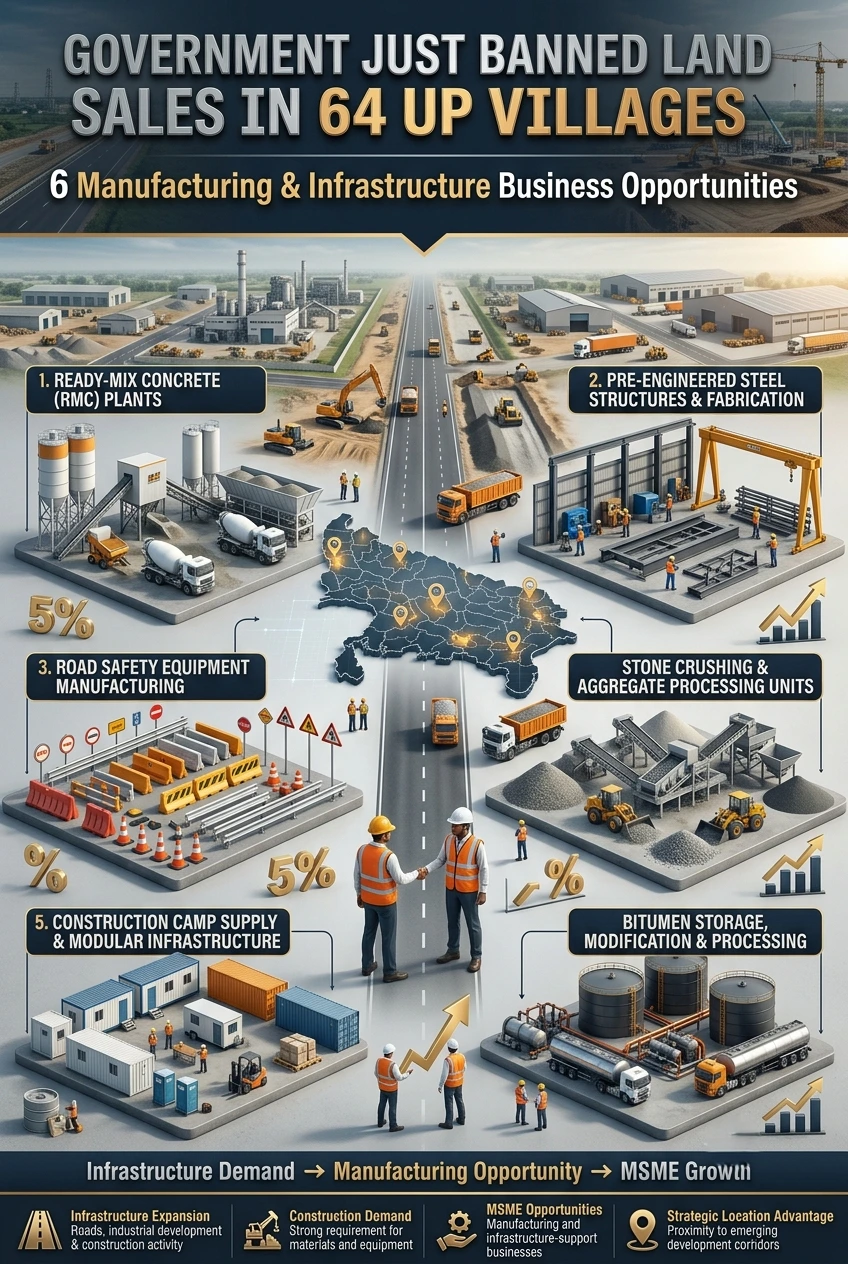
4. Stone Crushing and Aggregate Processing Units
This expressway will require millions of metric tonnes of crushed aggregate for its sub-base and base course works. This demand can be met by stone-crushing units in the Vindhyan belt of UP and the Himalayan foothills near Shamli. Live Hindustani’s report on land acquisition in 64 villages shows the scale. This demand pipeline is likely to continue for years.
Access Complete Business Plan: Crushed Stone Manufacturing Business Guide
5. Construction Camp Supply and Modular Infrastructure
Any big expressway work involves thousands of people working in construction camps for years. Modular housing, portable toilet systems, Canteen catering materials, and making of safety equipment are in high demand in construction. An MSME that takes the role of an infrastructure provider to the main contractor has lower capital needs and a higher repeat business.
6. Bitumen Storage, Modification, and Processing
An expressway’s main surface course is bituminous paving. The PMB plants are situated near the project area which can provide PMB material directly to the contractors. UP has no surplus of PMB manufacturing and hence it is indeed an opportunity for the early movers who have source of bitumen from Mathura or Panipat refineries.
Import–Export Opportunity Analysis
The Shamli–Gorakhpur Expressway brings in tangible export/import substitution potentials:
Export Markets
- Indian norms are gaining traction in Nepal, Bangladesh and the African market and Indian road safety products (crash barriers, signage, reflective sheeting) are being exported.
- The components of construction equipment produced in UP’s developing manufacturing hubs can cater to the markets in South Asia and in the middle east.
- Sugarcane products, wheat and processed food from the fertile corridor of the Uttar Pradesh will reach nearer to the border point of Nepal at Gorakhpur.
Import Substitution
- A significant volume of specialist road construction equipment parts (pavers, compactors) is imported. UP manufacturing or refurbishment is now able to compete with units for components.
Nepal Trade Corridor Dividend
Indian MSME Success Stories in the Expressway Economy
1. JMD Strips Pvt. Ltd., Noida (Road Safety Products)
JMD Strips is a small metal fabrication shop that has grown into a manufacturer and supplier of BIS-certified crash barriers and beam guard rails. It serves NHAI and state highway projects across North India. The company scaled up by establishing itself near the Yamuna Expressway corridor. It later won contracts for several UP expressway packages. They learned that the benefits of being early to the corridor project can last several years.
2. Shiva Cement & Aggregates, Sonbhadra, UP
This small scale MSME took advantage of its proximity to the Bundelkhand Expressway to supply construction aggregate and fly-ash brick to the main project contractors. As a certified sub-supplier, the unit was registered early in the land acquisition process, thus committing itself to a three-year supply contract. Their experience has demonstrated that the size of the supplier is not a key factor, only early and certified.
3. Agrofresh India, Gorakhpur
Agrofresh is located close to Gorakhpur and deals in cold storage solutions and agricultural processing machines. The company is now expanding its service to the agri-belt districts of Muzaffarnagar and Meerut, while the Gorakhpur corridor now links westward to Shamli. Expressway connectivity is facilitating their expansion and helping them grow without corresponding increases in logistics costs.
Choose the right startup backed by real market demand
About NPCS – Niir Project Consultancy Services
Niir Project Consultancy Services (NPCS) is one of the most experienced industrial consultancy companies in India which have successfully assisted entrepreneurs, MSMEs and large industrialists to launch manufacturing and infrastructural related businesses for over 50 years.
NPCS offers:
- Market Research: Demand analysis, competitor mapping and pricing benchmarking of products used in expressway construction supply chains.
- Feasibility Studies: Site specific feasibility for RMC plants, aggregate units, bitumen processing, road safety manufacturing and modular construction systems.
- Technology Consultancy: Selection of plant, machinery and process technology for new manufacturing enterprise in construction materials industry.
- Business Setup Support: Assistance with a business set up process from project idea to the commissioning of the plant with government liaison for scheme benefits.
NPCS offers a blueprint for entrepreneurs to seize the opportunity of the Shamli – Gorakhpur Expressway from business idea to an operational plant.
Business Opportunity at a Glance
| Industry | Highway Infrastructure & Construction Ecosystem |
| Market Driver | Shamli–Gorakhpur Expressway land acquisition (64 villages, UP 2026) |
| MSME Opportunity | Construction materials, readymix concrete, road signage, logistics, hospitality |
| Export Potential | Construction equipment parts, processed stone/aggregates, road safety products |
| Government Support | Bharatmala Pariyojana, MSME Schemes, PM GatiShakti, UP Industrial Policy 2022 |
| Risk Level | Medium (land acquisition timeline, regulatory delays) |
| Growth Outlook | High – multi-year project with sustained demand through 2030 |
Conclusion: Act Before the Machinery Arrives
The Shamli–Gorakhpur Expressway is no more a possibility now but a reality. Moreover, The Live Hindustan report says that the land acquisition process has already started and the government has prohibited land sale and purchase in 64 villages. Therefore, This is the strongest warning any entrepreneur can have – the machine is being oiled and it will come.
Manufacturers, logistics providers, agri-processors and infrastructure suppliers will have a concentrated opportunity that is predictable and time-bound. Therefore, businesses that have established themselves, completed certifications, and registered with UPEIDA and NHAI will gain an early advantage. They can benefit when contractor procurement begins.
The expressway links to two places on the opposite side of the world, Shamli in the west and Gorakhpur in the east. Furthermore, It links India with Nepal in the north. Ultimately, It can link ambition with profit for the entrepreneurs who take action.