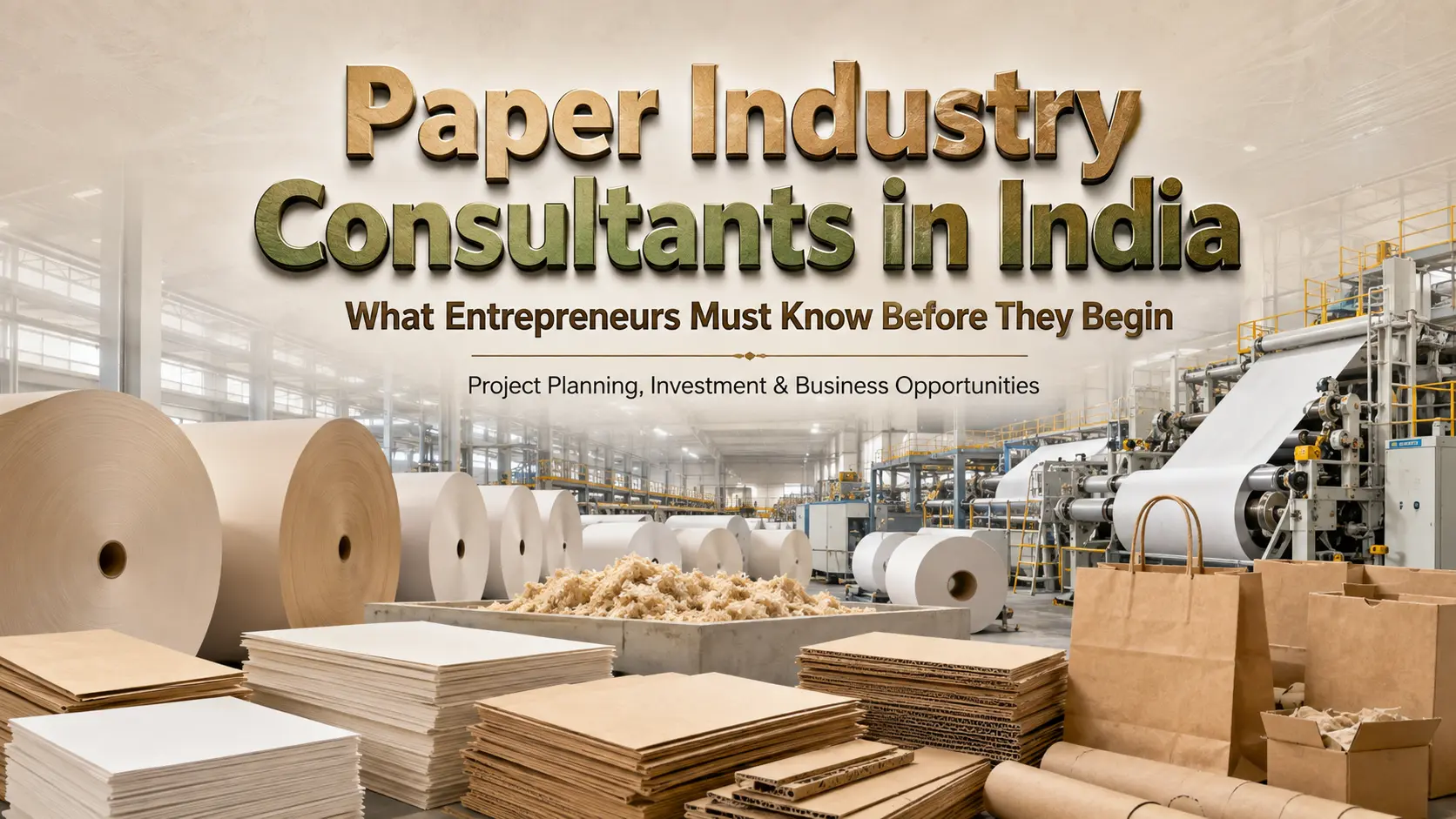

The paper industry is at a turning point in India. Demand for packaging is on the rise, ecommerce is changing supply chains, and the government’s single-use plastic ban is forcing billions of rupees to be spent on paper substitutes. One issue that entrepreneurs in this industry have been asking themselves as they look at starting a kraft paper production facility, a corrugated board plant, a tissue manufacturing plant or a specialty paper plant is “who will take over the project from concept to commissioning? That’s where Paper Industry Consultants in India come into the game. This article provides an in-depth understanding of what a paper plant consultant should expect, how to choose the best paper industry consultants in India, and how paper plant consultants play a key role in feasibility, compliance, and execution in this rapidly expanding industry.
Why Paper Industry Consulting Matters More Than Ever
Presently India is among top 15 paper producers with over 850 paper mills covering the entire country with production of almost 25 million tonnes of paper per annum. Domestic is the writing and printing paper, packaging paperboard, newsprint, tissue, and specialty grades and currently expanding at a 6- to 8-percent compound annual rate. But in India, consumption of paper per capita is around 15-17 kg/person per year, which is very low as compared to the international average of 57 kg/person. In between that structure and a population of 1.4 billion is a great and largely unexploited market. It is an actual opportunity for investors and first-generation entrepreneurs.
Opportunity, however, is as opportunity goes without guidance. Paper production is a complicated process — from making pulp to chemical recovery to getting fibers, treating effluents, managing energy consumption, and others. There are significant capital requirements. Compliance with regulations, especially as per the guidelines of Indian Paper Manufacturers Association (IPMA) and Central Pulp and Paper Research Institute (CPPRI) — both the top institutes influencing policy and technical standards for the paper industry — is not an easy task. Paper Mills are under strict effluent and emission norms by State Pollution Control Boards. Occupational safety is regulated by the Factory Act. All this is difficult and costly without a technically proficient consultant.
That is why the need of a specialised paper industry consultant in India has been increasing in proportion to the development of the paper industry. A paper plant consultant that’s credible: Connects market opportunity to bankable and compliant, operationally viable projects.
Explore This Book: The Complete Technology Book on Pulp & Paper Industries
What Paper Plant and Process Consultants Actually Do
Many entrepreneurs mix up the definition of a consultant with contractor. It is a significant difference in manufacturing with large capital investments, such as paper.
Feasibility Studies and Techno-Economic Analysis
The first step of a paper industry consultant is to help the client understand if the proposed project is commercially viable or not. This includes demand analysis of the grade of paper, availability of raw materials (wood pulp, agro-residues, recycled fibre), water, power infrastructure assessment and a detailed financial model including capital expenditure, working capital, break-even analysis and projected profits. This will be the Detailed Project Report (DPR) which is the most vital document for any businessman who wants to borrow money from a bank, avail any government scheme or draw investment from business partners.
Engineering and Process Design
In addition to counting, a paper plant consultant is involved in the technical design of the plant. This covers the design of a flow diagram, plant layout, specification and selection of machinery (stock preparation, headbox, press and dryer sections, calendering and winding), design of effluent treatment plant and planning of plant utilities. Pulp and Paper Technology specialists tend to have practical experience in CPPRI or at large integrated paper mills, enjoying a firsthand understanding of the process that textbook consultants are not privy to.
EPC and Project Management Support
Larger consulting firms accept Engineering, Procurement, and Construction (EPC) contracts, which involve handling the entire project delivery process, from civil construction to equipment commissioning. Process plant consultants often perform partial or full EPC, which includes the sourcing of reputable machinery suppliers, contract review and erection and commissioning supervision. This is particularly useful for newcomers who don’t have the technical team on-board to manage a new development.
Regulatory Compliance and Government Liaison
In India, the manufacture of paper is a regulated activity. The plants must be environmental cleared by the State Pollution Control Boards, registered under the Factories Act, registered under the Goods and Services Tax (GST) and approved by the Fire Non Commission (Fire NOC) and in some cases, approval under extended producer responsibility (EPR) norms by MoEF&CC. Leading paper industry consultants in India assist their clients in meeting these needs effectively, cutting down on approvals time and mitigating expensive mistakes at the licensing phase. Data and policy on IBEF’s Paper and Packaging page and Invest India’s paper sector profile can further help entrepreneurs in this regard.
Access Complete Business Plan: Paper Industry & Paper Products
Why India Has Become a Hotspot for Paper Industry Consulting
India is one of the most dynamic markets for paper industry project consulting in Asia, owing to the following reasons. First, the government’s sustained efforts on manufacturing under the Department for Promotion of Industry and Internal Trade (DPIIT) have made the process of setting up an industrial unit simpler, including in the areas of land acquisition, cluster development schemes for paper MSMEs, and environmental clearance.
Secondly, the transition from single-use plastics as a result of the phased ban has structurally boosted demand for paper-based packaging in the FMCG, food service, retail and pharmaceutical sectors. Third, e-commerce, which relies wholly on corrugated packaging and kraft paper, has been responsible for consistently investing in new manufacturing capacity for corrugated board and boxes. IBEF estimates that the paper packaging market in India is now at around ₹1,67,110 crore and will expand at a compound annual growth rate (CAGR) of almost 19.5 percent through 2030.
Fourth, import substitution is an increasingly important role. Imports to India of newsprint, specialty grades and some high-quality coated papers are considerable. Domestic capacity additions in these segments are obvious business opportunities — and obvious business requirements for consulting firms capable of developing bankable feasibility reports, and finding the right technology to help connect investors.
Since the inception, the Indian Pulp and Paper Technical Association (IPPTA) has been alerting these opportunities through its technical publications and annual convention to which the plant engineers, technologists and entrepreneurs from all over the country come.
How to Evaluate and Shortlist the Best Paper Industry Consultants in India
Selection of a right consultant for a paper project is a very risky decision. These are the criteria which are most important.
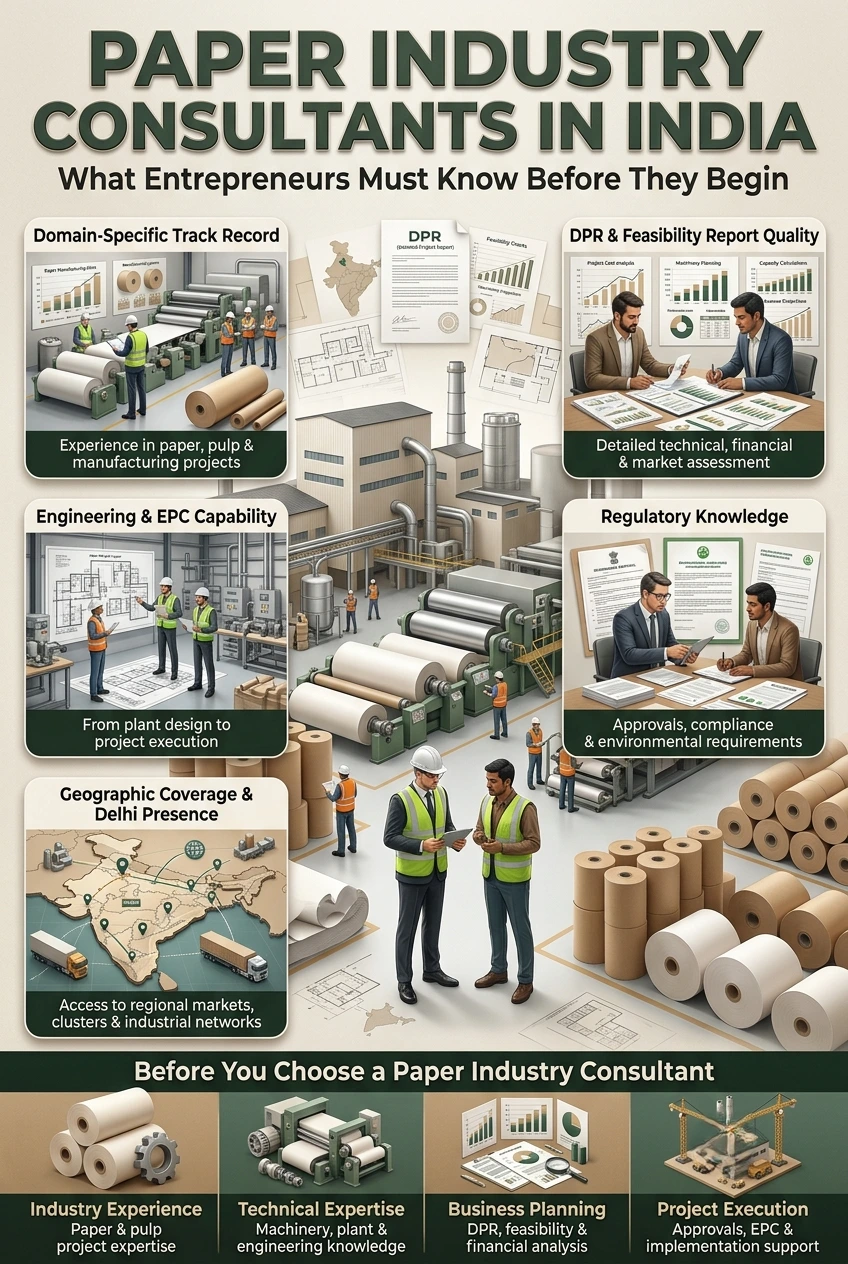
1. Domain-Specific Track Record
While general engineering consultants can often be involved in diverse manufacturing projects, the paper industry has special attributes, including fibre chemistry, water use, unique energy demands, and specialty effluent treatment. Search for consultants who have provided feasibility studies or DPRs specifically for paper and allied paper products (kraft paper, tissue, duplex board, corrugated boxes, newsprint). Request references from clients and, if available, view completed projects.
Related Article: How to Start a Kraft Paper Manufacturing Business from Waste Cartons
2. DPR and Feasibility Report Quality
A Detailed Project Report has a direct impact on whether banks approve loans, whether government agencies approve projects and whether the business plan passes the scrutiny mark. The best paper industry consultants in Delhi and India as well produce a DPR comprising manufacturing process and raw material sourcing, specification of the machines with options of the machine vendors, demand analysis with primary and secondary research, complete financials including IRR and Payback Period and plant layout drawings. A DPR with none of these elements is deficient for a serious project financing.
3. Engineering and EPC Capability
There are some consulting engagements that are advisory only in nature, such as market research, regulatory mapping, and financial modelling. Others need full level engineering execution support, which includes process design, civil and structural drawings, equipment procurement, and commissioning supervision. When it comes to a greenfield plant over 30TPD, seek out a firm that has depth in engineering — one that can sign off on technical drawings as opposed to simply do PowerPoint presentations.
4. Regulatory Knowledge
The consultant should be up to date with IPMA guidelines, Pollution Control Board requirements for paper mills (Minimum National Standards — MINAS — for effluents etc.), EPR obligations and eligibility of MSME scheme. Paper mill effluent is one of the more complicated compliance areas in Indian manufacturing, and a consultant who disregards this risk isn’t serving the client.
5. Geographic Coverage and Delhi Presence
For the entrepreneurs of North India, it is very crucial to consult with these consultants as much they are based in Delhi or around. Not only because they are easily accessible people for the entrepreneurs, but also by the fact that these central government offices (DPIIT, MSME Ministry, Ministry of Environment) are located in Delhi. There are a number of paper industry consultants in Delhi who have active government liaison teams just for this purpose.
Role of NPCS in Paper Industry Project Consultancy
New Delhi-based Niir Project Consultancy Services (NPCS) is a pioneer in the field of industrial project consultation services in India having more than 20 years of experience in the Indian paper industry since its establishment in 1994. NPCS’ reputation has been established over many years of project profiling, covering more than 150,000 project successes across 85 countries in various manufacturing industries, including paper and allied products.
NPCS also prepares Detailed Project Reports and techno-economic feasibility studies for the entire range of paper industry sub-sectors—namely kraft paper manufacturing, waste paper recycling, corrugated board and box manufacture, tissue paper, duplex board, newsprint, handmade paper, paper bags and cups, specialty paper conversion. Complete project financials, such as profitability projections, break-even analysis, and working capital requirements, accompany each report, along with market demand analysis, process flow diagrams, plant layout and machinery selection, raw material sourcing options, and manufacturing process details.
An important advantage of NPCS for entrepreneurs interested in several project ideas is its in-depth paper industry project profiles catalogue that can be found at NPCS Paper Industry Profiles. At this place, a first-timer entrepreneur can see project profiles in dozens of paper and allied product categories without having to invest in a particular product idea. The project identification phase is an important one that is frequently overlooked, and is where many entrepreneurs lose, or waste, a tremendous amount of time and money. NPCS’ way of creating a structured report that integrates market intelligence with technical and financial feasibility has made it a go-to resource for MSME planners, loan applicants and industrial investors in the country.
Smart entrepreneurs start here—find your perfect venture
NPCS operates under the broader Niir umbrella and its consulting approach aligns well with the needs of boutique management consulting firms in India that serve the paper manufacturing segment. For NRI investors and first-generation entrepreneurs who want a structured entry point into the paper industry, NPCS’s DPRs serve as credible, bankable starting documents.
Paper Industry Consulting in Delhi and the Broader India Landscape
Delhi-NCR is the nerve centre of all the industrial consulting organizations in India. Most central government ministries and regulatory bodies such as DPIIT, MoEF&CC, MSME Ministry have their focus here, providing a quicker access to approval pipelines and policy updates for supporting consultants based in this area. Further, Delhi’s location near Saharanpur (where CPPRI and IPPTA are located) provides paper technology specialists a friendly environment to access the most significant paper technology research institution in India.
Outside Delhi, the consulting world for the paper industry is diffused throughout the key manufacturing states. There are more paper mills in Gujarat, Maharashtra and Uttar Pradesh in India and consulting firms that specialise in these areas are located in Ahmedabad, Mumbai and Lucknow. Several large integrated paper mills also operate in Tamil Nadu and Andhra Pradesh, where regional consultants have established a base for agro-residue-based papermaking (sugarcane bagasse and wheat straw). This segment continues to grow because limited wood availability drives the demand for alternative raw materials.
For entrepreneurs, the intended plant site, the consultant’s familiarity with the region’s Pollution Control Board, and the availability of the required Government offices should determine the consultant’s location. In the case of DPR and feasibility, however, the domain knowledge of the consultant is more important than geography. Many of the best paper industry consultants in Delhi provide their services on field for site assessment and machinery inspection, but otherwise provide remote services for project identification and DPR.
Comparing Consulting Service Types in the Paper Industry
The table below summarises the main types of consulting services available to paper industry entrepreneurs in India — their core focus, key deliverables, and best-fit client profile.
| Service Type | Core Focus | Key Deliverables | Best-Fit Client |
| Feasibility & DPR Consulting | Market viability, financial planning, process overview | Techno-economic DPR, demand analysis, financial model | First-time entrepreneur, bank loan applicant, MSME investor |
| Process Engineering Consulting | Plant design, process optimisation, utilities planning | Process flow diagrams, PFDs, equipment specs, layout drawings | Expanding unit owner, greenfield project developer |
| EPC Consulting / Turnkey | End-to-end project delivery from design to commissioning | Civil drawings, procurement support, commissioning | Investor requiring full project execution support |
| Regulatory & Compliance Consulting | Environmental clearances, PCB norms, factory licensing | NOC applications, MINAS compliance reports, EPR mapping | Plant operator facing new or changing regulations |
| Project Identification & Profiling | Evaluating multiple business options in paper sector | Project profiles, comparative ROI analysis, sub-sector shortlists | Diversifying entrepreneur, NRI investor exploring options |
| Export & Market Entry Consulting | Export potential, buyer identification, pricing strategy | Export feasibility, trade data analysis, certification guidance | Mid-scale unit targeting international paper markets |
Conclusion: Practical Next Steps for Paper Industry Entrepreneurs
The paper industry in India offers genuine, sustained investment potential — across packaging, tissue, specialty grades, and recycled paper. However, converting that potential into a successful operating unit requires structured, expert guidance. Therefore, A credible paper industry consultant — whether a boutique management consulting firm with deep paper sector expertise or a large engineering consultancy with EPC capability — is not a luxury. It is a prerequisite for any serious project.
Start with project identification. First, Review multiple sub-sectors before committing capital. Resources like IBEF’s paper and packaging sector overview, IPMA’s industry positions, and IPPTA’s technical publications provide industry context at no cost.
Once a product and capacity are shortlisted, commission a Detailed Project Report from a consultant with a verified paper industry track record. Then, Use the DPR as the foundation for bank finance, government scheme applications, and investor conversations. Moreover, Do not start civil construction before the DPR is complete and reviewed.
Next, Then focus on regulatory compliance. Engage your consultant early on environmental clearance, PCB approvals, and factory licensing — these are the most common bottlenecks in Indian paper project timelines. Finally, invest in a robust raw material strategy. Paper manufacturing margins are tightly linked to input costs, and a competent process plant consultant can manage supply-chain risks upfront to make the difference between a profitable and a struggling unit.
Overall, India’s paper sector is growing. Consequently, Entrepreneurs with the right guidance, the right DPR, and the right compliance approach are well-positioned to build durable businesses in this essential, expanding industry.