The manufacturing sector in India is undergoing a complete transformation and copper is at the center. Every spectrum of the country’s industrial growth story requires copper and copper products, be it for electric vehicle charging, renewable energy grids, smart city wiring, or industrial motors. In the context of an entrepreneurial or investment approach to the copper and copper products industry in India, collaboration with the right copper and copper products industry consultants cannot be avoided anymore. The success of a copper project and the cost of a potential failure can depend on the quality of technical and commercial advice obtained in the early stages.
The demand of copper in India is growing at a rapid pace. The domestic demand is expected to surge by more than 10% per year as a result of the power infrastructure improvement, EV penetration, and ambitious renewable energy targets. Nonetheless, even with this strong demand, domestic capacity to produce copper has historically been below demand, resulting in large manufacturing opportunity gaps in India. The field of copper wire drawing, copper alloy casting, copper tube manufacturing, copper powder production and secondary copper refining are all emerging as new spaces of entrepreneurial capital. However, the technical, regulatory and commercial nature of these projects is complex and can be a risky undertaking without expert guidance.
This guide is for the founder of a startup, investors in the manufacturing industry, and MSME entrepreneurs who wish to know how to find, assess and engage with the best copper and copper products industry consultant in India. It explains what these consultants do, the reason why the copper industry in India is so attractive to investors and how you can choose the right consultant for your project.
Related Article: Copper Manufacturing Business in India: Opportunities, Cost, and Market Outlook
What Copper Plant and Process Consultants Actually Do
Many first-time business owners often mistake a copper plant consultant for a business advisor. In fact, the best copper and copper products industry consultants in India work at the nexus of engineering, market research, financial modelling and regulatory element. They start work long before the first brick is laid.
The Detailed Project Report (DPR) is at the heart of their services, which is the key document required for any project before it receives bank finance, MSME support or backing from investors. A well-prepared DPR for a copper and copper products unit includes a detailed description of the manufacturing process, technical specifications of the machines and equipment, source of raw materials (cathode copper, copper scrap or ore concentrate), plant layout and requirement of utilities, product mix and productions capacity (in metric tonnes per day, MT/TPD), market demand analysis and competitive landscape and complete financials of the project (capital expenditure, revenue projection, profitability timeline, and break-even analysis).
In addition to the DPR, process plant consultants can also prepare techno-economic feasibility studies to enable investors evaluate the viability of a project before they invest their money. Many consultants also work with their clients on the Engineering, Procurement and Construction (EPC) phase, including the selection of equipment vendors, plant installation and commissioning. Process engineering consultants provide depth in the field, optimising the copper metallurgy operations from smelting to refining to electrolysis to wire drawing to alloy casting. Regulatory consultants help the founders in getting their products registered as BIS products in the Quality Control Order (QCO) for copper products, Pollution Control Board (PCB) approval, factory licensing status under the Factories Act and the registration under the Goods and Services Tax (GST). To sum up: A good copper industry consultant can save the founders money and time by doing it right the first time.
Why India Has Become a Hotspot for Copper and Copper Products Consulting
There are some strong structural reasons why India is an extremely interesting area for investment in the copper sector – and as a consequence also in the copper and copper products consulting business. For any entrepreneur, it’s crucial to understand these growth drivers as context on which they can assess a project in this area.
The energy transition is driving up copper demand, to start with. India has ambitious targets for solar and wind energy capacity and copper is at the heart of all renewable energy infrastructure, including wiring a solar energy farm, inverters, wind turbine generators and grid inter-connections. Moreover, India is witnessing rapid growth in the electric vehicle Industry. Demand is being driven by the copper content found in each EV, which is about three to four times higher than that found in a conventional internal combustion engine vehicle. The International Copper Association India (ICA India) has reported that the demand for copper in India will be 5.4 times higher in 2047.
Second, the Ministry of Mines, Government of India has been actively promoting domestic copper production by policy interventions. The government’s Quality Control Order (QCO) that stipulates Bureau of Indian Standards (BIS) certification for copper products has also increased the quality standards and at the same time imposed a restriction on substandard imports, which will benefit the quality-compliant and domestic copper goods. The import substitution avenue is especially intriguing for MSME investors interested in Copper Alloys, Copper Fittings, Copper Tubes and Semi-fabricated Copper Products.
Get Detailed Project Report (DPR): Copper and Copper Products and Projects
Third, India’s infrastructure drive (metros, smart cities, power transmission investments, housing construction, etc.) provides a backstop for structural copper demand in building construction and industrial use. According to the India Brand Equity Foundation (IBEF), India is the third-largest electricity producer in the world with installed power capacity of more than 440 GW and power addition is going on with each power addition requiring copper usage. Moreover, Invest India has brought to the fore big corporate investments in the copper industry, such as the bold move by the JSW Group of investing ₹2,600 crore in copper mining, indicating a larger thrust towards self-reliant domestic copper value chain.
These trends are all converging to make copper one of the most promising manufacturing opportunities in India right now, provided of course you’re willing to invest in it. The big concern for entrepreneurs and investors isn’t if or when, but how. The answer starts with getting the right consultant.
How to Evaluate and Shortlist the Best Copper and Copper Products Industry Consultants in India
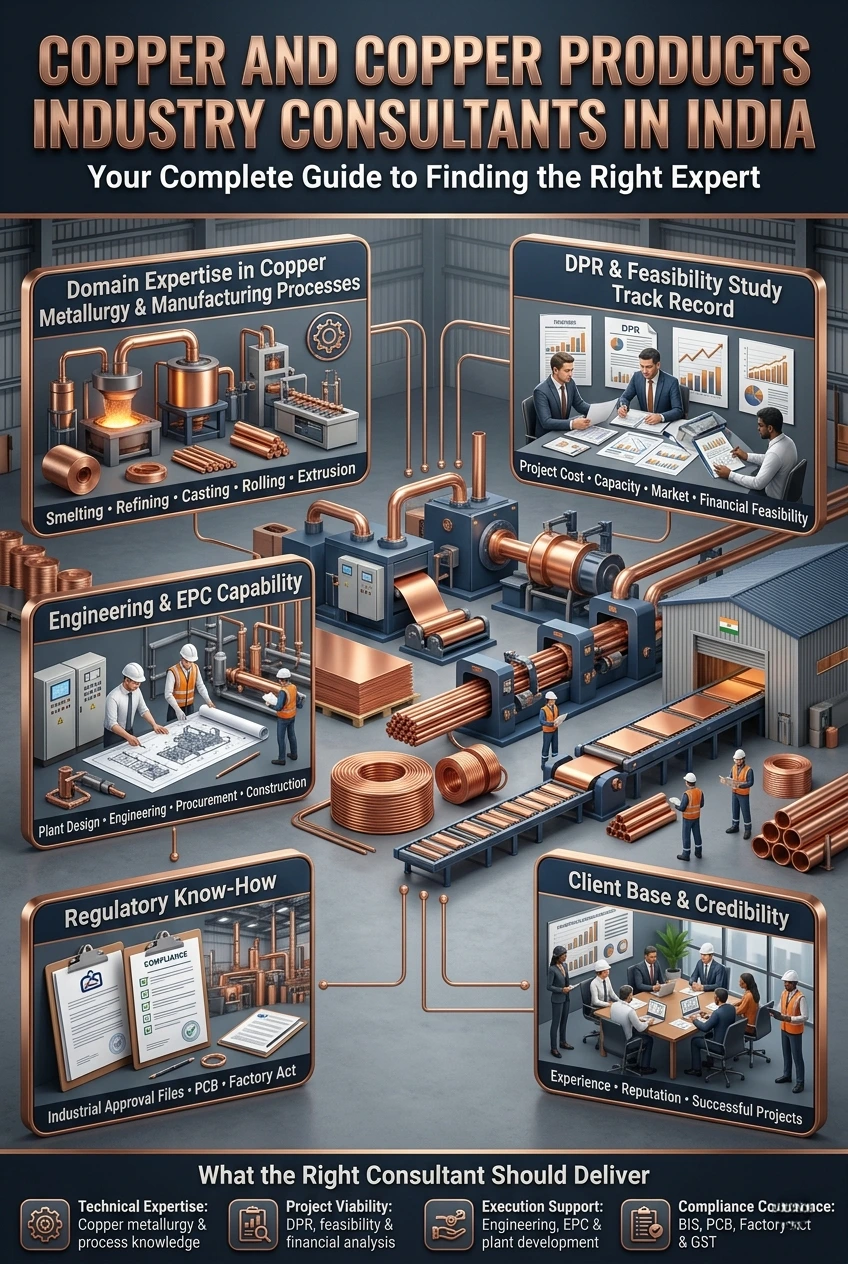
Choosing a consultant for a copper project is not simply a matter of picking the largest firm or the cheapest quote. The right fit depends on the nature of your project, the stage you are at, and the specific expertise you need. Here are the key criteria that experienced investors and project developers use when evaluating the top copper and copper products industry consultants in India.
1. Domain Expertise in Copper Metallurgy and Manufacturing Processes
The copper value chain is technically diverse. Copper metallurgy covers everything from ore beneficiation and smelting to refining, wire drawing, casting, and alloying. A consultant who has worked only on copper wire drawing may lack the insight needed to advise on a copper powder or copper mould tube project. Therefore, confirm that your shortlisted consultant has demonstrable, sector-specific experience — not just general manufacturing consulting. Ask to see previous DPRs or feasibility reports in the copper and copper products space, and verify whether they cover the specific sub-segment you are targeting.
2. DPR and Feasibility Study Track Record
The Detailed Project Report is often the centrepiece of any copper plant consultancy engagement. A well-structured DPR enables founders to secure term loans from banks, convince investors, and apply for MSME scheme support. Evaluate a consultant’s DPR quality by reviewing the depth of their market research, the accuracy of machinery cost estimates, and the realism of their financial projections. Generic, template-based reports that merely fill in numbers without contextual market logic are a red flag. The best consultants produce DPRs that read as genuine market intelligence documents — not just compliance paperwork.
3. Engineering and EPC Capability
Process engineering consultants and EPC consultants serve different but complementary roles. A process consultant designs the manufacturing flow, selects the technology route, and prepares process flow diagrams. An EPC consultant manages engineering, procurement, and construction on a turnkey basis. Depending on your project’s scale and complexity, you may need one or both. Boutique management consulting firms in India often partner with engineering firms for the EPC phase, while some full-service consultancies offer integrated capability. Clarify scope upfront and ensure your consultant has the engineering bandwidth to handle plant layout, utility design, and equipment commissioning support — not just paper-based feasibility.
4. Regulatory Know-How: BIS, PCB, Factory Act, and GST
Regulatory compliance is a critical dimension that inexperienced consultants often underestimate. For copper and copper products manufacturing, the Bureau of Indian Standards (BIS) certification under the mandatory Quality Control Order (QCO) issued by DPIIT and the Ministry of Mines is now a legal requirement for many product categories. Additionally, any copper manufacturing or smelting facility must obtain consent from the relevant State Pollution Control Board (PCB) under the Environment Protection Act and Water/Air Acts. Factory licensing under the Factories Act is mandatory for units above prescribed worker thresholds. A competent copper industry consultant understands these regulatory layers and can guide founders through clearance timelines, documentation requirements, and ongoing compliance obligations.
5. Client Base and Credibility
A consultant’s credibility is built on the outcomes their clients have achieved. Ask about the types of clients they have served — whether startups, MSMEs, or large industrial groups — and the projects that have actually gone into production. Consultants who have served clients across multiple states, international investors, or NRI project developers are typically more equipped to handle complex, large-scale copper manufacturing assignments. Additionally, look for consultants who are connected to institutions such as Hindustan Copper Limited (HCL) for upstream technical context, and who follow sector developments published by ICA India and the IBEF metals and mining platform.
Role of NPCS in Copper and Copper Products Project Consultancy
Among the established names in India’s industrial consulting ecosystem, Niir Project Consultancy Services (NPCS) — headquartered in Delhi and accessible at niir.org — stands as one of the country’s most experienced providers of Detailed Project Reports and techno-economic feasibility studies for the copper and copper products sector. Founded in 1994, NPCS has over three decades of continuous consulting practice across Indian manufacturing sectors. Its credentials speak clearly: over 150,000 successful projects delivered, clients across 85 countries, and a team comprising engineers, financial experts, market analysts, and process specialists.
What makes NPCS relevant specifically to copper and copper products entrepreneurs is the depth and breadth of their project profile library for this sector. From copper wire drawing and enamelling plants to copper powder manufacturing, copper ingot and rod production from scrap, copper mould tube fabrication, and copper concentration from ore — NPCS has prepared technical and financial feasibility reports across the full spectrum of the copper value chain. Each NPCS project report covers manufacturing process details, process flow diagrams, machinery and raw material specifications, market demand analysis, capacity planning, and complete project financials including profitability projections and payback period calculations.
For entrepreneurs who are still at the project identification stage — deciding which copper sub-segment to enter — NPCS’s comprehensive copper and copper products project profiles catalogue at NPCS Copper and Copper Products Project Profiles is a practical starting point. Browsing through these project profiles allows founders to compare investment levels, capacity options, and production processes across multiple copper manufacturing ideas — enabling a more informed go/no-go decision before committing to a full DPR.
Get Detailed Insights from This Book: Our Books
NPCS exemplifies the kind of established India consultancy firm that serves first-generation entrepreneurs seeking both technical guidance and business intelligence in one engagement. Their work is particularly valuable for founders who lack prior exposure to copper manufacturing and need a credible, data-backed foundation before approaching banks or institutional investors.
Best Copper and Copper Products Industry Consultants in Delhi and Across India
Delhi and the NCR region remain India’s primary hub for industrial consulting firms serving the copper and non-ferrous metals manufacturing sector. The capital’s proximity to government ministries — the Ministry of Mines, BIS headquarters, and DPIIT — gives Delhi-based consultancies a natural advantage in regulatory intelligence and policy access. Many of India’s most experienced boutique management consulting firms in the industrial space are headquartered here, with project execution experience across the full national geography.
However, the landscape of copper industry consultancy in India is geographically distributed. Mumbai-based consultants are typically stronger in financial modelling and project finance, given the city’s capital markets orientation. Pune and Ahmedabad firms often bring strong engineering and EPC execution capability, particularly for copper wire and cable manufacturing projects in western India — where Hindalco’s Birla Copper complex and the growing EV component manufacturing cluster create natural demand. Chennai and Hyderabad consultants often serve the electronics and electrical components manufacturing segment of the copper value chain.
For investors targeting copper-rich states — Rajasthan (Khetri copper belt), Madhya Pradesh (Malanjkhand), and Jharkhand (Ghatsila) — consultants with field knowledge of ore beneficiation, mine-to-metal integration, and state-level environmental clearances offer the right expertise. Regardless of geography, the best copper and copper products industry consultants in Delhi and across India combine technical depth with commercial realism — helping founders build projects that are both feasible and financeable.
Identify high-growth industries before others do
Copper and Copper Products Consulting Services: Types, Deliverables, and Best-Fit Clients
| Consulting Service Type | Core Focus and Key Deliverables | Best-Fit Client Profile |
| DPR / Feasibility Consultancy | Market research, process design, machinery specs, project financials, profitability analysis, bank-ready report | First-generation entrepreneurs, MSME founders, NRI investors entering copper manufacturing |
| Process Engineering Consultancy | Process flow diagrams, copper metallurgy optimisation, technology selection (electrolysis, wire drawing, smelting), utility engineering | Investors scaling existing copper units or establishing new process plants above 500 MTPA |
| EPC Consultancy | End-to-end engineering, procurement, and construction management; plant commissioning and testing; turnkey project delivery | Large-scale copper refinery, copper alloy casting, or copper wire rod plant investors seeking turnkey implementation |
| Regulatory & Compliance Consultancy | BIS QCO certification support, PCB consent applications, Factory Act licensing, GST and MSME scheme facilitation | Copper manufacturers setting up new units or expanding operations who need regulatory clearance navigation |
| Market Research & Investment Advisory | Demand-supply analysis, price benchmarking, competitor mapping, import substitution opportunity identification, project shortlisting | Private equity investors, industrial groups, and NRI entrepreneurs evaluating multiple copper sub-sector entry options |
Conclusion: Practical Next Steps for Copper and Copper Products Entrepreneurs
India’s copper and copper products manufacturing sector stands at an inflection point. The convergence of rising domestic demand, government policy support, import substitution imperatives, and the energy transition is creating a rare window of opportunity for well-prepared entrepreneurs and investors. However, seizing this opportunity requires more than ambition — it requires expert guidance from copper and copper products industry consultants who combine technical depth, regulatory fluency, and commercial realism.
As a practical next step, start by clarifying your project idea and investment appetite. Are you looking at copper wire drawing, secondary refining, copper alloy casting, or a niche product like copper powder? Once you have a broad direction, explore multiple project options through the NPCS Copper and Copper Products Project Profiles — comparing investment levels, product mix, and market potential across different sub-segments. Then engage a shortlisted consultant for a preliminary feasibility discussion before commissioning a full DPR.
For regulatory context and policy updates, track developments from the Ministry of Mines, the Bureau of Indian Standards (BIS), and the International Copper Association India. For investment opportunity intelligence, the IBEF Metals and Mining Platform and Invest India offer reliable sectoral snapshots. Combined with the right consulting partner, these resources give you the informational foundation to move confidently from project idea to operational plant.
Copper is the metal of the energy transition era — and for Indian manufacturing entrepreneurs, now is an excellent time to be part of the copper and copper products value chain. The right consultant will not just help you write a report — they will help you build a business.