
AI Business Ideas for MSMEs
Introduction: A Turning Point for Indian MSMEs
Every few years the Indian industrial scenario hits a tipping point. Here we are, us. The AI Impact Summit 2026 is now a policy signal, a market signal and a business opportunity in one! Participants of the Summit, entrepreneurs from the technology-manufacturing space and MSME investors looking at business ideas, will have their investment decisions, government procurement agenda and competition dynamics in the Indian industry influenced by what happens at this Summit.
India boasts of a vast population of MSMEs, with almost 63 million of them. They account for approximately 30% of GDP and a larger proportion of the workforce (more than 110 million). But most of the rest are still running on old processes: manual quality reviews, paper inventory, reactive maintenance and disjointed supply chains. AI Impact Summit 2026 is a step in that direction, bringing AI to the forefront of India’s journey towards industrial modernization.
It’s not a matter of robots taking over jobs. It’s about low cost and scalable technology, that makes the manufacturing in India more competitive, more precise, more profitable. In today’s world, as an entrepreneur, you can no longer ask yourself, “should we use AI? As it is today, the question that no entrepreneur should ask is “should we use AI? It is “how quickly can we incorporate it and what help is there?”
Why AI-Driven MSME Tech Is the Business Opportunity of This Decade
Industry analysts have been projecting compound annual growth rates exceeding 40% for the global AI market in the manufacturing sector. Then India is hoping for a substantial portion of that. The domestic demand side is no exception, with a host of pull factors driving technology adoption including rising input costs, quality-conscious export buyers and supply chain reconfiguration following the pandemic.
The Indian enterprises are allocating more resources towards AI technology every year, with manufacturing and logistics being the top-three sectors in terms of investment, according to NASSCOM. The necessity of government mandates and the need of market are driving the MSME segment to catch up.
The demand for quality traceability is growing, and is now a requirement for Indian suppliers to their export buyers in Europe, US, and Japan, without which they cannot compete. In the modern era, for a small manufacturer in Pune or Coimbatore, the use of AI tools for inspection has turned into a necessity rather than a luxury.
Related Article: How AI Is Transforming Indian Manufacturing: 10 Practical Use Cases Every MSME and Startup Founder Should Know
The Cost-Reduction Angle: Why This Makes Business Sense
The value of the business logic is greater than the evangelism of technology. This is the basic scenario: typical MSME in batch production loses 8-12% production capacity due to defects, downtime and inefficient scheduling. Many of these tools for process optimisation can be recovered with AI and range from products costing as little as ₹25,000 per month as SaaS subscriptions. If the efficiency of a unit with a turnover of ₹5 crore improves by 5%, then the amount of money saved is ₹25 lakh. The ROI case is a real and measurable case.
Moreover, India’s own drive to produce semiconductors and electronics under the Production Linked Incentive (PLI) scheme is driving up demand for AI-based process controls upstream. The components for smart factory, edge computing infrastructure and IoT sensor assemblies are quickly turning into opportunities for import substitution. Business owners who get in on this supply chain now will have a 3–5-year lead.
Government Policies and Incentives Supporting MSME Tech Adoption
The policy landscape for the use of AI and technology by Indian MSMEs is more conducive than ever before. There are a number of central government schemes that focus on reducing the financial and technical investment considerations of technology integration. The Ministry of MSME has a number of programs that directly impact the entrepreneurs who are entering into this area.
MSME Technology Upgradation Support (CLCSS and CGTMSE)
The Credit Linked Capital Subsidy Scheme (CLCSS) offers a 15% capital subsidy on institutional credit of up to INR 1 crore for technology upgradation of the projects. This implies that an entrepreneur investing ₹1 crore in AI enabled machinery gets ₹15 lakh subsidy as a direct benefit. The Credit Guarantee Fund Trust for Micro and Small Enterprises (CGTMSE) is also crucial as it offers collateral-free loans up to ₹2 crore – a critical support system for first-generation entrepreneurs who may not have any property to offer as collateral.
Digital MSME Scheme and SAMARTH Programme
Digital MSME Scheme encourages the use of cloud computing, ERP systems and digital tools in small manufacturing entities, up to 50% of which will be subsidised by the scheme. The government’s commitment to embedding the use of technology on the shopfloor is evident in the introduction of AI skills training modules into the curriculum of the SAMARTH programme (Scheme for Capacity Building in Textile Sector) and its counterparts in other manufacturing sectors.
Get Detailed Insights from This Book: Our Books
PLI Scheme: Sectoral Incentives for Technology-Led Manufacturing
The Production Linked Incentive (PLI) scheme is run by DPIIT and the Ministry of Commerce and is available for 14 key sectors with a percentage incentive ranging from 4% to 20% of incremental production. sectors that can directly benefit incentive eligibility through AI-integrated manufacturing processes include electronics, pharmaceutical APIs, advanced chemistry cell batteries, telecom equipment and white goods. Adoption of compatible technology standards gives access to longer-term contracts and working capital facilities to an MSME that supplies to large enterprises which are part of the PLI scheme.
State Government Incentives: A Significant Layer
In addition to central schemes, some States provide their own technology adoption support options. Invest Maharashtra offers capital subsidy of up to ₹50 lakh to technology enabled MSME units. TIDCO, Government of Tamil Nadu is providing “plug and play” smart factory infrastructure in its industrial corridors. The government has set up co-working centres, mentorship programmes and pilot testing centres dedicated to AI-manufacturing startups at T-Hub, which operates in Telangana and iCreate which operates in Gujarat. The entrepreneurs must draw a roadmap of the industrial policy of their home state, as most states have introduced clauses on AI in their MSME policies.
Business Ideas Unlocked by AI Impact Summit 2026 for Manufacturing Entrepreneurs
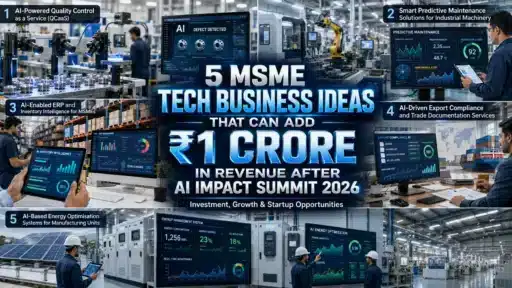
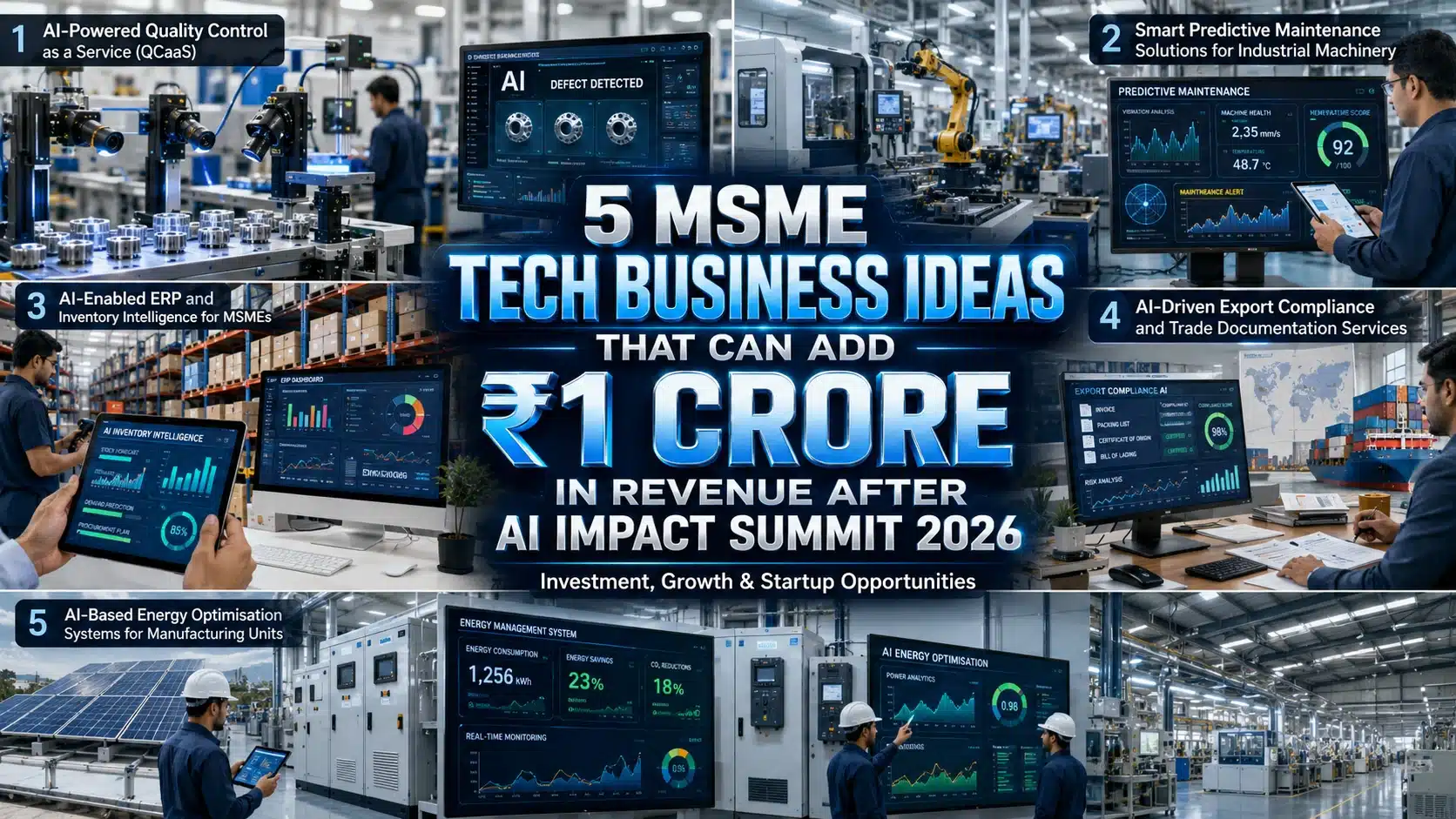
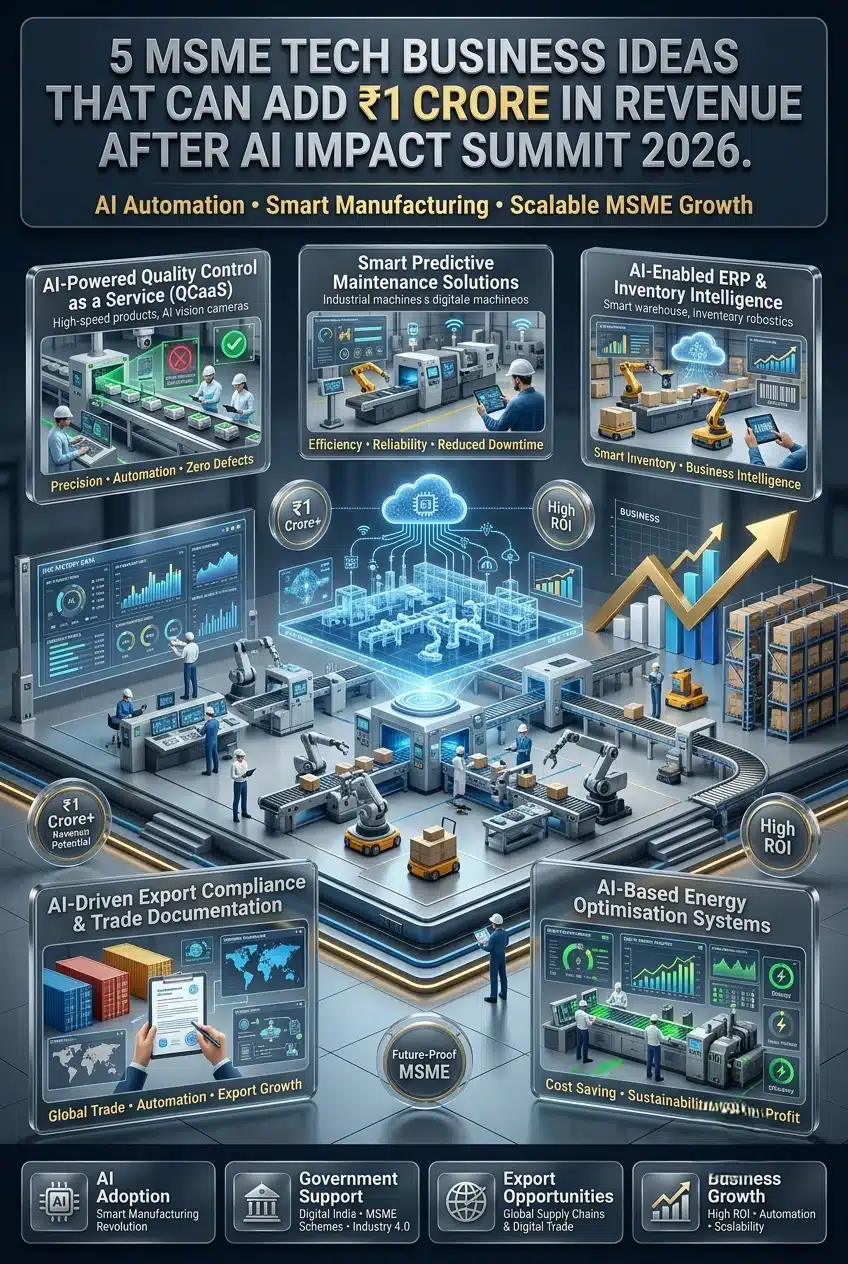
1. AI-Powered Quality Control as a Service (QCaaS)
One of the most practically impactful business concepts that come from the fusion of AI and manufacturing. Dozens of MSME foundries, forging companies and plastics manufacturers operate the manual quality inspection process which is time consuming, inconsistent, and relies on skilled labor which is increasingly hard to come by. An entrepreneur may develop a business model where they deploy computer vision cameras and AI inference engines at their client shop floors and provide quality detection as a monthly subscription service.
For hardware, the investment amount per deployment is usually around ₹8–15 lakh and for annual recurring revenue per client, it is in excess of ₹4–6 lakh. So, this is a ₹1 crore plus ARR business when you have 20 clients in your portfolio. What’s great about this model is that the entrepreneur doesn’t have to create anything, they are the owner of the AI platform and the deployment skills, and the client receives an inexpensive, scalable solution with no big capital investment.
2. Smart Predictive Maintenance Solutions for Industrial Machinery
One of the biggest cost factors that destroy industries in India is the industrial downtime. The loss of production due to an unplanned stoppage in a continuous process plant, e.g., a textile spinning mill or a food processing line, can cost ₹5–20 lakh a day. IoT vibration sensors, temperature monitors, and AI anomaly detection algorithms can achieve a 30–50% decrease in unplanned downtime through predictive maintenance. The entrepreneur can set up a set of hardware and software components from within India’s IoT parts manufacturers and offer it as a mix of one-time sale of the hardware (₹3–8 lakh per machine cluster) and subscription to the software. This is an ideal opportunity post-Summit as sensor-based automation is now incorporated as an eligible capex under the CLCSS and Digital MSME Scheme by the Government and clients can avail subsidy on the investment.
Access Complete Business Plan: Project Reports & Profiles
3. AI-Enabled ERP and Inventory Intelligence for MSMEs
Most of the ERP for MSMEs in India are glorified accounting software applications – they record what has happened, not what will happen. The real AI-driven inventory and production planning system can forecast the raw materials required, warn of supply issues, recommend order amounts and create purchase orders automatically when the stock falls short of the optimum raw material level. It’s a SaaS-model business that has very low marginal cost per additional client. The market is huge; even if you take out 0.1% of India’s MSMEs, who are 63,000, that’s your potential market client base. This can be created and monetised by entrepreneurs with software development skills or in collaboration with software development companies. The monthly subscription fees range from ₹5,000 to ₹20,000 per client, making it easily affordable, and the AI logic itself generates true switching costs, safeguarding long-term revenue.
4. AI-Driven Export Compliance and Trade Documentation Services
Compliance is becoming increasingly burdensome for MSME manufacturers in India for exports, ranging from the EU carbon border adjustment mechanisms to FDA traceability standards for pharmaceutical exports. Today, AI can handle much of the export paperwork, including preparing a certificate of origin, HS code classification, customs duty and generating quality certificates. A good business that is developing a compliance-automation solution for export MSMEs is solving a genuine and pressing issue. The government’s emphasis on diversifying India’s export basket is also a positive aspect of the market. Export workflows have been digitalised by the India Trade Portal and DGFT, and by installing an AI compliance tool on these government platforms, exporters with 50-200 shipments annually can realise immediate value.
5. AI-Based Energy Optimisation Systems for Manufacturing Units
In the energy intensive MSME industries such as ceramics, glass, chemicals or textiles, usually 15–25% of the total production cost is the energy cost. AI-based energy management systems can be used to analyse energy usage, forecast peak demands, optimise compressor and motor loads, and detect waste, among many other functions – typically resulting in 10-18% energy cost savings. For a manufacturing unit with 5,000 sq ft area, and consuming ₹30 lakh each year at an average rate of electricity of ₹7–10 per unit for commercial/industrial consumers in India, the savings could be up to ₹3–5 lakh per year.
Installation cost of an AI-based energy monitoring system ranges from ₹5–8 lakh and the payback period is usually less than 24 months, making it a simple business case for the sales pitch. This can be done as a hardware+analytics business with the hardware also being eligible for MSME technology upgradation subsidies.
Import–Export Opportunity Analysis for AI-Tech MSME Businesses
Indian entrepreneurs have multiple opportunities due to the interplay between trade and AI and manufacturing technology. From the import side, India is currently taking a lot of industrial AI equipment like computer vision processors, edge AI chips, vibration sensors and industrial IoT gateways. Make in India and Semiconductor Mission are both focused on gradually eliminating the imports with local manufacturing. An entrepreneur joining in the industrial AI component assembly, even as a final assembly and integration unit, can gain an advantage of import substitution and even export opportunity.
On the export side, India’s talent pool of software and AI developers provides a significant cost advantage to domestic AI manufacturing solution providers in global markets. A predictive maintenance SaaS platform developed and operated in India can be sold at 40-60% lower prices than similar solutions in the USA or Europe while remaining profitable. In the near term, Southeast Asian manufacturing clusters in Vietnam, Indonesia, Thailand, and Bangladesh are likely export markets for India’s AI-manufacturing SaaS solutions. These markets have similar cultural backgrounds and manufacturing processes, making adoption easier.
Sustaining export-oriented AI-tech MSMEs, the government has introduced various schemes like India Trade Portal and Market Access Initiative. MSMEs can avail 50% reimbursement under the MAI scheme for participating in international trade fairs, which is relevant for businesses that wish to showcase the solutions of AI in Manufacturing to the world.
Discover business ideas that actually make money
Indian MSME Success Stories in AI and Manufacturing Technology
Utthunga Technologies (Bengaluru)
Sudhakar Rao is the founder of one of the top industrial automations and IoT solution providers in India, Utthunga Technologies. Utthunga began as a small engineering services company and grew through its extensive work in the field of manufacturing process automation for companies such as ABB and Siemens, all over the world. Their rationale was simple: to win global reference customers and then use those wins to secure domestic industrial customers. They are now present in several countries. The takeaway for any new entrepreneur is that developing depth in the domain and understanding that you have to serve a demanding international clientele is the formula for a strong reputation in the country.
Altizon Systems (Pune)
Altizon, co-founded by Vinay Nathan, built an Industrial IoT platform called Datonis that connects factory machines to the cloud for real-time monitoring, analytics, and predictive maintenance. They targeted mid-size Indian manufacturers — exactly the MSME segment that the AI Impact Summit 2026 is addressing — and grew through a combination of pilot projects and word-of-mouth among industrial clusters. Altizon raised institutional funding and has gone on to serve clients in manufacturing, pharmaceuticals, and energy. Their model demonstrates that an India-first IIoT strategy is commercially viable and that domestic MSMEs are willing to pay for genuine efficiency outcomes.
Addverb Technologies (Noida)
Addverb Technologies, promoted by Sangeet Kumar and backed by the Reliance group, manufactures industrial robots and warehouse automation systems in India. It is notable for MSME entrepreneurs because of its supply chain model. The company actively develops and uses Indian MSME component suppliers. Addverb’s growth shows that Indian companies can scale in hardware-intensive robotics. They can achieve this by combining manufacturing capabilities with software intelligence. Entrepreneurs building AI-enabled manufacturing tools can target companies like Addverb as customers. They can also use it as a benchmark for future growth.
How NPCS Can Help You Evaluate and Execute Your AI-Manufacturing Business Idea
At Niir Project Consultancy Services (NPCS), we work with entrepreneurs at exactly the stage where excitement meets execution. Identifying a promising AI-manufacturing business opportunity is the starting point; validating it with a rigorous feasibility study is what converts an idea into a fundable, investable project.
NPCS prepares Market Survey cum Detailed Techno-Economic Feasibility Reports (DPRs) for entrepreneurs planning to set up new industrial or technology ventures. For AI-manufacturing projects, our reports cover technology process flows, machinery and equipment sourcing, raw material and input cost analysis, market demand validation, financial projections including project cost, profitability at various capacity utilisation levels, ROI timelines, and break-even analysis. We also map applicable government schemes and financial incentives specific to your project and location.
Over 30 years’ experience in industrial consultancy, 150,000+ project reports served in 85 countries and backed by ISO 9001:2015 certification – we have the depth and authority you need to analyse whether feasible to evaluate the viability of your project. If you are planning a move to AI manufacturing and to MSME Technology, let us find out whether the math works to help prevent committing more capital than is wise to do so.
Visit us at niir.org or entrepreneurindia.co to explore our project report library or request a custom feasibility study.
MSME AI Tech Adoption: Key Indicators and Business Benchmarks
The indicative market and investment indicators that are relevant for AI-manufacturing business opportunities in India are presented in the below table:
| Business Segment | Approx. Setup Cost (₹) | Monthly Revenue Potential (₹) | Key Government Scheme | Target MSME Sector |
| AI Quality Control (QCaaS) | 25–40 Lakh | 3–8 Lakh (20 clients) | Digital MSME Scheme | Auto, Plastics, Foundry |
| Predictive Maintenance IIoT | 15–30 Lakh | 2–5 Lakh (10 deployments) | CLCSS, Digital MSME | Textile, Food Proc., Pharma |
| AI ERP / Inventory SaaS | 10–20 Lakh (Dev) | 5–15 Lakh (50 clients) | Digital MSME Scheme | All Manufacturing Segments |
| Export Compliance AI Platform | 8–15 Lakh (Dev) | 3–6 Lakh (30 clients) | MAI Scheme, DGFT | Pharma, Engineering, Textile |
| Energy Optimisation System | 12–20 Lakh | 2–4 Lakh (15 clients) | CLCSS, State Industrial Policy | Ceramics, Glass, Chemicals |
Note: Revenue figures are indicative based on industry benchmarks and pricing norms. Actual results depend on client acquisition, product differentiation, and market conditions. All financial assumptions should be validated through a professional feasibility study.
Frequently Asked Questions (FAQ)
1. What is the AI Impact Summit 2026, and why does it matter for MSME entrepreneurs?
The AI Impact Summit 2026 is a premium national gathering of policy-makers from the government, leading technology companies, premier academia, and business associations. The summit aims to chart the path for AI adoption in India. Its relevance for entrepreneurs, founders, and MSMEs depends on one key factor: where government support, public procurement demand, and private capital will flow. Such high-level forums often lead to scheme changes, sector-specific technology guidelines, and faster financing for related technologies. These developments usually take shape within 12–24 months after the event.
2. Do I need a technology background to start an AI-manufacturing business in India?
Not at all. Many of the very successful players have developed businesses off this integrated/service delivery model – using partnering AI providers for the technology and selling on based on the capabilities they bring in areas such as implementation, customer success and the sector itself. I think what’s more important than programming is a very strong knowledge of one or more industries within manufacturing – its challenges, how it buys and how it is regulated. The tech can be bought/partnered the expertise cannot easily be bought.
3. Which government scheme is most useful for an MSME technology startup in India?
It depends on the nature of your business. If you are a hardware-plus-software business, CLCSS (Credit Linked Capital Subsidy Scheme) and CGTMSE (collateral-free loans) are highly relevant. If you are primarily a SaaS or digital services business, the Digital MSME Scheme offers subscription-cost co-funding. Targeting export markets, the Market Access Initiative (MAI) scheme and Export Credit Guarantee Corporation (ECGC) cover matter. A proper feasibility study will map the most applicable schemes to your specific business model and location.
4. How large is the addressable market for AI solutions targeting Indian MSMEs?
India has approximately 63 million MSMEs, of which an estimated 3–5 million are in manufacturing. Even within that segment, AI adoption rates remain well below 10%, meaning the untapped opportunity is vast. Technology analysts place the Indian industrial AI market at several billion dollars annually and growing at rates that consistently outpace the global average. For an entrepreneur entering now, the market is early-stage enough to capture significant share without competing against entrenched global players.
5. What is the typical payback period for an AI technology investment at an MSME level?
This varies by application. Energy optimisation systems typically pay back in 18–30 months. Predictive maintenance solutions pay back in 12–24 months when unplanned downtime reduction is measured. AI quality inspection systems pay back faster in defect-sensitive industries like automotive components or electronics, sometimes within 9–15 months. As a vendor, this short payback period makes your pitch to MSME clients much easier — you are not asking them to believe in a 5-year horizon, but a 1–2 year ROI that shows up on their P&L.
6. How can NPCS help me assess my AI-manufacturing business idea before investing?
NPCS prepares Detailed Project Reports (DPRs) and techno-economic feasibility studies that cover everything from market demand validation and process flow design to financial modelling (project cost, revenue projections, profitability, and break-even analysis). For AI-manufacturing businesses, we also map government scheme eligibility and help structure the funding plan.
Consultants with decades of industrial sector experience prepare our reports, and they provide the structured due diligence that banks, investors, and internal decision-makers require before committing capital. Reach out through niir.org or entrepreneurindia.co to discuss your project.
Conclusion: The Window Is Open — For Now
The AI Impact Summit 2026 is not just an event for entrepreneurs. It creates new opportunities for them. Policy support, government funding, technology access, and market demand are coming together. This combination has not been seen in the MSME manufacturing sector for decades.
The business ideas outlined in this article are not theoretical. Indian companies already operating in this space have validated these opportunities through early successes, while real market demand and government schemes support their growth. However, early-mover advantage in any technology cycle has a limited shelf life. The window between “early adopter opportunity” and “crowded market” in Indian manufacturing technology is narrowing.
Entrepreneurs who combine manufacturing knowledge with AI integration can benefit greatly. The next three to five years offer a foundational opportunity that may define business trajectories for a generation.
The question is not whether to enter. It is how fast you can move with a well-validated plan in hand.