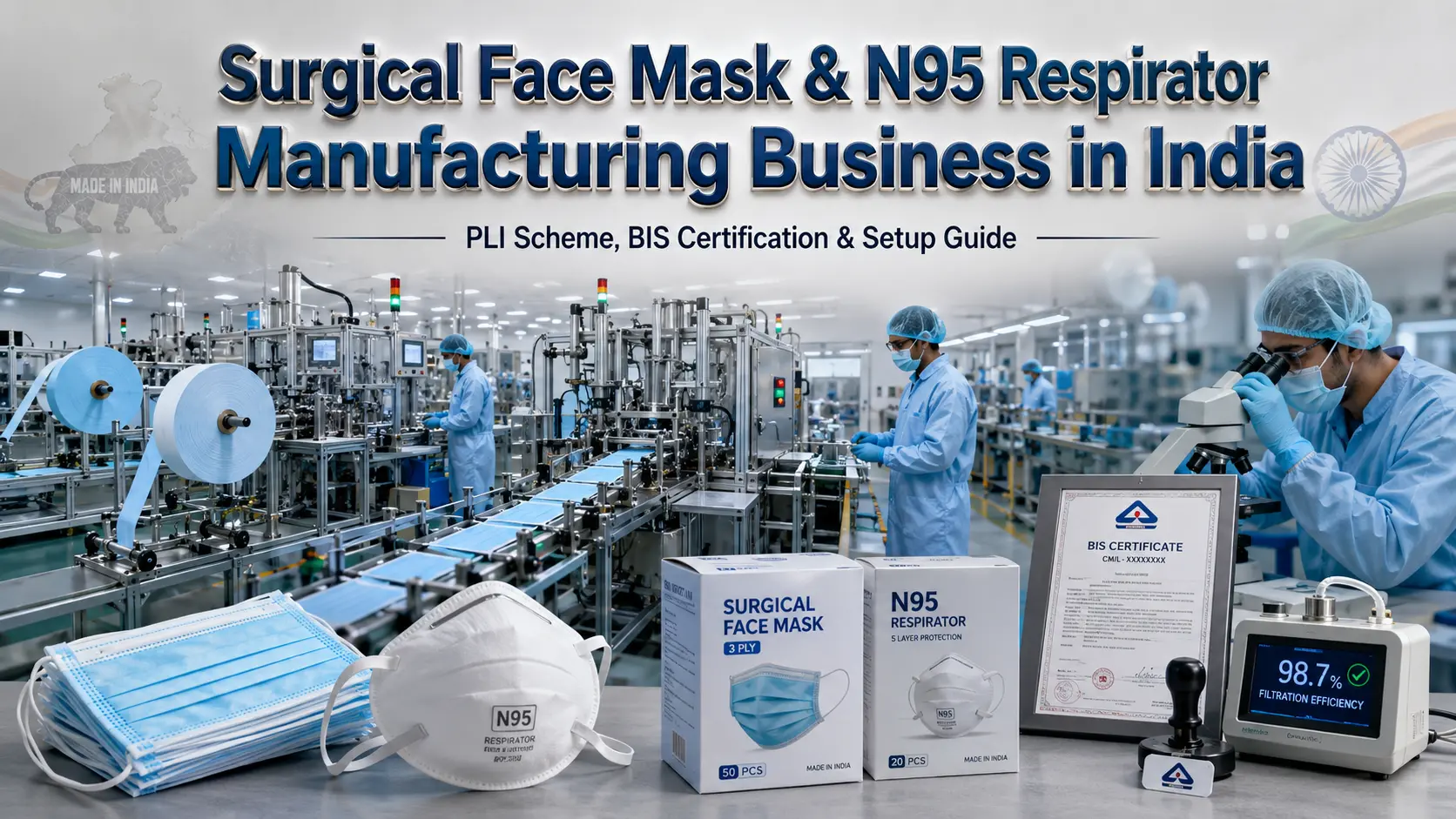

India’s COVID-19 response shifted the nation from being a 95 percent face mask importer to the world’s second largest face mask manufacturer in a span of just one year; and the structural need for protection with surgical and N95 masks is not abating, as hospital infection control protocols, OT standards and renewed healthcare awareness has created a permanent market in India with over Rs 2,000 crore worth of demand.
Market Opportunity: Why This Business Cannot Be Ignored
Prior to COVID, the manufacturing capacity for face-masks was negligible in India and the demand for 95 percent of masks came from China, Taiwan and South Korea. The Ministry of Textiles introduced the PLI Scheme for Medical Textiles with an outlay of ₹1,480 crore specifically to tackle this vulnerability, and the scheme includes product categories such as face masks, PPE coveralls, and surgical drapes. A policy-driven, time-bound incentive can make the current market entry very appealing for manufacturers able to enjoy the PLI benefits.
The market has now stabilised, and demand is expected to settle at 3–5 times the 2019 level, benefiting a large number of domestic manufacturers. In India, there is quality differentiation in the form of BIS certification for medical use, with IS:16289 (3-ply surgical mask) and IS:9473 (N95 respirator) premium pricing for the truly serious manufacturers over commodity manufacturers that are unable to meet BIS testing criteria.
Get Detailed Project Report (DPR): Production of Disposable Surgical and Medical Face Mask
Industry Analysis: Growth Drivers and Demand Outlook
Industry reports estimate that India’s domestic surgical and N95 face mask market is currently worth Rs 2,000–2,500 crore, and analysts expect it to grow at a CAGR of 10–12 percent. The Health Committee annual survey by FICCI has found that the NABH infection control protocol standardisation and OT compliance requirements are the leading institutional drivers for sustained mask demand growth for India’s growing network of accredited hospitals. In the face mask use in healthcare settings (WHO advisory), global protocols are established for the use of surgical masks and N95 respirators in clinical settings and continue to influence hospital systems around the world in their procurement criteria and quality standards.
Export markets in the Middle East, Africa, Southeast Asia, and Europe provide additional sources for revenue diversification. FIEO (Federation of Indian Export Organisations) assists Indian mask manufacturers in connecting with buyers in hospital supply trade fairs and Arab Health (Dubai) trade fairs in Africa. Usually, the margin in the export market is 20-30 percent higher than the domestic tender market, and manufacturers certified as EN 14683 or EN 149 will be able to enter the EU hospital procurement market directly. Indian manufacturers of face masks that are certified by the Bureau of Indian Standards (BIS) can reach out to procurement buyers from hospitals across Gulf and Africa countries via Pharmexcil (Pharmaceuticals Export Promotion Council) which arranges trade delegations to Arab Health Dubai and Africa Health exhibitions.
India Face Mask Market Snapshot
| Segment | Market Detail | Notes |
| Surgical 3-Ply Mask Market | Rs 1,200 crore+ post-COVID baseline | Healthcare and institutional buyers |
| N95 or FFP2 Respirator Market | Rs 800 crore+ | Healthcare and industrial use |
| Market Growth (CAGR) | 10-12% per year | Institutionalised healthcare demand |
| BIS Standard (3-ply surgical mask) | IS:16289:2014 | Mandatory BIS certification |
| N95 Standard India | IS:9473 (Respiratory Protective Devices) | For N95 class respirators |
| PLI Scheme Status | Medical Textiles PLI (Rs 1,480 crore outlay) | Eligible product category |
| Key Export Markets | Middle East, Africa, EU, ASEAN | Strong global demand |
How to Start: Step-by-Step Guide for Entrepreneurs
Step 1: Product Selection: 3-Ply Mask or N95 Respirator
Three-ply surgical masks consist of outer layer of PP spunbonded, BFE99 filter layer and soft inner layer, which is a lower-investment process with ultrasonic welding.
Read the Complete Book Here: Handbook on Medical and Surgical Disposable Products
Step 2: BIS Certification and CDSCO Registration
BIS IS:16289 is an Indian Standard issued by the Bureau of Indian Standards (BIS) that certifies surgical face masks for use in the medical field. BIS IS:9473 is applicable to N95 masks. Apply for product certification to BIS and register your manufacturing unit under Medical Devices Rules 2017 with State Licensing Authority at the same time. Appropriate documentation both from BIS and CDSCO should be done prior to the start of commercial production.
Step 3: Machinery: Mask Machine and Nonwoven Line
There are three layers of nonwoven unwinding station, nose wire insertion unit, ultrasonic welding machine, die cutting unit, ear loop welding station and output packaging line. The fully automated mask-making machine can produce 80-120 masks per minute. The production of N95 mask necessitates a cup-forming machine and an electret charge processing machine for the melt blown fabric.
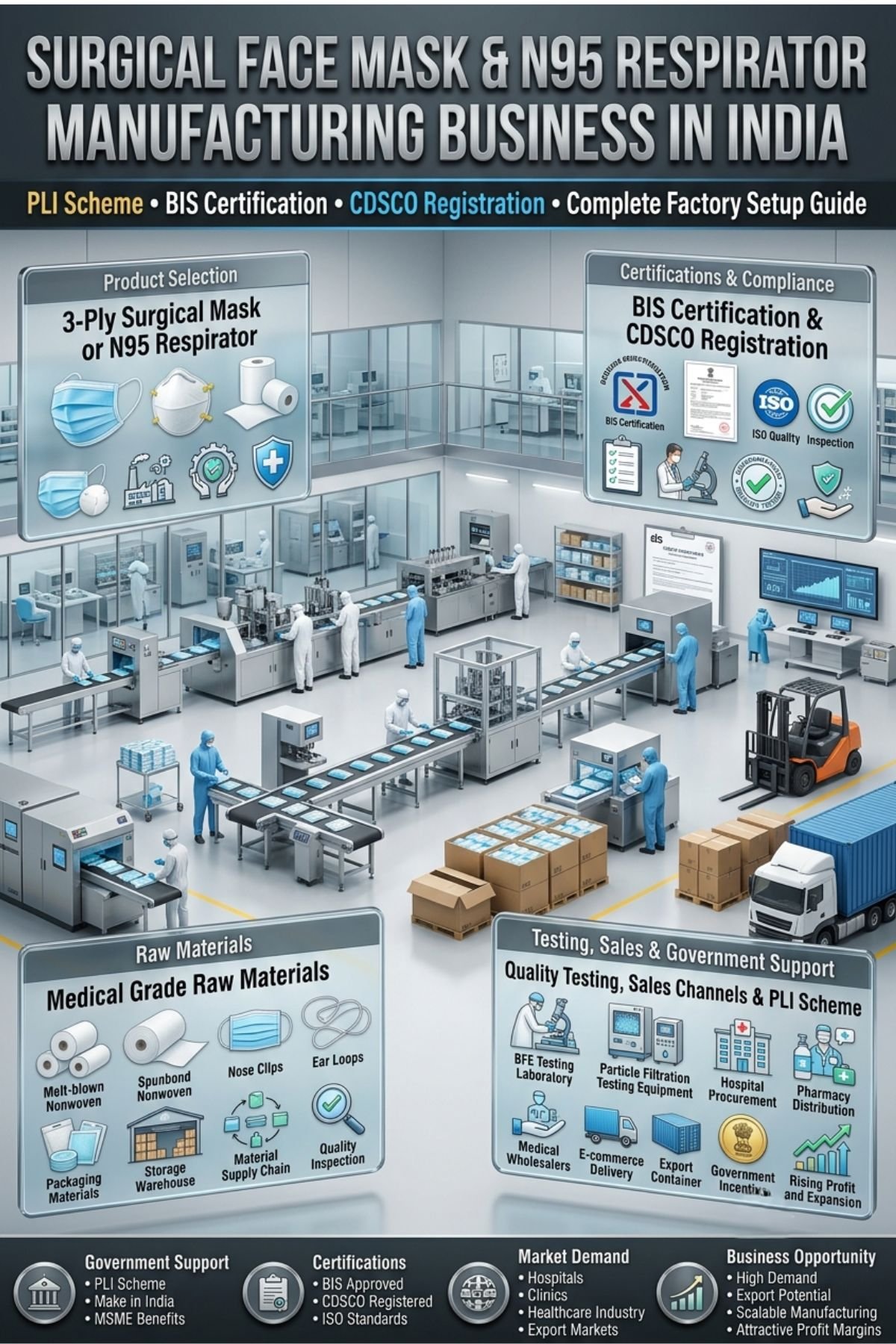
Step 4: Raw Material Sourcing: Melt blown Nonwoven
The critical raw materials used are melt blown nonwoven (BFE99 grade) as the filtration layer. Since the beginning of the COVID pandemic, India now has several domestic melt blown fabric manufacturers in Gujarat, Maharashtra and Rajasthan. Domestic supply of PP spunbonded fabric, nose wire, earloop elastic and individual packaging in polybag are available at competitive price.
Step 5: BFE Testing, Sales Channels, and PLI Application
Perform Bacterial Filtration Efficiency (BFE) (Minimum 95% for Type IIR surgical mask), Differential pressure, Splash resistance and Flammability test on all production batch as per IS:16289. Sign up on GeM for Government hospital procurement. If your unit is eligible, please apply for the benefit of PLI (Medical Textiles) from the Ministry of Textiles. To export, register on FIEO and learn about the buyer networks in the Gulf, Africa and Europe. The Ministry of Textiles provides eligibility criteria, investment levels, and production incentive lists through the PLI Medical Textiles scheme portal, and it updates the portal regularly with approved product category lists and application deadlines for face mask manufacturers. Get an Import Export Code and apply for RoDTEP benefits on the DGFT export promotion and RoDTEP portal before making your export shipments to hospital and pharmacy buyers in the Gulf, African countries and Europe for BIS certified masks.
Investment Breakdown for Surgical 3-Ply Mask Unit
| Cost Item | Estimated Amount (INR) | Notes |
| Automatic 3-ply mask machine (80-120 pcs/min) | Rs 15 – 30 lakhs | Core production equipment |
| Earloop welding machine (if separate) | Rs 3 – 6 lakhs | Or integrated in main machine |
| Industrial production space (2,000 sq ft) | Rs 5 – 10 lakhs per year | Lease in industrial estate |
| Raw material stock (1 month) | Rs 8 – 15 lakhs | Meltblown BFE99, spunbond, earloop |
| BIS IS:16289 certification and lab testing | Rs 3 – 5 lakhs | Mandatory product certification |
| Packaging and labelling equipment | Rs 3 – 5 lakhs | Poly packing and box packing |
| QC lab (BFE test kit, pressure gauge) | Rs 2 – 4 lakhs | In-house batch testing setup |
| Working capital (3 months) | Rs 8 – 15 lakhs | Salaries and utilities |
| TOTAL PROJECT COST (3-ply) | Rs 47 – 90 lakhs | Add Rs 1-3Cr for N95 line |
Turn your budget into a successful business plan
Financial Projections and Profitability
The total annual revenue of a 3ply surgical mask unit, operating 2 shifts with one automatic machine (capacity 120,000 masks per day) is Rs 2.5-4 crore, based on institutional pricing. Medical textiles have a net margin of 15-22 per cent after raw material, power, labour costs and pay back period of 1.5-2.5 years, which is one of the lowest in the medical disposables segment, according to the report of the Confederation of Indian Industry (CII).
Manufacturers produce N95 respirators to earn higher per-unit revenue of Rs 25–80 per mask, depending on certification and export channels, and to gain export premium benefits. India’s healthcare sector export market has been expanding at 15+ percent rate, year-on-year, according to IBEF’s report on the sector, and face masks and PPE are the fastest growing export segment since 2020. The IBEF Healthcare Sector Report shows that the medical textile export market is expanding at 15+ percent per year in India and face masks and PPE are the fastest-growing export segment since 2020.
Government Schemes and Incentives for Medical Manufacturers
| Government Scheme | Key Benefit | Eligibility |
| PLI – Medical Textiles | Production-linked incentive for masks, PPE, and medical nonwoven | Eligible medical textile manufacturers |
| PMEGP (KVIC) | 25-35% capital subsidy for micro and small units | New manufacturing units |
| CGTMSE (SIDBI) | Collateral-free MSME loan up to Rs 5 crore | MSME manufacturers |
| TUFS (Technology Upgradation Fund) | Interest subsidy on textile machinery investment | Textile and nonwoven manufacturers |
| State MSME Capital Subsidy | 15-25% subsidy on plant and machinery | State-notified MSMEs |
| RoDTEP Scheme | Duty refund on export of eligible goods | Registered exporters |
Entrepreneur Spotlight
Kiran Mehta | Surat, Gujarat
Kiran Mehta, a textile machinery family from Surat, converted excess PP nonwoven and converted heat sealing lines to make 3-ply surgical mask production in April 2020. In just 60 days he was making 2 lakhs masks per day and was providing GMSC (Gujarat Medical Services Corporation) during the peak of the pandemic for emergency procurement.
Kiran then invested Rs 65 lakh in dedicated automatic mask machines, got BIS IS:16289 certificate for the machines and now manufactures 1.5 million masks per month for government hospitals, corporate PPE kit assemblers and a Saudi Arabia pharmacy chain distributor. He earns Rs 3.2 crore per year and has good export orders.
Related Article: Start a Surgical Cotton Unit: Key Raw Materials You Must Source
How NPCS Supports Your Business Launch
Over the last 45 years, NIIR Project Consultancy Services (NPCS) have developed more than 8,000 Detailed Project Reports (DPRs) in various industrial segments including medical devices, hospital disposables. NPCS DPR constitutes Plant Layout, Machinery Specification with Contacts of Suppliers, Raw Material Sourcing, CDSCO Plant Licensing Pathway, Bank Ready Investment Analysis and Financial Projections for Surgical Face mask and N95 Respirators manufacturing.
All entrepreneurs who commission a NPCS DPR will get instructions on government schemes, export registration and quality certification roadmap as per the scale and state. For more information on projects in this sector, check out project reports at niir.org and entrepreneur India magazine for sector case studies and investment analysis at entrepreneurindia.co.
Key Reference Links and Further Reading
Bureau of Indian Standards – IS:16289 and IS:9473: https://www.bis.gov.in
FIEO – Federation of Indian Export Organisations: https://www.fieo.org
CII – Confederation of Indian Industry: https://www.cii.in
IBEF – India Brand Equity Foundation: https://www.ibef.org
Frequently Asked Questions
Q: Surgical Face Mask manufacturing in India needs BIS certification.
Surgical 3 ply face mask should be BIS certified according to IS: 16289:2014. That requires testing of bacterial filtration efficiency (BFE at least 95% for Type IIR), differential pressure, splash resistance and flammability. N95 respirators have to be certified by BIS as per IS:9473. India does not allow the sale of masks for medical use or their procurement by government hospitals unless they have BIS certification.
Q: What is Meltblown Nonwoven & Where to get it in India?
A: Meltblown nonwoven (MBF) is a microfiber PP fabric used for the core of surgical masks and N95 mask filters. BFE99 grade is required for IS:16289 compliance. There are a number of domestic manufacturers also including Berry India, AVGOL India, Fibertex India and some of the nonwoven manufacturers from Surat who have invested in the meltblown capacity during Covid. You can also import it from Taiwan and China.
Q: One automatic machine can make 10,000 masks a day.
A standard automatic 3ply surgical mask machine can create 80-120 masks per minute, which is equivalent to 50,000-75,000 masks per 8-hour shift or 1.5-2.25 million marks per month per machine. The government can participate in government tender and fulfil export orders without committing much capital with a combination of two machines.
Q: How many masks can one automatic machine produce per day?
The PLI scheme for Medical Textiles announced by the ministry of textiles has an outlay of Rs 1,480 crore and includes the technical textiles like face mask, PPE coveralls and surgical drapes. Qualifying manufacturers receive financial incentives based on their incremental sales over a base amount. For the latest eligibility details and application process please visit texmin.nic.in.
Q: The primary export markets of Indian face masks are Europe and America.
Q: Are you able to manufacture both 3-ply masks and N95 respirators in the same plant?
A: Yes. Many Indian manufacturers produce in the same plant but have different production lines. The meltblown nonwoven raw material is common to both products. The production of both segments enables revenue diversification, economical raw material procurement and higher utilization of factory capacity based on common infrastructure.
Conclusion
Surgical face mask and N95 respirator manufacturing is one of the most approachable entry points for the medical device manufacturing sector in India as PLI incentives and export demand in 80+ countries and BIS certification are the main quality credentials. The Ministry of Textiles’ PLI Scheme for Medical Textiles is still in force, and the production-linked financial incentives make investment in manufacturing even more appealing for qualified manufacturers that are new to the market today.
Get a Detailed Project Report (DPR) from NPCS. It helps you plan your machinery layout, BIS IS:16289 and IS:9473 certification timelines, raw material sourcing strategy, and PLI application eligibility. Make sure your product meets BIS requirements for bacterial filtration efficiency and safety before investing in mask-making equipment.