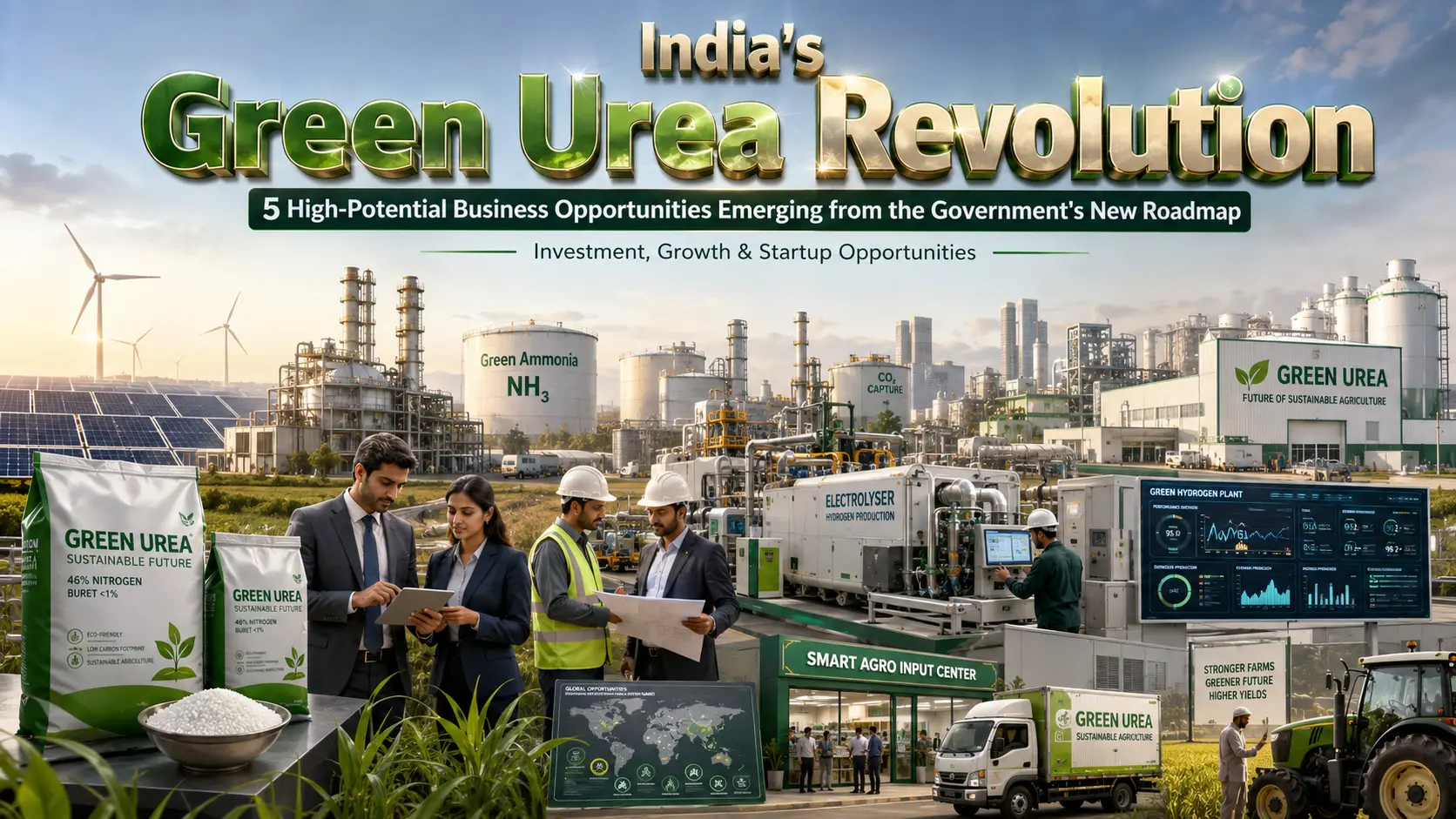

India Green Urea Revolution in India
A Policy Moment That Could Reshape Indian Agriculture Forever
It was an important event in the Indian fertiliser industry last week — and it is one you have to watch if you are an entrepreneur, MSME owner or a founder of a startup. The Indian government has officially announced a detailed plan to boost Green Urea production in the country, as reported by the Economic Times (ET) recently. This is not a draft policy paper or a committee recommendation, but a formal Expression of Interest (EOI) issued by the Department of Fertilisers (DoF) for setting up the Green Urea plants across the country.
The Solar Energy Corporation of India (SECI) under the National Green Hydrogen Mission (NGHM) is leading the way in a massive procurement push for 7.24 lakh metric tonnes (MT) of Green Ammonia annually at its centre. The Ministry of New and Renewable Energy (MNRE) has pledged a financial outlay of Rs 19,744 crore to speed up the development of green energy infrastructure in the country in support of this push.
India imports about 1 crore MT of urea per year, and the majority of domestic fertiliser plants are over 30 years old. The government has pledged to end its dependence on imports of green urea, aiming to shift focus to local production to deliver India’s goal of becoming a Net Zero by 2070, through its Green Urea roadmap. With clean energy, agriculture-tech, and industrial chemicals the CPCs, this is a rare alignment between founders and the market, and more importantly policy makers – and business doors are now open.
Get Detailed Insights from This Book: Fertilizers Manufacturing Handbook
What Recent Economic Times Reporting Means for Entrepreneurs
This is not just a routine policy update – it is one that has been picked up by the Economic Times. A high-level pre-EOI meeting was hosted at the headquarters of Projects and Development India Limited (PDIL), Noida, in the presence of a who’s who of the energy and fertiliser sector in the country including NTPC, SECI, leading fertiliser firms, electrolyser manufacturers, and Green Hydrogen technology suppliers.
This development translates to what happens on the ground:
- The government has taken the initiative from intention to action – they have issued an actual EOI, seeking to have private and public sector bodies set up Green Urea plants.
- The differential subsidy mechanism will help the manufacturer of fertilisers to survive from the higher cost of producing Green Ammonia and lower cost of producing conventional Grey Ammonia.
- The SECI will be the centralised buyer of the Green Ammonia and sell it to the fertiliser companies on market-linked rates of Grey Ammonia.
- Incentives are available from the producer side, and financial assistance is available to them for up to 10 years through long-term contracts, which will be offered to private investors.
- CO2 will be collected from thermal power, cement and steel plants and used as a sustainable raw material for urea production – finally establishing an industrial linkage chain.
Economic Times and government communication to an MSME or a startup is loud and clear: the eco-system is being created from the top down and those that take part in the supply chain today will have a huge first mover’s advantage.
Why This Industry Is Growing: The Market Forces at Play
India’s Urea Dependency Is a Strategic Vulnerability
India is the second largest consumer of Urea in the world after China. The country imports around 1 crore MT of rice per annum, thereby spending billions of dollars in foreign exchange and at the same time being vulnerable to global shocks in rice prices. All geopolitical events related to natural gas — one of the key raw materials fo0r conventional urea — have an immediate impact on the bills of the Indian government and the input costs of millions of farmers.(India Green Urea Revolution in India)
The Green Hydrogen Pivot Changes Everything
By using renewable energy in the electrolysis process, Green Hydrogen can be produced and utilized as a substitute for fossil fuels in the ammonia synthesis process. This produces Green Ammonia which is used as a raw material for Green Urea. India’s solar power generation capacity is already over 90 GW and growing at an unprecedented rate, enabling the production of Green Hydrogen at competitive prices in the near future. With the cost of renewables dropping year after year the economics of Green Ammonia continue to become more compelling every year.
A World-Scale Opportunity in Fertiliser Decarbonisation
Nearly 10 lakh MT of CO2 is needed per year for a single world scale urea plant of 12.7 lakh MT per annum. The roadmap by the government envisages capturing this CO2 in the thermal power, cement and steel industries which have plenty in India. This is an industrial symbiosis model that generates several “looping business opportunities” that are much broader than just developing a urea plant.
Identify high-growth industries before others do
Government Policies and Incentives: Your Toolkit as a Founder
The entrepreneurs interested in the Green Urea ecosystem should be aware of the following policy pillars in India. The Startup India Portal and DPIIT offer various advantages of registration and assistance with quick compliance for businesses entering this arena.
- National Green Hydrogen Mission (NGHM) — Mode 2A: Financial incentives for Green Ammonia producers with long-term agreements up to 10-years with total procurement target of 7.24 lakh MT/annum.
- The allocation of Rs 19,744 crore by the MNRE for the acceleration of the green energy infrastructure creates demand for equipment suppliers, engineering companies, and the EPC contractors.
- Differential Subsidy Mechanism: The Department of Fertilisers will pay the price premium of Green Ammonia over Grey Ammonia to the fertiliser companies which will remove the largest commercial hurdle.
- SECI as Central Off-Taker: SECI also guarantees the demand through competitive e-Reverse Auction which minimizes market risk for Green Ammonia project developers.
- Components of the Green Urea plant like electrolysers, heat exchanger, carbon capture equipment are priority items in Make in India programme for clean tech.
- Credit guarantee scheme and technology upgrading support for MSMEs joining clean manufacturing is available through MSME support provided by MSME by SIDBI and NSIC.
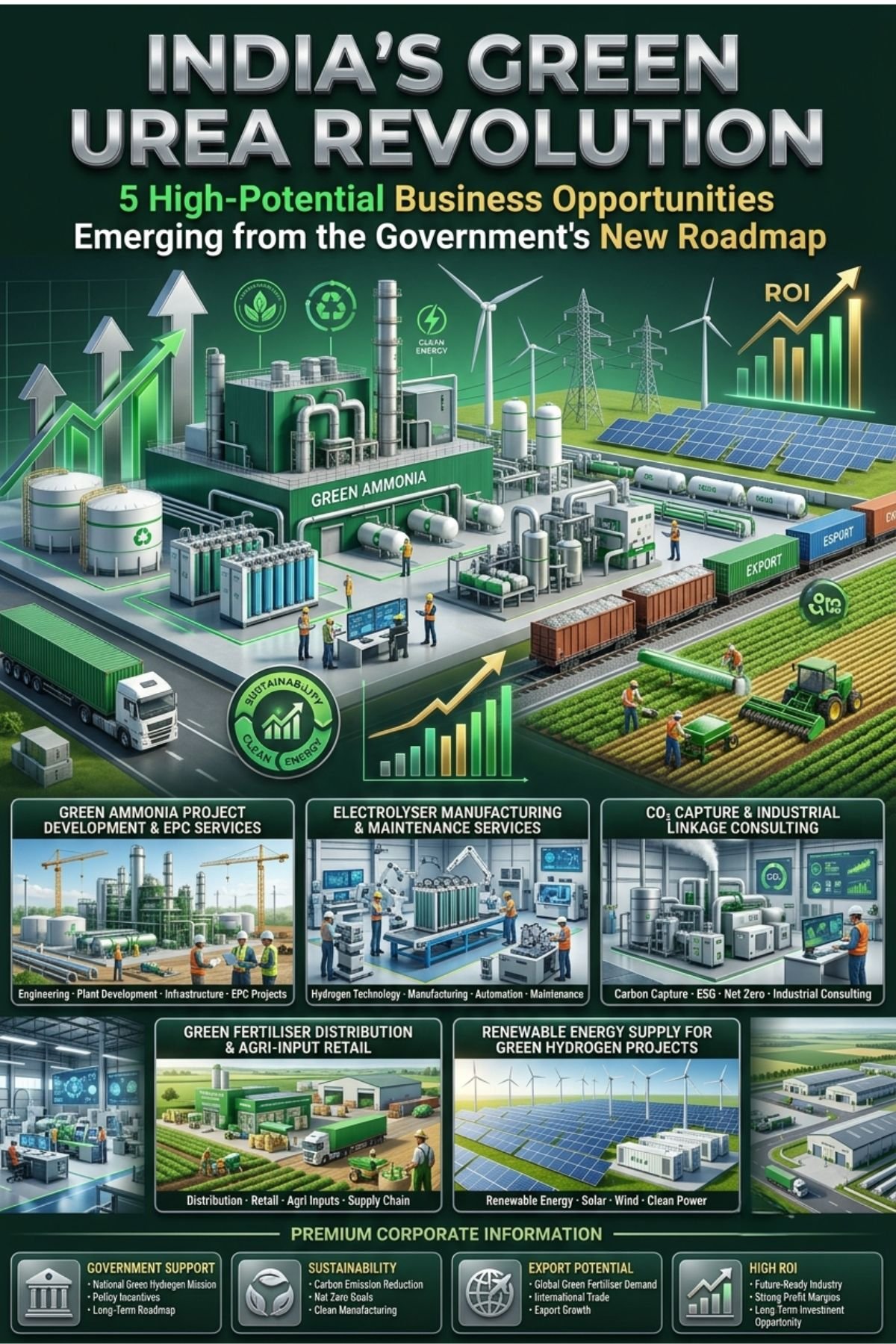
5 Business Opportunities Emerging from India’s Green Urea Roadmap
1. Green Ammonia Project Development and EPC Services
The government’s procurement target of 7.24 lakh MT/annum of Green Ammonia generates direct requirement for project developers who can bring in the solar/wind power, electrolyser systems and ammonia synthesis unit. Engineering skills-based startups can provide EPC (Engineering, Procurement & Construction) services for the fertiliser companies & PSUs installing Green Urea plants. This model is well suited for businesses that are able to form consortiums of technology providers, land buyers, and renewable energy providers.
Related Article: Green Ammonia & Methanol from Odisha’s Coastal Ports: The Industrial Chemical That Could Power India’s Decarbonisation
2. Electrolyser Manufacturing and Maintenance Services
Without electrolysers, hydrogen production is not possible at all. The production of Green Hydrogen is 100% reliant on electrolysers. Currently, most of the electrolyser equipment is being imported into India. The government’s commitment to large-scale production of Green Ammonia generates a significant domestic demand signal for indigenous production of electrolysers. MSMEs with fabrication, precision engineering, or electronics manufacturing capabilities should seriously consider this segment. For smaller systems, maintenance, repair, and operation (MRO) services for electrolyser stacks offer a recurring, low-capital-intensive revenue model.(India Green Urea Revolution in India)
3. CO2 Capture and Industrial Linkage Consulting
CO2 is used as synthesis input in the production of Green Urea. The annual requirement of CO2 for a world scale plant is around 10 lakh MT per year. This is an ideal opportunity for companies that provide services in integrating carbon capture technology. It also applies to those involved in industrial waste gas processing and consulting for CO₂ pipeline design. Ventures can act as a link between CO2 emitters (Power Plants, Cement Factories, Steel Mills) and Green Urea producers. High value-add, low capital model of advisory services.
4. Green Fertiliser Distribution and Agri-Input Retail
<p>As Green Urea production expands, stakeholders must establish an efficient distribution system to ensure that farmers receive the benefits of Green Urea and that last-mile delivery is guaranteed. Agritech startups and rural MSMEs can establish specialised distribution franchises for Green Urea. Adding soil testing, precision application advice, and digital crop management creates a unique agri-input business model that government purchasing programs will support.
View Full Project Details: Fertilizers, Fertilisers, Inorganic Fertilizers & NPK Projects
5. Renewable Energy Supply for Green Hydrogen Projects
All Green Ammonia projects need to be backed by a captive or contracted renewable energy source. Even Independent Power Producers (IPPs), renewable energy developers, and rooftop solar companies with aggregation capability can strengthen their role. They can become preferred renewable energy suppliers for upcoming Green Urea plants. The NGHM model supports renewable energy development and helps energy startups in wind and solar states through long-term PPAs.(India Green Urea Revolution in India)
Import-Export Opportunity Analysis
Founders should take into account both the import substitution potential and the export potential of India’s Green Urea roadmap. Chemical fertilisers and green energy equipment are provided export licence and trade facilitation by the Directorate General of Foreign Trade (DGFT).
Short-Term: Import Substitution in Electrolyser Components
Medium-Term: Green Ammonia Export to Japan and South Korea
Both Japan and South Korea announced Green Ammonia as one of the future clean fuels for energy transition. Both countries are keen on establishing a long-term supply agreement with low-cost Green Ammonia producers. With its abundant solar resources and strong government support through the NGHM, India is well-positioned to become a leading exporter of green ammonia. From 2027 to 2032, startups that bundle production capacity and secure long-term supply agreements with Japanese and Korean utilities will sign offtake contracts. They will also participate in a multi-billion-dollar export market.(India Green Urea Revolution in India)
Long-Term: Green Urea Export to Emerging Agriculture Markets
Certified low-carbon fertilisers are becoming a more and more sought-after product in agricultural markets in Southeast Asia and Africa. Indian Green Urea production will grow and its cost will decrease, leading to the opportunity for exports to Vietnam, Bangladesh, Nigeria and Kenya. Entrepreneurs who invest today in export-oriented production lines will be best positioned to meet this demand. This advantage is even stronger for those with carbon certification and traceability systems.
Indian MSME Success Stories in Clean Energy and Green Chemistry
Greenko Group: From MSME Roots to Green Hydrogen Pioneer
Hyderabad-based Greenko Group started as a small hydropower developer and has scaled into one of India’s largest renewable energy companies. It’s clear that Greenko’s strategy of investing in Green Hydrogen, with its integrated renewable energy facilities, is an example of how a focused clean energy investment can help an MSME become a national-scale enterprise. They serve as proof that the early green energy infrastructure players enjoy compounded competitive advantages.(India Green Urea Revolution in India)
Cochin Shipyard to Fertiliser Linkages: Public-Private MSME Models
In Gujarat, Rajasthan, and Tamil Nadu a number of MSMEs provide fabricated components to the existing fertiliser plants. With a few minor modifications, these clusters can also provide stainless steel pressure vessels, heat exchangers, instrumentation panels, and piping systems for new Green Urea facilities as the projects expand. Some MSME associations (CII/FICCI) are already doing mapping of these linkage opportunities.
Agri-Input Startups Bridging Farmers and Green Fertilisers
How Niir Project Consultancy Services (NPCS) Can Help You Enter This Sector
The Green Urea and Green Hydrogen sector is highly complex and capital-intensive. Entering this industry requires detailed feasibility studies, project cost estimation, regulatory compliance, and a clear market entry strategy. At this stage, Niir Project Consultancy Services (NPCS) can prove extremely useful for entrepreneurs and MSMEs.
NPCS provides full coverage for the value chain of green urea and clean fertiliser, such as:
- Detailed Project Report of Green Ammonia and Green Urea plants including capital expenditure, operating costs and ROI calculation
- Conduct feasibility studies for CO2 capture integration and utilization of industrial waste gas.
- An overview of the technology and the selection of electrolyser — Alkaline versus PEM versus Solid Oxide systems
- Identification and assisted application of Government schemes like NGHM, PLI and MSME Udyam schemes
- Market intelligence reports on global Green Ammonia trade flows and domestic demand outlook
- Know-how sharing and consultation in export of the above-mentioned products
<p>For any founder or MSME serious about the Green Urea opportunity, it’s always better to get expert Consultancy at pre-investment stage to mitigate the risk of execution and shorten project timelines. NPCS has been assisting hundreds of Indian MSMEs and startups to understand intricate industrial verticals and Green Urea is one of the most policy-oriented opportunities in this decade.(India Green Urea Revolution in India)
Data Table: India’s Green Urea Ecosystem at a Glance
<thead>
| Parameter | Current Status / Target | Business Implication |
| Annual Urea Import | ~1 crore MT | Massive import substitution opportunity |
| Green Ammonia Procurement Target (NGHM) | 7.24 lakh MT/annum | Guaranteed demand for Green Ammonia producers |
| MNRE Financial Support | Rs 19,744 crore | Infrastructure capex subsidy for green energy developers |
| Producer Incentive Duration | Up to 10 years (long-term agreements) | Investment certainty for project developers |
| CO2 Requirement (World-Scale Plant) | ~10 lakh MT/annum per plant | Carbon capture and CO2 supply business opportunity |
| Key Procurement Agency | Solar Energy Corporation of India (SECI) | Single off-taker reduces market risk |
| Net Zero Target Year | 2070 | Long-term policy tailwind for green fertiliser sector |
| Age of Existing Urea Plants | Many 30+ years old | Replacement capacity needed — new plant opportunity |
| Global Green Ammonia Export Markets | Japan, South Korea, EU | Export revenue stream from 2027 onwards |
FAQ: Founder Questions on the Green Urea Business Opportunity
Q1. What is the difference between Green Urea and conventional urea?
<p>Traditional urea production uses grey ammonia, which manufacturers produce using grey hydrogen derived from natural gas through the Haber–Bosch process, generating large amounts of CO₂. In green urea production, manufacturers use green ammonia produced from green hydrogen generated through renewable energy-powered electrolysis, significantly reducing the carbon footprint. However, the final urea has an identical chemical composition, allowing farmers to use it as a direct drop-in substitute.
Q2. What is the minimum investment required to enter this sector as an MSME?
The entry points are vast. They range from Rs 25 lakh – Rs 1 crore for capital-light initiatives, like CO2 capture consultation, electrolyser maintenance, repair and operations (MRO) services, and distribution of Green Urea. They may then range from Rs 3 crore – Rs 15 crore for mid-level electrolyser component manufacturing. And can extend to Rs 500 crore plus for large scale Green Ammonia project development, which will necessitate consortium finance through Development Finance Institutions (DFIs) or joint ventures with partners.
Q3. How does the government’s differential subsidy mechanism work in practice?
SECI procures Green Ammonia from producers through competitive e-Reverse Auctions at prevailing market rates. It then supplies Green Ammonia to fertiliser companies at conventional Grey Ammonia prices (based on Platts/Argus benchmark averages). The Department of Fertilisers compensates SECI for the price difference. This mechanism insulates both producers and consumers from the Green-Grey Ammonia cost gap, making the economics viable without requiring farmers or manufacturers to pay a premium.
Q4. Which states offer the best location advantage for Green Urea projects?
States with higher potential in renewable resources and a pre-existing fertilizer sector have a greater site advantage. Rajasthan and Gujarat (solar potential); Tamil Nadu and Andhra Pradesh (wind); Odisha and Jharkhand (closer proximity to steel and power plants which are potential CO2 sources); and Uttar Pradesh and Punjab (proximity to large consumer bases (farming) ). The government would prefer states with a conducive policy framework during the EOI process.
Q5. How can a startup apply for Green Urea-related government incentives?
Step1: Startup registration under Startup India for DIPP registration and taxation benefits. SECI facilitates Green Hydrogen and Green Ammonia project applications under NGHM Mode 2A incentives through competitive bidding. DFI financing required DPRs & technical feasibility. MSME entrepreneurs may also look into SIDBI’s Clean Energy products and MSME Sustainable Finance Scheme for working capital requirement.
Q6. What is the realistic timeline to see commercial Green Urea production in India?
Based on the current policy momentum, pilot-scale Green Urea production from inaugural plants is achievable by 2028-2029. Commercial-scale production contributing meaningfully to domestic supply is realistically a 2030-2033 development. However, the upstream supply chain — electrolysers, renewable energy, CO2 capture — will see commercial activity from 2026 itself, as project developers begin procurement and construction. Entrepreneurs entering the supply chain today will be well positioned for this opportunity.
Conclusion: The Window Is Open — Will You Step Through?
The Economic Times reporting on India’s Green Urea roadmap is not just a news item for the fertiliser industry. It is a starting gun for a multi-decade industrial transformation that will reshape how India feeds its 1.4 billion people and how it meets its climate commitments simultaneously. The government has done the hard part — creating the policy architecture, the financial incentive mechanism, and the institutional procurement framework.
What comes next depends entirely on the private sector’s speed of response. The 7.24 lakh MT Green Ammonia procurement target, the ₹19,744 crore MNRE commitment, and the SECI off-taker mechanism together create a rare combination. They ensure guaranteed demand, government financial support, and a clear market price mechanism. Founders who act now—by building electrolyser components, CO2 capture systems, agri-distribution networks, or renewable energy supply agreements—will help write the first chapter of India’s Green Urea story.(India Green Urea Revolution in India)
India’s agricultural future and its clean energy ambitions are converging in this single sector. The Economic Times market signal is clear. The government has done its part. The question now is: which entrepreneurs will seize this generational opportunity?
<p>For detailed project reports, feasibility analysis, and investment guidance for Green Urea and Green Hydrogen ventures, explore Make in India and Invest India for official sector-specific investment facilitation support.