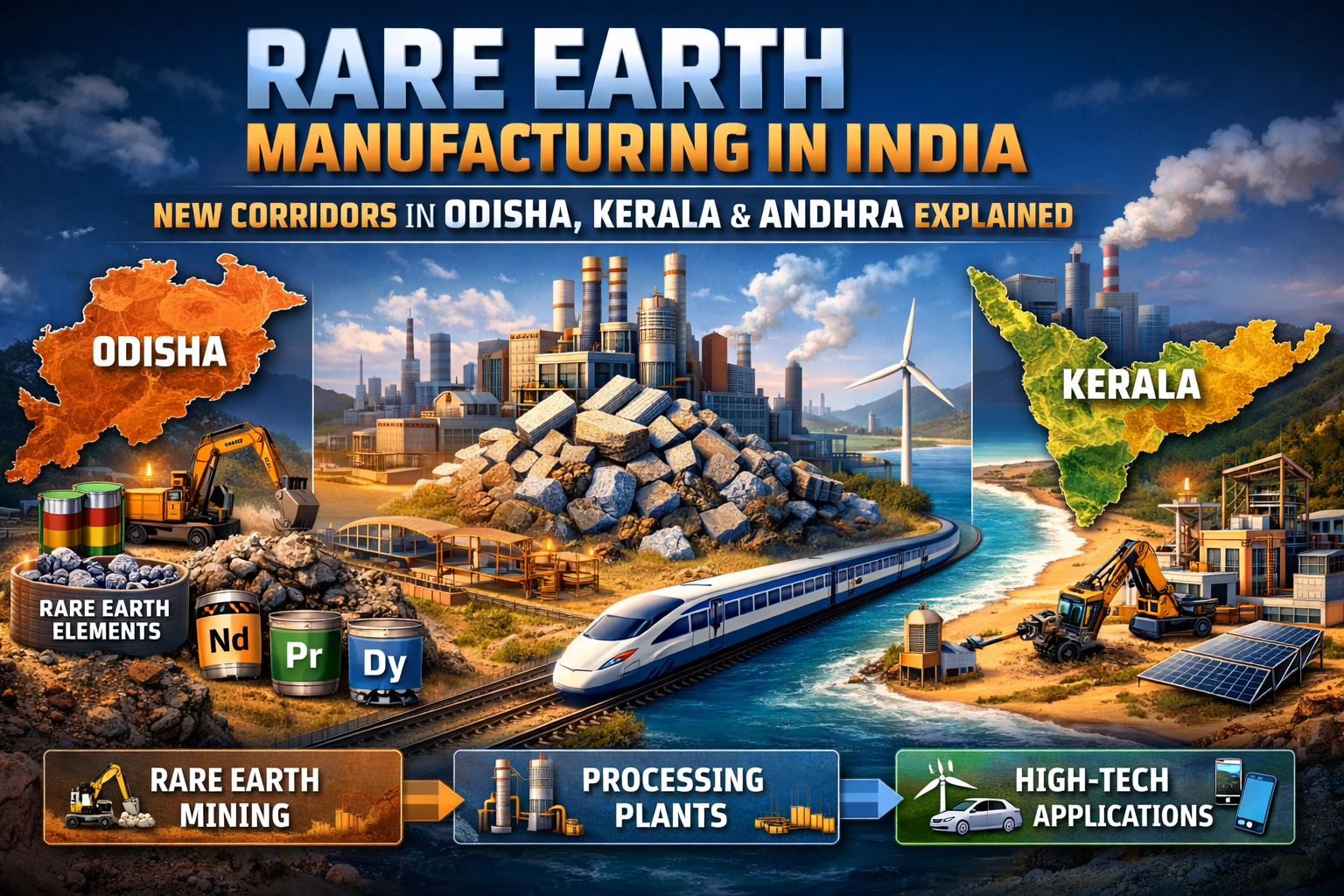

Rare Earth Manufacturing in India
There is a structural change underway in India’s manufacturing strategy. For decades, policy support has favoured most labour-intensive industries such as textiles, chemicals, auto components and pharmaceuticals. Recent announcements in the Union Budget, however, show a strong decimation towards capital-intensive, technology-centric manufacturing, especially in areas associated with critical minerals and advanced materials.
One of the most strategic results of this shift is the set up of Rare Earth Corridors in across mineral rich Coastal states of Odisha, Kerala and Andhra Pradesh. As ascertained through updates provided by the Press Information Bureau, these corridors are being designed as integrated industrial ecosystems of mining, mineral processing, research, and downstream manufacturing of Rare Earth Permanent Magnets (REPMs).
This initiative is a big signal that India is moving away from being a raw mineral exporter to being a value-added advanced materials manufacturing hub.
Read More: Our Books
Why Rare Earths Are Important to Modern Manufacturing
Rare earth elements are fundamentals for most high technology industries. Their importance is broad in electric mobility, renewable energy, defence, aerospace and electronics. India has significant reserves but still has to import finished products made from rare earth.
Important industrial applications include:
- Electric vehicle traction motors
- Wind turbine generators
- Semiconductor manufacturing equipment
- Defence Radar and missile systems
- Aerospace actuators (aerospace avionics)
India’s value addition from its rare earths reserves, though it holds more than 13 million tonnes of monazite reserves, remains limited; there has been a persistent gap in imports – mainly in the area of permanent magnets.
Rare Earth Corridors: Industrial Clusters
The Rare Earth Corridor framework is designed to overcome fragmented industrial development by developing geographically concentrated, end-to-end value chains. Instead of isolated mining or processing units, the corridors unite several stages of manufacturing in a single ecosystem.
Key elements of the corridor model are:
- Mining and mineral beneficiation
- Rare earth oxide separation plants
- Metal and alloy manufacturing units
- Permanent magnet fabrication facilities
- Layout of specific components and system integration units
Such clustering makes for greater cost efficiency, faster technology transfer and the sharing of infrastructure for utilities, logistics and environmental compliance.
Policy Support for REPM Manufacturing
To build domestic capacity, the Government has approved a dedicated scheme to build an estimated 6,000 metric tonnes per annum REPM manufacturing capacity. This policy framework is targeted toward import dependency reduction and global-scale competitiveness build up.
Key policy features include:
- Sales-linked incentives to domestic manufacturers
- Capital subsidies for advanced processing and cleanroom infrastructure
- Support for corridor-based integrated manufacturing facilities
This support greatly reduces the entry barriers for Indian entrepreneurs into a globally strategic industry.(Rare Earth Manufacturing in India)
Read More: Business Plans / Project Profiles
Business Opportunities Throughout the Value Chain
The Rare Earth Corridor initiative provides investment opportunities at various levels of the value chain where entrepreneurs can invest according to their capacity for investment in capital and for technical capability.
Upstream opportunities are cantered on chemical separation of rare earth oxides from monazite sands. These projects are amenable to MSMEs and can be incorporated in the chemical parks planned within the corridors.
Midstream Opportunities Production of magnet-grade alloys, especially NdFeB and SmCo alloys. A case study of a successful example of upstream-downstream integration is in Tata Advanced Materials Ltd. supported by the Tata Group based on the long-term industrial vision of Ratan Tata.
Downstream, there are opportunities in sintered permanent magnet production, which is the highest margin part of the rare earth ecosystem. Facilities usually include powder metallurgy, vacuum sintering, precision machining and surface treatment processes. Industry leaders like Anil Agarwal of the Vedanta Group have been emphasizing time and again on the strategic importance of graduating from raw mineral extraction to value-added manufacturing.
Component Manufacturing: Segments that are MSME Friendly
Beyond magnets, the corridor-based infrastructure allows MSMEs to get involved in downstream component manufacturing with shorter project timelines and export-focused demand.
Common component opportunities include:
- EV motor assemblies
- A magnetic sensors and encoders
- Industrial servo motors
- Automation Actuators: Precision
These segments provide relatively lower regulatory complexity as well as strong linkage with the global OEM supply chain.
Read More: Project Reports & Profiles

Demand Visibility and Trends in Profitability
Rare earth-based industries enjoy strong policy-basis of long-term demand visibility because of high demand for electric mobility, renewable energy, defence indigenization, and advanced manufacturing.
From a financial perspective, such projects will usually show:
- Long product life cycles
- Premium pricing power
- Export-linked revenue streams
- Entry barriers caused by technology
As a result, rare earth magnet manufacturing can provide higher levels of EBITDA margins compared to conventional metal fabrication businesses.(Rare Earth Manufacturing in India)
Lessons from the Industrial Leaders of India
Successful industrial expansion into advance materials has historically shown themselves to be a consistent pattern. Leaders like Ratan Tata and Anil Agarwal got into sectors with high import dependency during early phases of policy support and focussed on combining upstream resources with downstream manufacturing.
The Rare Earth Corridor initiative provides similar conditions today in the form of policy incentives, infrastructure development and comparatively low competition, which is a favourable environment for early movers.
Read More: Rare Earth Alloys for Industrial Startups
Importance of Detailed Feasibility Planning
Rare earth projects are capital and technology intensive and detailed feasibility planning is essential. Key areas of critical evaluation are:
- Chemical processing routes and technology selection
- Power, water and utility load requirements
- Environmental and regulatory compliance
- Cleanroom and precision manufacturing requirements
- Raw material logistics and export market access
Organizations such as Niir Project Consultancy Services support entrepreneurs by preparing Market Survey–cum–Detailed Project Reports (DPRs) that assess technical feasibility, market demand, and financial viability.
Read More: Why Rare-Earth Magnet Manufacturing Can Make India a Global Player
Conclusion: A Strategic Investment Window
The Rare Earth Corridor initiative underscores India’s recognition that future industrial competitiveness will be defined by control over advanced material supply chains rather than labour cost advantages alone.
For entrepreneurs aligned with long-term, policy-supported manufacturing opportunities, rare earth processing and permanent magnet manufacturing represent one of the most strategic investment avenues emerging today.
In advanced manufacturing, first-mover advantage often belongs to those who invest while infrastructure is still under development. Rare Earth Corridors may offer precisely that opportunity for India’s next generation of industrial founders.(Rare Earth Manufacturing in India)
FAQs
What is Rare earth corridors India?
Rare Earth Corridors are integrated industrial clusters that are dedicated to the mining, processing and manufacturing of rare earth based materials and components.
What states are within the corridor plan?
Odisha, Kerala and Andhra Pradesh are the main states because of their high reserves of rare earth on the coast.
Why rare earth magnets are important in EVs and wind energy?
They have high magnetic strength, efficiency, and small size, which is critical for the electric motor and generator of today.
Are MSMEs suitable participants in this sector?
Yes. Oxide separation, component manufacturing and assembly operations are especially suitable for MSMEs in corridor ecosystems.
Why is rare earth manufacturing the right time to invest?
Strong policy support, increasing domestic and global demand and limited competition are key elements that give strong incentive to first movers.