Tourism-based MSMEs in India is not the sight seeing – it is big springboard for the first generation of entrepreneurs. With a variety of landscapes, heritage sites and rural experiences, the country has a lot to offer in terms of micro-ventures that may require little capital investment but offer high returns. Unlike traditional hospitality which requires a massive investment in hotels and transportation, tourism-focused businesses can flourish based on community participation, local supply chain and scalable service models.
First generation founders can succeed if they look beyond traditional tourism offerings and investigate the entire range of tourism-supported opportunities. From Homestays to packaged food products, experience design to sustainable manufacturing, the tourism industry holds many routes to profitable entrepreneurship.
Read More: Our Books
Why Tourism is Business Multiplier in India
Tourism in India is booming:
- The country has 2.9 million international tourists every year, while domestic tourism brings in spending of Rs 55 – 60 billion.
- Rural tourism is also picking up: more than 570 homestays are registered in West Bengal alone.
- Initiatives of the Government of India such as PRASHAD, Swadesh Darshan and Swadesh 2.0 are aiding infrastructure support and funding opportunity for tourism adjacent MSMEs.
Entrepreneurs can create businesses with high-profit margins through these opportunities which require minimal initial costs and enable them to pursue business activities that generate continuous customer needs instead of offering single-time services.
Low-Investment Tourism Startups for First Generation Entrepreneurs
1. Homestay and Experience Circuits
- Eco-homestays: Kerala and Himachal Pradesh have demonstrated that small homestays can generate consistent income through repeat tourist visits.
- Weekend tourism packs: Customized short trips can be organized for domestic tourists that include accommodation, guided tours, and local experiences.
- Spiritual and heritage tours: There are packages targeting spiritual or heritage tourism with tours based on temples, forts, or cultural circuits etc. to cater to the niche tourist segments.
The main plan requires organizations to distribute products before they can start building their supply network. The organization needs to create its network of home stay accommodations, tour guides, and activity providers. Digital platforms enable organizations to handle their booking processes while customers can find services and experience their products.
2. Packaged Food Products
Tourist centres provide predictable demand for consumables. Entrepreneurs can manufacture locally made products such as:
- Fruit powders (Mango, Jamun, Kokum, Banana)
- Dehydrated ingredients and ready to cook mixes
- Eco-friendly packaged snacks
Advantages:
- Adding value to raw materials through processing and premium packaging – 5-8X
- Longer shelf-life (6 – 12 months with nitrogen-flush packaging)
- Export potential for international tourists or online markets
The business model of creators who produce tourist products enables them to use seasonal material resources which results in sustainable business growth.
Read More: Business Plans / Project Profiles
3. Sustainable Packaging
Eco-conscious tourism is increasing. Founders can capitalize on this trend by producing:
- Paper water bottles
- Biodegradable pouches
- Reusable cutlery and packaging
These products not only address the needs of local tourism businesses, but also meet an increasing global demand for sustainable solutions.
4. Fabrication MSMEs (Tourism Infrastructure)
Tourism growth in rural and hill areas creates predictable demand for the creation of fabricated products in B2B sectors, including:
- Solar mounting structures for eco-resorts
- Mast lighting poles and Crash barriers
- Resorts- cable trays and metal frameworks
Why it works:
- Contract driven orders reduce market uncertainty
- High volume orders improve margins and scale quickly
- Government and resorts projects ensure predictable revenue streams
Feasibility depends upon production capacity, power load, metalworking requirement, manpower and export potential.
Read More: Project Reports & Profiles
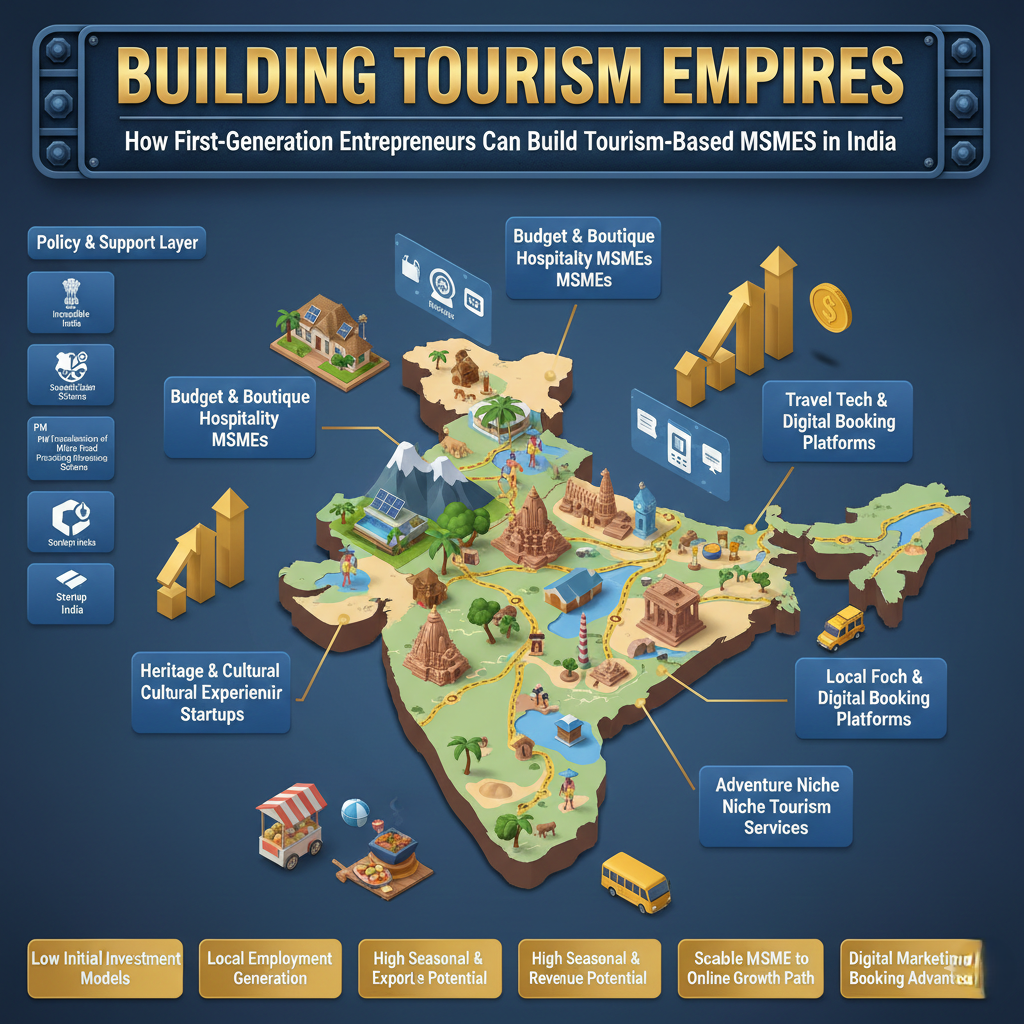
Economics of Tourism-Linked MSME
The principles followed by profitable tourism MSMEs are:
- Upward-sloping margins: A higher level of profit results from a higher level of production or service flow.
- Seasonality risk management: Identify periods of off-season demand and plan for demand smoothing.
- Verified supply chains: Make raw material continuity and supplier reliability
- Repeatable demand monetization: Focus on subscription, packaged products or recurring experiences.
The eco-friendly home-stay receives 20 to 30 visitors every month during its first operational period. The founders create a customer base which leads to increased business income through their special food items and outdoor adventure activities.
Feasibility and Support
DPR-mapped feasibility studies help first-generation entrepreneurs to evaluate:
- Manufacturing process design & product mix
- Raw material & power load estimation
- Risk and contingency planning – Seasonality risk
- Financial projection and machinery selection
Niir Project Consultancy Services (NPCS) provides organizations with comprehensive guidance to minimize their operational hazards while improving their financial credibility. With feasibility studies, it is possible for MSMEs to access loans, attract investors and scale in an efficient manner.
Read More: Rural Tourism Startups: 15 Scalable Business Ideas Backed by Government-Led Ecosystems
Promising Tourism Adjacent MSMEs Opportunities
Sector | Opportunity | Key Advantage |
Homestays & Experience | Weekend circuits, heritage tours | Recurring revenue, low asset intensity |
Packaged Food | Fruit powders, dehydrated mixes | Value addition, export potential |
Sustainable Packaging | Biodegradable bottles & pouches | Aligns with eco-tourism trend |
Fabrication | Solar mounts, lighting poles, cable trays | B2B contracts, scalable margins |
By having an eye for asset-light, repeatable business models, founders are able to scale their ventures without investing a lot in capital expenditure.
Read More: 10 New Manufacturing Business Opportunities in India for Startups and MSMEs
Conclusion
Tourism in India is not merely an experience sector, it is an entry point to sustainable and high margin micro ventures for first generation entrepreneurs. By leveraging:
- Experience aggregation
- Local manufacturing
- Linked to infrastructure
Scaling is an efficient way for founders to scale without heavy capital outlay. The combination of feasibility studies and supply chains with revenue models that can be duplicated enables tourism-based MSMEs to achieve financial success and business stability while preparing for export operations.
India’s tourism sector functions as a business multiplier which creates opportunities for innovative and sustainable entrepreneurial ventures. First-generation entrepreneurs who develop effective business strategies can transform their minor business concepts into successful ventures which will create significant social impact.
Frequently Asked Questions for Tourism based MSMEs
- Can the tourism link MSMEs get the loans from the banks?
Yes, when backed up by DPR mapped studies of margin behaviour, power load, product mix and B2B contract pricing logic.
- Should land be bought up before demonstrating demand for tourism?
No. Asset acquisition should only happen when the cost of leasing is higher than the ROI of ownership costs.
- Which tourism businesses grow the fastest?
Packaged food powders, sustainable packaging, experience circuits and B2B fabrication MSMEs tend to scale rapidly.
- What are the biggest risks?
Seasonality, moisture control, continuity of the supply, timing of working capital-but feasibility studies can overcome these.
- Can tourism ventures become export oriented?
Absolutely. Both products and experience intellectual property have the opportunity to enter the international markets.