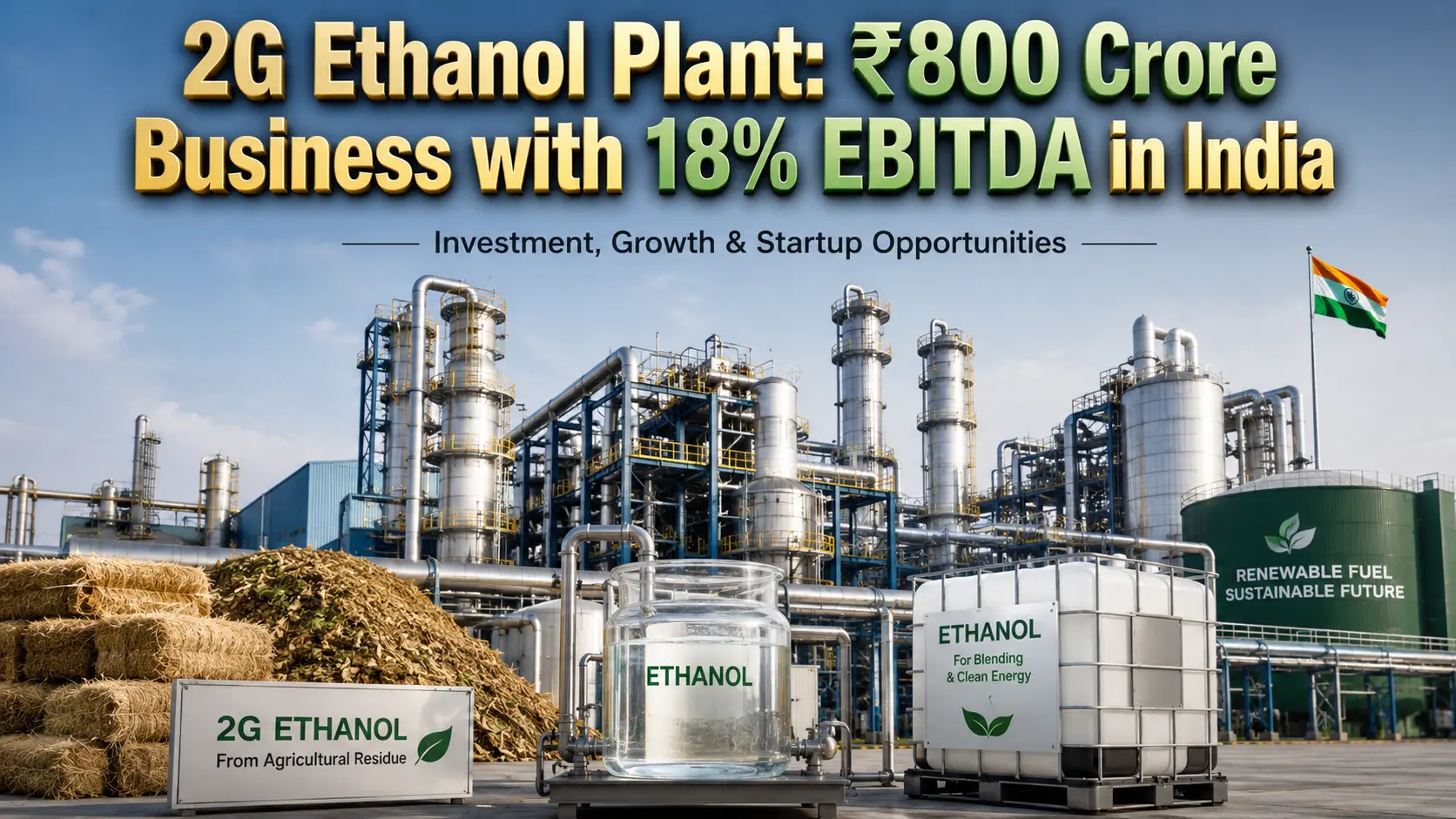

2G Ethanol Plant in India
Biofuels policy has become a reality in India. The 2G Ethanol production from agricultural wastes is in operation. Commercial reality—not pilot projects—is demonstrated by Bharat Petroleum Corporation Limited’s integrated facility at Bargarh, Hindustan Petroleum Corporation Limited’s paddy straw unit at Bathinda, and Numaligarh Refinery Limited’s bamboo biorefinery in Assam.
Farmers in India produce more than 500 million tonnes of crop residue every year. They burn most of it, which causes severe air pollution each winter. The 2G ethanol plant is an opportunity to monetize this waste and reduce the dependency of imports. Infrastructure is growing with the Ministry of Petroleum and Natural Gas setting a target of 20% ethanol blending and distillation capacity to go above 1,788 crore liters per annum. Where there is a source of feedstock and patient capital, policy support and market demand as well as environmental pressure converge for the industrial promoters.
Get Detailed Project Report (DPR): Ethanol Manufacturing as Bio-Fuel
Why 2G Ethanol Makes Industrial Sense Now
Ethanol is a traditional fuel produced from sugarcane juice, molasses, or grain. It can compete with food crops and is subject to fluctuations in sugar prices. The second-generation technology involves breaking down the lignocellulosic material in biomass such as rice straw, wheat stubble, bagasse, corn cobs, bamboo and others into fermentable sugars. There is plenty of feed stock, it is non-food, and it is often waste. In Punjab, 20 million tonnes of straw is produced every year. 15 million tonnes of rice residue is produced in Odisha. Assam has an excess amount of bamboo, but has no industrial demand for it.(2G Ethanol Plant in India)
In 2024, the government amended the Pradhan Mantri JI-VAN Yojana to include financial support for advanced biofuel projects using lignocellulosic feedstock. Total outlay: ₹1,969.50 crore until 2028-29. It now encompasses bolt-on plants, brownfield extensions, and technologies based on industrial waste, synthesis gas and algae. According to the Annual Report 2024-25 of Ministry of Petroleum and Natural Gas, Government of India, the oil marketing companies signed long-term offtake agreements with 232 bidders to create dedicated capacity of 1,106 crore liters per annum.
The three principles of economics are availability of in-house feedstocks (within 50 km radius), optimization of capital cost and monetization of co-products. A typical 100 KLPD 2G plant consumes 300–350 tonnes of dry biomass per day, amounting to about 1 lakh tonnes per year. An efficient collection infrastructure can supply this quantity from a 25–30 km catchment area. We estimate the capital cost for a standalone 100 KLPD unit to range between ₹800 crore and ₹1200 crore, depending on the technology provider, site readiness, and the extent of integration with existing units. When the 1G plant operates in parallel with 2G, integrated 2G+1G projects yield better project IRRs because the shared utilities result in lower per-unit capex.
Technology Routes and Process Economics
There are several possible technology pathways. Enzymatic hydrolysis dominates: steam explosion or dilute acid treatment pre-treats the biomass, and cellulase and hemicellulase enzymes then hydrolyse cellulose and hemicellulose into glucose and xylose. During fermentation, these sugars become ethanol, and we then distill and dry it to produce anhydrous ethanol (fuel grade). A third-generation technology that does not depend on biomass is gas fermentation, which IOCL is implementing at its Panipat unit. In this process, the refinery converts off-gases into ethanol, and IOCL integrates the technology with the petrochemical complex.
Process efficiency is the basis for margin structure. Enzyme costs represent the largest variable cost, accounting for 25–35% of total expenses. Strong technology partners such as Praj Industries, Chempolis, Beta Renewables and SEKAB have successfully lowered enzyme dosage via better pre-treatment and process integration. The valorization of co-products is a major issue. The plant becomes energy self-sufficient because it uses non-fermentable residue (lignin) as fuel in a boiler to generate steam and power, which it can export to the grid. The Bargarh unit of BPCL will produce 25 MW of green power, which will both offset the internal consumption and enable the export of 5 MW. Some plants produce high-value chemicals from hemicellulose streams such as furfural and acetic acid. The bamboo biorefinery of NRL aims for 50 TMTPA of ethanol, 18 TMTPA furfural and 11 TMTPA acetic acid.(2G Ethanol Plant in India)
Firstly, Cost and logistics of feedstock are important. Moreover, The cost of paddy straw at the farm gate is ₹2000 – ₹3000 per tonne and the other collection, baling, transportation, and storage costs are ₹1500 – ₹2500 per tonne. Furthermore, The plant must have feedstock available throughout the year, and workers must store it in a covered area for 4–5 months. Additionally, Fungal degradation requires moisture content to be less than 15%. However, New entrants in this sector do not understand the complexity of managing feedstock. Therefore, You’re not building a plant, you’re building an agricultural supply chain with farmer aggregators, baling contractors and logistics partners. Existing sugar mills with bagasse cogeneration experience, such as Shree Renuka Sugars and Godavari Biorefineries, have natural advantages in terms of existing farmer linkages, storage facility and know how on generation of steam.
Get Detailed Insights from This Book: Handbook on Maize (Corn) Processing and Manufacture of Maize Products

Project Opportunities: Where to Focus
Surplus grain states—Punjab, Haryana, and Western Uttar Pradesh—generate a huge amount of paddy straw. Existing distillery capex optimized by brownfield expansion. Shared fermentation and distillation, as well as effluent treatment, lower costs. Capacity: 50-100 KLPD (2G) + 50-100 KLPD (1G). Target: OMCs. Capex: ₹600-900 crore. EBITDA: 12-16% after stabilization.
Bamboo Biorefineries in Northeast: Assam, Tripura, and Mizoram have abundant bamboo. Higher lignin but stable supply. NRL’s Assam Bio-refinery validated conversion at pilot scale. Capacity: 30-50 KLPD plus furfural. Target: OMCs, chemicals. Capex: ₹400-600 crore. EBITDA: 14-18%.
Adding 2G capacity at sugar mills with bagasse. JI-VAN includes bolt-on projects, thereby accelerating the approval process. Capacity: 30-60 KLPD. Target: Captive use or OMC contracts. Capex: ₹250-400 crore. EBITDA: 15-20%.
CBG-to-Ethanol Hybrids: HPCL’s HP-RAMP process converts rice straw to CBG. Eluru biorefinery is a combination of 150 TPD rice straw for CBG and 3 KLPD 2G ethanol. CBG supplies to city gas distributors, and ethanol to OMCs. Capacity: CBG 5-10 TPD + ethanol 10-20 KLPD. Capex: ₹100-200 crore. Combined EBITDA: 18-22%.
Real-World Execution: Learning from Pioneers
Firstly, Praj Industries’ Pramod Chaudhari was the voice of the 2G ethanol technology partner in India. Moreover, Chaudhari has pursued the development of enzymes in-house. Furthermore, Integrated providers, that is, those who have control over production of enzymes, have pricing power. Similarly, Shree Renuka Sugars’ Narendra Murkumbi had the first 1G capacity, lay relationships with OMCs and then grew its to 2G. Additionally, Godavari Biorefineries’ Saraogi family has been monetizing co-products and sustaining margins exceeding 18% is industrial alcohol, specialty spirits, bio-chemicals.(2G Ethanol Plant in India)
2G ethanol is not only about distillation, but about a value chain for the agri-industry, where the successful promoters are. They spend on farmer education, chain digitization and co-product research and development. They are not on the hunt for the cheapest capex, but they’re on the hunt for operational stability.
Find high-return business ideas based on your budget & ROI
Import Substitution and Export Potential
Firstly, India nearly eliminated ethanol imports as it achieved 18.36% blending in March 2025. However, sustainable aviation fuel (SAF) provides opportunity. SAF is a regulatory push for airline adoption. In addition, 2G ethanol serves as a feedstock approved for alcohol-to-jet conversion. India’s first commercial SAF flight took off in May 2023. Additionally, National Policy on Biofuels has established the targets of SAF – 1% by 2027 and 2% by 2028 and 5% by 2030 for international flights. Consequently, 2G plants that land SAF agreements are able to sell the ethanol at the export price of ₹90-120 per litre – two times the domestic ethanol price of ₹57-65 per litre.
Novozymes and Genencor are enzymes that are imported to India. The domestic enzyme production is increasing. The IOCL Panipat R&D Centre demonstrates the production of enzymes. Operating costs reduced by 20-30% with indigenous enzyme capacity – changing the economics of the project.
Financing and Subsidy Framework
Firstly, Viability gap funding (VGF) support of up to 50% of the project cost with a maximum limit of ₹150 crore per project facility is provided by the JI-VAN Yojana for the 1st of a kind technology. Additionally, 15-25% of capital subsidies and stamp duty waivers and concessions on power tariff for 5 years are provided by State governments. Moreover, NABARD and REC gave ₹500-700 crore term loans to BPCL and HPCL at 8-9% interest.
The typical 2G ethanol project has a debt-to-equity ratio of 70/30. Stabilized plants with annual operating days of 300+ have equity returns of 14-18%. The feedstock chains mature in the initial years, with 60-70% utilization. They should model 3-year ramp-ups, rather than instant full-capacity.
Moreover, Consultancies such as NIIR Project Consultancy Services prepare market-oriented feasibility reports that include process flow diagrams, equipment specifications, raw material sourcing, and financial projections with profitability analysis. These analyses help validate feedstock availability, select the appropriate technology, and estimate break-even timelines before committing capital, especially when capital expenditure is high (hundreds of crores) and the payback period ranges from 7–10 years.
Related Article: Ethanol Blending and Beyond: A New Era of Manufacturing Opportunities in India (2026)
Risks Worth Acknowledging
Moreover, The risk of feedstock is existential. When farmers discover alternative uses—biochar, feed for cows, and composting—the supply of dry gets depleted. Long-term contracts are important but difficult to enforce. Technology risk persists. Additionally, Formula for enzymes that is optimized for one biomass may not perform as well in another biomass. Furthermore, Mechanical completion was achieved for BPCL’s Bargarh plant, indicating that pilot to commercial scale is no walk in the park. Additionally, Ethanol procurement price changes are considered regulatory risk. The price is determined and adjusted yearly. Therefore, Demand Risk is focused on blending Risks. Delaying the 20% blending from 2025-26 to 2027-28 slows down the demand growth.(2G Ethanol Plant in India)
Conclusion: Build for the Long Arc, Not the Quick Win
2G ethanol is not only years with a decade long ROI, but also commodity-like margins and complexity of operation. The macro case looks solid, though. India imports over $150 billion worth of crude oil each year. Blending one percent of ethanol substitutes for $2-3 billion in crude imports. The government is committed to 20% blending and the need for energy security is not going to change that. The benefits of agricultural waste valorization go beyond politics, as it helps mitigate pollution and boost farmer income.
Entrepreneurs have a clear framework. Have access to feedstock or agricultural supply chain knowledge? Are you able to take 2-3 years and accept sub-optimal returns and stabilize? Moreover, Are there technology partnerships with security of enzymes? Do you live in a geography where there is a surplus of feedstock and state incentives exist? If yes, 2G ethanol is among few sectors where policy tailwinds, market structure, and environmental logic converge.
First movers such as BPCL, HPCL and NRL are securing feedstock catchments and OMC offtake. Meanwhile, Independent promoters need to be proactive in securing land in biomass clusters, completing technology arrangements and submitting JI-VAN applications ahead of the scheme’s sunset date of 2028-29. Preparation is better than speed—delay is sure to be irrelevant. During the start of consolidation in 2028-2030, plant running 320 days a year at 90% capacity will determine plant structure and acquisition valuations.
2G ETHANOL PROJECT ECONOMICS COMPARISON
| Plant Type | Capacity (KLPD) | Capex (₹ Crore) | EBITDA Margin | Gestation (months) |
| Standalone 2G (Paddy Straw) | 100 | 800-1,200 | 12-16% | 36-48 |
| Integrated 2G+1G (Grain Base) | 50+50 | 600-900 | 14-18% | 30-42 |
| Bamboo Biorefinery | 30-50 | 400-600 | 14-18% | 36-48 |
| Bolt-On at Sugar Mill | 30-60 | 250-400 | 15-20% | 24-36 |
| Hybrid CBG + 2G Ethanol | 10-20 ethanol | 100-200 | 18-22% | 24-30 |
FREQUENTLY ASKED QUESTIONS
Q1: What is the min. investment requirement for a 2G ethanol plant in India?
A: The cost of a small scale 30 KLPD plant is around ₹250-400 crore and for 100 KLPD standalone plant, it is around ₹800-1200 crore. 2G+1G projects are optimised capex projects as it involves sharing some utilities. The cost of feedstock logistics infrastructure is 15-20% of base capex.
Q2: How long does it take to break even on a 2G ethanol investment?
Payback periods are in the range of 7-10 years – assuming a total of 280-300 operating days per year after design stabilization. Integrated plants with co-product revenue (power, furfural) break-even after 6-8 years. The first 2-3 years are used at a maximum capacity of 60-70%.
Q3: What type of Government Subsidy for 2G ethanol plants?
Viability gap funding is available under JI-VAN Yojana up to ₹150 crore per project at 50% of the project cost. There are also capital subsidies of 15-25% provided by state governments, stamp duty waivers and power tariff concessions. Priority sector lending allows for 70% debt financing at 8-9% interest rate.
Q4: What are the key challenges with the operation of 2G ethanol plants?
The primary challenge is managing the feedstock supply chain, because it requires securing farmers’ contracts, controlling moisture, and maintaining storage facilities to ensure a year-round supply within an economical transport radius. Cost optimization and process stabilization of enzyme takes 18-24 months. More complex effluent treatment than for 1G plants.
Q5: Do 2G ethanol plants have the option for export or just domestic sales?
The good stability is generated from long term offtake contract at domestic sale with OMCs. As for export it can have 2G ethanol can use for feedstock of alcohol to jet plant to createSAF, Export Price will range from 90-120/liter compared with domestic price ranging from 57-65 /liter.