Low Investment Business Ideas in Karnataka
Karnataka is at a unique crossroad. It is a state that can feed AND manufacture AND export AND innovate — all in one. Geographically, demographically and in policy, Karnataka is one of the few states in India to have the depth at this moment that entrepreneurs looking for business opportunities with limited capital and potential for a long-term bet are seeking. The state is indeed equipped for business in various sectors, from the café-lined lanes of Bengaluru to the loomed-up silk, and to the port-adjacent industrial clusters near Mangaluru.
This article is not a “one size fits all” list. A consultant-grade field analysis of 25 business ideas in Karnataka that are both economically viable and have first-tier government backing and have potential for scalability – for first-generation entrepreneurs and MSME investors who seek economic return with an investment ranging from ₹3 lakhs to ₹60 lakhs in seed capital.
This analysis is unique in that regard because of its context. In the world of startups, tech and SaaS are the leading buzzwords in Karnataka. Legitimate though this is, it fails to acknowledge a vast food processing, green energy, traditional manufacturing, agri-value chain and service-based business opportunity, where competition is light, margins are good, and government incentives are easy to come by. The 25 ideas listed here are not lists of templates, but ideas that came out of real project feasibility work, trade data and state-level market intelligence.
Why Karnataka Is a Preferred Destination for MSME Investment
The economic structure of Karnataka is true to the term “multi-sector”. The state has a significant share in India’s export basket from sericulture, coffee to aerospace and IT. It is geographically close to key port facilities, has high local demand centres and has a highly qualified but relatively affordable workforce.(Low Investment Business Ideas in Karnataka)
To the new business owner, they mean three practical benefits:
- Availability of competitive raw material prices in all the different areas of the value chain, including agri, mineral and forest-based areas
- A large and expanding addressable consumer base, from Tier-1 to Tier-3 towns.
- Well-developed logistics capabilities for both domestic and export markets
India’s MSME sector is a large contributor to the employment of millions of people and plays a significant role in the state’s GDP and exports in the state of Karnataka. The state’s industrial policy emphasizes on investments in sunrise industries with the help of the single window clearance and investment facilitation in the Karnataka Udyog Mitra portal. Moreover, more than 270 notified industrial areas are under the management of KIADB in the state which offer all the necessary infrastructure for setting up new manufacturing units.
Here it is straightforwardly about the profit motive. The low land/lease rates outside Bengaluru, large availability of Tier-2 and Tier-3 consumer demand, availability of agri raw materials in North Karnataka and Kodagu, and the strong government-backed incubator ecosystem in Dharwad, Hubballi, Belagavi and Tumkur, all make it easier for motivated entrepreneurs to make quicker and less expensive moves than in most other States in India. The barriers to market entry are not sky-high for investors to make a move today. That window shrinks when Tier-2 commercialization gets going.
Get Detailed Project Report (DPR): Karnataka Investment & Entrepreneurship Guide
Government Policies & Incentives Supporting New Businesses in Karnataka
Karnataka has one of the most structured policy frameworks for MSME and start-up investments in the country. Furthermore, national schemes add further financial support to the state level incentives, making it a strong package for the first time promoter.
Some important schemes to consider for entrepreneurs considering business ideas in Karnataka are:
- PM-FME Scheme: 35% capital subsidy on eligible plant and machinery for food micro-enterprises
- PMEGP (PM’s Employment Generation Programme): margin money subsidy for first generation entrepreneurs (15-35%)
- MUDRA Loans (Tarun & Shishu category): provide loans to small manufacturing and service units of ₹50,000 to ₹10 lakh
- CGTMSE (Credit Guarantee Trust Fund for MSMEs): Collateral Free Loan to Promoters with Lesser Fixed Assets — cgtmse.in
- Production-based incentives in food processing, textiles and auto components for achieving scale (PLI Schemes)
- Karnataka Industrial Policy: capital investment subsidies, power tariff concessions, and KIADB land allotment support — investkarnataka.co.in
Category B incentives provided by the Industrial Policy of the Government of Karnataka are especially generous for SC/ST entrepreneurs. Moreover, the Karnataka Startup Policy offers avenues for seed funding, access to mentorship, and market facilitation for registered startups, with the aim of creating an ecosystem conducive to the growth of early-stage businesses.(Low Investment Business Ideas in Karnataka)
25 Low Investment Business Ideas in Karnataka for Entrepreneurs
1. Organic & Natural Farming with Value Addition
The varied agro climatic conditions of Karnataka ranging from Malnad coffee belt to black soil tracts of Bidar provide an exciting ground for the organic farming initiatives. But the true possibilities lie in value-added products: cold-pressed oils, organic turmeric powder, herbal teas and dried fruit blends. When entrepreneurs establish post-harvest processing units and link them with contracted farming networks, they can create their own product lines which can be sold at high premiums to specialty retail and export markets.
2. Silk & Handloom Product Manufacturing
Mysuru grade silk is known all over the world, but the value chain of the raw fabric is not in full swing. The entrepreneurs who establish Handloom Garment Units, Saree Dyeing Units, or Silk Home-furnishing brand in Karnataka can benefit from the raw Silk supply advantage and can go for premium markets both domestic and export. This is especially possible for small-scale producers from Channapatna, Ramanagara or Mysuru clusters through the e-commerce channel.
3. Cloud Kitchen / Regional Cuisine Food Brand
Bengaluru’s food delivery market is one of the highest in India, however the true white space is in authentic regional cuisine, which are not available in large QSR chains such as Coorgi pork dishes, North Karnataka jowar-roti formats, Udupi-style vegetarian thalis, etc. A cloud kitchen with a regional identity can become profitable in 6-9 months with a ghost brand approach on Zomato and Swiggy. The investments required for mid-sized cloud kitchen with equipment are approximately ₹5–10 lakh.(Low Investment Business Ideas in Karnataka)
4. IT-Enabled Services & Micro-SaaS
Micro-SaaS products and localised IT services are an easy-to-access beginning for founders who are technically inclined, and they can be done by large IT firms, as well. Micro-SaaS products and localised IT services are a low barrier to entry for technically inclined founders, especially in Tier-2 cities, and can be by large ITs also. Payroll apps for small manufacturing, GST compliance apps for traders and inventory management applications for kiranas cater to genuine demand. Founders who create these using a hyper-local support model, instead of competing with national platforms, have got good traction and recurring earnings.
5. EV Component Fabrication
The EV transition in two-wheelers and three-wheelers has generated real demand for locally made components such as battery enclosures, wiring harnesses, aluminium structural parts and plastic molded components. Given the existing auto ancillary ecosystem around Tumkur and Peenya, Karnataka is well poised for the small-scale EV component units. PLI scheme for the Advanced Chemistry Cell segment and the automotive segment gives direct financial incentives to the qualifying manufacturers.
6. Incense Sticks (Agarbatti) Manufacturing
Bengaluru is the biggest city for manufacturing of agarbatti in India and contributing to a significant portion of the national export of this commodity. It is a highly scalable business with input access and labour friendly. Entrepreneurs can start semi-automatic Agarbatti units with an investment of ₹ 2-5 lakh and deal in Agarbatti-to-Agarbatti distributors or export houses. The premium variants (sandalwood, charcoal-free and aromatherapy) have margins of 3–4 times more than commodity agarbatti and are becoming popular in international markets.
7. Granite & Natural Stone Processing
One of the largest granites producing state in India is Karnataka, which is having the presence of granite deposit in Hassan, Chitradurga and Kolar district. The potential for MSME investors is not related to quarrying, but to processing — cutting, polishing, and finishing slabs for home use and export for construction. A granite processing unit with gang saws and polishing machines is a capital efficient introduction into a business of high demand and export oriented.
8. Coffee Processing & Branded Export
One of the best coffee growing belts in India is Coorg, Chikkamagaluru and Hassan. However, the bulk of the coffee produced there is traded as commodity green beans to exporters. For entrepreneurs looking to develop a small batch roasting, grinding and branding facility and sell specialty coffees, in India’s metros and in export markets across Europe and Japan, margins of 40-60 per cent on the branded product compared to commodity can be achieved. The investment for micro-roastery is less than ₹10 lakh.
9. Eco-Tourism & Nature Homestay
Karnataka has exceptional natural and cultural tourism resources with its territory of the Western Ghats, its misty estates of Coorg, its heritage landscape of Hampi, and the fringe of forests in the Kabini area. Boutique eco-resorts, nature camps and heritage homestays can be successful in the business with an initial investment of less than ₹20 lakh and can generate significant revenue based on occupancy, especially during the peak season from October to March. The Karnataka Tourism homestay scheme offers homestay registration assistance and promotional support.(Low Investment Business Ideas in Karnataka)
10. Ayurveda & Herbal Product Manufacturing
The demand of natural personal care, immunity supporting supplements and classical ayurvedic formulations has risen in both domestic and export market. The state of Karnataka, having access to forest products, has got an abundant supply of botanicals and is situated near the research infrastructure in Bengaluru to carry out small scale manufacturing of herbal products. B2B is the path for entrepreneurs to explore prior to direct-to-consumer; it is supplying wellness brands and exporters.
Get Detailed Insights from This Book: Herbal Cosmetics & Ayurvedic Medicines (EOU) (3rd Revised Edition)
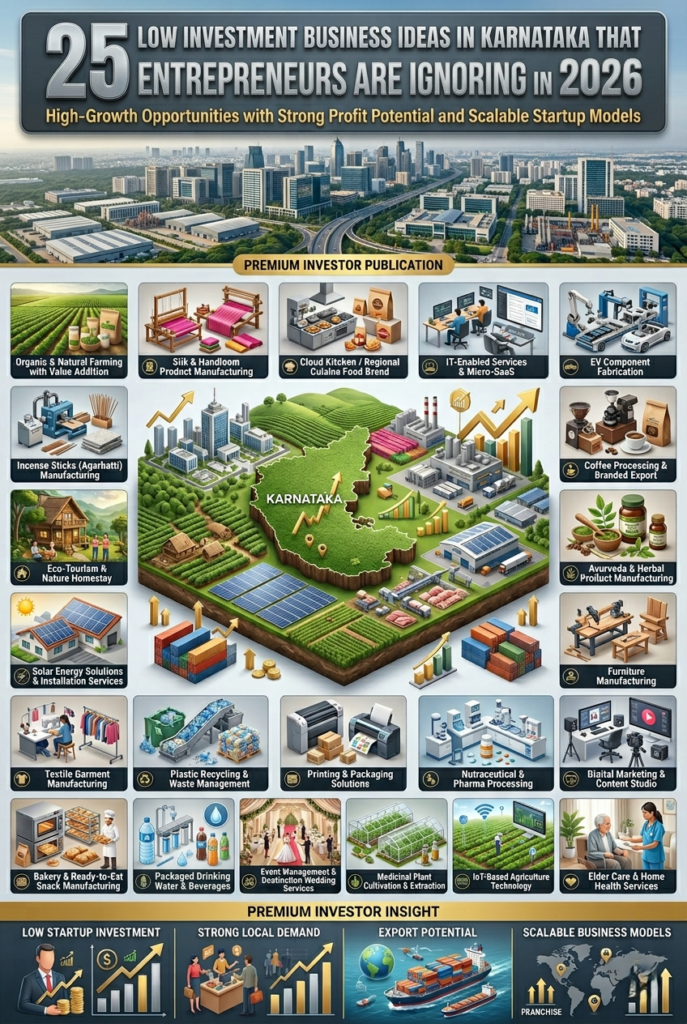
11. Solar Energy Solutions & Installation Services
The PM Surya Ghar Yojana and the incentives implemented by Karnataka have resulted in a huge pipeline of rooftop solar installations, both in the residential and commercial sectors and in agriculture as well. A solar installation and maintenance startup, as opposed to a solar manufacturing business which needs a great deal of capital, can make significant project income, but on a relatively low amount of working capital. In North Karnataka, the installation of agricultural solar pumps in this region is a niche with a high demand.
12. Poultry & Meat Processing
The urban population and increased protein demand in Karnataka has ensured continued demand for processed and packaged poultry products. Entrepreneurs can establish integrated units (procurement, slaughter, value added processing, cold chain packaging) to provide to modern retail, food service and institutional customers. NABARD’s livestock sector lending schemes offer working capital at attractive interest rates to eligible units.
13. Furniture Manufacturing (Wood & Engineered Wood)
The demand for home furniture is steady in Bengaluru, Hubballi-Dharwad and Mangaluru due to consistent growth of residential real estate in these cities. For those who have the woodworking skills or design ability, modular furniture manufacturing units can be established that can provide to builders, interior designers or direct retail. Engineered wood options lower the cost of raw materials without impacting margins greatly, making it an available choice for capital-light entrepreneurs.(Low Investment Business Ideas in Karnataka)
14. Packaged Drinking Water & Beverages
Packaged water and flavoured beverage brands are still witnessing high demand in Tier-2 and Tier-3 towns of the state, Karnataka. The strategy can be to install water processing units with a capital investment of ₹8-15 lakh, that are certified as BIS products for institutional water supply, e.g. construction sites, schools, corporate parks, etc., as well as retail water supply. Sugarcane or herbal tender coconut-based drinks enjoy premium positioning in urban markets.
15. Textile Garment Manufacturing (Export-Ready)
The garment export industry is based in Bengaluru but is also picking up in Dharwad and Mysuru in Karnataka and offers a sub-contracting system that new MSME manufacturers can access. A job-work unit can be started as a simple stitching infrastructure by the enterprisers, which will help them to enhance the capability before establishing the brand or buyer relationship with the exporters. The initial investment for 20 machines is about ₹15–20 lakh.
16. Plastic Recycling & Waste Management
The State of Karnataka generates a considerable amount of dry waste in urban areas and the plastic management guidelines in the State establish a market for collecting, segregating and recycling dry waste units, with the backing of rules for enforcement. Small scale PET/HDPE recycling facilities can provide the PET/HDPE pellets and flakes to the downstream manufacturers with lucrative spreads. This business is also eligible for government grants in the fields of solid waste management and green economy.
17. Printing & Packaging Solutions
Karnataka food, pharma and consumer goods industry provides regular demand for flexible and rigid packaging. Entrepreneurs who have flexographic or digital printing facilities can beat the package manufacturers who are getting packages from Bengaluru distributors at high prices. A digital-print packaging unit for customised boxes and labels for small-run food brands of MSMEs is an opportune offering.
18. Pharmaceutical Raw Material & Nutraceutical Processing
The robust pharmaceutical manufacturing ecosystem around Bengaluru has generated an API intermediate industry, nutraceutical formulations, and a contract packaging industry for Karnataka. Small companies from a chemistry or pharma background can be allowed to join as contract processors or custom formulators of well-established brands. This opportunity has been much broadened by the swift rise of the AYUSH sector, offering herbs for supplements and wellness-grade formulations.
19. Digital Marketing & Content Studio
From farmer-producer groups producing farm-fresh products in Coorg to the artisans from Dharwad, the MSME and Startup Industry of Karnataka desperately requires affordable, credible Digital Marketing and Content Production. Retention agency business models with 20-30 region MSME clients are achievable for entrepreneurs who have videography skills, social media strategy, or performance marketing skills. Low capital requirements: Skills, network and execution quality are the limiters.
Discover business ideas that actually make money
20. Bakery & Ready-to-Eat Snack Manufacturing
The institutional demand from hospitals, tech parks, hotels and quick serve restaurants in Karnataka has provided good opportunity to packaged snack and bakery manufacturers. Food aggregators are an opportunity for the entrepreneurs to sell their FSSAI-approved branded Karnataka snacks such as multigrain chakli, millet-based health bars, coffee flavoured biscuits in domestic modern trade and export markets.
21. Metal Fabrication & Industrial Components
Karnataka’s engineering and auto ancillary manufacturing clusters at Tumkur, Peenya and Dharwad have hundreds of MSMEs catering to precision manufacturing. Welding, CNC and Sheet Metal enthusiasts can join the Vendor landscape with relatively small investments in equipment. Good order books from anchor buyers greatly mitigate this model in its early years.(Low Investment Business Ideas in Karnataka)
22. Event Management & Destination Wedding Services
The rising middle class in Karnataka, coupled with its unparalleled geographical spread ranging from the palace in Mysuru to forest lodges in Coorg and beachfront properties in Karwar has led to the establishment of a premium event management industry. Entrepreneurs can run boutique destination wedding and corporate retreat management services with low manpower and earn between ₹5–20 lakh per event.
23. Medicinal Plant Cultivation & Extraction
Commercially important medicinal plants like ashwagandha, brahmi, kalmegh and ginger lily grow naturally in the forest fringe areas of Karnataka. Simple extraction techniques such as the production of essential oils, dried herb standardization and the production of herbal concentrate will enable entrepreneurs to provide a range of pharmaceutical, food and cosmetic end-uses of the herbal industry in the country. NABARD and AYUSH schemes are both available for both cultivation and processing investment.
24. IoT-Based Agriculture Technology
The progressive farming community and increasing connectivity between various districts in Karnataka is driving demand for affordable precision agriculture solutions such as Soil Moisture Sensors, Drip Automation Controller, Crop Disease Identification Apps. With suitable electronics design and rural distribution ability entrepreneurs can develop and market cheap IoT packages to the progressive farmers throughout the State. Government Agriculture Technology Schemes offer procurement and pilot support to eligible start-ups.
25. Elder Care & Home Health Services
There are a large number of elderly people (retired professionals, NRI families) in Bengaluru and Mysuru. The demand for qualified elderly care attendants, home physiotherapy services and assisted living consultancy services is also increasing at a quick rate and is still much in demand, but not supplied. Entrepreneurs who develop organized, trained, and branded home health services, to fill the void of ASHA workers and to compete with the nursing home market can develop both volume and trust-premium pricing in this area.
Import–Export Opportunity Analysis for Karnataka-Based Startups
It’s not just about the IT services that Karnataka is known for when it comes to exports. The state is one of the leading exporters of silk fabric, coffee, cashew, granite, readymade garments in the country. The APEDA (Agricultural & Processed Food Products Export Development Authority) portal helps MSMEs get access to markets, export certification and facilitation of buyers for agri-food exporters.
The major trading houses in Karnataka export Agarbatti to the Middle East, Southeast Asian countries and Africa, where the quality of the Agarbatti product is appreciated as temple grade. Small manufacturers with FIEO memberships and who participate in the trade fairs will reap export premiums, which they can’t get in domestic trade. Likewise, there is demand from Japanese, South Korea and European buyers for handloom and silk because the natural-fibre textiles are highly valued by them.
Import substitution is also a crucial aspect. There is still a huge demand for specialty enzymes, flavor extracts and packaging films in Karnataka’s food processing industry. Business owners doing these input categories, even at a small level, usually have local customers and have the ability to talk to government procurement programmers that do favor indigenous products.(Low Investment Business Ideas in Karnataka)
Indian MSME Success Stories Relevant to Karnataka Entrepreneurs
Bhavani Enterprises (Agarbatti Sector) — M. Suresh Kumar, Bengaluru
This agarbatti manufacturing company in Bengaluru had expanded from 10 workforce in Kalasipalya to become a medium sized exporter catering to markets in the Middle East and ASEAN. Suresh Kumar’s approach was easy to understand – get the masala base from the regional suppliers, invest in semi-automatic rolling machines to minimise reliance on human labour, and create a differentiated premium line that would be sold under a brand name. The takeaway from the lesson is clear — commodity businesses can welcome new players, but the ones which differentiate a commodity business with branding and products turn it into a ₹5 crore business when the time comes.
ID Fresh Food — P.C. Musthafa, Bengaluru
ID Fresh Food is now a well-known brand, but in its inception in Bengaluru, it was a fresh idli-dosa batter start-up that had a single vision, and limited infrastructure – the urban professional will pay for convenience and quality. Musthafa’s model, which is based on the principle that it is better to build discipline in the value chain and stay focused on a small area, is directly applicable to all food entrepreneurs who are venturing into the Karnataka processed food market today. Today, ID Fresh has a valuation of hundreds of crores, but the idea of conceiving the company was an investment of ₹10 lakh for the batter-packing machines.
Naturez Organic (Herbal & Organic Products) — Dharwad
This start-up company from North Karnataka established a domestic and export venture based on certified organic spices and herbal preparations without any involvement of APMC system, by directly addressing the farming clusters in the towns of Gadag and Bidar. A defensible supply position was created by the promoter’s early investment in organic certification and international food safety accreditation, which commodity competitors could not easily replicate. The lesson that has stuck with them is that complying with the investments feels like a lot of money in year 1, but by year 3 they’re competitive moats.
How NPCS Can Help You Evaluate Your Karnataka Business Project
Niir Project Consultancy Services (NPCS) have a professional expertise in preparing Market Survey cum Detailed Techno-Economic Feasibility Reports (DPRs) for setting up new industries/businesses in Karnataka and India. Our reports include:
The following are detailed manufacturing processes and process flow diagrams:
- Determining the product mix and analysing the demand for products and services.
- Machinery specs, sourcing of raw materials, capacity planning
- Prepare project financials including profitability & break-even analysis
- Complete project financials with profitability and break-even analysis
Regardless if you are able to look into the feasibility, profitability and long-term scalability of an agarbatti unit in Bengaluru, a granite processing unit in Hassan or an organic food brand in Coorg, NPCS has the analytical rigor and sector experience needed to help you make an informed decision before you invest. We are committed to supporting entrepreneurs to make sound investments decisions instead of making generalised market assumptions.
Related Article: Which Manufacturing Units Are Booming in Karnataka in 2026
Key Business Sectors in Karnataka — Investment & Revenue Reference Table
| Business Sector | Approx. Investment (₹ Lakh) | Potential Monthly Revenue (₹ Lakh) | Key Support Scheme |
| Organic Farming / Agri-Processing | 5–15 | 3–8 | PM-FME, NABARD |
| Silk & Handloom Products | 8–20 | 4–10 | Handloom Weavers’ Welfare Scheme |
| Café / Cloud Kitchen | 3–10 | 2–6 | Startup Karnataka, MUDRA |
| IT & Software Services | 2–8 | 5–20 | Startup India, DPIIT Recognition |
| EV Components Manufacturing | 20–60 | 10–30 | PLI Scheme (Auto), FAME II |
| Incense / Agarbatti Making | 2–5 | 1.5–4 | PM-FME, PMEGP |
| Granite & Stone Processing | 15–40 | 8–20 | MSME Cluster Development |
| Eco-Tourism & Homestay | 5–20 | 2–8 | Karnataka Tourism Policy |
| Ayurveda & Herbal Products | 4–12 | 3–9 | AYUSH Wellness Centre Scheme |
| Solar Energy Solutions | 10–30 | 5–15 | PM Surya Ghar Yojana |
Source: Ministry of MSME, Government of India; Karnataka MSME Policy; NPCS Sector Intelligence. Figures are indicative ranges based on small-scale unit configurations.
Frequently Asked Questions (FAQ)
Q1. What are the most lucrative low-investment business ideas for Karnataka?
With an under 20 Lakhs investment, food processing (agarbatti, coffee, organic products), digital services and agri-value addition appear to be the sweet spot for entering entrepreneurship in Karnataka with risk-return potential.
Q2. What is the most fitting government scheme for my food business in Karnataka?
35% capital subsidy is provided on the purchase of plant and machinery under PM-FME. Applicant must register as MSME (Udyam registration on Udyam portal) prior to application of scheme. Udyam Registration is a mandatory prerequisite for all schemes.
Q3. Can a small manufacturer from Karnataka cater to exports?
Certainly. APEDA & FIEO facilitate first-time exporters by helping in finding buyers and certifications. Standardization cost will be 1-3 lakh which can easily be recovered by export premium in short time span.
Q4. What is the necessity of a Detailed Project Report (DPR)?
A DPR plans all your cash flows, break-even period, and machine costs. It is mandatory for most banks under CGTMSE and MUDRA schemes. Risks identified and planned for prevent them becoming losses.
Q5. Do investors from outside Karnataka also receive benefits from the state?
Yes. State incentives in Karnataka are accessible for all types of investors. The Udyog Mitra single window is responsible for approvals, land, and scheme registration for all qualifying MSME units registered in the state.
Q6. What is the least investment needed to set up a business in Karnataka?
Businesses such as cloud kitchen and digital marketing require 3-5 lakh to be set up while the minimum investment for manufacturing units is between 10-20 lakh which are covered by the subsidy of PMEGP or PM-FME scheme at 25-35% on capital expenditure.
Final Takeaway: Karnataka Is Ready. Are You?
Between the sheer availability of raw materials, the strong policy ecosystem, and the evident demand for the product, Karnataka has the best combination for an MSME investment in India in 2026. These 25 business ideas aren’t hypotheticals – each of them represents actual market transactions, financed by government schemes and proven to have a real consumer base throughout the state.
Yet, there is a difference between a “good idea” and a “good business.” The first difference is, in many ways, the level of readiness. Entrepreneurial journeys are always best propelled forward when entrepreneurs make early investments in getting a credible DPR, determining their scheme eligibility, and creating rigorous financial forecasts, in contrast to simply banking on the notion of the “market demand” being self-evident.(Low Investment Business Ideas in Karnataka)
Thus, whether you are a first-generation founder, a seasoned professional crossing over into business, or an NRI investor keen on seeing investment in Indian manufacturing-Karnataka, as of now, is one to watch intently. The window of opportunity is open. The infrastructural capacity is in place. And for the right person, moving with intent and decisiveness, the potential is immense.