
 Grasim Industries (Century Rayon)
 Tata Steel
 JSW Steel
 ITC (Agri Business Division)
 Godrej & Boyce
 Aditya Birla Management Corporation
 Thermax (Chemical Division)
 UPL
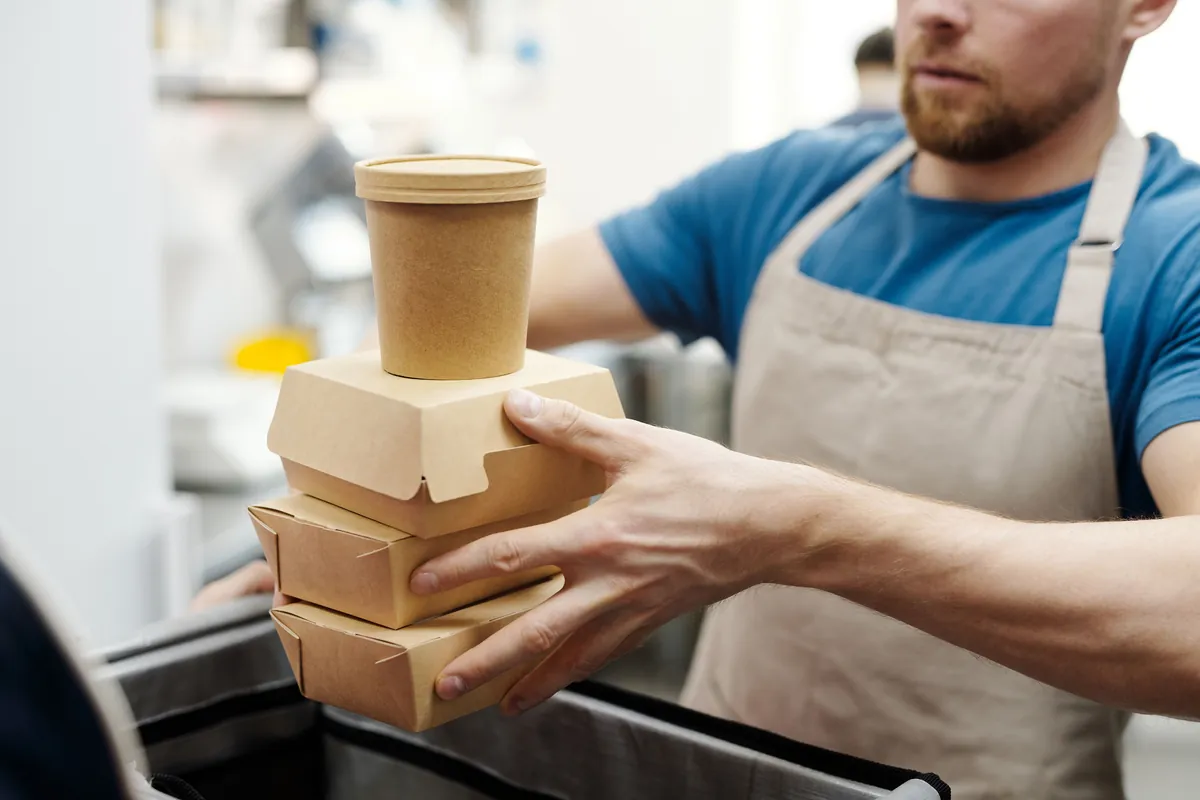
Cloud kitchens, restaurants, caterers, airlines and railways all buy takeaway containers in volume, and a takeaway food container manufacturing consultant helps you set up a plant to supply them. The plant thermoforms PP sheet or presses aluminium foil into microwaveable boxes, meal trays and lidded containers. Entrepreneurs choose it because food delivery keeps growing and the product is bought repeatedly. NPCS supports you with capacity planning, technology selection and a detailed project report.
Takeaway Food Container Manufacturing at a Glance
| Typical capacity | ~50,000–10 lakh pieces per day |
|---|---|
| Land | ~0.5–3 acres |
| Power load | ~200 kW–1 MW |
| Water | Low |
| Manpower | ~15–80 |
| Indicative investment | ~₹1–20 crore |
Investment basis: excludes land.
Figures are indicative ranges. Your project report works them out for your capacity and location.
Market Demand for Takeaway Food Containers in India
Demand rests mainly on the growth of food delivery. Every order needs a container that stays leak-proof and, for many dishes, survives a microwave. Units are concentrated in Delhi-NCR, Gujarat, Maharashtra and Tamil Nadu, close to large food markets and resin supply. Seasonality is low, so orders stay fairly steady through the year, although exports are limited.
- Food delivery platforms and cloud kitchens
- Caterers and restaurants
- Airlines and railways
- Distributors serving retail shops
Takeaway Food Container Products You Can Make
Most new units start with PP microwaveable containers and lidded round or rectangular boxes, which suit cloud kitchens and caterers. Compartment meal trays serve institutional buyers such as airlines and railways. Aluminium foil containers need a separate press line, so many plants add them later.
- PP microwaveable containers, compartment meal trays, aluminium foil containers, round and rectangular boxes with lids
Takeaway Food Container Manufacturing Process
The takeaway food container manufacturing process for PP starts with sheet, either bought in or extruded in-house, which is then thermoformed in moulds. Trimming removes the skeleton, which is the leftover sheet web that can be reground. Foil containers are made differently, by press forming with dies.
Quality is controlled at several points. Wall thickness is checked on the formed part, lids are tested for fit, and containers go through leak and microwave tests. Food-contact compliance depends on using suitable resin from the start.
- Sheet extrusion (optional)
- Thermoforming
- Trimming
- Stacking
- Packing; foil: press forming with dies
Raw Materials and Machinery for Container Plants
PP sheet or granules are the main input, with PP sourced from Reliance and other producers. Aluminium foil is available domestically, and printing inks are needed for branded containers. The machines that matter most are the thermoforming machine and its moulds, since mould quality decides lid fit. A sheet extruder is optional, and foil lines need a container press.
- Sheet extruder
- Thermoforming machine
- Moulds
- Foil container press
- Packing
Licences and Approvals for a Takeaway Food Container Plant
Start with Udyam registration, then obtain State Pollution Control Board consent before construction and again before production. Plastic processing from virgin resin falls in the Green category under CPCB S.No. 132. No QCO applies, but food-contact plastics must meet FSSAI packaging regulations. You'll also need EPR registration as a plastic packaging producer.
- Udyam registration first
- Consent to establish before construction
- FSSAI packaging compliance for food contact
- EPR registration as plastic packaging producer
| Pollution category | Plastic processing from virgin resin: Green (CPCB S.No. 132) |
|---|---|
| HSN code | 3923 or 3924 (plastic containers), 7612 (foil containers) |
| GST | 18% |
| BIS / quality control order | No QCO |
| FSSAI | Food-contact plastics must meet FSSAI packaging regulations |
| Other licences | EPR registration as plastic packaging producer; Udyam |
Choosing the Right Takeaway Container Technology
Three routes exist for takeaway containers, and each suits a different buyer. Thermoforming lines make PP trays and boxes in large volumes at lower tooling cost. Thin-wall injection moulding suits rigid, precise containers, though moulds cost more. Foil container presses serve caterers and airlines that want oven-ready packs. Your product mix and budget should decide the route, and a feasibility study compares them for your capacity.
Choosing the Right Plant Size for Container Manufacturing
Plant size changes the project sharply, with capacity from about 50,000 to 10 lakh pieces per day and investment from roughly ₹1–20 crore, excluding land. A small unit needs about 15 workers and a modest hall, while a large one needs up to 3 acres and around 1 MW of power. Many entrepreneurs begin small, prove their distributor network, and then add lines.
Government Schemes and Project Finance
PMEGP and state incentives may support a takeaway container unit, depending on its size and location. A bankable project report shows lenders the cost, margins and repayment capacity. NPCS reports are used for bank loans and government programmes such as PMEGP, MSME schemes, Mudra and NABARD-linked projects, subject to each lender's requirements.
What Decides Success in a Takeaway Food Container Business
Good operators get lid fit and consistent quality right, and they build a reliable distributor network. The main risks are plastic regulations and price competition. Skeleton trim can be reground, which helps control material cost.
- Quality and lid fit on every batch
- A steady distributor network
- Planning for plastic regulations
- Reusing skeleton trim as regrind
How NPCS Helps You Set Up a Takeaway Food Container Plant
NPCS helps with the decisions that shape this project: capacity, thermoforming versus foil technology, machinery selection and vendor selection. Our team also supports plant layout, installation and commissioning, and guides you through approvals and finance. Your takeaway food container manufacturing project report is tailored to your capacity, budget and market area.
NPCS's published client list records 66 assignments across packaging projects between 2009 and 2026, for clients in 18 states and 6 countries.
What Your Takeaway Food Container Manufacturing Project Report Covers
- Project introduction and BIS specifications
- Manufacturing process with flow sheet
- Market survey (demand, imports/exports, existing units)
- Personnel
- Plant and machinery with suppliers
- Land and building with layout
- Raw materials with sources and rates
- Financials (project cost, working capital, cost of production, profitability, break-even, 5–10 year cash flow, projected balance sheet, IRR/NPV/payback)
Takeaway Food Container Manufacturing: Frequently Asked Questions
How much does it cost to set up takeaway food container manufacturing in India?
Investment is typically about ₹1–20 crore, depending on capacity and technology, and this excludes land. A small thermoforming unit sits at the lower end. Your project report works out the exact cost for your capacity and location.
Which licences are needed to start a takeaway food container plant?
You'll need Udyam registration, State Pollution Control Board consent, and EPR registration as a plastic packaging producer. Plastic processing from virgin resin is Green category. Food-contact plastics must also meet FSSAI packaging regulations. No QCO applies.
How much land and power does a takeaway container unit need?
Typically about 0.5–3 acres of land and 200 kW to 1 MW of power, depending on capacity. Water needs are low. A larger unit with in-house sheet extrusion will sit at the higher end of both figures.
How to start takeaway food container manufacturing?
Begin by fixing your product, such as PP boxes or foil trays, and a target capacity. Then compare technology, prepare a project report, register under Udyam, and obtain pollution control consent before building. Machinery selection and finance follow.
How can NPCS help with a takeaway container project?
NPCS prepares a detailed, bankable project report and supports machinery selection, vendor selection, plant layout and approvals. Share your planned capacity and location, and our team will outline the project cost and the next steps.