
 Tata Steel
 JSW Steel
 ITC (Agri Business Division)
 Godrej & Boyce
 Aditya Birla Management Corporation
 Grasim Industries (Century Rayon)
 Thermax (Chemical Division)
 UPL
Solar cell makers and integrated module manufacturers are the buyers for a plant that grows monocrystalline silicon ingots and slices them into wafers. Investors choose this project to move upstream and replace imported wafers. A solar ingot and wafer plant consultant helps you test the economics before committing heavy capital. NPCS prepares the project report, reviews technology and machinery options, and guides you through approvals and finance.
Solar Ingot and Wafer Plant at a Glance
| Typical capacity | ~1–10 GW per year |
|---|---|
| Land | ~30–100 acres |
| Power load | ~50–300 MW (energy intensive) |
| Water | High |
| Manpower | ~500–2,500 |
| Indicative investment | ~₹1,500–3,000 crore per GW (indicative) |
Investment basis: excludes land.
Figures are indicative ranges. Your project report works them out for your capacity and location.
Market Demand for Solar Ingot and Wafer Plants in India
Demand comes from cell and module makers who want assured domestic wafer supply. Upstream integration and import substitution are the main drivers. ALMM listing requirements for cells also raise domestic demand for wafers. Export potential is medium, so the home market should anchor your plan.
Projects are concentrated in Gujarat, Tamil Nadu, Andhra Pradesh and Odisha. Seasonality is low, so volumes stay steady through the year.
- Solar cell manufacturers buying wafers
- Integrated module makers building upstream capacity
- Developers aiming to substitute imported wafers
Solar Ingot and Wafer Products You Can Make
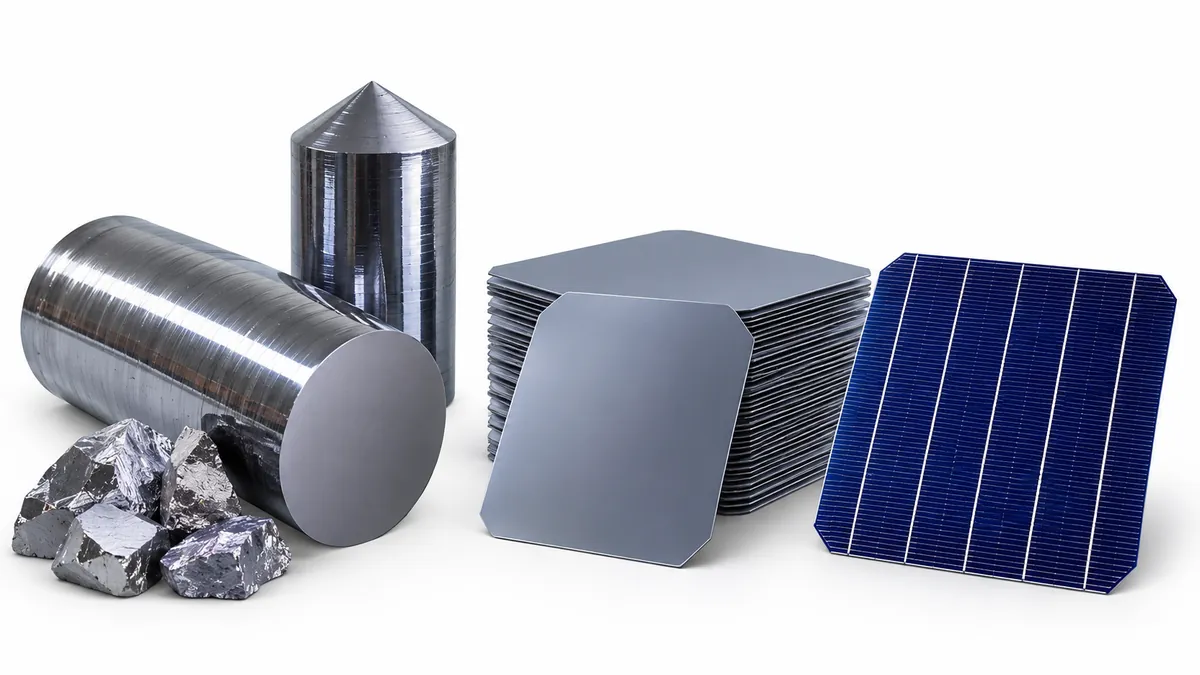
You can supply mono ingots in n-type or p-type, or sell wafers in formats such as M10 and G12. Choose the format your target cell customers already run, since cell lines are tuned to specific wafer sizes.
- Mono ingots (n-type and p-type), wafers (M10, G12 and other formats)
Solar Ingot and Wafer Plant Process
The solar ingot and wafer plant process starts with polysilicon charged into a crucible. In the Czochralski method, a seed crystal is slowly pulled from the molten silicon to form a single-crystal ingot. The ingot is then cropped and squared before wire-saw slicing turns it into wafers.
Quality control runs through the flow. Typical checks cover resistivity, lifetime, thickness and total thickness variation. Cleaning and final inspection decide whether wafers meet the cell maker's specification. Silicon kerf and tops from cutting are recycled, which helps material yield.
- Polysilicon charging
- Czochralski crystal growth
- Cropping and squaring
- Wire-saw slicing
- Cleaning
- Inspection
- Packing
Raw Materials and Machinery for the Plant
Polysilicon is the main input and is largely imported, so supply contracts matter. You will also need dopants, crucibles and diamond wire. The machines that shape output and yield are Cz pullers and diamond wire saws, supported by squarers, cleaning lines and inspection systems. Many plants plan integration with cell and module lines.
- Cz pullers
- Squarers
- Diamond wire saws
- Wafer cleaning lines
- Inspection systems
Solar Ingot and Wafer Plant Licence and Approvals
Start with business registration, then apply for consent to establish from the State Pollution Control Board before construction. The category is generally Orange, but the State PCB fixes it. Add a factory licence and a power connection at scale. After commissioning, obtain consent to operate. No QCO applies to this product.
| Pollution category | Generally Orange; the State PCB fixes the category |
|---|---|
| HSN code | 3818 (doped silicon wafers) |
| GST | Classification-dependent; applied in the project financials |
| BIS / quality control order | No QCO |
| Other licences | Power connection at scale; factory licence |
Securing Polysilicon for Your Plant
Because polysilicon is largely imported, your raw material plan decides both cost and continuity. Discuss supply terms with more than one source and plan storage for crucibles and diamond wire as well.
Your project report should test how changes in polysilicon cost affect margins. Recycling silicon kerf and tops also helps recover value from material that would otherwise be lost.
Choosing the Right Plant Size
Capacity ranges from about 1 to 10 GW per year, and the requirements move with it. Land can run from about 30 to 100 acres, power load from about 50 to 300 MW, and manpower from about 500 to 2,500.
Smaller units are easier to finance but carry a higher cost per GW. Larger plants use scale to lower cost but need heavier capex and firm offtake. Match size to confirmed buyers and available power.
Government Schemes and Project Finance for Solar Wafer Plants
The PLI scheme for high-efficiency solar PV modules, in its integrated tranche, is relevant to upstream investors. ALMM listing requirements for cells also support domestic demand. A bankable project report helps lenders review your plan. NPCS reports are used for bank loans and government programmes, subject to each lender's requirements.
What Decides Success in a Solar Ingot and Wafer Plant
Operators who do well control three things: power cost, a dependable technology partner and sufficient scale. The main risks are Chinese dominance in the market and the very high capex. Plan for both before you commit.
- Secure low-cost, reliable power
- Select a proven technology partner
- Build scale with confirmed cell-maker buyers
How NPCS Helps You Set Up a Solar Ingot and Wafer Plant
NPCS supports the decisions that matter most here: capacity, Cz puller and wire saw selection, vendor choice, plant layout and approvals. Our team prepares a detailed or bankable solar ingot and wafer plant project report, and assists with installation and commissioning. We also check financials against your location and power cost.
NPCS's published client list records 5 assignments on solar ingot and wafer projects between 2020 and 2026 for clients in 4 states, including detailed project reports, bankable project reports and techno-economic feasibility studies.
What Your Solar Ingot and Wafer Plant Project Report Covers
- Project introduction and BIS specifications
- Manufacturing process with flow sheet
- Market survey (demand, imports/exports, existing units)
- Personnel
- Plant and machinery with suppliers
- Land and building with layout
- Raw materials with sources and rates
- Financials (project cost, working capital, cost of production, profitability, break-even, 5–10 year cash flow, projected balance sheet, IRR/NPV/payback)
Solar Ingot and Wafer Plant: Frequently Asked Questions
What is the solar ingot and wafer plant setup cost in India?
The indicative investment is about ₹1,500–3,000 crore per GW, excluding land. The final figure depends on capacity, technology and location. A project report works out the cost, working capital and returns for your specific plan.
Which licences and pollution category apply to a wafer plant?
The pollution category is generally Orange, and the State Pollution Control Board fixes it. You will also need a factory licence and a power connection at scale. Consent to establish comes before construction, and consent to operate follows.
How much land and power does a solar ingot and wafer plant need?
Plants typically need about 30–100 acres and a power load of about 50–300 MW, depending on capacity. Water requirement is high. Power is energy intensive, so securing supply and cost early is critical.
How to start a solar ingot and wafer plant business?
Begin with a feasibility study covering capacity, technology partner, polysilicon sourcing and buyers. Then finalise location, apply for approvals and arrange finance. Machinery selection and commissioning follow. NPCS can guide each of these steps.
How can NPCS help with my wafer plant project?
NPCS prepares detailed project reports, bankable reports and feasibility studies, and supports machinery and vendor selection, layout and commissioning. Share your planned capacity and location, and our team will outline the project economics and approvals.