
 ITC (Agri Business Division)
 Thermax (Chemical Division)
 SRF
 DCM Shriram Industries
 Deepak Nitrite
 Gujarat Ambuja Exports
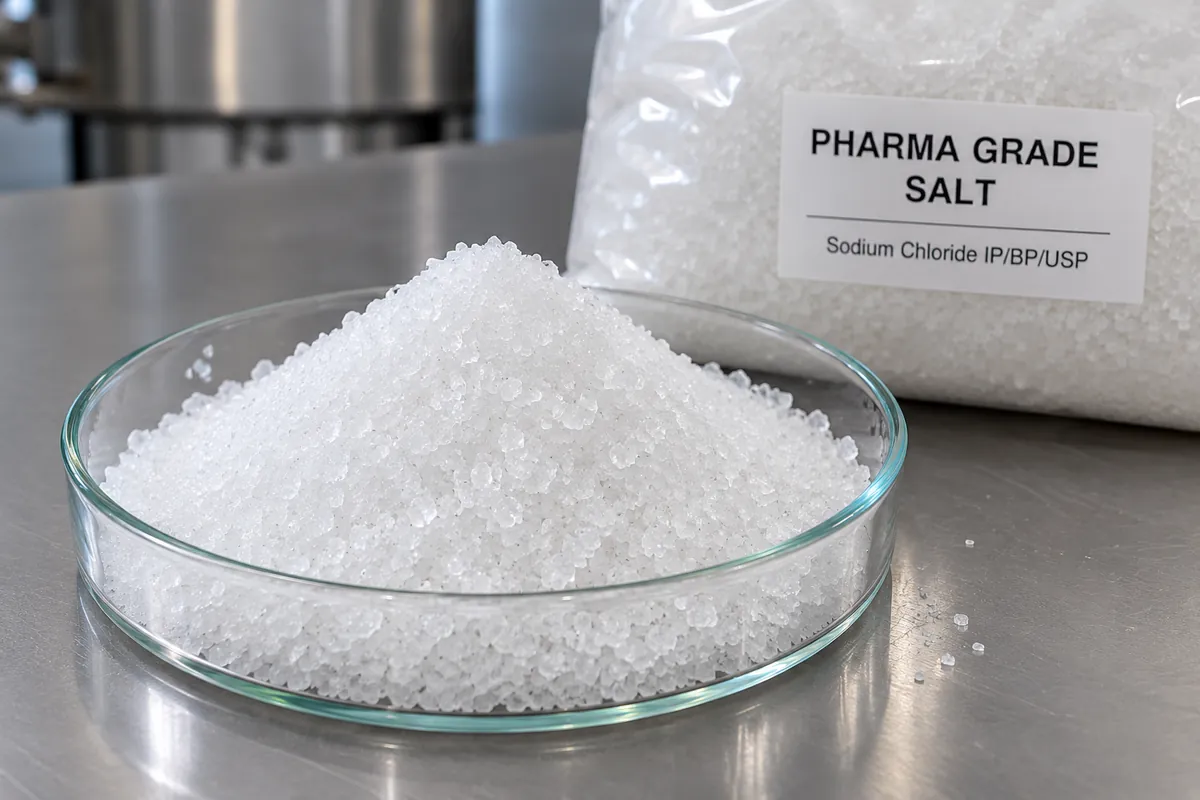
IV fluid makers, dialysis solution producers and pharma formulators all need sodium chloride that meets IP, BP or USP limits, and a pharma-grade sodium chloride plant consultant helps you build the unit that supplies it. Entrepreneurs choose this project because import substitution and growing IV fluid demand create steady buyers. NPCS has advised industrial clients since 1994. Our team prepares the technical plan, cost estimate and approvals roadmap before you commit capital.
Pharma-Grade Sodium Chloride Plant at a Glance
| Typical capacity | ~1,000–10,000 TPA |
|---|---|
| Land | ~2–5 acres |
| Power load | ~500 kW–2 MW |
| Water | High (purified water) |
| Manpower | ~20–60 |
| Indicative investment | ~₹10–50 crore |
Investment basis: excludes land.
Figures are indicative ranges. Your project report works them out for your capacity and location.
Market Demand for Pharma-Grade Sodium Chloride in India
Demand for pharma-grade sodium chloride comes mainly from IV fluid and dialysis growth, along with a push towards import substitution. Raw salt supply is concentrated in Gujarat and Tamil Nadu, so these two states are also the natural clusters for refining units. Export potential is medium, and seasonality is low, which keeps production planning fairly steady.
- IV fluid and dialysis makers buying in regular volumes
- Pharma companies using it in formulations and as an excipient
- Exporters supplying overseas pharma buyers
- Laboratories needing small lots of high-purity salt
Pharma-Grade Sodium Chloride Products You Can Make
Most new units start with IP/BP/USP sodium chloride, since it serves the widest set of pharma buyers. Dialysis grade and low-endotoxin grade suit more demanding customers. Food-grade refined salt is an allied product that can use spare capacity, subject to FSSAI licensing.
- IP/BP/USP sodium chloride, dialysis grade, low-endotoxin grade, food-grade refined salt (allied)
Pharma-Grade Sodium Chloride Plant Process
The plant works by dissolving raw salt, stripping out impurities and recrystallising it under clean conditions. The usual technology is recrystallisation in vacuum evaporators under GMP conditions. Chemical purification removes calcium, magnesium and sulphate before the brine reaches the evaporator, which is where purity is largely decided.
Quality is checked at the end and along the line. Testing covers assay, heavy metals, bacterial endotoxins, sulphate and other impurities per IP, BP or USP. Packing in a clean room protects the finished lot from contamination.
- Dissolution
- Chemical purification (removal of calcium, magnesium, sulphate)
- Filtration
- Vacuum evaporation and crystallisation
- Centrifuging
- Drying
- Sieving
- GMP packing
Raw Materials and Machinery for the Plant
Solar or vacuum salt is the main input, supported by purification chemicals and a large volume of purified water. Salt is usually sourced from Kutch and Jamnagar in Gujarat or Thoothukudi in Tamil Nadu. Among the machines, the vacuum evaporator and the centrifuge matter most, because they set crystal quality and throughput.
- Dissolvers
- Purification tanks
- Filters
- Vacuum evaporator
- Centrifuge
- Fluid bed dryer
- Sifter
- Clean-room packing
Licences and Approvals for a Pharma-Grade Sodium Chloride Plant
Approvals follow a set order: unit registration, consent to establish from the State Pollution Control Board before construction, then product licences, and finally consent to operate. Salt refining is generally Green or Orange because of brine discharge. No QCO applies to this product.
- Drug manufacturing licence and GMP for pharmacopoeia grade used as an API or excipient
- FSSAI licence if you also sell food-grade salt
| Pollution category | Salt refining is generally Green or Orange (brine discharge) |
|---|---|
| HSN code | 2501 (salt, incl. pure sodium chloride) |
| GST | Classification-dependent by grade; applied in the project financials |
| BIS / quality control order | No QCO |
| FSSAI | FSSAI licence for food-grade salt |
| Other licences | Drug manufacturing licence and GMP for pharmacopoeia grade (used as an API or excipient) |
Quality Standards and Certification Buyers Expect
Pharma buyers approve suppliers before they place orders, so certification planning should start early. GMP compliance and a drug manufacturing licence are the base requirements for pharmacopoeia grade. Your lots must also pass assay, heavy metals and bacterial endotoxin tests against IP, BP or USP. Build testing and documentation into the plant design, not as an afterthought, because customer approval is the most common delay in this business.
Securing Raw Material for Your Plant
Reliable salt supply decides your cost base. Solar salt from Kutch, Jamnagar and Thoothukudi is the usual starting point, and vacuum salt is the alternative. A location in Gujarat or Tamil Nadu shortens the haul and eases supplier negotiation. Because purified water use is high, plan the water source and treatment capacity alongside salt contracts, and assess supplier quality before committing volumes.
Government Schemes and Project Finance
Support for this project mainly comes through state incentives, which vary by state, so check what your chosen location offers. NPCS reports are used for bank loans and government programmes such as PMEGP, MSME schemes, Mudra and NABARD-linked projects, subject to each lender's requirements. A bankable project report gives lenders clear costs, margins and repayment figures.
What Decides Success in a Pharma-Grade Sodium Chloride Plant
Operators who do well keep GMP discipline and control endotoxins from the first batch. The main risk is slow approval by pharma customers, so plan working capital for that wait. Treat the by-product mother liquor (bittern) and brine discharge as part of the design.
- Strict GMP compliance
- Endotoxin control
- Early customer approvals
- Planned handling of bittern and brine
How NPCS Helps You Set Up a Pharma-Grade Sodium Chloride Plant
Our team supports the decisions that shape this project: capacity, evaporator and crystalliser selection, vendor choice and plant layout. We also guide production process, installation and commissioning, and line up the approvals sequence. The pharma-grade sodium chloride plant project report then brings these choices together with financials that lenders can review.
NPCS's published client list records 164 assignments across chemicals and petrochemicals projects between 2009 and 2026, for clients in 20 states and 23 countries.
What Your Pharma-Grade Sodium Chloride Plant Project Report Covers
- Project introduction and BIS specifications
- Manufacturing process with flow sheet
- Market survey (demand, imports/exports, existing units)
- Personnel
- Plant and machinery with suppliers
- Land and building with layout
- Raw materials with sources and rates
- Financials (project cost, working capital, cost of production, profitability, break-even, 5–10 year cash flow, projected balance sheet, IRR/NPV/payback)
Pharma-Grade Sodium Chloride Plant: Frequently Asked Questions
How much does it cost to set up a pharma-grade sodium chloride plant in India?
An indicative investment is about ₹10–50 crore, depending on capacity, and it excludes land. Your final figure depends on technology, clean-room scope and location. A project report works out the cost for your planned capacity.
Which licences and pollution category apply to this plant?
Salt refining is generally Green or Orange because of brine discharge. You'll need a drug manufacturing licence and GMP for pharmacopoeia grade, plus an FSSAI licence if you sell food-grade salt. No QCO applies.
How much land and power does a pharma-grade sodium chloride plant need?
Typically about 2–5 acres of land and a power load of roughly 500 kW–2 MW, depending on capacity. Water need is high because the process uses purified water, so check supply before choosing a site.
How do I start a pharma-grade sodium chloride plant business?
Start by fixing your target grade and capacity, then prepare a project report. Next, choose a site near salt supply, apply for consent to establish, and secure GMP and drug licences. Begin customer approvals early.
How can NPCS help with my sodium chloride project?
NPCS prepares the detailed project report, feasibility study and market research, and guides machinery selection, vendor choice and layout. Share your planned capacity and location, and our team will outline the cost and approvals.