
 Tata Steel
 JSW Steel
 ITC (Agri Business Division)
 Godrej & Boyce
 Aditya Birla Management Corporation
 Grasim Industries (Century Rayon)
 Thermax (Chemical Division)
 UPL
Activated carbon makers and briquette exporters buy coconut shell charcoal in steady volumes, and that demand draws entrepreneurs in coconut-growing states to set up carbonisation units. A coconut shell charcoal plant consultant helps you decide the capacity, the kiln or retort, and the approvals before money is committed. NPCS has advised on such projects since 1994. Our team prepares the project report, shapes the technical plan and supports you through machinery selection and planning.
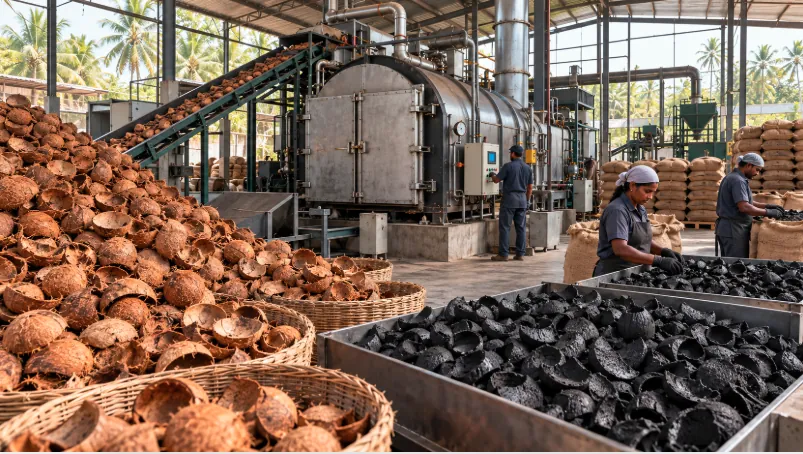
Coconut Shell Charcoal Plant at a Glance
| Typical capacity | ~5–50 TPD shells |
|---|---|
| Land | ~1–3 acres |
| Power load | ~30–200 kW |
| Water | Low |
| Manpower | ~10–40 |
| Indicative investment | ~₹30 lakh–₹5 crore |
Investment basis: excludes land.
Figures are indicative ranges. Your project report works them out for your capacity and location.
Market Demand for Coconut Shell Charcoal in India
Demand comes mainly from industries that need a clean, hard carbon source. Activated carbon is used for water treatment and gold recovery, while shisha and BBQ briquettes find buyers abroad. Export potential is high. Production is concentrated near the shell supply in Kerala, Pollachi, Tiptur and Andhra Pradesh. Shell supply peaks from February to May, which shapes buying and stocking plans.
- Activated carbon makers buying charcoal as feedstock
- Briquette exporters serving BBQ and hookah markets
- Traders supplying metallurgy and other industrial users
Coconut Shell Charcoal Products You Can Make
You can sell plain charcoal to activated carbon makers, or add value with powder and briquettes. Activated carbon buyers usually take graded charcoal. Briquettes suit exporters, though they add a press and dryer to the plant.
- Coconut shell charcoal, charcoal powder, shisha and BBQ briquettes
Coconut Shell Charcoal Plant Process
The coconut shell charcoal plant process starts with dry shells and ends with graded, packed charcoal. The key choice is carbonisation. Traditional pit or drum kilns cost less, while continuous retorts recover smoke and heat, giving cleaner operation and higher yield. Quality is controlled by testing fixed carbon, ash, volatile matter and moisture, since activated carbon buyers specify these. Briquette lines add powdering, binding, pressing and drying after the charcoal stage, and recovered heat can feed that dryer.
- Shell collection and drying
- Carbonisation (kiln or continuous retort)
- Cooling
- Crushing and grading
- Packing; briquettes: powdering, binding, pressing, drying
Raw Materials and Machinery for a Charcoal Plant
Dry coconut shells are the only major input, sourced from Kerala, Tamil Nadu (Pollachi), Karnataka (Tiptur) and Andhra Pradesh. The kiln or retort matters most, because it sets yield and emission levels. A crusher and screens then grade the output to buyer specifications. Briquette makers also need a press and a dryer.
- Carbonisation kilns or retort
- Crusher
- Screens
- Briquette press and dryer
- Packing
Coconut Shell Charcoal Plant Licence and Approvals
Pollution clearance is the main hurdle. Charcoal kilns are generally Orange or Red because of smoke, while continuous retorts with emission control are easier to permit. Apply to the State Pollution Control Board for consent to establish before construction, then consent to operate before production. A factory licence is also required, and no QCO applies.
| Pollution category | Charcoal kilns are generally Orange or Red because of smoke; continuous retorts with emission control are easier to permit |
|---|---|
| HSN code | 4402 20 (charcoal of shell or nut) |
| GST | Classification-dependent; applied in the project financials |
| BIS / quality control order | No QCO |
| Other licences | Factory licence |
Securing Coconut Shell Supply
Shell supply peaks from February to May, so many units stock heavily in those months and run on inventory later. Locating near Pollachi, Tiptur or the Kerala belt shortens transport and gives you direct contact with shell sellers. Shell price is a known risk for this business. Dry storage space and working capital for bulk buying should be planned in the project report.
Choosing the Right Coconut Shell Charcoal Plant Size
Capacity typically ranges from about 5 to 50 TPD of shells, and investment from about ₹30 lakh to ₹5 crore excluding land. A smaller unit with kilns suits a first venture near a shell source. A larger plant usually needs a continuous retort, emission control and a briquette line. Your shell availability and buyer commitments should decide the size.
Government Schemes and Project Finance
Coconut Development Board schemes and state incentives may support units in this sector, subject to eligibility. Banks and agencies expect a bankable report with costs, margins and repayment. NPCS reports are used for bank loans and programmes such as PMEGP, MSME schemes, Mudra and NABARD-linked projects, subject to each lender's requirements.
What Decides Success in a Coconut Shell Charcoal Plant
Good operators secure shell supply early, protect carbonisation yield and control emissions. The main risks are smoke compliance and shell price. Pyroligneous liquid (wood vinegar) and drying heat can add value if planned.
- Reliable shell supply through the February to May peak
- High carbonisation yield
- Emission control that keeps permits secure
- Use of recovered heat in drying
How NPCS Helps You Set Up a Coconut Shell Charcoal Plant
Our team works through your real decisions: capacity, kiln or retort, machinery and vendors, plant layout and approvals. We also guide production process planning and support installation and commissioning. A coconut shell charcoal plant project report from NPCS is tailored to your location, budget and shell sourcing.
NPCS's published client list records 16 assignments on coconut shell charcoal projects between 2011 and 2024 for clients in 11 states and 1 country, including bankable project reports and techno-economic feasibility studies.
What Your Coconut Shell Charcoal Plant Project Report Covers
- Project introduction and BIS specifications
- Manufacturing process with flow sheet
- Market survey (demand, imports/exports, existing units)
- Personnel
- Plant and machinery with suppliers
- Land and building with layout
- Raw materials with sources and rates
- Financials (project cost, working capital, cost of production, profitability, break-even, 5–10 year cash flow, projected balance sheet, IRR/NPV/payback)
Coconut Shell Charcoal Plant: Frequently Asked Questions
How much does coconut shell charcoal plant setup cost in India?
Indicative investment runs from about ₹30 lakh to ₹5 crore, excluding land. The figure depends on capacity, kiln or retort choice and whether you add briquettes. Your project report works out the cost for your location.
Which licences are needed for a coconut shell charcoal plant?
You need a factory licence and State Pollution Control Board consents. Charcoal kilns are generally Orange or Red because of smoke, while retorts with emission control are easier to permit. No QCO applies to this product.
How much land and power does a charcoal plant need?
Typically about 1–3 acres of land and a power load of about 30–200 kW, depending on capacity. Water need is low. Briquette lines and larger retorts push requirements towards the higher end.
How to start a coconut shell charcoal plant business?
Begin by fixing capacity, shell sourcing and the carbonisation technology. Then prepare a project report, apply for pollution consents and factory licence, order machinery and line up buyers such as activated carbon makers or briquette exporters.
How can NPCS help with my charcoal project?
NPCS prepares the project report, helps select technology, machinery and vendors, and supports layout, approvals planning and finance documentation. Share your planned capacity and location, and our team will respond within 24 hours.