
 Grasim Industries (Century Rayon)
 Tata Steel
 JSW Steel
 ITC (Agri Business Division)
 Godrej & Boyce
 Aditya Birla Management Corporation
 Thermax (Chemical Division)
 UPL
E-commerce carton sealing keeps BOPP tape in steady demand, and many entrepreneurs now look at setting up their own unit. A bopp tape manufacturing consultant helps you decide whether to slit bought-in jumbo rolls or run an in-house coating line. NPCS has advised industrial clients since 1994, and our team prepares project reports that cover capacity, machinery, approvals and finance for your specific plan.
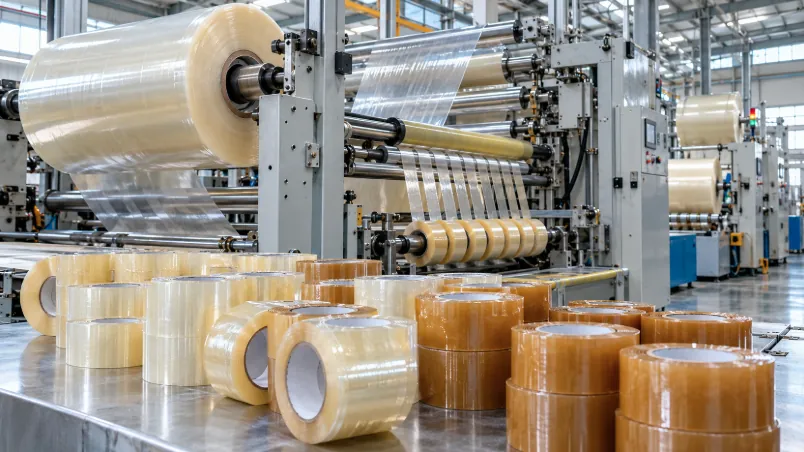
BOPP Tape Manufacturing at a Glance
| Typical capacity | ~1–20 TPD |
|---|---|
| Land | ~0.5–3 acres |
| Power load | ~100–600 kW |
| Water | Low |
| Manpower | ~10–60 |
| Indicative investment | ~₹50 lakh–₹15 crore |
Investment basis: excludes land.
Figures are indicative ranges. Your project report works them out for your capacity and location.
Market Demand for BOPP Tape in India
Demand for BOPP tape follows e-commerce shipments, because every parcel needs a sealed carton. FMCG companies and general manufacturers add steady volume, while stationery distributors buy smaller printed and specialty rolls. Production is concentrated in Gujarat, Delhi-NCR, Maharashtra and Tamil Nadu, close to film makers and large buyers. Export potential is low, so most units plan around domestic customers.
- E-commerce and logistics firms sealing parcels
- FMCG companies and manufacturers packing cartons
- Stationery distributors buying small rolls
BOPP Tape Products You Can Make
Transparent and brown packaging tape is the usual starting point because it sells to the widest set of buyers. Printed logo tape suits brand-conscious customers, and double-sided and masking tapes can be added later as allied lines.
- Transparent and brown packaging tape, printed logo tape, double-sided tape, masking tape (allied)
BOPP Tape Manufacturing Process
The BOPP tape manufacturing process starts with film that is corona treated so the adhesive bonds firmly. The film is then coated, dried and wound into jumbo rolls, which are slit and rewound into the widths buyers want. Logo tapes pass through a printing stage before packing. Quality control focuses on adhesion, tack, thickness and tensile strength, checked on each batch. Weak adhesion is the most common reason for rejected consignments, so testing at the coating stage matters most.
- Film unwinding
- Corona treatment
- Adhesive coating
- Drying
- Winding into jumbo rolls
- Slitting and rewinding
- Printing (logo tapes)
- Packing
Raw Materials and Machinery for BOPP Tape
BOPP film is the main input, bought from domestic film makers, along with acrylic emulsion or hot-melt adhesive, release coating and paper cores. Adhesives are also sourced domestically. The coating line with dryer is the largest investment, while slitting-rewinding machines are the core equipment if you only convert bought jumbo rolls.
- Coating line with dryer
- Corona treater
- Jumbo rewinder
- Slitting-rewinding machines
- Printing machine
Licences and Approvals for a BOPP Tape Unit
Start with Udyam registration and a factory licence, then take the State Pollution Control Board consent to establish before construction begins. Coating with water-based adhesive is generally Green, but solvent-based coating can be Orange. Apply for consent to operate before commercial production. No QCO applies to this product.
| Pollution category | Coating with water-based adhesive is generally Green; solvent-based coating can be Orange |
|---|---|
| HSN code | 3919 (self-adhesive plates, sheets, tape) |
| GST | 18% |
| BIS / quality control order | No QCO |
| Other licences | Factory licence; Udyam |
Choosing the Right BOPP Tape Technology
Buying jumbo rolls and slitting them keeps capital cost low and gets you to market sooner. However, margins are thinner because you pay the converter's price for the coated film. An in-house coating line costs far more and needs adhesive expertise, yet it gives control over adhesion and cost. First-time investors often begin with slitting and add coating once volumes justify it.
Choosing the Right Plant Size
Capacity can range from about 1 to 20 TPD, and investment from about ₹50 lakh to ₹15 crore, excluding land. A small slitting unit needs modest space, power and manpower. A coating plant at the upper end needs more land, higher power load and a larger team. Match the size to the buyers you can realistically secure in your first year.
Government Schemes and Project Finance
PMEGP can support slitting units, and some states offer their own incentives. Eligibility depends on your project and location. NPCS reports are used for bank loans and government programmes such as PMEGP, MSME schemes, Mudra and NABARD-linked projects, subject to each lender's requirements. A clear cost and cash flow plan strengthens any application.
What Decides Success in a BOPP Tape Unit
Successful operators control film and adhesive cost and keep adhesion consistent from batch to batch. Price competition is the main risk, so plan for it.
- Buy film and adhesive at competitive rates
- Test adhesion and tack on every batch
- Plan for festive e-commerce peaks
- Sell film trim as scrap to recover value
How NPCS Helps You Set Up a BOPP Tape Unit
Our team works through the decisions that shape this project: slitting versus coating, capacity, machinery selection and vendor choice. We also support plant layout, approvals and the financial model your bank will review. You get a bopp tape manufacturing project report built around your budget, location and target buyers.
NPCS's published client list records 3 assignments on bopp tape projects between 2016 and 2018 for clients in 2 states, including techno-economic feasibility studies.
What Your BOPP Tape Manufacturing Project Report Covers
- Project introduction and BIS specifications
- Manufacturing process with flow sheet
- Market survey (demand, imports/exports, existing units)
- Personnel
- Plant and machinery with suppliers
- Land and building with layout
- Raw materials with sources and rates
- Financials (project cost, working capital, cost of production, profitability, break-even, 5–10 year cash flow, projected balance sheet, IRR/NPV/payback)
BOPP Tape Manufacturing: Frequently Asked Questions
How much does BOPP tape manufacturing setup cost in India?
Indicative investment ranges from about ₹50 lakh to ₹15 crore, excluding land. A slitting unit sits at the lower end and a coating line at the higher end. Your project report works out the exact figure for your capacity.
Which licences are needed for BOPP tape manufacturing?
You need Udyam registration and a factory licence, plus State Pollution Control Board consent. Water-based adhesive coating is generally Green, while solvent-based coating can be Orange. No QCO applies. Take consent to establish before building.
How much land and power does a BOPP tape plant need?
Land typically ranges from about 0.5 to 3 acres and power load from about 100 to 600 kW, depending on capacity. Water requirement is low. A slitting-only unit needs the lower end of each range.
How to start BOPP tape manufacturing?
Decide between slitting bought jumbo rolls and an in-house coating line, then fix capacity and location. Register under Udyam, obtain pollution consent, select machinery and secure film supply. A detailed project report ties these steps together.
How can NPCS help with a BOPP tape project?
NPCS prepares a project report covering process, machinery, raw materials, approvals and financials. Our team also advises on technology choice, vendor selection and layout. Share your planned capacity and location, and we'll tailor the report to them.