
 New
Bestseller
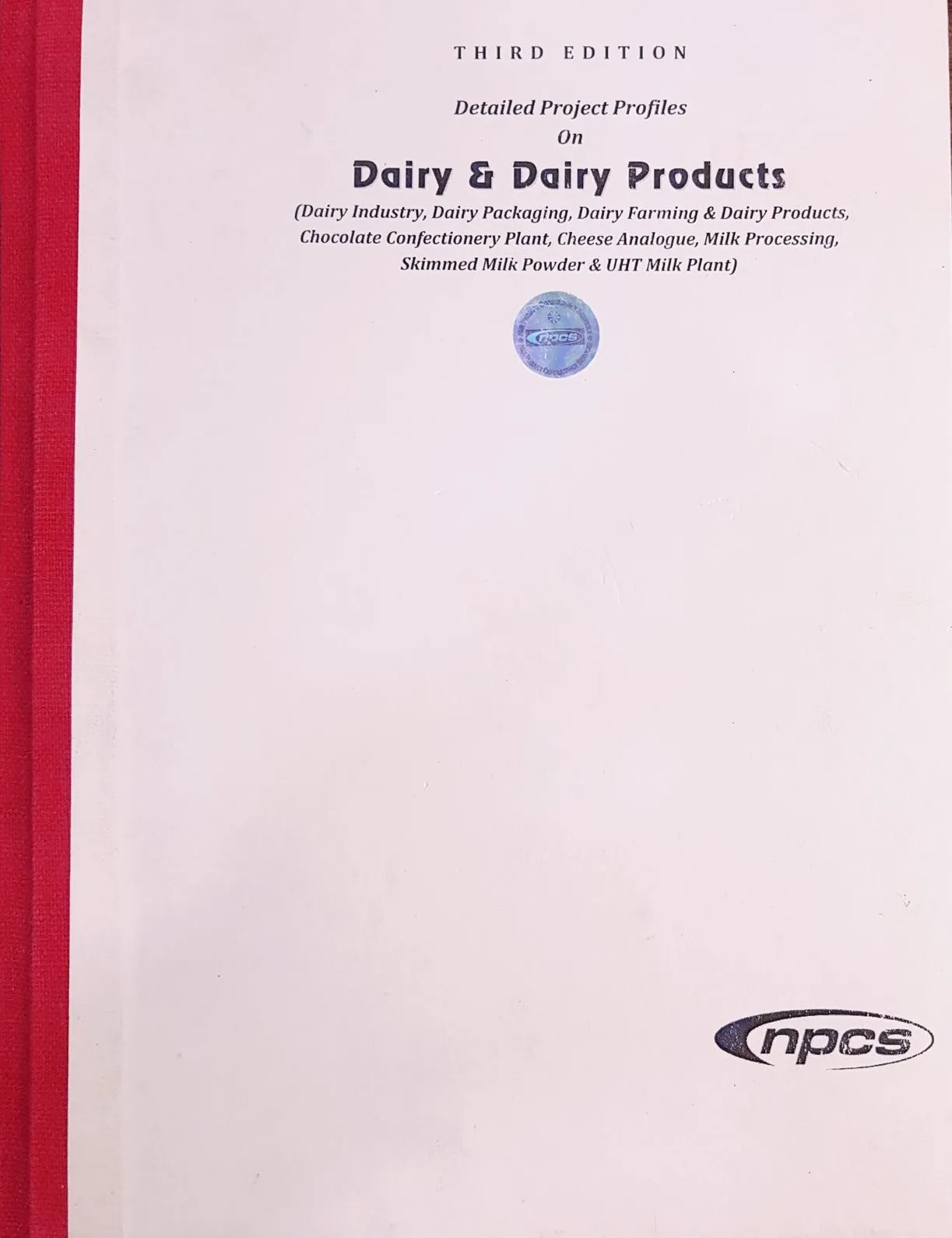
Detailed Project Profiles on Dairy & Dairy Products (Dairy Industry, Dairy Packaging, Dairy Farming & Dairy Products, Chocolate Confectionery Plant, Cheese Analogue, Milk Processing, Skimmed Milk Powder & UHT Milk Plant) (3rd Edn.)
Detailed Project Profiles on Dairy and Dairy Products · 3rd edition
This book gives project profiles on dairy farming, dairy packaging and dairy products such as flavoured milk, curd, ghee, paneer, cheese analogue, skimmed milk powder and UHT milk. It helps entrepreneurs evaluate dairy projects with processes and plant economics.
₹2,595 US$69.95
Plus GST as applicable
- Hardcover
- 244 pages
- In stock, ships in 5 working days
- ISBN
- 9788195577545
- Pages
- 244
- Author
- Ajay Kumar Gupta
- Publisher
- NIIR PROJECT CONSULTANCY SERVICES
- Edition
- 3rd edition
- Language
- English
- Product code
- NI16
Who this book is for
- Entrepreneurs planning a dairy farm or milk plant
- Dairy cooperatives
- Chocolate and confectionery makers
- Consultants and investors
What's inside
- Dairy industry basics, milk composition and testing
- Aseptic and modified atmosphere dairy packaging
- Dairy farming: breeds, feed, housing and cattle disease
- Chocolate confectionery plant
- Cheese analogue
- Milk processing for flavoured milk, pouches, curd, yogurt, ghee, paneer and butter
- Skimmed milk powder and UHT milk
- Plant economics for each project
Table of contents
Show or hide the full contents
1) DAIRY INDUSTRY
a) INTRODUCTION
b) MILK COMPOSITION
c) PROPERTIES OF MILK
d) STANDARDISATION OF WHOLE MILK AND CREAM
e) DAIRY PRODUCTS
f) SIGNIFICANCE OF MILK AND DAIRY PRODUCTS FOR HUMANS
g) MILK TESTING PROCEDURE
2) DAIRY PACKAGING
a) INTRODUCTION
b) ASEPTIC PACKAGING
c) ADVANTAGES OF ASEPTIC PACKAGING TECHNOLOGY
d) ADVANTAGES OF ASEPTICALLY PROCESSED MILK ARE
e) STERILISATION OF ASEPTIC PACKAGING MATERIALS AND EQUIPMENT
f) TYPES OF ASEPTIC PACKS
g) MODIFIED ATMOSPHERE PACKAGING
3) DAIRY FARMING
a) INTRODUCTION
b) USE OF MILK
c) B.I.S. SPECIFICATIONS
d) COMPOSITION OF MILK
e) PHYSICAL CHARACTERISTICS OF MILK
f) PROPERTIES OF MILK
g) BREEDS OF INDIAN CATTLE
h) CATTLE FEED
i) FEEDING PRACTICES OF DAIRY CATTLE
j) CATTLE DISEASE AND TREATMENT
k) MILKING PROCESS
l) EFFLUENT TREATMENT PLANT
m) CATTLE HOUSING
4) DAIRY FARMING & DAIRY PRODUCTS
a) INTRODUCTION
b) REQUIRED SKILL ACTIVITIES IN DAIRY FARM
c) TYPES OF CATTLE BREEDS
d) PROPERTIES OF DAIRY PRODUCTS
e) BENEFITS OF A2 PRODUCTS
f) PRODUCTS SPECIFICATION
g) B.I.S. SPECIFICATIONS
h) HOUSING OF NEW BORN CALVES
i) FLOOR SPACE REQUIREMENT PERANIMAL
j) HOUSING FOR LACTATING ANIMALS
k) FEEDING PRACTICES OF DAIRY CATTLE
l) CLASSIFICATION OF FEED STUFFS
m) FEEDING DAIRY CATTLE
n) MANUFACTURING PROCESS OF CATTLE FEED
o) PROCESS FLOW DIAGRAM OF CATTLE FEED
p) CATTLE DISEASE AND TREATMENT
q) MILK
r) MANURE
s) LAYOUT OF DAIRY FARM
t) PLANT ECONOMICS
5) CHOCOLATE CONFECTIONERY PLANT
a) INTRODUCTION
b) COMPOSITION OF PRODUCTS
c) TYPES OF PRODUCT
d) USES OF PRODUCTS
e) HEALTH BENEFIT OF PRODUCTS
f) B.I.S. SPECIFICATIONS
g) COMPOSITION & DIFFERENT CONTENTS OF CHOCOLATES PRODUCTS
h) CHOCOLATE MANUFACTURING PROCESS
i) PROCESS FLOW DIAGRAM
j) TOFFEE MANUFACTURING PROCESS
k) PROCESS FLOW DIAGRAM
l) CANDY MANUFACTURING PROCESS
m) PROCESS FLOW DIAGRAM
n) WAFERS MANUFACTURING PROCESS
o) PROCESS FLOW DIAGRAM
p) PLANT ECONOMICS
6) CHEESE ANALOGUE
a) INTRODUCTION
b) USES
c) PROPERTIES
d) APPLICATIONS AND ADVANTAGES OF ANALOGUE CHEESE PRODUCTS
e) B.I.S. SPECIFICATIONS
f) MANUFACTURING PROCESS
g) FORMULATION
h) PROCESS FLOW DIAGRAM
i) STERILIZATION
j) PLANT ECONOMICS
7) MILK PROCESSING (FLAVOURED MILK (CHOCOLATE), MILK IN POUCHES, CURDS, FLAVOURED YOGURT, GHEE, PANEER & BUTTER)
a) INTRODUCTION
b) USE & APPLICATIONS OF MILK
c) COMPOSITION OF MILK
d) PHYSICAL CHARACTERISTICS OF MILK
e) PROPERTIES OF MILK
f) MILK PRODUCT DETAILS & SPECIFICATIONS
g) MILK PROCESSING DETAILS
h) MILK PROCESSING FLOW DIAGRAMS
i) FOOD LAWS AND REGULATIONS
j) OTHER GOVERNMENT REGULATIONS
k) PLANT ECONOMICS
8) SKIMMED MILK POWDER
a) INTRODUCTION
b) TYPES OF MILK
c) MILK COMPOSITION/CONSTITUENTS
d) SPECIFICATIONS OF THE PRODUCTS
e) PROPERTIES
f) USES & APPLICATIONS
g) STORAGE STABILITY OF MILK POWDER
h) RAW MATERIAL DETAILS
i) MANUFACTURING PROCESS
j) PROCESS FLOW DIAGRAM
k) PLANT ECONOMICS
9) UHT MILK PLANT
a) INTRODUCTION
b) TYPES OF CONSUMPTION
c) PHYSICAL AND CHEMICAL STRUCTURE OF MILK
d) MILK PRODUCTS AND PRODUCTIONS RELATIONSHIPS
e) COMPOSITION OF MILK
f) ADDITIVES AND FLAVORING
g) MILK COMPOSITION ANALYSIS
h) B.I.S. SPECIFICATIONS
i) MANUFACTURING PROCESS
j) PROCESS FLOW DIAGRAM
k) PLANT ECONOMICS
Need a detailed project report?
This book explains the technology. For a bank loan or an investment decision, NPCS also prepares project reports with plant cost, machinery and five-year financials.
About this book
Read the full description
***********Limited Edition- available in Photostat Version Only************
Dairy products, milk, and milk-based foods such as butter, cheese, ice cream, yoghurt, and condensed and dried milk are all examples of dairy products. Milk has been utilized by humans to supply both fresh and storable nutritious foods from the beginning of recorded history. Almost half of the milk produced in some countries is eaten as fresh pasteurized whole, low-fat, or skim milk. The majority of milk, on the other hand, is processed into more stable dairy products that are sold all over the world, such as butter, cheese, dry milks, ice cream, and condensed milk.
Cream is a dairy product made from the higher-fat layer of milk that is skimmed off before homogenization. The fat in homogenized milk rises to the top because it is less dense. This process is enhanced in the industrial manufacture of cream by centrifuges known as "separators." It is sold in many grades in several countries, depending on the overall butterfat percentage. It includes significant levels of saturated fat and can be dried to a powder for transportation to distant markets. To distinguish it from cream skimmed from whey, a by-product of cheese production, cream skimmed from milk is referred to as "sweet cream." Whey cream is lower in fat and has a saltier, tangier, and "cheesy" flavour.
Butter is a dairy product created from churned cream's fat and protein components. At room temperature, it's a semi-solid emulsion made up of approximately 80% butterfat. It can be used as a spread at room temperature, melted as a condiment, and as an ingredient in baking, sauce making, pan frying, and other cooking methods.
Yogurt, sometimes known as yoghurt, yogourt, or yoghourt, is a dairy product made from the fermentation of milk by bacteria. Yogurt cultures are the bacteria that are used to manufacture yoghurt. These bacteria make lactic acid by fermenting carbohydrates in milk, which reacts with milk protein to give yoghurt its texture and acidic flavour. The most frequent milk used to produce yoghurt is cow's milk.
Cheese is a dairy product made by coagulating the milk protein casein into a variety of flavours, textures, and shapes. It is made out of proteins and fat from cow’s milk. To force the casein to coagulate, the milk is frequently acidified and enzymes such as rennet or bacterial enzymes with similar activity are added. After that, the solid curds are separated from the liquid whey and squeezed into cheese. Aromatic moulds can be found on the rind, outer layer, or throughout some cheeses.
Custard is a term used to describe a range of culinary preparations made with sweetened milk, cheese, or cream that has been thickened with an egg or egg yolk, as well as flour, corn starch, or gelatin. Custard can range in viscosity from a thin pouring sauce to a thick pastry cream used to fill éclairs, depending on the recipe. Custards are most commonly found in custard desserts or dessert sauces, and typically contain sugar and vanilla; however, savory custards, such as those found in quiche, are also widespread.
The average dairy cow produced less than 1,500 liters of milk per year in the early 1800s. One cow currently produces an average of 6,500 liters of milk per year, with some cows producing up to 10,000 liters, thanks to developments in animal nutrition and selective breeding. While the Holstein-Friesian cow produces the most milk, other breeds such as Ayrshire, Brown Swiss, Guernsey, and Jersey are noted for providing milk with more fat, protein, and total solids, despite producing less.
Milk contains a variety of proteins, depending on what is needed to keep the young of the species alive. These proteins boost the nutritional value of milk and other dairy products while also providing certain properties that are useful in a variety of processing procedures. Casein is a key milk protein that exists as a multi-subunit protein complex that is spread throughout the fluid phase of milk. The casein complexes are broken under specific conditions, resulting in curdling of the milk. The separation of milk proteins into two separate phases, a solid phase and a liquid phase, occurs during curdling.
Many vitamins can be found in milk. The vitamin C (ascorbic acid) content, on the other hand, is quickly destroyed by heat during pasteurization. UV irradiation causes vitamin D to develop spontaneously in milk fat, but not in sufficient amounts to meet human nutritional needs. The fat-soluble vitamins A and D are regularly added to beverage milk. It is necessary by law in the United States to fortify skim milk and low-fat milk with vitamin A (in water-soluble emulsified formulations).
The global dairy products market is expected to grow at a CAGR of 5.2%. Milk production is one of the most important enterprises in agriculture sector and dairy products are an essential staple food for majority of the population, making a significant contribution to dietary intake and accounting for ~10-15% of household expenditure on food. In coming years, milk products industry is poised to have a positive impact on the global food industry. The factors such as rising populations along with urbanization, changing diets, growing technological advancements in dairy processing, and rising innovation are increasing the demand for dairy and dairy products across the globe.
The slowdown in dairy industry growth is extremely concerning in light of rising demand driven by a bigger population, higher incomes, and increased health consciousness. Milk demand is expected to surpass 180 million tones, according to the National Dairy Development Board (NDDB).
The world's population is rapidly increasing. The Population Reference Bureau (PRB) estimates that the world human population will expand at a rate of 1.1 percent per year. The world's population is predicted to grow by 33% as a result of this. As the world's population grows, so does the demand for food. Increased urbanization is associated with increased population density, which has historically resulted in higher personal income and demand for dairy products. As diets have become richer and more diverse, per capita consumption of milk and milk products has increased dramatically. Milk and milk products are a good source of a variety of vital micronutrients as well as high-quality protein. Milk and milk products may become a more prevalent source of protein in the future, propelling the expansion of the global dairy products market, due to the world's growing population and increasing demand for high nutritious products.
The book covers a wide range of topics connected to Dairy Industry, Dairy Packaging, Dairy Farming & Dairy Products, Chocolate Confectionery Plant, Cheese Analogue, Milk Processing, Skimmed Milk Powder & UHT Milk Plant, BIS Specifications, as well as their manufacturing processes and plant economics.
A thorough guide on Dairy and Dairy Products manufacture and entrepreneurship. This book is a one-stop shop for everything you need to know about the Dairy and Dairy Products, which is ripe with opportunity for producers, merchants, and entrepreneurs. This is the only book that covers the process of making commercial Dairy and Dairy Products. From concept through equipment procurement, it is a veritable feast of how-to information.
Questions about this book
Is this a printed book or a PDF?
This is a hardcover edition, shipped within 5 working days of payment. The free sample PDF on this page shows the contents and introduction.
Which edition is this?
This is the 3rd edition of the Detailed Project Profiles on Dairy and Dairy Products.
Can I order from outside India?
Yes. Buyers outside India pay the US$ price shown. WhatsApp or email us for the delivery time to your country.
Can colleges, libraries or companies order in bulk?
Yes. Write to npcs.india@gmail.com or WhatsApp us with the titles and quantities for a quote.
How do I pay?
Add the book to the cart and pay online, or WhatsApp us to order and pay by bank transfer.