


The pharmaceutical sector has always been structurally vulnerable in India, due to high reliance on Active Pharmaceutical Ingredients (APIs) and bulk drugs intermediates from abroad. That weakness is being tackled through an industrial strategy that is about to shift from planning to production in Himachal Pradesh. The government is preparing to hand over 81 industrial plots to pharma manufacturers by October 2026. Manufacturers are expected to begin first-phase production by December 2026, while all units will come online by March 2027 at the bulk drug park in Una district.
This is not merely an industrial tale of the region. This is one such pharma infrastructure transition, that became one of the most tangible and time bound business opportunities for pharma manufacturers, investors, MSMEs & Startups in the pharma supply chain (PSC) in the last few years of northern India. Businesses that recognize the meaning behind this park and act quickly may gain a leg up in the increasingly dynamic market.
What This Development Means for Indian Businesses
The development of the Una Bulk Drug Park is being carried out on 11,240 bighas, which is a very significant amount of land, and highlights the seriousness with which development of a self-sufficient base of pharmaceutical raw materials in the state is being taken up. But for now, the pharma manufacturers in Himachal Pradesh and some neighbouring states have to procure a large amount of their bulk drug supplies from other states or directly from imports which adds the cost, complexity and vulnerability to the supply chain.
The park design focuses on the operability considering the movement of heavy vehicles, raw materials, and finished goods will take place on internal roads, each 21 feet in width. There is also a plan in place for dedicated parking facilities within each plot. The Himachal Pradesh State Industrial Development Corporation (HPSIDC) is spearheading efforts to develop infrastructure, which will enable industries to commence operations without the usual delay normally faced in poorly served industrial areas.
The impact for businesses is complex. The park offers local sourcing of critical bulk drug ingredients to drug formulators and finished-dose producers in the states of Himachal Pradesh and Punjab, thereby cutting down the lead times and logistics expenses. The park provides an already established infrastructure ecosystem with market access opportunities for entrepreneurs who are interested in establishing API and intermediate manufacturing units. The state government has made it clear that the park will be open to investors from other states, in addition to those from outside Himachal Pradesh.
As the park opens, supply chain professionals, chemical producers, ancillary service providers, analytical laboratories, and packaging companies are just some of the many types of businesses that will likely benefit from increased demand.
Why This Industry Could See Stronger Growth
Pharmaceutical industry in India is one of the most internationalized industries in India. The nation is the world’s top producer of generics by volume. But the weakness of the industry has been security of raw materials. The government’s Production Linked Incentive (PLI) Scheme for Pharmaceuticals directly addresses this structural gap by providing thousands of crores to API manufacturers and bulk drug parks. The central government supports Una’s park as one of three national parks under this scheme, giving it commercial credibility that standalone industrial zones often lack.
At present India is importing major portion of its API from China. Geopolitical disruption, product quality problems or supply chain disturbances coming in from import sources can escalate and lead to a home-based production crisis. The potential of domestic API manufacturing, especially in well-known pharma hubs such as Himachal Pradesh, directly diminishes this systemic risk. The Una park is not just a state-based project but one that could be a drug intermediate supplier to local companies as well as pharma companies throughout India.
While the domestic pharmaceutical market continues to expand relatively steadily, with factors such as growing access to healthcare, the ageing population, growing prevalence of chronic diseases, and increased use of generic drugs also contributing. Continuous government purchasing through Jan Aushadhi also ensures a base demand for affordable drugs – and affordable drugs depend on affordable APIs. The domestic bulk drug manufacturing cluster directly contributes to the economy of low-cost drugs.
Government Policies and Incentives
For entrepreneurs who may want to invest in this area, they can tap into a multilevel support structure.
The Government of India has implemented the Bulk Drug Park scheme at the central level. The scheme operates under the Department of Pharmaceuticals, Ministry of Chemicals and Fertilizers. Government grants support the development of common infrastructure in approved parks. As a result, the scheme reduces capital expenditure for each allottee.
The PLI Scheme for Key Starting Materials (KSMs) offers production-linked financial incentives to manufacturers. Manufacturers receive these incentives after meeting specific production targets for the materials.
Himachal Pradesh has a detailed state industrial policy. It provides subsidies on term loans and interest on term loans. The policy also offers entry tax exemptions on certain categories of industrial inputs. In addition, eligible industries can receive electricity tariff incentives.
The Industries Department of Himachal Pradesh administers these incentives. New allottees at the park in Una are expected to be eligible for the relevant state incentive package.
Get Detailed Project Report (DPR): Pharmaceutical & Bulk Drug Manufacturing Guide
MSME entrepreneurs can also access the MSME Ministry’s Udyam Registration Portal, which helps them formalize their businesses and avail various MSME Government Schemes such as Credit Guarantee Scheme, Technology Upgradation Support Scheme, Priority Sector Lending etc. The MSME Samadhaan portal offers grievance redressal and handholding assistance to new manufacturers, as does the CHAMPIONS portal.
For startup founders from the pharma-adjacent technology domain, they have the option to avail of support from Startup India (SII) that provides three years tax exemption, ease of compliance and a fund of funds structure. Pharmaceuticals Export Promotion Council of India (Pharmexcil) offers market intelligence, buyer meets and export facilitation services to API and formulation manufacturers who are interested in export markets.

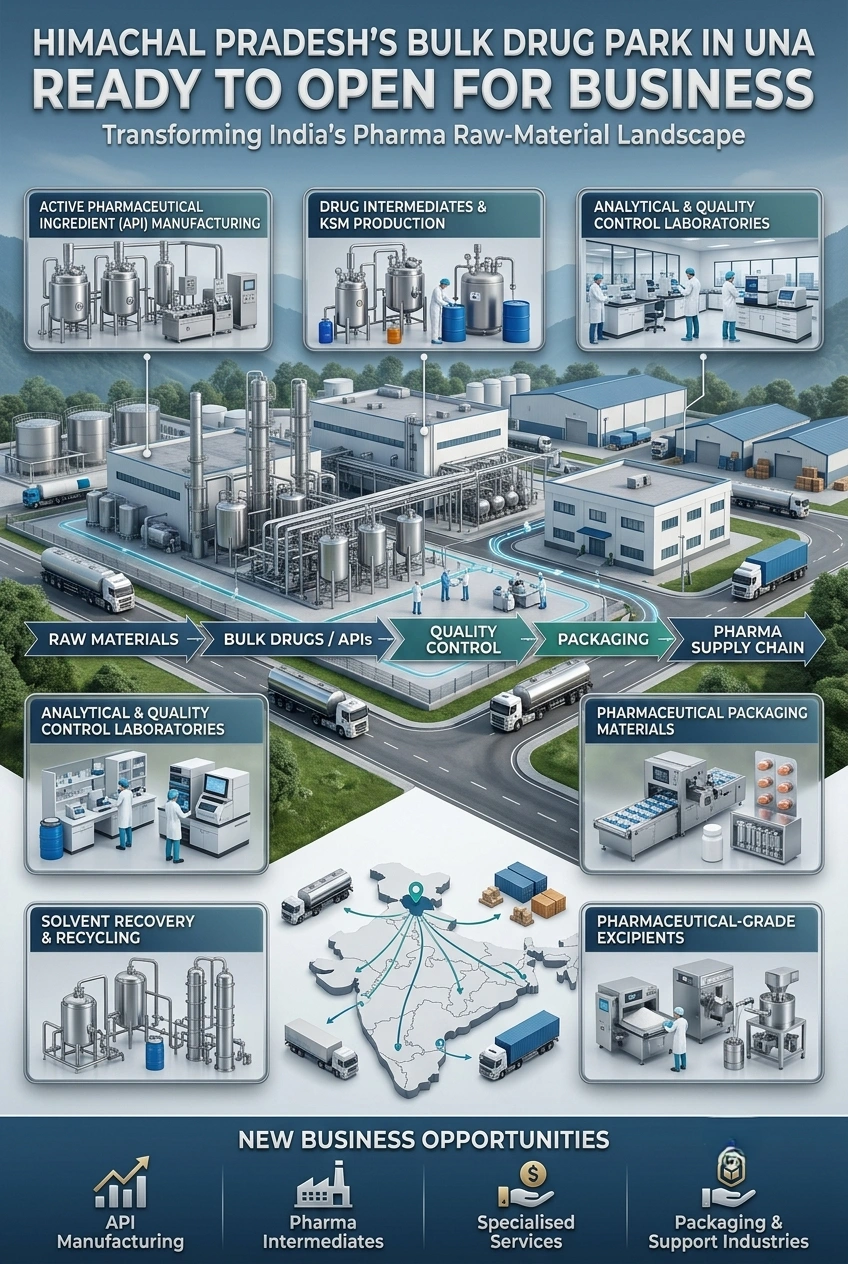
Manufacturing Business Opportunities Emerging From This Development
Retail prices are determined by the price of the drug itself. Retail price is a function of the price of the drug itself. The following manufacturing options are worthwhile considering:
1. Active Pharmaceutical Ingredient (API) Manufacturing
The first and most obvious is API’s own manufacturing process. The Una Park is specifically created for units that manufacture bulk drugs, which make up the active component of the drug formulation. Antibiotics, anti-diabetics, anti-hypertensives and pain management molecules are examples from high-demand API categories. Chemical synthesis facilities for MSME manufacturers can be set up at the park, or MSMEs can license existing chemical synthesis processes. The capital investment requirement is also different based on the complexity of the product but can be commercially viable for MSME scale plants for off-patent APIs. In addition to the domestic market, there are opportunities for export to Southeast Asia, Africa and Latin America.
Explore This Book: Handbook on Active Pharmaceutical Ingredients (API), Drugs & Pharmaceutical Products
2. Drug Intermediates and Key Starting Materials (KSM) Production
APIs do not get created in one go; there are intermediates and KSMs. The production of these precursor chemicals is an opportunity that is not as capital intensive as the production of full API, but is nonetheless important in the supply chain. The EIY is heavily import substitution oriented as India imports many KSMs. The fine chemicals, organic chemicals, or specialty chemicals makers are poised to take an informed look at this segment of business.
Get Detailed Insights from This Book: Drugs & Pharmaceutical Technology Handbook
3. Analytical and Quality Control Laboratory Services
All pharmaceutical companies need to carry out stringent quality testing on raw materials, in-process controls, finished product and stability testing, as well as regulatory documentation. Many manufacturers in one park, this generates recurrent demand for analytical laboratory services from third parties. Establishing an analytical laboratory in or near the park is a business opportunity that expands with park population, and is accredited by NABL. Moderate investment and predictable recurring revenue, as compared with manufacturing investment.
4. Pharmaceutical Packaging Materials Manufacturing
Special packaging is needed for bulk drug manufacturers to transport and store their product — HDPE drums, aluminum foil laminate pouches, fiber drums with liners, blister foils (downstream formulators), and tamper evident containers. If a packaging manufacturer is located close to a dense manufacturing area, then the proximity enables the manufacturer to service multiple clients effectively. It is a capital-moderate opportunity right for MSME entrepreneurs; and has strong growth potential as the park becomes full.
5. Industrial Chemical Solvent Recovery and Recycling
Organic solvents are used in the pharmaceutical industry, especially for API synthesis, in large amounts. Solvent recovery and recycling help manufacturers reduce raw material requirements while meeting effluent management requirements. A centralized solvent recovery unit can serve several park tenants, creating an industrial service business that delivers both environmental compliance support and cost savings. This “dual value proposition” can appeal to both park management and individual manufacturers.
6. Pharmaceutical-Grade Excipient Manufacturing
APIs are the active ingredients in medicines, whereas excipients make up the majority of most medicines (binders, fillers, disintegrants, lubricants, coatings). There are currently numerous excipients, many of which being imported, or sourced from distant domestic suppliers. A major excipient manufacturing plant located in the Una park can tap the downstream demand of the formulation manufacturers from the output of API from the park. Other products, such as microcrystalline cellulose, lactose, magnesium stearate, and croscarmellose sodium have proven markets in this country.
Import-Export and International Market Opportunity
Export Opportunity: India’s history of exporting API and pharmaceuticals is well known.
The country exports to more than 200 countries. These markets include countries with regulatory requirements such as WHO GMP or country-specific regulations.
API manufacturers can establish regulated-market or export-oriented businesses in the Una park. In the short term, they can target semi-regulated markets in Africa, Southeast Asia, and Latin America. Within the next three to five years, they can also aim to obtain approval for regulated markets.
High-volume generic APIs offer some of the most commercially viable export opportunities. This is especially true for APIs coming out of patent expiration. Opportunities also increase when supplies from other global sources become limited.
Import Substitution: India spends a substantial amount on import of pharmaceutical raw materials, especially from China, which is a highly sensitive expenditure. Domestic production potential is high for categories such as vitamins, vitamin intermediates, antibiotic KSMs, cardiovascular drug intermediates, and anti-infective APIs. The Una Park is purposely designed to be able to address these gaps. Those who choose products in line with high-import-dependency API categories have a head-start on benefiting from both policy tailwinds and natural market dynamics.
India Trade Portal, handled by Federation of Indian Export Organisations (FEIO) offers import-export data for the various commodities, which can be beneficial for entrepreneurs to know the most import dependent API categories and plan accordingly.
Related Article: Pharmaceutical Drugs Industry Consultants in India
Indian MSMEs and Startups in Related Industries
Several Indian companies are working in the Pharma manufacturing and API supply chain and there are some examples of them devising viable commercial careers in the sector:
Divi’s Laboratories (Hyderabad): Divi’s started as a niche API and intermediate manufacturer. It initially focused on regulated international markets and is now a large-cap company. Its growth demonstrates the scalability possible for MSME-origin API manufacturers. However, this requires investment in quality systems and regulatory compliance from the outset. For new market players at the Una park, Divi’s provides a relevant template. They can focus on a small product basket and develop deep expertise in the manufacturing process.
Shilpa Medicare (Raichur, Karnataka): Shilpa Healthcare has evolved from a small company into a known API supplier to regulated oncology markets. Its focus on a specific API category, oncology, differs from commodity APIs. This approach demonstrates how product specialisation can create defensible market positions for mid-sized Indian manufacturers. When assessing the Una park, entrepreneurs should consider whether they can pursue a niche specialisation strategy.
What Entrepreneurs Should Evaluate Before Investing
Any serious evaluation of a manufacturing opportunity at or adjacent to the Una Bulk Drug Park should cover the following dimensions:
Product Selection: Import dependency data, domestic demand trajectory, patent status, regulatory pathway complexity, and the competitive landscape should guide the choice of API or intermediate for manufacturing. High-volume off-patent APIs with established synthesis routes reduce technical risk for first-time manufacturers.
Raw Material Access: API synthesis requires chemical raw materials, solvents, and reagents. Evaluate supply reliability, cost predictability, and the extent to which the Una location reduces or increases procurement complexity relative to established pharma clusters.
Regulatory Requirements: API manufacturing requires compliance with Schedule M under the Drugs and Cosmetics Act, along with WHO-GMP certification for export-oriented units. Build regulatory compliance timelines and costs into the investment plan from the outset.
Machinery and Technology: Capital expenditure for pharmaceutical manufacturing equipment is significant. Evaluate whether standard commercially available reactors, dryers, and filtration equipment can meet the target product requirements, or whether the project requires specialized technology, licensing, or technical collaboration.
Workforce: Himachal Pradesh has an established pool of pharmaceutical manufacturing talent, particularly in the Baddi-Barotiwala-Nalagarh corridor. Assess whether skilled personnel are accessible for operations in Una, and factor in training costs if specialized skills are limited locally.
Market Development: Who will buy the API? Identify potential customers — formulation manufacturers in Himachal Pradesh and neighboring states — before committing capital. Long-term supply agreements with anchor customers significantly de-risk the investment.
Break-Even and Working Capital: API manufacturing has meaningful working capital requirements due to raw material procurement cycles and production lead times. Understand the working capital financing structure before committing to a project.
Your investment deserves the right opportunity
How NPCS Can Help Entrepreneurs Evaluate the Opportunity
NPCS – Niir Project Consultancy Services has extensive experience in preparing Detailed Project Reports (DPRs), conducting market feasibility studies, and providing technology consultancy for pharmaceutical manufacturing projects including API units, bulk drug manufacturing, and pharma intermediates.
For entrepreneurs evaluating investment in the Una Bulk Drug Park ecosystem, NPCS can assist with:
Preparation of comprehensive project reports covering plant layout, machinery specifications, raw material sourcing, manpower planning, financial projections, and regulatory requirements. Market research covering domestic demand assessment, import substitution potential, and export market identification. Technology consultancy including process selection, equipment vendor evaluation, and quality system design. Investment evaluation support covering break-even analysis, IRR calculations, and sensitivity testing under different pricing and volume scenarios.
Whether you are a first-time entrepreneur evaluating pharma manufacturing for the first time, or an established industrial group looking to expand into API or intermediate manufacturing, structured consultancy support significantly increases the quality of investment decisions.
Business Opportunity Snapshot
| Industry | Pharmaceutical Bulk Drug & API Manufacturing |
| Market Driver | Government-supported bulk drug park infrastructure; PLI Scheme for APIs; import substitution mandate |
| Key Development | 81 industrial plots at Una Bulk Drug Park to be allocated from October 2026; first-phase production targeted by December 2026 |
| MSME Opportunity | API manufacturing, drug intermediates, analytical labs, excipient manufacturing, packaging materials, solvent recovery |
| Manufacturing Potential | High — dedicated park infrastructure with road connectivity, parking, and planned utilities |
| Export Potential | Significant — semi-regulated and regulated markets in Africa, Southeast Asia, Latin America, EU |
| Import Substitution | Strong — antibiotics, cardiovascular APIs, anti-infective KSMs, vitamins and vitamin intermediates |
| Government Support | Central PLI Scheme for Pharmaceuticals; HP State Industrial Policy; MSME schemes; Startup India |
| Investment Consideration | Moderate to high capital; working capital intensive; regulatory compliance timeline important |
| Risk Level | Medium — market demand is established; regulatory and technical risks are manageable with expert guidance |
| Growth Outlook | Positive — domestic pharma market growing; export demand strong; import-substitution policy tailwinds |

Conclusion
The Una Bulk Drug Park represents a concrete and time-bound pharmaceutical manufacturing opportunity in northern India. It has emerged as one of the region’s most promising industrial projects in recent years. Eighty-one plots are set for allocation from October 2026. Production is targeted to begin in December 2026. Therefore, the commercial clock is already running.
Entrepreneurs and investors who move early can gain a significant advantage. Properly prepared project reports and realistic investment plans can support faster decision-making. Early movers may benefit from first-mover access to plot allocation. They can also establish early supply relationships with pharma manufacturers in the region.
India’s long-term pharmaceutical supply-chain strategy is moving in a clear direction. It aims to reduce import dependence and increase domestic API and intermediate manufacturing. The strategy also supports stronger integration between bulk drug production and formulation capacity. The Una park is a physical manifestation of this strategy. It creates real and addressable business opportunities for manufacturers across the supply chain spectrum.(Una Bulk Drug Park)
For entrepreneurs considering this space, the immediate next step should be structured. Conduct targeted market research to identify the right product category. Commission a detailed project report that honestly covers investment requirements and financial viability. Finally, engage with the state’s industrial authority to understand the plot allocation timeline and eligibility criteria. The opportunity is real. The commercial infrastructure is being built. The time to conduct serious due diligence is now.