India’s tea industry is one of the few industries where agriculture is conducted in accordance with predictable consumer demand. While tea cultivation takes place in gardens throughout Assam, West Bengal, Tamil Nadu and Kerala, real value creation occurs at the blending and packaging stage. If you are planning to be in the business of manufacturing with an investment of anywhere between the range of 1-3 Crore, a tea blending and packaging unit can be a sensible unit which is also possible to scale up and export friendly.
Tea is not a luxury product. It is used on a daily basis in homes, offices, hotels, hospitals, railways, and corporate spaces. This constant demand renders it less volatile as compared to many other FMCG categories. For businessmen who desire to find stable consumption behaviour and flexible product mix, there is strong possibility of good long-term business in this business.
This guide explains market demand, investment cost, machinery required, licenses, margins, risks, and scalability in an organized manner.
Read More: Tea Blending and Packaging
Tea Market Demand in India: Why the Time is Right
India is one of the biggest producers and consumers of tea in the world. However, the profit margins are not generated at the plantation level only. The greatest margin expansion occurs when tea is cleaned, mixed for uniform taste, packed in moisture-proof packaging, and delivered to distributors or institutional buyers.
The demand arises from various channels like retail shops, supermarkets, tea cafes, hotels, hospitals, airline catering and export buyers. What makes the sector attractive is that it is not monopolized. Thousands of regional brands and private label manufacturers get by.
Key demand drivers include:
- Increasing institutional consumption of tea in corporate offices and hospitality
- Retail chains market growth of private label brands
- Strong export demand from Middle East and CIS countries
- One reason for this is the fact that many people are shifting toward specialty blends such as masala and herbal tea.
This diversified demand has the advantage of reducing the reliance on one source of revenue.
Why Tea Blending & Packaging is a Smart MSME Business
Unlike the chemical or heavy manufacturing industries, the operational simplicity of tea blending and packaging is relatively simple. The process is not complex, with no complex reactions and high-risk machinery. Instead, success relies on constancy, moisture control, and the quality of the packaging.
From a business feasibility point of view, this sector presents:
- Predictable year-round demand
- Moderate capital investment
- Flexible product mix
- Export scalability
- Institutional B2B opportunities
Institutional buyers tend to favour dependable MSME suppliers who are capable of delivering consistent quality at competitive prices. This eliminates the requirement of heavy marketing budget in the early stage.
Investment Needed to Start Tea Packaging Unit
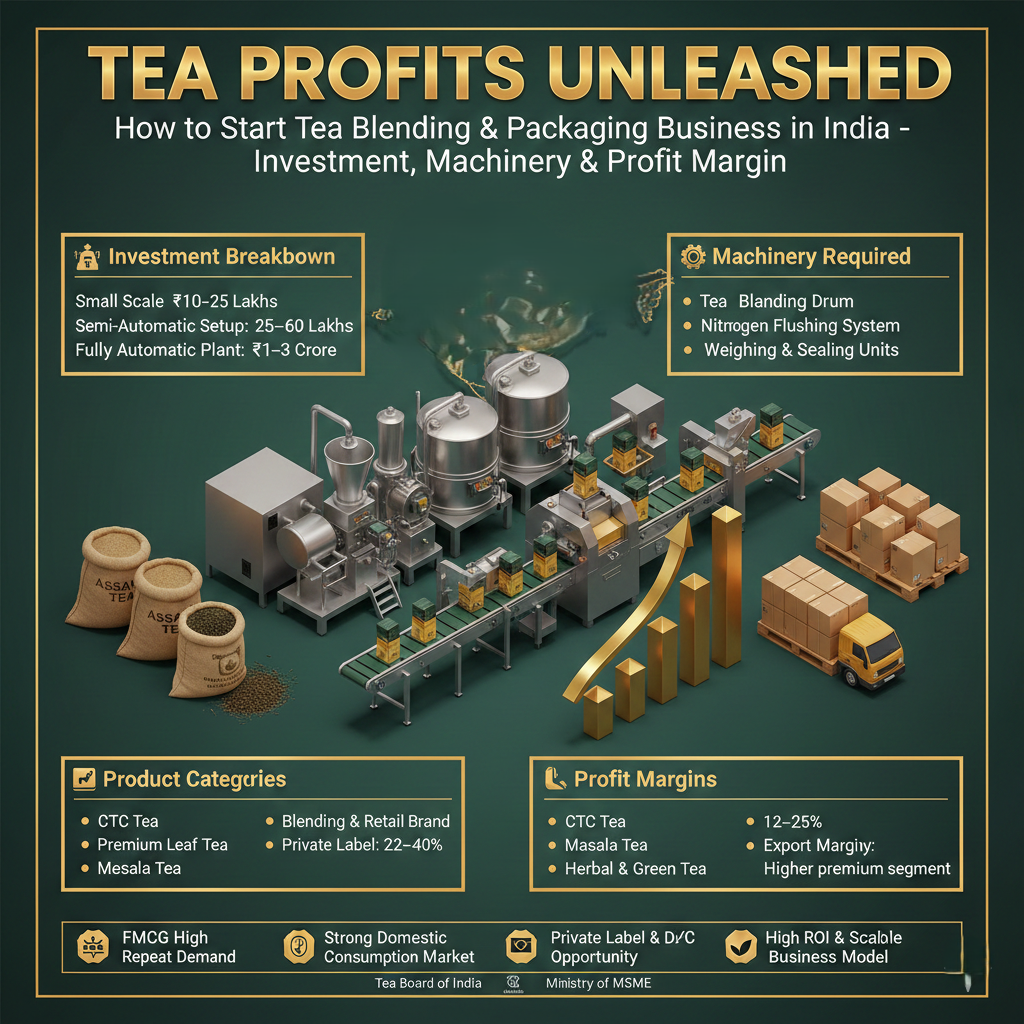
For 1 shift of capacity of 2000-3000 kgs/day, the total project cost generally comes in the range of Rs 1 crore to Rs 3 crore.
Major cost components are machinery, installation, packaging set-up, working capital and warehouse rental. Machinery and installation might involve an expenditure of ₹45 – 70 lac on the basis of level of automation. Initial packaging materials like poly pouches, labels and corrugated boxes may cost between Rs8-12 lakh.
Working capital is very important in this business. Since the cycles of tea procurement and distributor credit terms differ, a minimum working capital of at least Rs.25-40 lakhs is suggested in order to have smooth working.
Many new entrepreneurs underestimate the working capital needs. Although, stable cash flow planning is as important as machinery selection.
Read More: A Business Plan for Tea Blending and Packaging (Tea, Green Tea & Herbal Tea)
Machinery Needed for Tea Blending & Packaging
A tea packaging unit does not need highly complex equipment but good quality machinery does ensure the consistency and integrity of the seal provided to the product.
The essential machinery set-up generally includes:
Cleaning & Conditioning Section
- Vibrio sifter
- Destoner
- De-duster
Blending Section
- Ribbon blender or drum mixer
Packaging Section
- Automatic form fill seal (FFS) machine
- Sealing machine
- Batch coding printer
Secondary Packaging
- Corrugated box packing line
The most important factor is quality of sealing. Tea is very sensitive to moisture, and particularly so during monsoon. Poor packaging integrity can cause product spoilage and damage to the brand.
Explanation of Manufacturing Process
The manufacturing process starts by procuring raw tea through auctions or suppliers. They clean the tea to remove the dust and impurities. After grading and moisture conditioning, workers blend the materials to achieve a uniform taste and colour profile.
If a company produces flavoured or masala tea, it controls the flavour mixing. Automatic packaging machines then package the blended tea in moisture-barrier pouches. Workers seal, batch-code, and label each pouch before packing them in corrugated boxes for dispatch.
Operational discipline is more important than industrial complexity. Consistency in the ratio of blends and control of moisture determine long-term customer retention.
Read More: The Complete Book on Cultivation and Manufacture of Tea (2nd Revised Edition)
Profit Margin and Break-Even Analysis
Sales channel strategy determines tea packaging margins. Retail branding may allow for moderate margins but must be marketed. Institutional and private label supply tend to offer better margin stability because of the order volume.
Approximating margin behaviour:
- Retail SKUs: 8–18%
- Institutional B2B: 12–22%
- Export bulk: 10–20%
- Private label manufacturing: 14 – 24%
Firstly, A 2,500kg per day plant running at 70% capacity can produce healthy contribution margins. However, After the expenses involved in operational costs such as manpower, rent, electricity, and logistics, monthly net profits can be from 5-8 lakhs after the sales get stabilized.
Break-even period usually ranges between 18-30 months based on capacity utilization.
Licenses Needed to Establish Tea Packaging Business
To operate a tea blending and packaging facility in India you must complete these legal requirements:
- FSSAI license
- GST registration
- MSME/Udyam registration
- Trade license
- Factory license (if any)
- Import Export Code for export operation)
The regulatory compliance process helps businesses establish trust with institutional customers.
Read More: High Growth Green Manufacturing Businesses: How Vegan Leather and Agro-Waste Products Are Reshaping Industry
Export Opportunities in Tea Packaging
Export markets provide businesses with beneficial growth opportunities because they can produce bulk orders more effectively. Moreover, Export buyers normally order in 5kg, 10kg, or 25kg moisture-resistant packaging formats.
They focus primarily on:
- Blend consistency
- Competitive pricing for containers
- Moisture-proof packaging
- On-time shipment
For MSME units, private label export manufacturing can be one of the most rapidly growing channels of export.
Major Risks Involved in Tea Packaging Business
Although the business seems straightforward, one must handle some risks with caution. For example, Humidity can harm products that are not well sealed. Moreover, Procurement cost fluctuations can have a marginal impact. Additionally, Distributor payment delays can put pressure on working capital.
Careful relationships with suppliers, disciplined inventory planning and quality packaging machinery reduce these risks significantly.
Read More: Paper Bottle Manufacturing Business – An Infrastructure-Led Opportunity in Beverage
Conclusion
Indeed, Starting a tea blending and packaging business in India is less about plantation ownership and more about supply discipline, SKU consistency, and moisture-proof packaging. Furthermore, The business benefits from stable demand, moderate investment requirement, and export scalability.
If planned with proper financial forecasting and channel strategy, this sector can provide steady growth and long-term sustainability without heavy industrial complexity.
Frequently Asked Questions (FAQ)
- What is the minimum investment required to start a tea packaging unit?
A competitive small-scale unit generally requires ₹1–3 crore depending on automation and capacity. - Is tea blending business profitable in India?
Yes. With proper sales mix and cost control, margins between 12–24% are achievable. - What is the ideal starting capacity?
2,000–3,000 kg per day in a single shift is considered practical for beginners. - How much working capital is needed initially?
₹25–40 lakh is recommended for smooth procurement and distributor credit cycles. - Is tea business seasonal?
No. Tea demand remains stable throughout the year across retail and institutional segments. - Can MSME units export tea?
Yes. With IEC registration and proper compliance, MSMEs regularly export bulk tea. - What is the biggest mistake new entrepreneurs make?
Compromising on packaging quality and seal integrity to reduce initial machinery cost.