Introduction: Synthetic Rubber Manufacturing Business
For many first-generation entrepreneurs, chemical manufacturing seems daunting because of assumptions of capital requirements and complex technology. The synthetic rubber and polymer industry is commonly seen as a realm reserved for some of the largest petrochemical corporations. This belief keeps a very large proportion of MSMEs away from a sector which, in reality, has a lot of strong opportunities downstream.
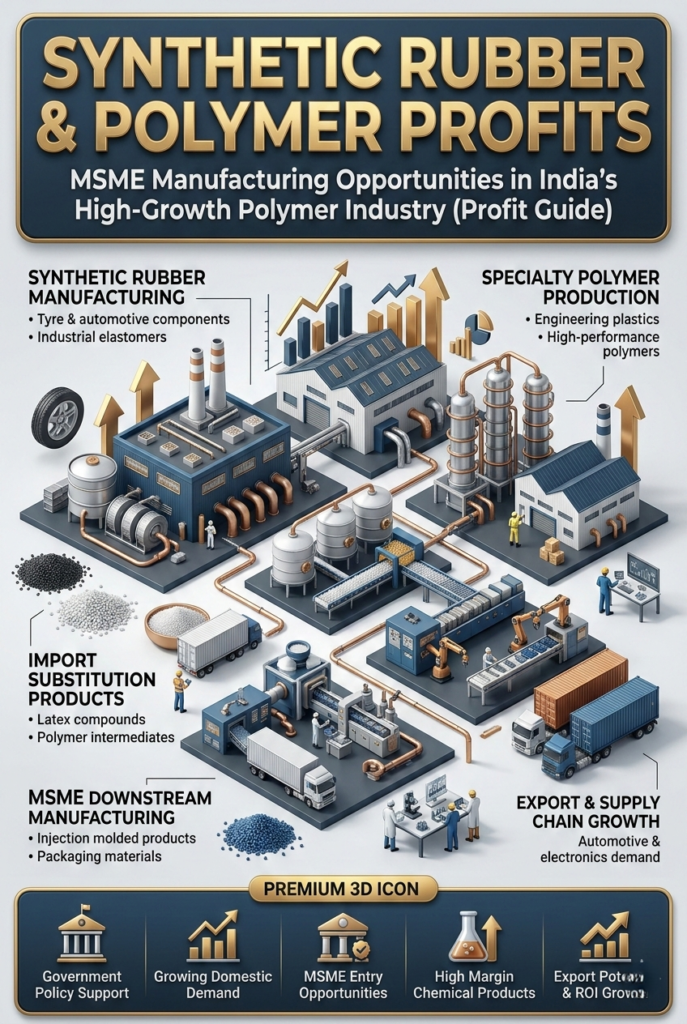
The fact is that the manufacturing of synthetic rubber and polymers is a layered value chain. While the upstream production of monomers and resins is capital intensive, downstream activities like compounding, blending, masterbatch manufacturing and performance plastic processing lend themselves well to MSMEs.
According to the Department of Chemicals & Petrochemicals, petrochemicals are the key input for automotive, infrastructure, textiles, agriculture, packaging and electrical equipment industries. Production figures reveal that polymers/olefins alone account for almost six out of ten percent of total petrochemical production, clearly revealing the existence of strong and consistent downstream demand.
For entrepreneurs, this is an indication of space to enter the value chain at a stage where profitability is related to the formulation performance rather than the production volume.
Read More: The Complete Book on Rubber Processing and Compounding Technology (4th Revised Edition)
What Can India’s Petrochemical Production Mix Tell Us
The petrochemical production structure in India reveals the share of polymers and olefins followed by fibber intermediates, synthetic yarns, aromatics and performance plastics. Although the upstream portion of synthetic rubber is small, its downstream consumption is large.
The following are some of the applications of synthetic rubber:
- automotive components
- industrial machinery parts
- construction materials
- electrical insulation products
High capacity utilization across basic petrochemicals represents consistent procurement by downstream manufacturers. Once MSMEs assure quality consistency they often get repeat orders and long-term supply contracts.
Why Synthetic Rubber and Polymer Manufacturing is Suitable for MSMEs
From a techno-economic point of view, the downstream polymer and rubber units are in good match with the capabilities of MSMEs. These projects generally involve medium capital outlay and permit phased growth as demand increases.
Some important structural advantages are:
- manageable size of plants and utilities
- modular scalability by adding more lines
- stable B2B demand throughout the industries
Unlike commodity chemicals, margins in this segment are driven by the accuracy of the formulation, process discipline and application-specific performance. MSMEs that have been able to deliver reliable customer specifications have generally seen improved buyer retention and stability in pricing.
Rubber Compounding for Automotive and Industrial Use
The automotive industry is one of the biggest users of synthetic rubber compounds. Rubber hoses, gaskets, seals, belts, and vibration-damping components are a critical part of any manufacturing process for vehicles and industrial equipment.
MSMEs involved in rubber compounding usually do well by concentrating on:
- consistent mixing quality
- controlled curing cycles
- стаbile raw material sourcing
Industrial groups like Welspun Group have shown the way in which material innovation coupled with infrastructure and automotive demand can develop scalable manufacturing enterprises. MSMEs can copy this model with a smaller scale through serving niche applications inside of automotive supply chains.
Read More: BUTYL RECLAIM RUBBER – Manufacturing Plant, Detailed Project Report, Profile, Business Plan, Industry Trends, Market Research, Survey, Manufacturing Process, Machinery, Raw Materials, Feasibility Study, Investment Opportunities, Cost and Revenue
Polymer Masterbatch Production for Packaging Applications
Packaging manufacturers rely more on polymer masterbatches to provide added functionality and appearance. These masterbatches enhance product performance and help converters to meet regulatory and customer requirements.
Common functional masterbatches are:
- UV stabilizers
- anti-static additives
- flame retardant compounds
Companies such as UFlex Ltd. were built on global operations thanks to bolstering downstream polymer innovation as opposed to base resin production. For MSMEs, in terms of scalability in the manufacturing of masterbatch, this is relatively simple as capacity expansion typically requires additional extrusion lines.(Synthetic Rubber Manufacturing Business)
Read More: Rubber & Plastic Industries, FRP Products, Polymers, PET, PVC, LDPE, HDPE, Polypropylene, Acrylic and Polyutherthane Projects
Thermoplastic Elastomers: An Emerging MSME Opportunity
Thermoplastic elastomers have the flexibility of rubber and the ease of plastic processing. These materials are increasingly used in footwear, medical devices, electronics and automotive interiors.
From a feasibility perspective, this segment has:
- batch-based production
- low to moderate energy use
- good export acceptance
Investing in basic laboratory testing is important for formulation repeatability, which is key to customer approvals and long-term contracts.
Synthetic Latex Producing for Adhesives and Coatings
Synthetic latex emulsions have been extensively utilized in construction chemicals, textile processing, paper coatings and paints. Demand in this segment is mostly contract based so planning of production is more predictable.
Entrepreneurial journeys like Nirma Group emphasize the importance of formulation consistency and operational discipline. Latex manufacturing plants are modular so that MSMEs can increase capacity gradually by adding reactors.
Read More: Top 20 Rubber Products Manufacturing Business Ideas
Performance Plastics for Engineering and Industrial Application
Performance plastics play a major role in electrical insulation, automotive panels, industrial housings and flame retardant components. MSMEs that specialise in polymers filled with glass or flame retardant compounds can serve a domestic as well as export market.
This approach to growth is not unlike that of Aarti Industries, which grew by focusing on value-added chemical intermediates as opposed to bulk production.
Export Potential of Indian MSMEs
The Indian petrochemical ecosystem fosters exports of polymer compounds and rubber intermediates. Once quality certifications are in place MSMEs can provide global automotive, construction and packaging supply chains.
Export oriented products generally include:
- elastomeric seals & gaskets
- polymer masterbatches
- Performance plastic components
Making a Feasibility Assessment Before Investing
Before investing in a project for a synthetic rubber or polymer, entrepreneurs have to consider a number of technical and financial parameters. These include energy use, material wastage, curing efficiency, environmental compliance, and working capital requirements.
Professional feasibility studies are important in this stage. Organizations such as Niir Project Consultancy Services prepare Market Survey cum Detailed Techno-Economic Feasibility Reports which include manufacturing processes, machinery selection, market demand analysis, and profitability projection.(Synthetic Rubber Manufacturing Business)
Read More: Beginner’s Guide to Starting a Tyre Pyrolysis Unit in India
Final Perspective
Synthetic rubber and polymer manufacturing offers MSMEs one of the most balanced entry points into India’s petrochemical value chain. Entrepreneurs who focus on formulation stability, process discipline, and buyer qualification are better positioned to secure long-term contracts and scalable growth. First-generation founders who want to establish industrial businesses that grow at constant rates should consider downstream polymer and elastomer manufacturing because it offers them a highly attractive business opportunity.
Frequently Asked Questions
Is the manufacturing of synthetic rubber a good business for first-time entrepreneurs?
Yes, in particular downstream operations such as compounding, blending and masterbatch production.
What is the average investment for MSME project?
Most of the projects are in between Rs 2 crores to 15 crores range depending upon the capacity and automation.
Is there an export demand for polymer and rubber products?
Yes, especially in the automotive, packaging, construction and engineering industries.
What are the major risks involved?
The main difficulties for the company arise from two problems which involve fluctuating raw material prices and unstable material quality.
Can the capacity for production be easily increased?
Yes, downstream units provide the ability to expand modularly with the addition of more mixing or extrusion lines.