When entrepreneurs explore profitable manufacturing industries in India, the most common question they ask is:
“Which manufacturing industry is growing the fastest in India?”
However, growth alone does not guarantee success.
Manufacturing is a capital-intensive business. Investments in the above-mentioned areas are almost impossible to recover. In such an environment, profitability matters far more than headline growth rates.
A more relevant and profitable question is:
“Which manufacturing industries in India consistently make money and allow new units to scale faster?”
An analysis of India’s corporate profitability landscape, highlighted in the Business Today December issue, reveals a clear pattern. Profits are concentrated in industries with essential demand, institutional buyers, stable policies, and strong supply chains. In particular MSMEs, these sectors offer the most dependable chances for the establishment of new manufacturing plants.
This article discusses the reasoning behind the position taken by profitability as the best indicator of manufacturing success and also points out the most lucrative manufacturing industries in India where new units can grow quicker and safer.
Read More: Top 3 Profitable Manufacturing Opportunities in 2026: Ferrosilicon, Vedic Paint & Bamboo Wood Pellets
Why Profitability Is a Stronger Signal Than Growth in Manufacturing
Growing industries seem very appealing at first sight, but in reality, most of them are characterized by:
- Low profits
- Very aggressive price competition
- Volatility in demand
- Big working capital requirements
Profits, however, show the actual condition of an industry.
A continuously profitable manufacturing sector generally means:
- Predictable and repeated demand
- Power to set prices or cost efficiency
- Capacity to bear economic downturns
- Higher confidence for banks and financers
A Business Today report from December states India’s biggest profit makers are mostly located in the power and infrastructure, health care, FMCG, pharmaceuticals, chemicals, and finance-linked ecosystems sectors. These sectors are basic, not speculative ones.
Manufacturing entrepreneurs can’t ignore that. The existence of strong supplier ecosystems in profitable sectors enables MSME manufacturers to expand their operations without incurring large risks.
How Profitability Enables Faster Manufacturing Scale
The growth of a manufacturing facility is accomplished quickly if the following conditions are met:
- Value of demand increases without incurring a lot of marketing costs
- Customers are keep on ordering and ordering for a long time
- Expansion of capacity is done gradually
- At every stage of growth financing is readily available
High-profitability industries are the ones that will naturally give such kinds of advantages. The buyers in these industries take reliability, compliance, and quality to be the most important factors while the price is the least important. Thus, the pressure on the manufacturers is reduced which in turn leads to gradual and sustainable growth.
1. Power and Infrastructure Manufacturing
Power and infrastructure companies are the ones that always come at the top of the list when it comes to the most profitable companies in India.
Their profitability is driven by:
- Long-duration projects
- Revenue generated from asset-backed
- Policy stability and strong government support
A strong performance in power finance and infrastructure-linked companies is mentioned in the Business Today December issue, suggesting that the capital flow into this sector will be sustained.
High-Scaling Manufacturing Opportunities
The new manufacturing units that are installed in this sector will have a very good demand visibility and they will be looking for the big buyers like utilities, EPC contractors, and government institutions.
One of the major profitable manufacturing areas is:
- Electrical transmission and distribution equipment (HT/LT panels, switchgear)
- Renewable energy balance-of-plant components (mounting structures, cable trays)
- EV and energy storage infrastructure (battery enclosures, power electronics housings)
Almost all of the components in the electrical and renewable energy sectors that India imports are the specialized ones, which means that there is a very strong opportunity for domestic manufacturers in the area of import substitution.(Profitable Manufacturing Industries in India)
Read More: High-Growth MSME Manufacturing Opportunities in India’s Power, Energy and Infrastructure Sectors
2. Healthcare and Pharmaceutical Manufacturing
Healthcare is one of the most profitable and resilient sectors in India. Additionally, the demand coming from hospitals, government programs, and exports is non-cyclical and therefore permanent.
Manufacturing units scale faster in this sector because healthcare demand does not depend on economic cycles.
Scalable Manufacturing Opportunities
- Medical consumables and disposables (syringes, IV sets, diagnostic products)
- Pharmaceutical formulations and intermediates (oral solids, liquid dosage forms)
- Hospital infrastructure products (ICU beds, stainless-steel medical furniture)
India’s strong pharmaceutical export base allows new manufacturers to grow through backward integration and global markets.
3. FMCG and Food Processing Manufacturing
FMCG businesses never lose their profitability because they always meet the needs of their consumers every day. However, manufacturers in the backend supplying core, intermediates, and packaging get their share of profits without incurring costs on branding or advertising.
The manufacturing units in this area double up their operations quickly because of the vast population growth and the increase in per capita income.
Profitable Opportunities in FMCG Manufacturing
- Food ingredients, dehydrated products, and spice processing
- FMCG and food packaging materials (flexible films, paper-based packaging)
- Home and personal care intermediates (surfactant blends, cosmetic bases)
In addition to this, the export of standardized products with longer shelf life also contributes to the capacity expansion.
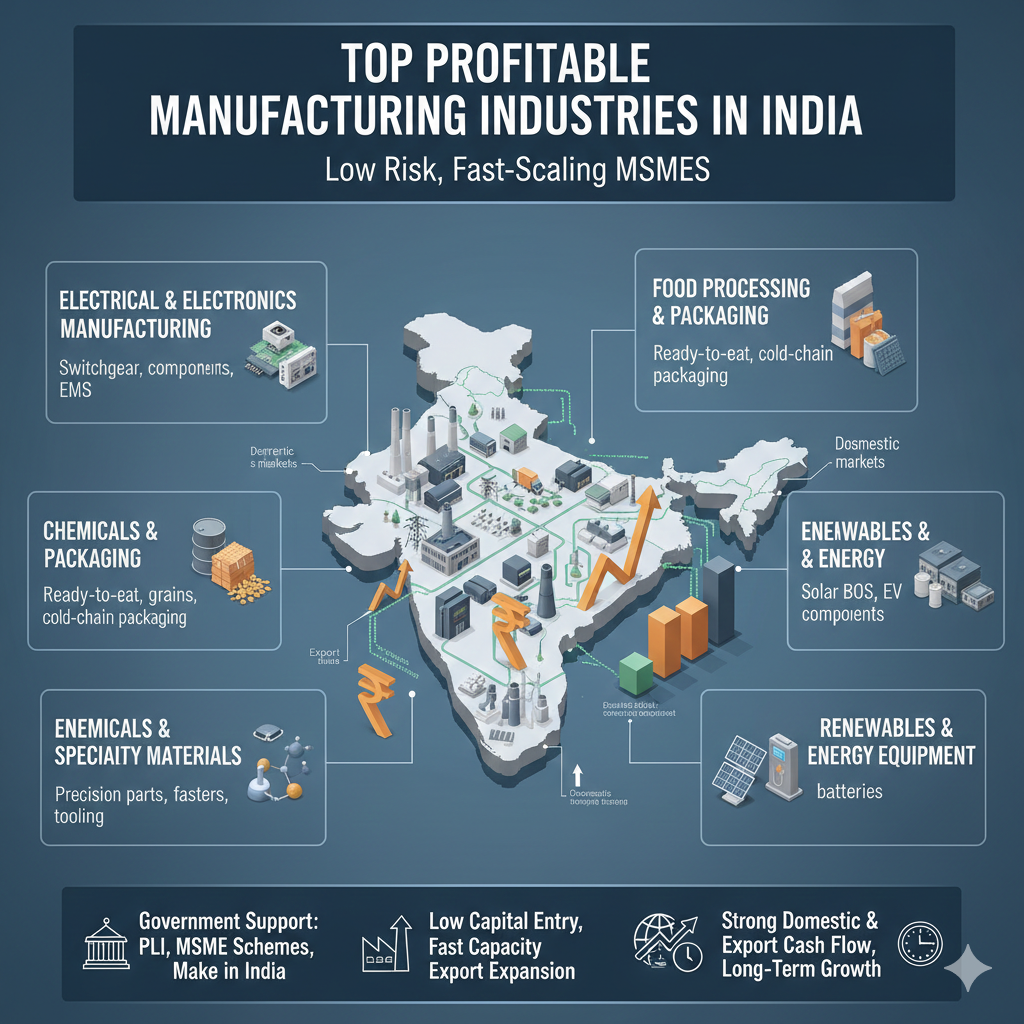
4. Chemicals and Industrial Materials Manufacturing
The chemical industry is always making money since it sells to various customers like pharmaceuticals, agriculture, FMCG, and infrastructure, thus draining the risk by having a wide diversification. Demand is stable because of this diversification and risk is reduced.
Manufacturers expand more quickly because of long-term contracts in the industrial market and also because of the huge import substitution potential.
High-Potential Chemical Manufacturing Areas
- Specialty and performance chemicals
- Industrial process chemicals
- Agro and nutrient chemicals (micronutrients, specialty fertilizer inputs)
India’s dependence on imported specialty chemicals creates a major opportunity for technology-driven domestic manufacturers.
Read More: Rosin Cored Soft Soldering Wire – Manufacturing Plant, Detailed Project Report, Profile, Business Plan, Industry Trends, Market Research, Survey, Manufacturing Process, Machinery, Raw Materials, Feasibility Study, Investment Opportunities, Cost & Revenue
5. BFSI-Linked Manufacturing and Industrial Services
The prosperous BFSI (Banking, Financial Services, and Insurance) sector indirectly pushes the manufacturing sector to growth as they are the main providers of credit in all sectors.
As the financial inclusion process goes deeper, the need for physical and digital banking infrastructure will be high continuously.
Manufacturing Opportunities in BFSI Ecosystem
- ATM kiosks and smart banking infrastructure
- Secure storage systems and vaults
- Modular office furniture for banks and financial institutions
Because purchases are often financed through structured credit, order conversion rates are higher, thus allowing steady scale-up.
Read More: Bread Factory. How to Make Bread. Bread Making Plant. Indian Bakery Food
Why Some Manufacturing Units Scale Faster Than Others
Fast-scaling manufacturing firms often have the following characteristics in common:
- They cater to essential, non-discretionary sectors
- Their target customers are B2B institutional buyers, not consumer branding
- They are in the sectors that banks and lenders prefer
There were many successful Indian MSMEs that started off in a low-profile manner by supplying basic products to the industry that had high-profit margins and later on grew continually.
Feasibility: The Foundation of Sustainable Manufacturing Scale
The scaling of manufacturing is not merely a vision; it is linked to the project’s viability and organization.
Professional feasibility study ensures that the projects are scalable before any money is invested in them.
Niir Project Consultancy Services (NPCS) supports entrepreneurs by preparing Market Survey and Detailed Techno-Economic Feasibility Reports, covering:
- Choosing the manufacturing process and technology
- Analysis of market demand and competition
- Planning of capacity and product mix
- Financial projections and profitability determination
Using this approach, the risk is considerably reduced and at the same time the proper support is provided for a smoother expansion.
Read More: Profitable Agro Based Projects with Project Profiles (Cereal Food Technology) (2nd Revised Edition)
Government Ecosystem Supporting Profitable Manufacturing
India’s manufacturing sector growth has received the backing of:
- Ministry of Power
- Ministry of Health and Family Welfare
- Ministry of Food Processing Industries
- DPIIT and MSME-focused initiatives
through clear policy direction. These bodies grant manufacturing investors the needed regulatory clarity, provide incentives and offer long-lasting policy stability.
Final Insight: Profitability Is the Best Guide
The changes and developments in the trends and incentives do not influence profitability that much as it is the case with the other aspects of business.
The Business Today December issue confirms that industries built on essential demand, institutional buyers, and disciplined execution consistently outperform.
For manufacturing entrepreneurs, the lesson is simple:
Follow profitability, validate feasibility, and build where demand is permanent.
Manufacturing units serving profitable markets do not only continue to exist—they grow more quickly and in a more sustainable manner.
Frequently Asked Questions (FAQs)
Which manufacturing industries are most profitable in India?
Power and infrastructure, healthcare and pharmaceuticals, FMCG-linked manufacturing, specialty chemicals, and BFSI-supported ecosystems consistently show strong profitability.
Is profitability more important than growth for new manufacturing units?
Yes. Profitability ensures stable cash flows, easier access to finance, and long-term sustainability.
Can first-time entrepreneurs enter these manufacturing sectors?
Yes. Many opportunities exist at the MSME supplier level with repeat institutional demand.
What are the reasons behind the rapid scaling of backend manufacturing units?
They do not incur costs related to branding, cater to large customers, and get the most out of supply agreements that last for a long time.
In what ways does a feasibility report contribute to fast scaling?
It recognizes demand, expenses, risks, and profits beforehand, thus, allowing proper planning and less complicated growth.