Export business India to Vietnam
Vietnam-India bilateral trade is moving towards a new stage in 2026. This isn’t just a policy change, it’s an opportunity for entrepreneurs, given the multiple agreements that have been signed and the shared objective to substantially boost bilateral trade.
While Vietnam is quickly becoming the world’s manufacturing powerhouse, it remains very dependent on imports for essential products and services, particularly in the pharmaceuticals, technology solutions, processed foods and industrial input sectors. India, having excellent production potential, can fill this gap.
For Indian entrepreneurs, the question is not whether opportunities exist, but whether there is an effective business model to capture the opportunities.
Why the India–Vietnam Trade Shift Matters
Vietnam has become a key manufacturing hub for the world, particularly for companies seeking to diversify away from China. But it is still lacking in some key respects in its domestic ecosystem.
This is a special opportunity:
- Increased demand for value added imported goods
- To encourage greater access to Indian suppliers for goods and services.
- The positive policy incentives for bilateral trade are notable.
- The potential for expansion is $10 billion over the next few years.
The export businesses with the target of Vietnam market can get higher growth with relatively lower competition than saturated domestic market.
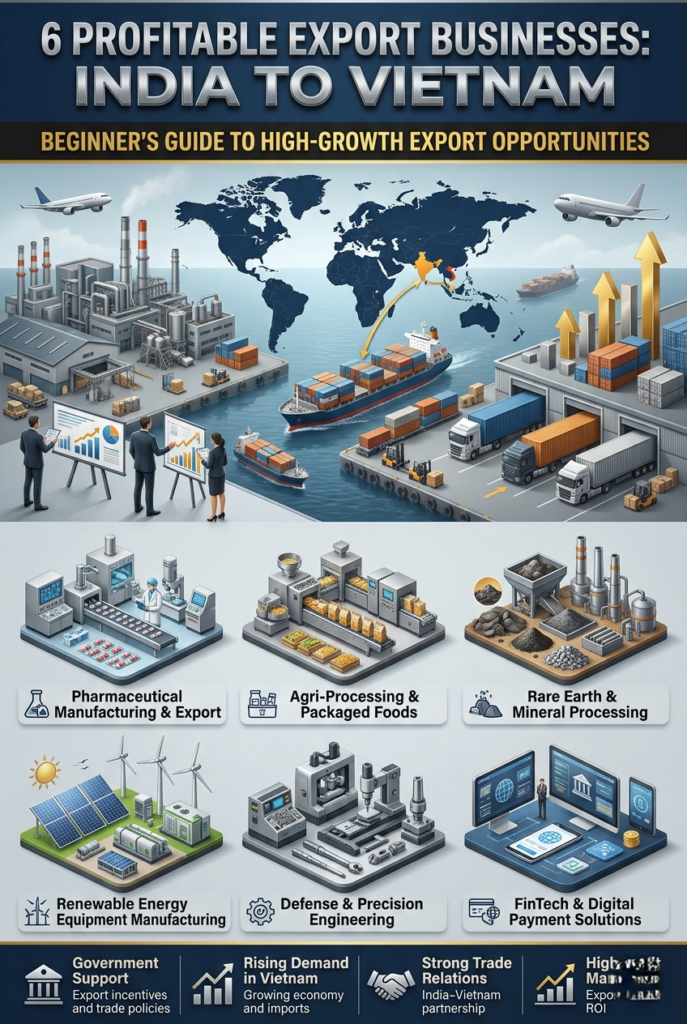
High-Potential Business Ideas for 2026
There are six well-chosen areas that have high demand, profitability, and scalability.
1. Pharmaceutical Manufacturing and Export
India is referred as the “pharmacy of the world” and Vietnam imports much of its medicines from there. Better regulation will help Indian companies meet the challenges of export expansion effectively.
Why it works:
- Representative and persistent needs
- Strong profit margins
- Created the international brand of the Indian pharma sector
Best suited for: Entrepreneurs with some investment capacity and some knowledge of regulations.(Export business India to Vietnam)
Get Detailed Insights from This Book: Business Ideas for Startup in Drugs & Pharmaceutical Industry with Project Profiles (3rd Edition)
2. Agri-Processing and Packaged Foods
The middle class is increasing in Vietnam leading to a growing demand for processed and packaged food products. However, Indian businesses can add value to raw agricultural products by processing them, rather than exporting them.
Opportunities include:
- Frozen fruits and vegetables.
- Ready-to-eat meals
- Packaged spices and food products.
Benefits:
- Lower entry barrier
- Strong export demand
- Faster market entry
3. Rare Earth and Mineral Processing
The rare earth elements are essential for electric vehicles, renewable energy, and electronics. India has nature reserves but its processing capacity is yet to be developed.
Why it is a strategic opportunity:
- High global demand
- Limited competition
- Long-term growth potential
Note: Investment and technical expertise is more required in this sector with high potential in terms of first mover advantage.
Access Complete Business Plan: Rare Earth Permanent Magnet: A High-Growth Strategic Manufacturing Opportunity for Startups
4. Renewable Energy Equipment Manufacturing
Vietnam is keen on investing in clean energy. The country is aiming for sustainable development goals and demands are high in components used in solar and other renewable energies.
Business area:
- Solar panels and components
- Energy storage systems
- Related electrical equipment
Advantages:
- Supported by government sector
- Sector for the future
- Future sustainable demand
Related Article: Top 20 High-Growth Renewable Energy Startups to Launch in India
5. Defense and Precision Engineering
Vietnam is diversifying its defense imports and open for collaborations with Indian firms. The offers consist of specialization in manufacturing and engineering.
Opportunities:
- Components manufacturing
- Precision engineering parts
- Technical collaborations
Best suited for: Manufacturers with previous experience and technical knowledge.
6. FinTech and Digital Payment Solutions
The sector of FinTech is one of the fastest-growing and also needs comparatively low capital as compared to manufacturing.
As the number of online transactions between India and Vietnam grows, the need for cross-border payment solutions and financial services is also on the rise.
Why choose FinTech:
- Low initial investment
- Fast scalability
- High return potential
How to Start an Export-Oriented Business
A lot of business owners fail not because they had bad ideas, but because they didn’t execute well. There needs to be a structured way of doing it.(Export business India to Vietnam)
Step 1: Market Research
- Assess market gaps in Vietnam.
- Undertake competition analysis, pricing analysis
- Study import procedure
Step 2: Make a Detailed Project Report
A project report would be produced to assess the:
- Investment requirements
- Cost of machinery & setup needs to be considered.
- Will be assessed based on expected sales revenue, profit margins.
- Risk factors
When applying for loans or funding, this document is also very important.
Step 3: Select the appropriate location.
There are different advantages of various regions in India based on industry:
- Mineral industries: Jharkhand, Odisha
- Pharmaceuticals: Telangana, Gujarat
- Food processing: Maharashtra
The state of Technology and FinTech in Karnataka. Technology and FinTech in Karnataka.
Step 4: Register and Obtain Licenses
In order to establish, you need to register the business and obtain:
- Registration of the business
- Import Export Code (IEC)
- GST registration
- Industry-specific licenses
Step 5: Secure Funding
Sources of funds are:
- Bank loans
- Government schemes and subsidies
- Private investors
Sound financial planning would help in regulating long-term risks.
Estimated Investment and Returns
All sectors have investment and profit levels:
- FinTech: ₹30–50 lakh, fast returns (18–30 months)
- Agri-processing: ₹50 lakh- to ₹2 crore moderate returns
- Waste disposal companies: ₹2–10 crore, high and stable margins
- Renewable energy: medium to high investment with long term growth.
- Rare earth processing: High investment, strategic returns
The main point is to select an option that fits your budget and experience.
Choose the right startup backed by real market demand
Risk Management Tips
To minimise risk in your business:
- Focus on a specific niche rather than a wide-ranging strategy.
- Pay attention to quality and compliance
- Establish good relationships between stakeholders in the supply chain
- Don’t invest too much in the first phase
Make use of a professional feasibility report. Work on a professional feasibility report.
Why Expert Guidance Matters
The launch of a manufacturing business involves different technical and financial aspects. It is important to consult professional.(Export business India to Vietnam)
NIIR Project Consultancy Services supports entrepreneurs with elaborate project reports and feasibility studies, based on the actual market scenario.
They will usually give a report that contains:
- Breakdown of investments and costs.
- Details of the machinery and plant set up.
- The amount of profit expected and ROI calculations
- Regulatory and compliance guidance
They have more than 20 years of experience and have helped hundreds of companies realize their ideas into a working unit. This is a type of planning that can be useful to the first-time entrepreneur, saving time and money.
Conclusion: Timing Is the Real Advantage
The expansion of trade between India and Vietnam is not something that is possible in the future, but is happening today. There is an increasing demand, supportive policy, and gaps in supply.
Business owners that act early can:
- Reach new markets with more competition
- Establish a competitive position in the market
- Accelerate growth in a developing trade route
A long wait also can mean the loss of opportunity as the market fills up.
There are three important elements to success in this space:
Proper planning, appropriate sector and timely implementation.
Frequently Asked Questions (FAQs)
Q1. What is the biggest advantage of the growth of India-Vietnam trade?
It boosts the demand for export of Indian products and generates fresh business opportunities.
Q2. What Business is best for a beginner?
FinTech and agri-processing are simpler to start considering the lower investment and simple operations.
Q3. Would you like a project report?
Yes, it will help in planning, reducing risks, and making fundable.
Q4. What is the investment needed?
It starts at 30 lakh and can go up to few crores, depending on the industry.
Q5. What business is best to get into?
Generally, there are relatively low set up costs, and this is where the fastest returns usually come from in the FinTech space.
Q6. What are ways to lessen business risk?
Choosing the right industry, sound financial judgment and expert advice is the answer.