


It was one of India’s strongest statements of the year for the pharmaceutical industry. The Department of Pharmaceuticals, Ministry of Chemicals and Fertilisers, has officially released the second call for applications under the Promotion of Research and Innovation in Pharma and MedTech (PRIP) Scheme — a ₹5,000 crore government program aimed at boosting India’s pharmaceutical and medical device innovation ecosystem.
According to News on AIR, this is a big turning point for entrepreneurs, MSMEs, Startups, and manufacturers in the pharma and MedTech industry. But the government is at the same time investing in the innovation pipeline of the Indian pharma industry by steering its companies to move up the innovation value chain — from generics to complex biologics, biosimilars, novel drug delivery systems and advanced medical devices.
As a medical device innovator, formulation startup, medical devices business, or a pharma entrepreneur, this is not a policy you can afford to ignore. Applications will open around mid-September 2026. Time is brief. This is a huge opportunity.
What Recent Reporting Means for Your Business
On August 28, 2026, News on AIR reported that the second round of applications under the PRIP Scheme has begun with financial assistance of up to ₹100 crore being provided for each eligible project. This is following the first call which already garnered significant industry participation.
What Happened
The government has opened up applications for two categories of projects: early-stage and late-stage. Early-stage projects are focused on MSMEs and startups at Technology Readiness Levels (TRL) 1, 2 or 3, or as a concept validated, prototype stage innovation. Late-stage projects are geared towards companies that are more advanced in their commercialization process. The government is seeking new innovation pipelines as the applicants from the first round are not allowed to re-apply for the same projects.
Why It Matters
Currently, India is third largest in the world in terms of pharmaceutical volume and 11th in value with over 3000 companies and more than 10,500 manufacturing units. By 2030, the domestic pharma industry will be worth $130 billion. In FY 2024-25, pharma exports have increased by more than 9% YoY to over $30 billion. However, India’s R&D expenditures as a percentage of revenue are still low when compared with other countries. That’s where PRIP directly intervenes.
What Opportunities Emerge
All of the stakeholder groups benefit. Enlightenment on government support for entrepreneurs with funding support is provided. The MSMEs can now pursue complex generics and biosimilars projects which are difficult to pursue in the past with high investment. Co-development of new formulations with the research institutions at NIPER is possible for the manufacturers. Investors get a pipeline of government approved and funded pharma startups with commercialisation avenues. Exporters can develop their own molecules for markets such as the U.S., EU and Japan, which have regulations in place.
Why Act Now
The application submission opens in mid-September, 2026. The applications are submitted in two stages: Concept Note and Application for shortlisted candidates. Preparation takes time. Early movers are going to be ahead of the curve in getting good and well-formulated concept notes out. This is the second, and likely final, general invitation prior to awarding of PRIP funding.
Related Article: India’s Pharma Boom: 5 Startup Opportunities You Can’t Ignore
Why India’s Pharma & MedTech Industry Is Growing Rapidly
The Indian pharma industry is witnessing a structural shift from a volume-based generics business to innovation-based biopharma business. There are multiple factors contributing to this increase.
Firstly, the global biosimilar market, which India is a natural leader in, is expected to see an unprecedented growth rate of around 15.8%, while India’s domestic biosimilar market is projected to reach a value of $1.5 billion by 2025. Second, in the next decade, the patent protection for billions of dollars of global branded drugs is coming to an end.Second, in the next decade, there is the opportunity for complex generics and biosimilar manufacturers to capitalize on billions of dollars of global patented drugs. Third, India’s MedTech industry is booming, and the demand for diagnostics, robotic surgical devices, AI-powered devices, and platforms that integrate telemedicine has risen significantly since the pandemic.
The government recognises this. In addition to PRIP, India has launched the Biopharma SHAKTI initiative in Union Budget 2026–27 with an outlay of ₹10,000 crore to establish India as a global hub for biologics manufacturing. The National Biopharma Mission, NIPERs (National Institute of Pharmaceutical Education) as Centres of Excellence and PLI Scheme for Pharmaceuticals are all part of a policy ecosystem that offers both capital and institutional support.
As reported by News On AIR, the PRIP Scheme specifically targets priority areas including new medicines, complex generics, biosimilars, precision medicine, orphan drugs, antimicrobial resistance drugs, and novel medical devices — aligning perfectly with global pharmaceutical demand trends.
Government Policies & Incentives That Entrepreneurs Must Know
1. PRIP Scheme – ₹5,000 Crore R&D Push
The PRIP Scheme by the Department of Pharmaceuticals provides up to ₹100 crore per project. It supports early- and late-stage R&D across six priority areas: NCEs, complex generics, biosimilars, precision medicine, medical devices, and orphan drugs. The scheme includes MedTech Mitra and Patent Mitra as support platforms for commercialisation and IP protection.
2. PLI Scheme for Pharmaceuticals – ₹15,000 Crore
PLI scheme for Pharmaceuticals provides financial incentives for incremental sales of complex drugs like biosimilars, cell therapy, gene therapy and patent drugs. It is beneficial for both MSMEs and large companies.
3. Biopharma SHAKTI – ₹10,000 Crore
The News on AIR reports that this initiative will focus on the facility for manufacturing of biologics and biosimilars and will be introduced in Budget 2026-27 to provide a five-year timeframe for Indian businesses to develop world-class biopharma manufacturing capabilities.
4. NIPER Centres of Excellence
Presently, there are seven National Institutes of Pharmaceutical Education and Research (NIPERs) with dedicated Industry CoEs for MSMEs and start-ups for research and development of new drugs, formulation development and technology transfer.
5. Startup India & DPIIT Recognition
As of Mid-2024, DPIIT has acknowledged 2127 pharma startups. The income tax benefits, compliance ease and priority access to government schemes, such as the PRIP for DPIIT recognised startups.
6. Strengthening of Pharmaceutical Industry (SPI) Scheme
The SPI Scheme is especially designed for MSMEs to improve the shared pharmaceutical infrastructure to ensure small manufacturers comply with the WHO-GMP and FDA compliance requirements necessary to qualify for export.

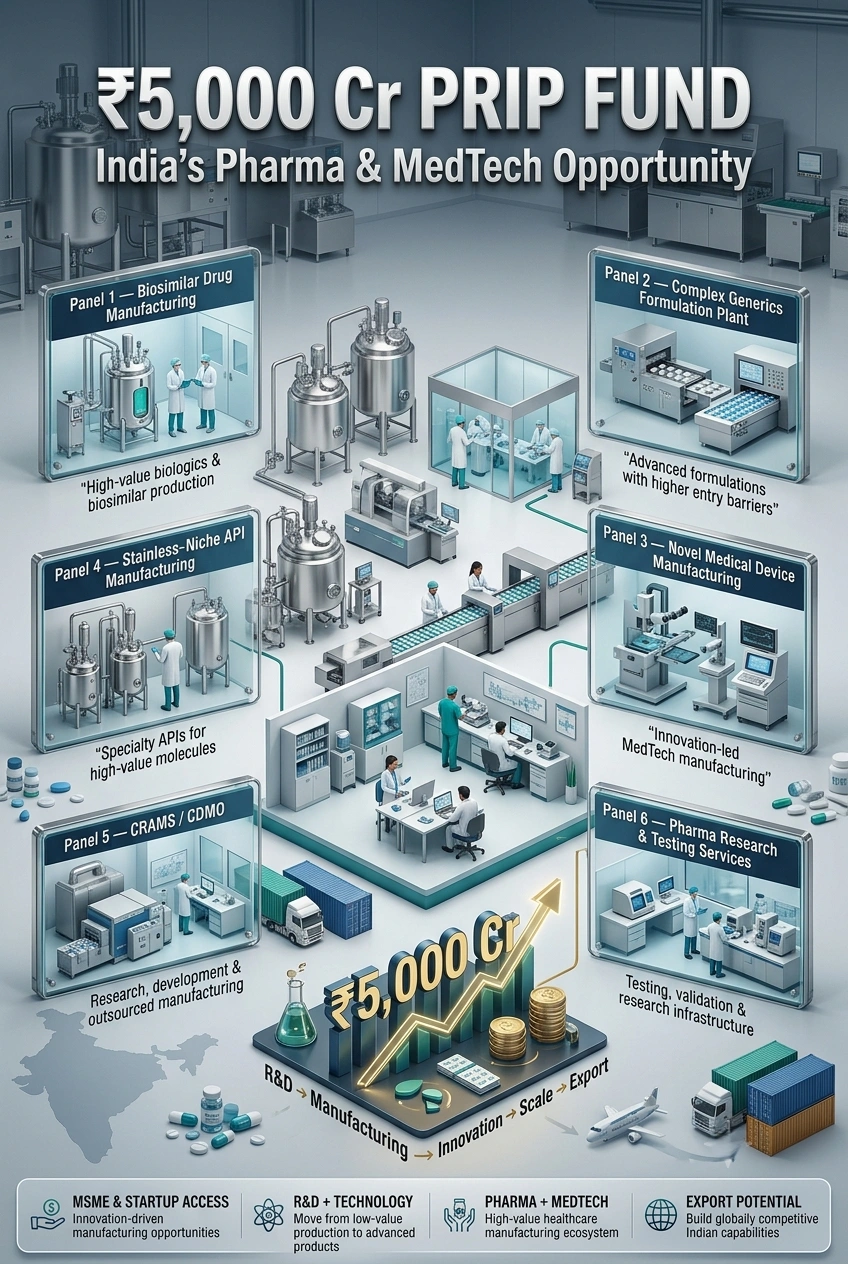
Six Manufacturing Business Opportunities Emerging from the PRIP Scheme
1. Biosimilar Drug Manufacturing
Biosimilars are directly included as a funded R&D category in the PRIP Scheme. Biosimilars are medicines of a biological origin that have the same effect as the branded medicines, such as cancer drugs, diabetes drugs, drugs for rheumatoid arthritis and autoimmune diseases. The biosimilar market in India is increasing at a rate of about 15.8% CAGR. The high cost of biologic development can be offsite through government funding of research and development for biosimilar through PRIP and startups can establish manufacturing units with NIPERs. Target markets are the USA, the EU, Australia and emerging markets in Africa and Southeast Asia.
2. Complex Generics Formulation Plant
The challenges of standard tablet production are the next step in complexity as seen with drug-device combinations, inhalation products, extended-release formulations, liposomal injectables and more. The PRIP Scheme does explicitly encourage complex generic development. A scientist entrepreneur, who has the ability to obtain access to pharmaceutical grade manufacturing facilities, can formulate complex generic candidates and seek support from the PRIP support scheme for scale up and subsequently license/export the finished product to regulated market. Well-equipped MSMEs can easily get in without any trouble.
3. Novel Medical Device Manufacturing
Robotic surgical devices, genetic technology-based diagnostics, in-vitro diagnostic (IVD) devices, software as a medical device, and telemedicine enabled platforms are in the scope of the PRIP Scheme’s MedTech category. All of these are manufacturing opportunities. The majority of complex medical devices are imported into India at present. The development of a single niche device category — for example, a locally developed IVD for infectious disease screening — could lead to a viable and exportable business with long product lifecycles and high margins.
View Full Project Details: Medical Devices & Disposables Industry in India
4. Active Pharmaceutical Ingredient (API) Manufacturing for Niche Molecules
India is currently importing a significant amount of API from China. The PLI Scheme for Bulk Drugs together with the PRIP Scheme caters to the incentives for domestic production of API, particularly for complex or niche molecules used in biosimilars, orphan drugs, and specialty drugs. Establishing an API plant for a molecule that has a high appearance in the funded project of a PRIP places an MSME at a strategic position in the supply chain with potential long-term supply agreements with larger formulators.
Get Detailed Insights from This Book: Handbook on Active Pharmaceutical Ingredients (API), Drugs & Pharmaceutical Products
5. Contract Research and Manufacturing Services (CRAMS / CDMO)
The CDMO segment of India is among the fastest growing in the world. Trusted and cost-competitive partners are preferred by pharma companies around the globe for their clinical stage manufacturing solutions. An MSME with GMP infrastructure and with R&D support from PRIP can serve the needs of the multinational pharma companies, biotech startups and Toll manufacturing facilities in India for offering CDMO services. Laurus Labs and Divi’s Laboratories have proven what is achievable at scale: there is a definite mid-market need for MSME CDMOs.
6. Pharma Research Infrastructure and Testing Services
The world-class testing, validation and analytical infrastructure is required for supporting the pharmaceutical innovation ecosystem. NABL can establish a testing laboratory, bioequivalence centre, stability testing centre, and drug discovery support centre for the benefit of entrepreneurs. They cater to every other pharma manufacturer and have direct relevance to projects funded by PRI which involves a very strict analytical validation at every TRL stage. It is an extremely hot demand, and capital efficient for the full-scale manufacturing.
Get Detailed Project Report (DPR): Pharmaceutical & Fine Chemicals Manufacturing
Import–Export Opportunity Analysis
India exported pharmaceutical products worth of $30 billion in the financial year 2024-25, with the exports increasing by more than 9% compared to the previous year. It is the leading supplier of generic medicines in the world accounting for about 20% of the global demand for generic medicines and about 70% of the global demand for vaccines. It is a policy to take India from the generic segment to the higher value innovation segments that can get premium prices in the world market, called the PRIP Scheme.
Export Markets: India’s biggest export market is the USA, at around 31% of the total pharma exports. The secondary markets in Europe, Africa, Southeast Asia and Latin America are very strong. These Indian-made biosimilars have huge margins — such as Biocon Biologics bagging 22% of trastuzumab prescriptions in some markets.
Import Substitution: India is importing complex medical devices, high-end diagnostic equipment, and specialised APIs in huge quantities. All local-made devices help cut this import bill and develop local IP. The government has announced that India aims to become a global hub of MedTech manufacturing and PRIP is the main R&D instrument for this objective.
International Demand: The international biosimilar market will surpass $100 billion by 2030. The worldwide medical device industry will reach a total value of more than $700 billion. India’s cost competitiveness, coupled with regulatory knowledge and a growing workforce with an innovation mindset gives it a distinct advantage in capturing a significant slice of both markets.
Indian MSME & Startup Success Stories in Pharma and MedTech
Biocon Biologics — Bengaluru
Biocon Biologics, a subsidiary of Biocon Ltd. has established an international biosimilar business from India. The company has successfully introduced biosimilars in the United States and the EU markets and has gained a good share in oncology biosimilars. Now, with the help of PRIP-type funding and institutional support being available, the path to Biocon’s success is now more accessible than ever for the next generation of Indian biotech founders.
Laurus Labs — Hyderabad
Laurus Labs is a prime example of focused growth in the MSME to midcap space in pharma. The company developed from an API manufacturer to a complete CDMO that produces oncology injectables and ARV (antiretroviral) formulations. The company’s stock surged more than 80% in 2025, fuelled by its oncology growth and CDMO contract acquisition.The stock has increased by more than 80% in 2025 following its CDMO contract wins and oncology growth. The same opportunities are provided by the PRIP Scheme for start-up API and CDMO companies focused on niche therapeutic areas.
PharmNXT Biotech — Emerging Startup
PharmNXT Biotech is a representative of a new breed of emerging Indian biopharma startups who are taking advantage of government schemes, collaborations with NIPER and foreign capital to go from R&D to manufacturing. From resilience to real acceleration – India’s biopharma engine in 2025, quotes Ankush Kapoor, Founder & CEO of PharmNXT Biotech. It is this attitude that makes the second call by PRIP Scheme a real launching pad for scientific founders.
Choose the right startup backed by real market demand
About NPCS – Niir Project Consultancy Services
Niir Project Consultancy Services (NPCS) is one of the premier industrial consultancy and research organizations of India having more than 4 decades of experience in assisting entrepreneurs, MSMEs, start-ups and large industries from manufacturing and process industries and emerging sectors.
NPCS provides:
- Detailed Project Reports (DPR) for pharma manufacturing ventures, biosimilar plants, API units, and MedTech companies
- Market Research and feasibility studies for PRIP Scheme applications and PLI proposals
- Technology Consultancy including process engineering, plant design, and regulatory pathway advisory
- Business Plan preparation for investors, bank financing, and government grant applications
- Industry data and primary research for export-market entry in the US, EU, and ASEAN
For pharma entrepreneurs preparing PRIP concept notes or detailed project applications, NPCS project reports provide the financial modelling, market validation, and technical content required by government evaluators.
PRIP Scheme – Business Intelligence Data Table
| Parameter | Details |
| Industry | Pharma & MedTech R&D – Drugs, Biosimilars, Medical Devices |
| Market Driver | ₹5,000 Cr PRIP Scheme – second call open mid-September 2026 |
| MSME Opportunity | Up to ₹100 Cr per project; early-stage TRL 1–5 support |
| Export Potential | India targets $130 Bn pharma market by 2030; exports crossed $30 Bn FY 2024–25 |
| Government Support | PRIP Scheme, PLI Pharma, Biopharma SHAKTI (₹10,000 Cr), NIPER CoEs |
| Risk Level | Medium – R&D-intensive; commercialisation timelines can be long |
| Growth Outlook | Strong – Biosimilars 15.8% CAGR; MedTech devices rapid growth through 2033 |

Conclusion: Your Window to India’s Pharma Innovation Gold Rush
The second call for PRIP Scheme applications is a significant business signal for Indian pharma entrepreneurs in 2026. The government is deploying ₹5,000 crore to transform India from a generics manufacturing powerhouse into a global innovation leader in pharmaceuticals and medical devices.
The business opportunities are direct and concrete. These include biosimilar manufacturing units, complex generics formulation plants, novel medical device companies, niche API manufacturers, CDMO businesses, and pharma testing infrastructure. Each opportunity aligns with the PRIP Scheme. It also meets India’s pharmaceutical export market demands. Moreover, these businesses can benefit from the next decade of global pharma growth.
Entrepreneurs, MSMEs, startup founders, and investors who move now can gain an early advantage. They can build government-validated, PRIP-funded businesses during this extraordinary period of Indian pharma expansion.
The application window opens mid-September 2026. Register on the PRIP portal today. Prepare your concept note. Engage a consultancy partner to build your project report. And position your business at the forefront of India’s pharmaceutical innovation revolution.