


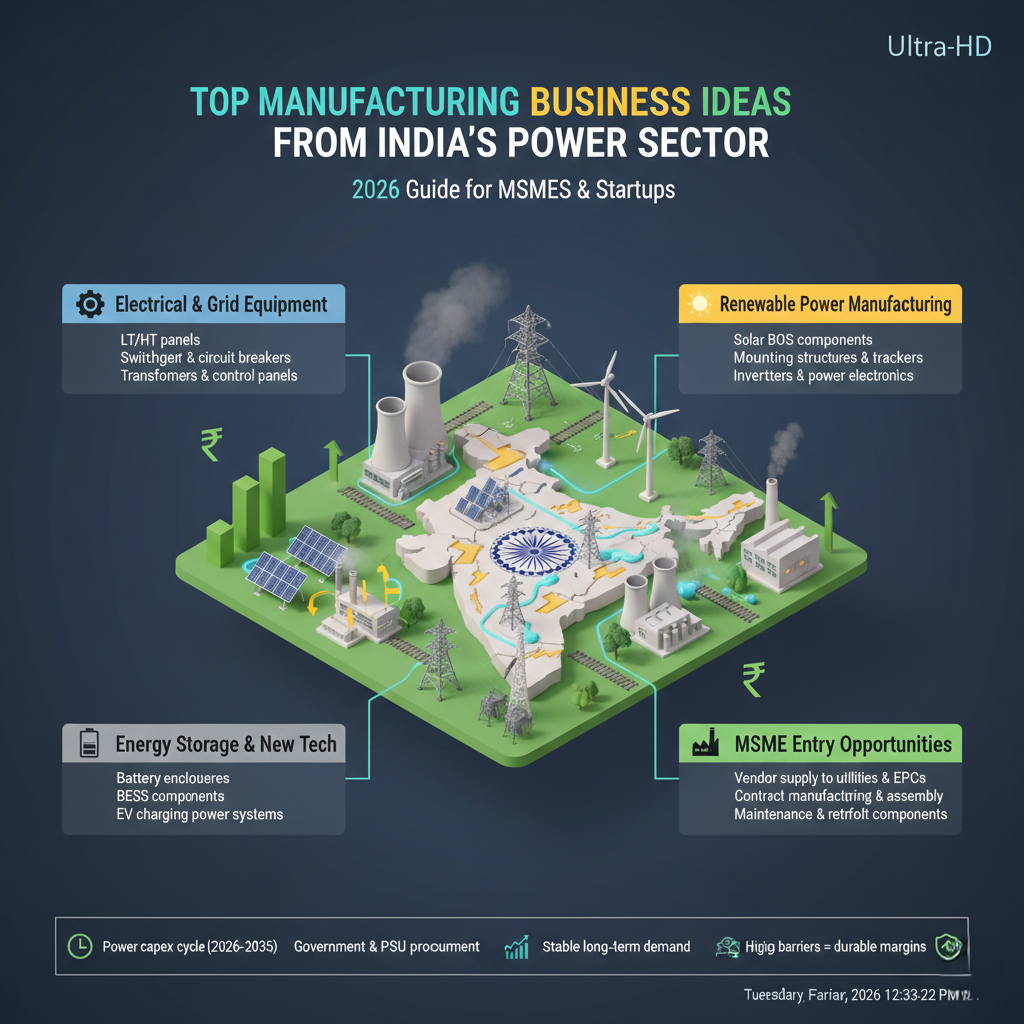
Power sector manufacturing India sector has become one of the greatest pillars of the country’s industrial and infrastructure economy. Once dominated by the electricity generation sector, today there is a diverse manufacturing ecosystem today, including electrical equipment and components, automation systems, and grid support technologies. This transformation has provided the long-term stable manufacturing opportunities for entrepreneurs, the startups and MSMEs across India.
According to the Ministry of Power, Government of India, the country has achieved the near zero peak power shortage and crossed 1,300 billion units of annual electricity generation. Transmission and distribution infrastructure has grown exponentially, reaching industrial clusters, renewable energy areas and rural areas. These developments lead directly to sustained demand for electrically manufactured domestic products.
This article explains practical manufacturing business ideas that directly linked to India’s power sector growth and with focus on the ones that are feasible for first generation entrepreneurs and MSMEs.
Read More: Solar PV Power and Solar Products Handbook
India’s Power Sector: A Strong Base for Manufacturing Growth
India now has one of the world’s largest integrated systems for power operations. Continuous investment in generation capacity, high-voltage transmission networks, substations, renewable energy evacuation infrastructure and distribution reforms have resulted in permanent demand for electrical equipment.
Key indicators that support the manufacturing demand include:
- Near elimination of peak power shortages,
- Annual electricity generation of more than 1300 billion units|
- Expansion of transmission lines over 200,000 circuit kilometres
- Rapid growth in high-voltage transformation capacity
- Nationwide smart metering and grid modernization efforts
Each of these developments requires equipment such as power cables, insulators, transformers, switchgear, control panels and accessories, much of which can be manufactured by domestic MSMEs.
Why Power Sector Manufacturing is the Best for Startups and MSMEs
Manufacturing businesses related with power sector are very different from consumer driven industries. Demand here is infrastructure backed, supported by policy and long term in nature.
Key advantages include:
- Government and utility supported demand
- Standardized technical specifications
- Repeat procurement cycles
- Lower market volatility
- High scope for import substitution
- Export potential in power markets that are in development
These factors ensure that there is less uncertainty in demand and entrepreneurs can plan their investments with a long-term perspective as opposed to the short-term fluctuations in the markets.
Read More: Battery Projects, Automobile Batteries, Lead Acid Battery, Lithium Battery, Lithium-Ion (Li-Ion) Battery, Maintenance Free Rechargeable Battery, Battery Recycling, Battery Plate, Battery Separator
Power Cable Manufacturing: A Reliable Demand Segment
Power cables are the backbone of the electricity network. From generation plants and substations to urban underground cabling, renewable energy parks and rural electrification projects, cables are needed in all stages of power delivery.
Demand for power cables is influenced by:
- Transmission and distribution expansion
- Renewable energy integration
- Industrial electrification
- Smart city and underground cabling projects
While India has a strong base of cable manufacturers, the import of specialized and high performance cables still exists, providing scope for the new entrants.
This segment is attractive for the startups because:
- Production capacity can be scaled up gradually
- Volumes of consumption are high and frequent
- Stable demand from: – Utility, EPC, and industrial buyers
- Export opportunities in Africa, South-East Asia and the Middle East
Many successful Indian cable companies started off as regional providers and then went national with the help of quality certifications and utility approvals.
Electrical Insulator Manufacturing for transmission Networks
Electrical insulation is an important safety device for overhead transmission and distribution lines. With the increase of high voltage networks and the increasing attention to polluted and coastal corridors, the demand for advanced insulators has been increasing steadily.
Both porcelain and polymer insulators enjoy a large demand:
- Polymer insulators are preferred in high pollution and coastal areas
- Porcelain insulators still dominate conventional substation
This segment is suitable for MSMEs as follows:
- Manufacturing technology is well-developed
- Raw materials are available at the domestic level
- Utility procurement occurs in bulk tenders
- Long term supply contracts are typical
Indian insulator manufacturers who have invested early in testing facility and certifications have built stable export-oriented businesses.
Read More: Solar Power Plant – Manufacturing Plant, Detailed Project Report, Profile, Business Plan, Industry Trends, Market Research, Survey, Manufacturing Process, Machinery, Raw Materials, Feasibility Study, Investment Opportunities, Cost and Revenue
Transformer Parts And Accessories Manufacturing
Transformers are one of the most valuable assets in the power system. Each transformer needs a number of parts which will often be brought in from ancillary manufacturers and not be manufactured in house.
Instead of producing whole transformers, startups can specialize in the manufacture of components and accessories, such as:
- Tanks and radiators of transformers
- Conservators, expansion systems
- Bushings & insulation components
- Structural fittings & assemblies
Grid expansion, renewable integration and distribution upgrades have caused a rise in demand for transformers and transformer components. This segment offers:
- Reduced capital investment as compared to complete transformer manufacturing
- Repeat orders from OEMs
- Long term vendor relationships
- Steady margins including technical specialization
Switchgear Manufacturing: Ensuring Grid Safety and Reliability
Switchgear has a critical role in the protection of electrical systems from faults, overloads and short circuits. As utilities and industries become more focused on grid reliability, automation and safety, the demand for modern switchgear has risen.(Power sector manufacturing India)
While Companies often import high-end extra high voltage switchgear, low and medium voltage switchgear as well as assembled systems hold good potential for domestic manufacturers.
This segment is attractive because:
- Entry through assembly-based manufacturing possible
- Value & margins are increased due to customization
- After-sales service generates recurring revenue
- Gradual transition to design and manufacture is possible
Many of the established Indian switchgear companies started off as panel assembly and then developed the in-house capabilities.
Read More: Industrial Chemical Manufacturing Opportunities in India’s Power Sector in 2026
Electrical Panels and Control Systems Production
Electrical panels are operational control centers in power systems. They handle distribution of power, protection, monitoring, and automation in substations, industrial plants, and renewable energy installations.
Products include:
- Power control and distribution panels
- Motor control centers (MCCs)
- Protection and relay panels
- SCADA and automation panels
Demand has been on the rise because of smart grid initiatives, industrial automation and renewable energy projects. This business is good for engineering driven startups as success is more dependent on design capability and system integration rather than saturated manufacturing infrastructure.(Power sector manufacturing India)
Import Substitution: Long Term Growth Opportunity
Despite good domestic manufactures, India imports a few specialized electrical products. Government policies have increasingly taken a side in favor of domestic sourcing, provided that manufacturers meet quality, safety and certification standards.
Product categories that have a high import substitution potential include:
- Specialized and high-performance power cables
- Key characteristics of the current research project are: – Advanced polymer insulators
- Certain accessories of transformers are
- Automation and control systems
Startups that match the utility specifications of their products with compliance can replace imports over time and develop export-ready capabilities.
Read More: Electrical Components Manufacturing Opportunities in India 2026
Importance of Project Feasibility & Planning
Before establishing any manufacturing unit, the techno-economic feasibility analysis is very essential. Incorrect assumptions with regards to capacity, demand, or technology can add a significant amount of risk to a project.
A structured feasibility study should cover:
- Market demand analysis and competition analysis
- Manufacturing process selection
- Machinery and equipment planning
- Raw material sourcing
- Capital investment and financial projections
Professional project consultancy support, to help entrepreneurs to reduce risk and make sound investment decisions, particularly in areas of capital intensive manufacturing.
Lessons Learned from Indian MSME Success Stories
India’s electrical manufacturing ecosystem contains a large number of MSMEs that have grown steadily over the decades. Most adopted a similar strategies:
- That was – “focused on one product category”
- Received utility and EPC registrations early
- Invested consistently in quality & compliance
- Reinvested profits prior to expansion of capacity
These examples show that power-sector manufacturing can be rewarding for patience, compliance and long-term thinking and not aggressive short-term growth.
Conclusion: An Opportunity for Reliable Manufacturing for Entrepreneurs
Manufacturing business in tandem with the growth of India’s power sector potential – predictable demand, infrastructure-driven growth, import substitution opportunities, export scalability. For entrepreneurs looking for stable and future-ready manufacturing ventures, electrical equipment and manufacturing of components is one of the most reliable opportunities in India.
Startups and MSMEs can establish sustainable businesses through proper product selection which ensures technical compliance and their investment plans which require gradual implementation.
Frequently Asked Questions (FAQs)
Which manufacturing business is best for India Power Sector?
Power Cables, Electrical Panels, Insulators, Switchgear and Transformer Accessories provide steady demand and long term growth.
Is power sector manufacturing suitable for MSMEs and Startups?
Yes. Many products in the power sector can be produced in MSME scale with repeat demand from utilities and EPC contractors.
How much money is needed to start electrical manufacturing?
Investment differs depending on the product, but in general, component manufacturing and panel assembly require a lower capital than heavy equipment manufacturing.
Does government support power sector manufacturing?
Yes. Government policies are strongly promoting for domestic manufacturing, infrastructure expansion and import substitution.
Can Indian electrical manufacturing businesses export their products?
Yes. Indian electrical products are exported on a wide scale to Africa, South East Asia and Middle Eastern countries.


