Data‑Driven Guide for Entrepreneurs, MSMEs & Industrial Innovators
Introduction: India’s Infrastructure Moment Has Arrived
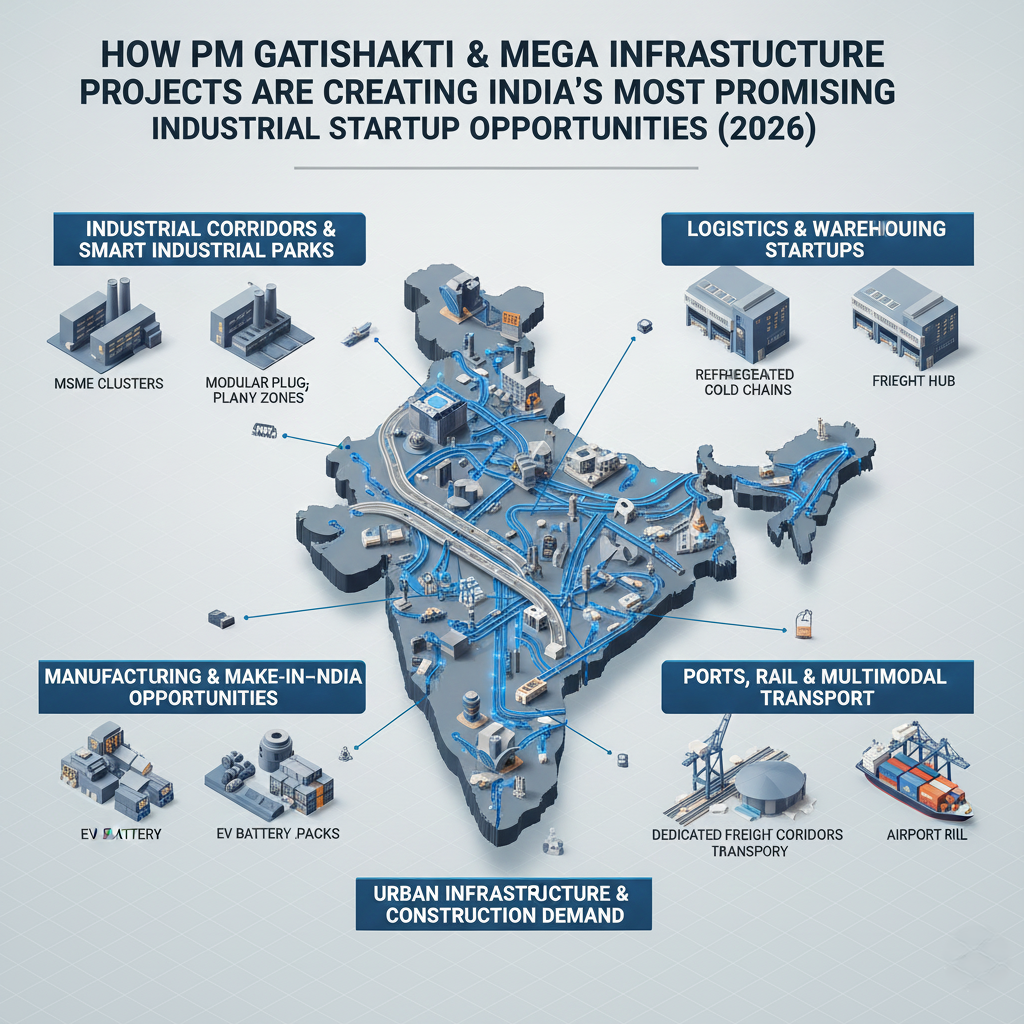
PM GatiShakti startups 2026 are creating unprecedented industrial opportunities in India as the country enters one of its most decisive phases of infrastructure-led growth since liberalisation. This technology-driven National Master Plan (NMP) is transforming how industries plan, execute, and monetise projects, opening doors for MSMEs and first-generation entrepreneurs.
Unlike earlier fragmented development models, PM GatiShakti integrates roads, railways, ports, airports, steel, energy pipelines, logistics hubs, and industrial clusters onto a single GIS‑based digital platform. The result is faster execution, lower logistics cost, and—most importantly—clear, data‑visible opportunities for new entrepreneurs.
Indian steel and infrastructure indicators have already shown considerable progress as per the Ministry of Steel Annual Report 2024-25:
- Finished steel consumption (Apr-Dec 2024): 111.49 MT (+11.4%)
- Crude steel production (Apr-Dec 2024): 112.01 MT
- Steel imports: 7.42 MT (+22.7%)
- PM GatiShakti has more than 2,100 steel units mapped for logistics optimisation.
These numbers send a clear message: India’s infrastructure boom is directly converting into manufacturing and MSME opportunities. For first‑generation entrepreneurs, 2026 could be the most favourable entry point into industrial business in decades.
Read More: India UK Vision of FTA 2030: Million-Dollar Opportunities in 2025 for new startups
What Is PM GatiShakti & Why It Matters for Entrepreneurs
PM GatiShakti is more than a government scheme—it is an industrial intelligence platform.
It gives policymakers and industries the ability to see:
- Availability of raw materials
- Transport accessibility
- Nearness to ports and markets
- Multi-modal logistics routes
- Cluster-based manufacturing opportunities
Read Business Plans / Project Profiles : Click Here
For startups and MSMEs, this means:
- Lower capital and operating expenses
- Quicker movement of raw materials and finished products
- Cleverer plant location decision-making
- Immediate access to upcoming industrial corridors
- Lowered project risk and execution delays
Gati Shakti is simply a tool to remove uncertainty—one of the greatest challenges to new industrial entrepreneurs.
Why 2026 Will Be a Breakout Year for Industrial Startups
Several powerful forces are converging simultaneously:
- Massive execution of highways, ports, railways, airports, metros
- Rapid rise in steel consumption across sectors
- Persistent import dependence in high‑value steel products
- Production‑Linked Incentive (PLI) schemes
- Green Steel and Circular Economy missions
- Digitally mapped logistics and industrial zones
Infrastructure drives steel. Steel drives manufacturing. Manufacturing fuels MSME growth.
This virtuous cycle makes 2026 a uniquely profitable year to launch industrial ventures.
India’s Steel Sector: Key Data Every Entrepreneur Should Know
Parameter | Apr–Dec 2024–25 | Growth |
Finished Steel Consumption | 111.49 MT | +11.4% |
Finished Steel Production | 107.19 MT | +4.4% |
Steel Imports | 7.42 MT | +22.7% |
Import Value | ₹61,171 crore | — |
Export Value | ₹29,821 crore | — |
Key Insight: India runs a steel trade deficit of over ₹31,000 crore. This deficit is a ready‑made import‑substitution opportunity for domestic manufacturers.
Read Our Book: Click Here
Top Industrial Startup Opportunities Emerging from PM GatiShakti (2026)
1. Pre‑Engineered Buildings (PEB) & Steel Structures
Construction and housing sectors represent more than 43% of India’s steel requirement. The growth led by GatiShakti in the form of warehouses, logistics parks, factories, and airports is further demanding the use of prefabricated steel solutions.
The only invite for start-up are:
- Industrial sheds & warehouses
- Cold storage structures
- Airport hangars & logistics buildings
Reasons for it: Low turnaround time, MSME friendly investment, and repeated demand from EPC.
2. Solar Module Mounting Structures (MMS)
An estimated amount of 45-55 tonnes of steel will be required for each MW of solar project. Manufacturing of MMS has taken place in the high growth phase because India is establishing solar parks and green corridors on a large scale.
Products included are:
- Galvanised mounting structures
- Tracker systems
- Hybrid aluminium‑steel supports
Read More: Startup Selector
3. Steel, GI and ERW Pipe
Water supply, gas pipelines, highways, and renewable projects are the sources of demand being created and also being sustained. Even though there is domestic capacity, India still imports quality pipes which gives room for new players in the market.
4. Steel Fabrication & Infrastructure Components
Railways, metros, ports, airports, and smart cities require customised steel components.
Manufacturing ideas:
- Bridge structures
- Terminal frames
- Port handling structures
5. Steel Scrap Recycling & Processing Units
The lack of processing facilities is forcing India to import scrap. The scrap-based manufacturing method is in line with the Green Steel Mission and will last for a long time sustainability-wise.
6. Ready‑Mix Concrete (RMC) & Steel‑Reinforced Products
Gati Shakti created highways, tunnels, dams, and bridges really fast and thus the demand for advanced construction materials was boosted.
7. Smart Logistics, Warehousing & Material Handling
As the number of steel units that have been digitally mapped goes above 2,100, the need for efficient logistics solutions is increasing.
Opportunities:
- Automated warehouses
- Coil‑handling systems
- Freight aggregation centres
8. Steel‑Based Furniture & Modular Infrastructure
The durability of modular steel solutions is attracting corporate offices, hospitals, and hospitality projects.
9. Stainless Steel Product Manufacturing
India’s import volumes of stainless steel cookware, plumbing, and industrial tubes are still high, which makes the MSME sector ideal for exports.
10. Industrial Fasteners, Bolts & Hardware
Control systems for infrastructure projects require millions of fasteners with precision, and large part of that is still being imported.
11. Construction Equipment & Attachments
Excavator buckets, loader arms, and steel attachments are needed constantly by highways, mining, and airports.
12. Machinery & Equipment for Steel Plants
Roughly 300 MT steel capacity is the target for India by 2030–31 which indicates that rolling mill equipment, material handling systems and pollution control units will be in demand.
Lessons from India’s Steel Leaders
Foresight has always been the characteristic of the Indian steel industry leaders—Ratan Tata, Sajjan Jindal, and Lakshmi Mittal—all of whom have built global enterprises by the strategic alignment with infrastructure cycles. Their stories teach us that long term vision combined with timely investment can create wealth for generations.(PM GatiShakti startups 2026)
About NPCS (NIIR Project Consultancy Services)
NPCS provides start-up entrepreneurs with the necessary Market Survey cum Detailed Techno Economic Feasibility Reports (DPRs) for their industrial projects.
Our reports cover:
- Manufacturing process & technology
- Market demand & competition analysis
- Machinery & raw‑material planning
- Financial projections & profitability
- Scalability and risk assessment
Conclusion: The Year 2026 Is the Best Time to Enter the Industry
India’s infrastructural transformation has not only improved the way the country is connected but also made it possible for thousands of industries to profit.
With PM GatiShakti, the increased demand for steel, the government’s robust spending, and the obvious gaps in import substitution, 2026 presents a singular opportunity of a lifetime for MSMEs and industrial startups.
If you have been just waiting to get into manufacturing or business related to infrastructure, now is the time.
Frequently Asked Questions (FAQs)
Q1. Is PM GatiShakti beneficial for small entrepreneurs? Yes. It reduces logistics costs, improves location planning, and connects MSMEs to large infrastructure projects.
Q2. Which industrial sector will grow fastest by 2026? Steel‑linked manufacturing, renewable energy structures, logistics, and construction materials.
Q3. Can MSMEs compete with large companies in infrastructure supply? Yes. Large EPC players depend heavily on specialised MSME suppliers.
Q4. Is steel manufacturing capital‑intensive? Primary steel is capital‑heavy, but downstream products and fabrication are MSME‑friendly.
Q5. How can NPCS help new entrepreneurs? NPCS provides feasibility studies, DPRs, and strategic guidance to reduce risk and improve profitability.