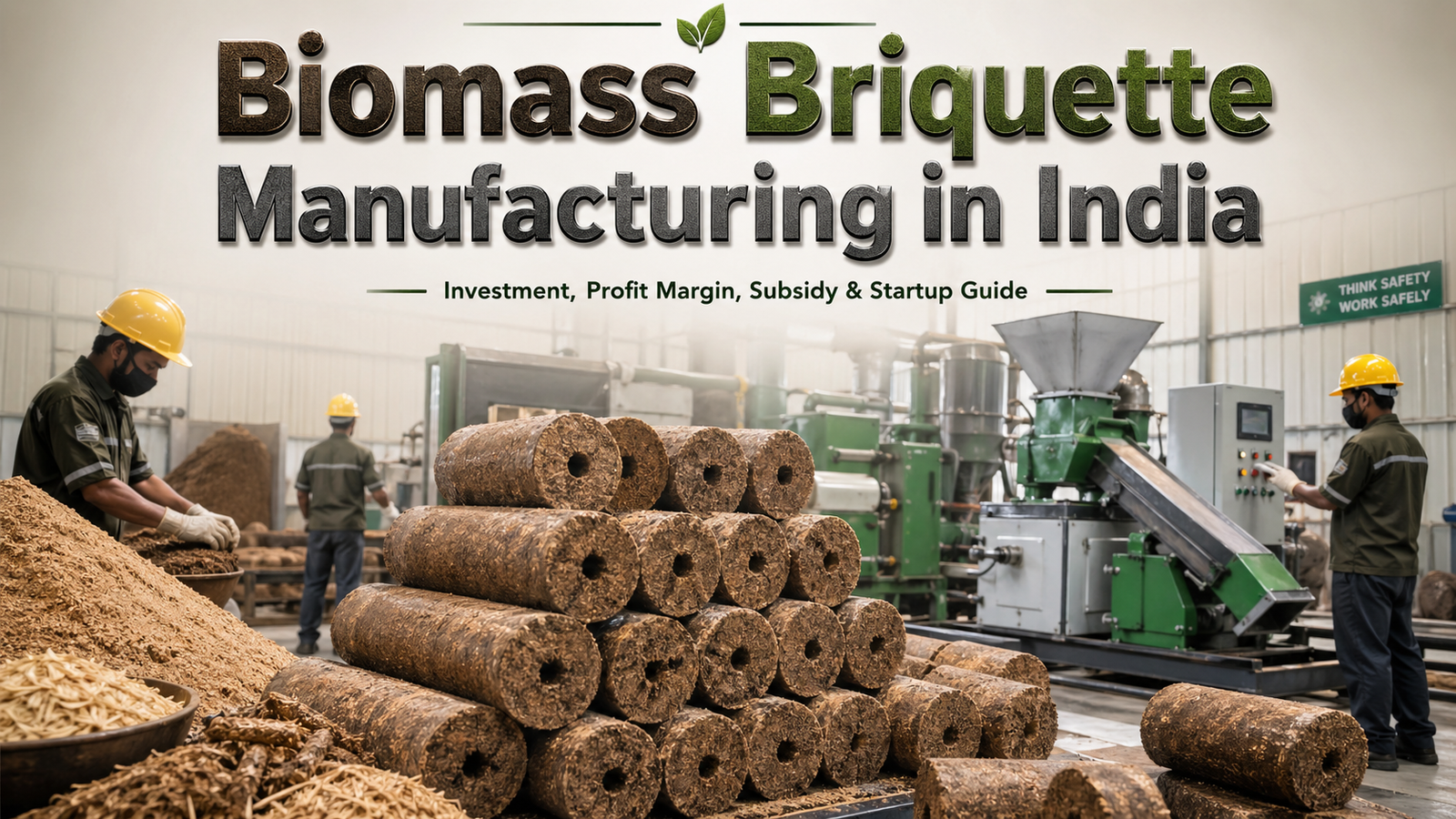

Introduction: Biomass Briquette Manufacturing Business
Every year, India generates a large amount of agricultural waste (over 750 million tonnes). These are rice straw, sugarcane bagasse, cotton stalks, mustard husk and other biomass wastes. But much of this waste is either openly burnt or simply discarded, leading to severe air pollution (particularly in the north).
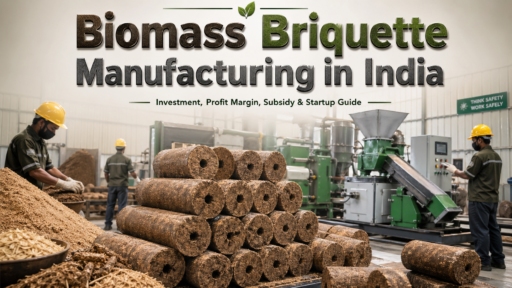
However, this waste is also a valuable resource for renewable energy. Biomass briquette production transforms farm waste into solid blocks of biomass fuel that can be used as a substitute for coal in industry.
Biomass briquettes are now extensively used in brick kilns, textiles, food processing, paper factories and boilers. As fuel prices climb and the environment comes under threat, this is quickly becoming a high growth MSME business in India.
Get Detailed Insights from This Book: The Complete Book on Biomass Based Products (Biochemicals, Biofuels, Activated Carbon)
Why Biomass Briquette Business is Growing in India
Biomass briquettes are growing due to economic and environmental considerations. For the last few years business groups are looking for cheap as well as green alternative of coal that can be substituted with briquettes.
Prices of coal fluctuate in India as well as based on its quality and transport costs, ranging from 7,000 to 12,000 per ton. Biomass briquettes are cheapest as it can be produced anywhere as well as locally to save on transport costs, that is fixed at a constant price.
Another most important point is to take in consideration the green initiative taken by government on decarbonization of industries. Industrial areas are now being pressured to switch fuels. Biomass briquettes are carbon-neutral, making them an excellent substitute for coal.
Export demand is also increasing. Germany, Netherlands, Japan and South Korea are particularly keen importers of biomass fuel for their renewable energy needs.
How Biomass Briquettes Are Manufactured
The process of manufacturing briquettes is very simple and can be undertaken by MSMEs. It does not involve chemical processing.
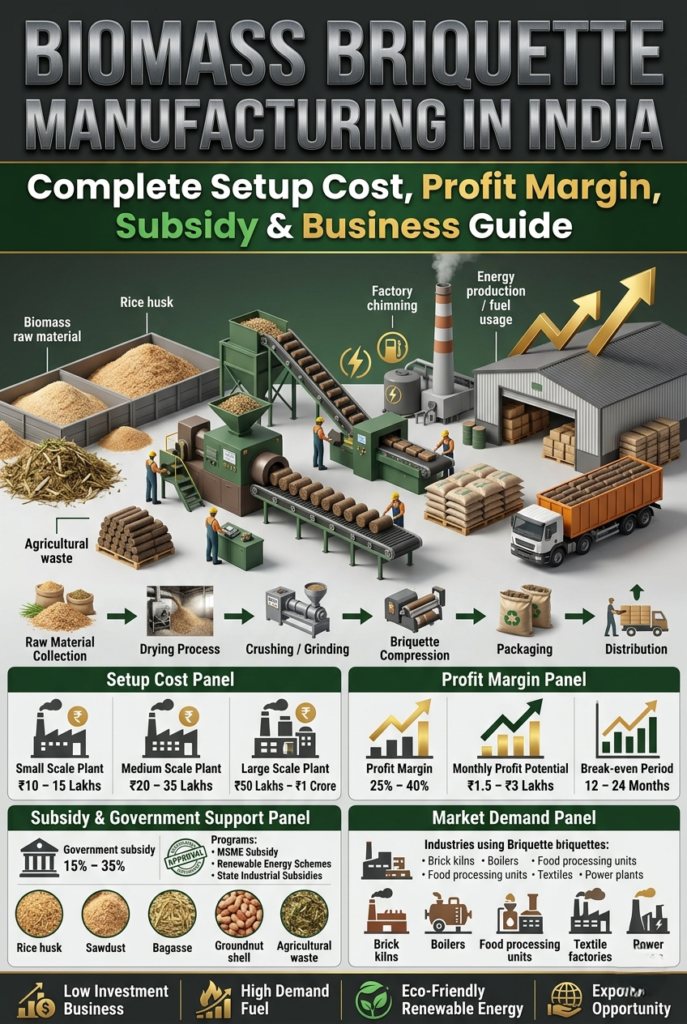
This involves collecting agricultural waste (e.g. husk, straw or sawdust). This is then dried to remove the moisture content, as dry biomass burns better.
The waste is then ground into finer particles, followed by compaction of particles to form solid fuel briquettes with a briquetting machine. Lignin content in biomass acts as a natural binder; hence no additional chemicals or agents are required.
Briquettes are then cooled, packed and delivered to industries.
Types of Biomass Briquette Projects
There are various ways to design biomass briquette project depending on investment, market and scope of the project as follow:
- Biomass briquettes for local industries
- Biomass pellets for export and power plants
- Torrefied briquettes for industrial purposes
- Char briquettes for niche fuel uses
Each type of project can involve different investment, technology and returns so entrepreneurs can chose their project based on their investment as well as skills.
Get Detailed Project Report (DPR): Biomass Gasification Power Plant Detailed Project Report (DPR)
Investment Required for Setting Up a Plant
This varies by capacity and automation.
A 400-500 kg/hour, small MSME scale unit can be set up with an investment of ₹18-30 lakh. This covers machinery, infrastructure and working capital.
A 1-2 tonnes per hour plant can cost ₹75 lakh to ₹1.5 crore. Export-oriented plants may cost more than ₹2 crore based on technology and automation.
Profit Margin and Financial Viability
Biomass briquette making is a lucrative and viable business with efficient sourcing of raw material.
The price of biomass briquette is typically between ₹4500 to ₹6500 per tonne, depending on quality and location. The cost of manufacturing is usually between ₹3,200 and ₹4,200 per tonne.
This translates into a margin of 18% to 30% (very good in a manufacturing enterprise).
Typically, break-even is reached between 14-24 months, particularly with industrial contracts.
Government Subsidy and Support
Biomass industries are highly encouraged by the Indian government under renewable energy schemes.
These include subsidy programs by MNRE, financing schemes by PMEGP and collateral-free loan programs by CGTMSE. Through these schemes, entrepreneurs can get financial support in the form of 25-35% subsidy.
Moreover, some states like Punjab, Haryana, Maharashtra and Uttar Pradesh provide further incentives to renewable energy-based MSME projects.
Find the most profitable startup for your investment range
Raw Material Availability in India
Raw material is the key element of business. India is an agricultural nation and biomass waste is readily available.
Some key sources include:
- Rice straw in Punjab, Haryana and UP
- Cane bagasse in Maharashtra and UP
- Cotton stalk in Gujarat and Maharashtra
- Groundnut shells in Rajasthan and Gujarat
- Sawdust from wood industries all over India
A viable plant would usually get the raw material from a 50-80 km radius to reduce transport cost and ensure supply.
Export Opportunity in Biomass Briquettes
Biomass energy products are emerging as India’s exports. Moreover, Global targets on carbon emissions are driving the international market.
In particular, Major markets are Europe, Japan and South Korea, as well as Southeast Asia. Furthermore, Biomass briquettes are used for industrial heating and electricity generation.
However, Briquettes for export need to be of high quality with low moisture and high calorific value. Additionally, For exports, certification from ENplus and ISO 17225 may be required.
As a result, Export prices is higher by 25%-40% and is highly beneficial to run the business, therefore, as profit from export can be higher as compare to local.
Role of NPCS in Biomass Briquette Business
NIIR Project Consultancy Services (NPCS) is a leading project consultancy firm in India for MSME sector.
Moreover, NPCS offers comprehensive business to business support such as project reports, feasibility reports, machinery selection, cost and financial analysis, market research and more. Additionally, These reports are being accepted by banks and financial institutions for their business loan and credit facilities.
Furthermore, NPCS is vital for biomass briquette entrepreneurs to minimize risks involved in the project by providing advice on planning of capacity, cost and profitability.
Related Article: How to Start a Biomass Briquettes Business in India
Conclusion
Biomass briquette production is a very feasible and (fast-growing) MSME opportunity in India. Firstly, It offers good raw material supply, increasing demand from industry, subsidies and exports.
However, The industry isn’t highly technical, but it requires careful planning, reliable raw material procurement and long-term industrial contracts. Therefore, By prioritising quality and efficiency, entrepreneurs can establish a viable manufacturing enterprise in this industry.
Furthermore, As India transitions to cleaner fuels, biomass briquettes are likely to be a key substitute for coal in industry in years to come.
References and Useful Government / Institutional Links
The following official government and institutional resources are recommended for further reading and for direct application to the schemes discussed in this article.
- Startup India – Official Portal –https://www.startupindia.gov.in/
- Ministry of Micro, Small & Medium Enterprises (MSME) –https://msme.gov.in/
- Udyam Registration Portal –https://udyamregistration.gov.in/
- Department for Promotion of Industry and Internal Trade (DPIIT) –https://dpiit.gov.in/
- Small Industries Development Bank of India (SIDBI) –https://www.sidbi.in/
- MUDRA / PMMY Official Portal – https://www.mudra.org.in/