

Manufacturing investment opportunities India
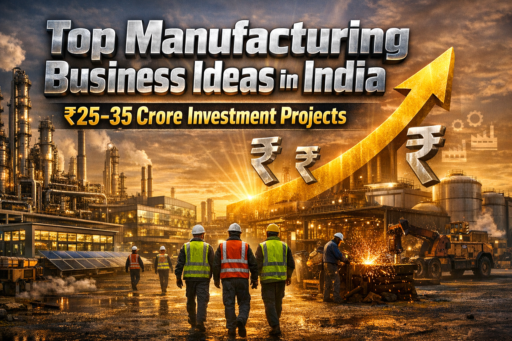
India’s manufacturing sector is entering a high expansion phase. Government initiatives like Make in India, Production Linked Incentive (PLI) schemes, global diversification of supply chains, etc. have opened new avenues for industrial entrepreneurs. For investors and growth-oriented startups, an investment of ₹25-35 crore is a sensible entry point into mid-scale manufacturing.
This capital range provides entrepreneurs with the opportunity to set up technology-driven factories that can cater to the domestic as well as the international market. Compared to small trading businesses, manufacturing projects in this category emphasize on long-term value creation, production efficiency, and scalable growth. At the same time, these projects are still manageable when compared with large industrial plants which require hundreds of crores in capital.
Before selecting a project, the entrepreneurs should make sure that the business fulfils three essential conditions:
- A sharp need for the product (demand and supply gap in the market)
- High import substitution potential
- Scalable production capability with predictable operating margins
When these factors match, a manufacturing venture in the investment of Rs.25-35 crores can be a very profitable industrial venture.
Read More: Solar PV Power and Solar Products Handbook
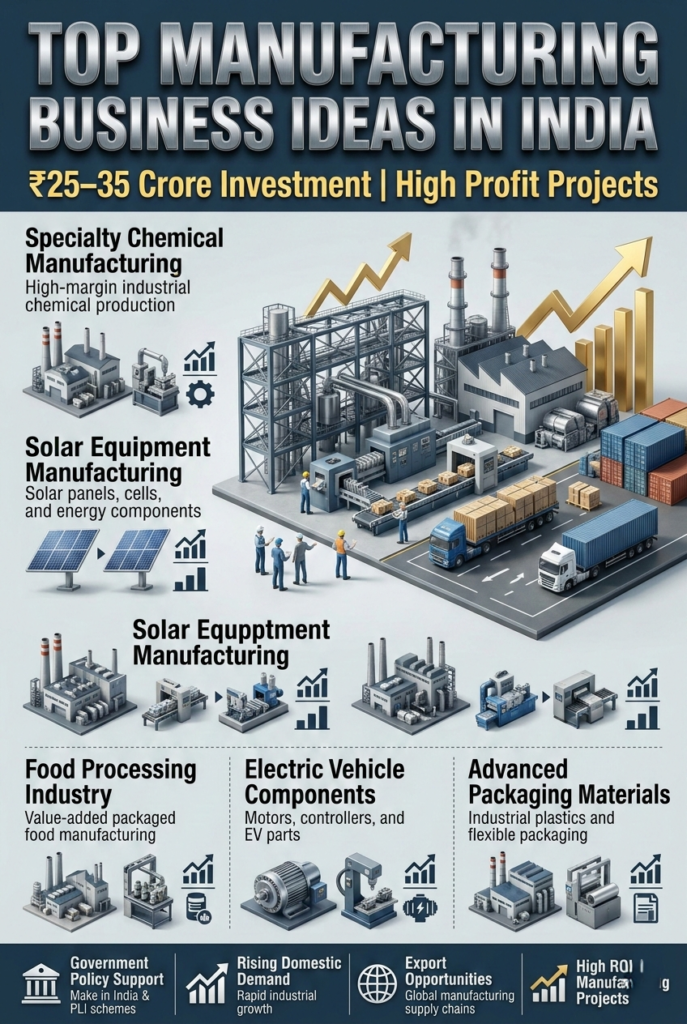
Manufacturing of Specialty Chemicals
The specialty chemicals industry has emerged as one of the fastest growing industrial areas in India. Over the past ten years, the industry has grown very rapidly with all the demands coming from pharmaceuticals, agriculture, coatings, and electronics.
Global companies are also shifting from sourcing strategies as environmental restrictions and production costs rise in China. This trend has been called the China+1 strategy and it has created significant opportunities for Indian Chemical manufacturers.
Despite the development of a domestic industry, India is still importing a number of high value chemical intermediates. Entrepreneurs have an opportunity to exploit this gap by manufacturing niche chemicals that are used in agrochemicals, pharmaceuticals, or performance materials.
A typical specialty chemical plant of the range of Rs. 30 crores, say, typically comprises items of equipment such as glass-lined reactors, solvent recovery and effluent treatment. Such plants are often concerned with the production of relatively small volumes of specialized intermediates and not with large volumes of commodity chemicals.(Manufacturing investment opportunities India)
Typical infrastructure in a chemical plant of the mid-range size are:
- Multi-purpose batch reactors
- Solvent recovery systems
- Quality testing laboratories
- Environmental treatment facilities
Regions such as Gujarat and Maharashtra have excellent chemical manufacturing ecosystems, with access to suppliers, logistics networks and skilled technicians.
Flexible Packaging Film Conversion
The Indian packaging industry is growing at a very fast rate due to the rising consumption across various sectors viz. food, healthcare, e-commerce, etc. FMCG companies are continually releasing new products that need advanced packaging solutions.
Although India manufactures huge volumes of base plastic films like BOPP and BOPET, there is not much capacity for specialized packaging conversion processes. These processes include coating, lamination, and metallization, which add barrier properties and durability to packaging materials.
A conversion oriented packaging facility can be set up with an investment of about INR 30-35 crore. Instead of making base films, the company is more focused on creating value with customized packaging formats for food brands, pharmaceutical companies, and consumer goods manufacturers.
A typical packaging conversion plant may include:
- Film lamination machines
- Coating lines and metallization lines
- Slitting and rewinding equipment
- Automated pouch making machines
Businesses in the sector often enjoy stable revenue because the demand for packaging is tied to everyday consumer products.
Read More: Medical Oxygen Gas Plant. Oxygen Bottling Plant
Manufacturing Active Pharmaceutical Ingredient (API)
India is well-known in the world as a major manufacturer of pharmaceutical formulations. However, the country still imports a large portion of the raw materials used to manufacture medicines. These raw materials are called Active Pharmaceutical Ingredients (APIs) and they are very important in the pharmaceutical industry.
Over the last few years, the Indian government has implemented incentives to promote domestic API production. The idea is to give the country a reduced reliance on imports and strengthen the pharmaceutical supply chain in the country.
For entrepreneurs who have a budget of Rs. 25 – 35 crores for investment, setting up a special API manufacturing facility can be a lucrative prospect. Such plants normally specialize in the manufacture of one or two highly sought molecules, rather than a wide variety of products.
A compliant API plant must meet strict Good Manufacturing Practice (GMP) standards, as well as include advanced purification and testing infrastructure. Pharma clusters like Hyderabad, Gujarat and Maharashtra are perfect locations as these have an established regulatory and supply chain ecosystem.
Solar Module Manufacturing
Renewable energy is emerging as one of the key industries in India’s economic development. The country has set ambitious goals for solar power generation, which means that domestic solar panel production needs to be increased in a big way.
Although local manufacturing capacity is expanding, India continues to import a large amount of high-efficiency solar modules. Government policies to promote domestic production with tariffs and incentive schemes are now in place.
Within the range of expenditure on Rs. 30 crores, entrepreneurs can set up a semi-automated solar module assembly line which can produce around 100-150 megawatts per year.
Major equipment of a solar module plant include:
- Cell stringing machines – Solar
- Module sealing laminators
- Module testing and inspection systems
- Frame assembly and packaging machinery
Demand for solar panels is supported by rooftop installations and solar parks and government programs such as PM-KUSUM.
Read More: Renewable Energy Sector, Green Power, Solar Energy, Biofuel, Hydroelectric, Wind, Geothermal, Biomass, Non-conventional Energy, New and Renewable Energy Projects
Processing Plant for Dairy Ingredients
India produces the greatest amount of milk of any country in the world, but the nation still imports a number of specialized dairyhttps://niir.org/blog/liquid-egg-processing/ ingredients. Products such as whey protein powder, lactose derivatives and functional dairy powders are well known in the food and nutrition industries.
The rise in the growth of sports nutrition products, bakery industries, and health supplements has led to an increase in demand for these ingredients. As a result, dairy ingredients processing plants have become attractive investment opportunities.
A plant based on spray drying and evaporation technology is in a position to convert liquid dairy streams into powdered products with a higher market value.
Products normally produced in such plants include:
- Milk powder
- Whey protein powder
- (Dairy products) Lactose and dairy derivatives
Institutional buyers such as bakeries, food manufactures, and nutrition companies provide consistent demand for these products.
Engineered Wood Panels Manufacturing
India’s furniture and interior designing markets are growing because of urbanization, the growth of middle classes, etc. Engineered wood products like Medium Density Fibreboard (MDF) and laminated board, are increasingly being used in modular furniture.
Many furniture manufacturers like MDF because it has a consistent quality and it is easier to machine than solid wood. However, domestic production capacity still has difficulty keeping up with rising demand.
With an investment of around ₹30-35 crore, a mid-scale engineered wood plant can be set up. These plants take the wood Fibers and make dense panels that are used widely in the furniture manufacturing industry as well as in interior construction.
Read More: How to Start a Solar Panel Manufacturing Business
Industrial Oxygen and Gas Facility
Industrial gases have an important role in modern manufacturing. Oxygen, nitrogen and argon are used in industries such as steel making, electronics manufacturing, fabrication and the healthcare industry.
The pandemic had emphasised the need for a stable supply of oxygen and there are still many regions where there is a lack of industrial gas production capacity.
A cryogenic air separation plant of cost of around Rs 25-30 Crore can be used to produce several industrial gases from atmospheric air. These plants usually have long-term supply contracts with industrial clients, so the revenue streams are quite stable.
Frozen Food Processing using IQF Technology
Changing lifestyles and growth in exports is driving the growth of the frozen food industry in India. Consumers are paying more for ready-to-cook meals and frozen vegetables because of convenience and extended shelf life.
Individually Quick Frozen (IQF) technology which is widely used to freeze food products at fast speed without any effect on texture and nutritional value.
A frozen food processing facility that matches the investment range of Rs 25-30 crore can consist of sorting systems, IQF tunnel freezers and cold storage infrastructure. Locating these plants near agricultural clusters can ensure access to fresh raw materials as well as minimize logistics costs.
Read More: Solar Cell Manufacturing in India 2026: Market Size, Investment Cost & Profitability Analysis
Importance of Feasibility Studies
The development of industrial projects which have costs between 25 to 35 crore requires dedicated development work which needs expert assessment to ensure successful outcomes. Industries which show potential for success will encounter financial challenges when their demand forecasts fail to match actual outcomes and their production capabilities fall short of current market requirements.
The detailed techno-economic feasibility study helps entrepreneurs to assess essential elements which they require for their major investment decisions.
Such studies usually analyse:
- Demand and growth projections for the market
- Production technology and machinery requirements
- Feasibility and profitability from a financial standpoint
- Raw material availability and supply chain logistics
The professional consulting company Niir Project Consultancy Services (NPCS) provides entrepreneurs with support to create complete project documents which enable them to evaluate their funding options.
Conclusion
Entrepreneurs who want to transition from running trading companies to establishing manufacturing operations can find valuable business prospects in the ₹25-35 crore investment range. Investors who choose to invest in industries that will experience substantial demand growth together with the potential for domestic production alternatives and large business expansion will achieve long-term success in building industrial enterprises.
India’s growing manufacturing ecosystem backed by government policies and increasing domestic consumption is a suitable ground for mid-scale industrial investments.
Some Frequently Asked Questions (FAQ)
Is it enough to start a manufacturing business in India with an investment of Rs 25-35 crore rupees?
The investment range which starts from this amount is suitable for various mid-scale manufacturing industries which include specialty chemicals food processing packaging conversion and engineering components.
What is the payback period for such projects?
Most industrial projects have a payback period of three to five years depending upon the capacity utilization and market demand.
Which industries have the best export potential?
Specialty chemicals, pharmaceutical APIs, frozen foods and automotive components are some of the current strong export opportunities for Indian manufacturers.
What is the greatest risk of manufacturing investments?
The most common risk is underutilized production capacity due to poor market research or poor customer networks.
Why location is important for industrial projects?
Location impacts logistical costs, availability of raw materials, approvals and availability of skilled labour, which can have a strong impact on profitability.