
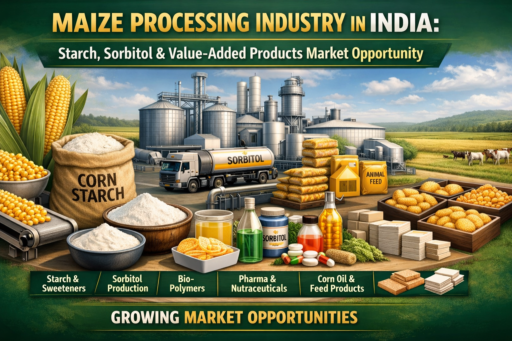


Introduction: Maize Processing Industry in India
India’s maize economy is slowly but surely changing. Traditionally regarded as a food and animal-feed crop, maize is now being seen as a vital raw material crop for a whole range of bio-industrial and value-added manufacturing applications. Products like maize starch, liquid glucose, dextrose, sorbitol, maltodextrin, maize gluten, and germ oil have become indispensable inputs for the pharmaceuticals, food processing, fermentation, textiles, paper and personal care industries.
Despite India being one of the largest producers of maize, it processes only a small fraction of the maize produced in the country into industrial derivatives. This mismatch in the availability of raw materials and downstream processing capacity has provided a production-led markets gap of high opportunity for MSMEs, industrial investments and agro-processing entrepreneurs.
Read More: Maize (Corn) Products in India (Starch, Glucose, Dextrose, Sorbitol) Trends, Opportunities, Market Analysis and Forecasts (Upto 2030-31)
Features of the Maize Processing Industry in India
India produces around 35-38 million tonnes of maize every year according to data of the Ministry of Agriculture & Farmers Welfare and Ministry of Food Processing Industries. However, only less than 12% of this maize is fed into organized wet milling and starch-based processing.
In contrast, developed maize processing economies convert a much greater proportion of maize into industrial ingredients. This is a structural gap, which brings out latent processing potential in India and also explains the ongoing reliance on imports of high purity starch derivatives.
Key Challenges Current Market
- Domestically grown maize: – Underutilization of domestically grown maize
- Import dependence of specialty starches and sorbitol
- Regional shortages of liquid glucose, dextrose
- Limited availability of pharmaceutical grade derivatives
Importance of Value Added Products from Maize
1. Maize Starch – The Intermediate in The Core
Maize starch is the backbone of the maize processing value chain. Firstly, It is used directly in:
- The products include: – Food and confectionery products
- Paper and corrugated board manufacturing
- Textile sizing and finishing
- Adhesives and binders
Moreover, Starch also serves as the base raw material for several high value downstream products.(Maize Processing Industry in India)
Read More: Handbook on Maize (Corn) Processing and Manufacture of Maize Products
2. Liquid Glucose and Dextrose
Firstly, Through a process of enzymatic hydrolysis, maize starch is broken down into liquid glucose and dextrose variants; which are widely used in:
- Confectionery and bakery fillings
- Drinking beverages and processed foods
- Oral rehydration salts (ORS)
- IV fluids and pharmaceutical formulations
- Fermentation, bio-ethanol production
3. Manufacturing Process of Sorbitol from Maize
Sorbitol is made from purified glucose syrup that is hydrogenated under high pressure with the help of nickel catalysts. As a result, It is a high margin derivative which has applications in:
- Pharmaceutical syrups
- Toothpaste, oral-care products
- Cosmetics and personal care
- Vitamin-C and Chemical manufacturing
Moreover, India continues to import pharmaceutical grade sorbitol, therefore this segment is very attractive for the domestic manufacturers.
4. Maltodextrin and Special Ingredients
Maltodextrin, produced by partial hydrolysis of starch, has experienced a rapid growth in demand because of its versatility of function. Moreover, It is widely used in:
- Infant nutrition
- Nutritional fields encompass the following:
- Instant food mixes
- Flavour encapsulation
Read More: Maize, Corn and its By Products, value added Products, Derivatives, Maize Processing Industry, Corn Starch, Dextrose, Liquid Glucose, Sorbitol, Oil, Gluten, Germ Oil, Wet Milling, Maize Starch Plant & related Products, High-Fructose Corn Syrup (HFCS)
Integrated Utilization of Maize Kernel
One of the greatest advantages of maize wet milling is the full utilisation of the kernel which increases the profitability of the plant.
- Maize gluten: Poultry and aquaculture feed
- Maize germ: Processed to Corn Oil
- Fiber and steep liquor Used in feed and fermentation
Therefore, This multi-product output structure provides for diversified revenue streams from one manufacturing facility.(Maize Processing Industry in India)
Maize Wet Milling technology and Manufacturing process
Moreover, Maize wet milling is a proven and scalable industrial technology consisting of:
- Steeping – Soaking maize kernels in water and sulphur dioxide
- Grinding – Separating germ, fibber, gluten and starch
- Starch purification – Preparing high purity starch slurry
- Enzymatic conversion – Using of a-amylase and glucoamylase
- Downstream processing – Evaporation, crystallization, spray drying
First, For the production of sorbitol, a glucose liquor is hydrogenated, In contrast, for the production of maltodextrin, a controlled partial hydrolysis is necessary, followed by spray drying for certain DE values.
Read More: Why India Imports Sorbitol Despite High Maize Production – A Golden MSME Manufacturing Opportunity
Plant Capacity and Scalability
Modern maize processing plants normally operate with 100 – 500 TPD maize input capacity. Additionally, One of the most important benefits is modular expansion, meaning investors can:
- start with starch and liquid glucose
- New: – to add dextrose crystallization later
- Integrate Sorbitol and Maltodextrin in Phases

Import-Export Trends and Domestic Demand Perspective
Despite strong maize cultivation, India still imports specialty starches, maltodextrin and pharmaceutical grade sorbitol. Moreover, Trade data shows an increase in the import of starch derivatives and glucose products at 6-8% CAGR during the past 5 years.
Key Demand Drivers
- Expansion of processed food manufacture
- Rapid expansion in pharmaceutical manufacture
- Rising markets for nutraceuticals and clinical nutrition.
- More intensive use of bio-based industrial inputs
This mismatch in demand and supply is particularly noticeable in central and eastern India, where there is a high availability of maize but limited processing infrastructure.
Competitive Landscape of India
The organized players in the Indian maize-based ingredients sector are currently dominated by organized players like Gujarat Ambuja Exports Ltd., Roquette India Pvt. Ltd., and Tate & Lyle India Pvt. Ltd.
However, most of the large-scale plants are concentrated in western India and this opens up opportunities for new units in maize producing states such as:
- Madhya Pradesh
- Bihar
- Telangana
- Eastern India
Logistics near to raw material offers a huge saving of logistics and improves the margin.
Read More: Why India Still Imports Sorbitol? Maize Processing Industry Capacity & Business Opportunity
Why Maize Processing is Attractive to MSMEs
Moreover, From an investment point of view, maize wet milling has a number of structural advantages:
- Year round availability of raw maize
- Multiple high value products from a single plant
- Strong domestic and export demand
- Import substitution opportunities
- Qualification for government agro-processing incentives
Furthermore, Project consultants like Niir Project Consultancy Services help entrepreneurs with feasibility studies, detailed project reports, machinery layouts and financial modelling.
Conclusion
India’s maize-based value-added manufacturing sector remains significantly underdeveloped relative to its agricultural strength. However, With rising demand from food, pharmaceutical, and nutraceutical industries—and continued reliance on imports—integrated maize wet milling presents a compelling manufacturing opportunity.
Moreover, Entrepreneurs who invest in maize processing today can capitalize on regional supply gaps, benefit from scalable technology, and position themselves at the center of India’s evolving bio-industrial ecosystem. Furthermore, As the country moves toward higher value addition in agriculture, maize processing stands out as a technically proven, economically viable, and future-ready industry.(Maize Processing Industry in India)
Frequently Asked Questions (FAQs)
Is maize wet milling profitable in India?
Yes. Firstly, Integrated plants earn money from different products and by-products, thereby enhances profitability.
What is the minimum viable plant size for MSME?
Additionally, Most MSME projects have an initial project capacity of 100 TPD maize input capacity and expansion flexibility.
Which derivative of maize has the best growth?
Moreover, Sorbitol and pharmaceutical-grade dextrose currently have the best growth in demand.
Does India still import maize based derivatives?
Yes. Furthermore, Specialty starches, maltodextrin and pharmaceutical grade sorbitol are still imported.
Can maize processing products be exported?
Yes. Finally, There is good export demand in Asia, Africa and the Middle East.


