Iron Ore Beneficiation Plant India
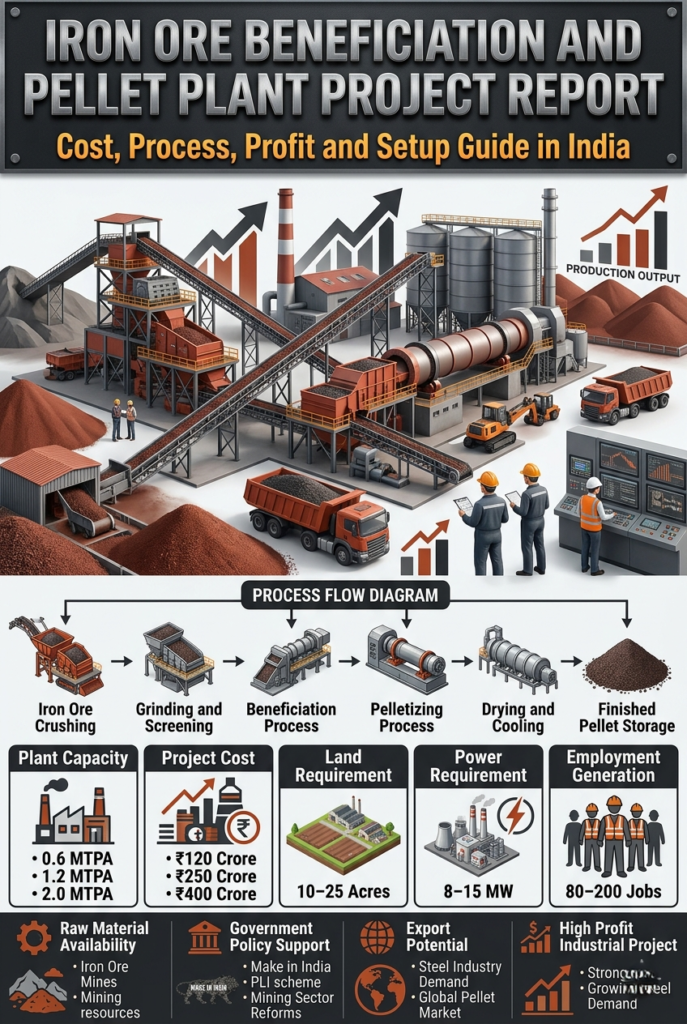
Steel plays a continued role in infrastructure, manufacture and industrial development across India. While iron ore mining has always remained the main activity in the industry, it is now moving toward value-added processing. Beneficiation and palletization enable companies to convert low-grade ore into high-grade material that modern steel plants need. This transition is providing great investment opportunities for entrepreneurs who wish to get beyond raw mineral extraction and establish long-term industrial businesses.
India has a good iron ore production base, which means there will be no shortage of raw materials. However, profitability in the current market is reliant less on extraction and more on efficient processing, logistics planning and positioning in the marketplace. Businesses that invest in beneficiation and pellet plants are able to catch higher margins and stable demand from steel and export markets.
Get Detailed Insights from this Book: The Complete Technology Book on Steel and Steel Products (Fasteners, Seamless Tubes, Casting, Rolling of Flat Products & others)
Why Beneficiation is Become Strategic Opportunity
Beneficiation has become essential since modern steel plants require uniform quality of raw material. Many iron ore deposits contain fines and impurities which decrease the efficiency of the furnace. Through beneficiation, these materials can be improved to a high-grade concentrate for production of pellets.
This process offers a number of operational and financial benefits:
- Improves the iron and the quality of the products
- Increases resource utilization From low-grade ore
- Reduces waste & environmental impact
- Enhances selling price and market demand
As companies are continuously establishing steel capacity in India, the demand for beneficiated ore and pellets will rise consistently over the next decade.(Iron Ore Beneficiation Plant India)
Business Models concerning Iron Ore Beneficiation Plants and Pellet Plants
Entrepreneurs may access this industry in various project models depending upon their investment capability and long-term strategy. Each model has its own advantages in terms of capital requirement, system complexity, and profitability potential.
Some of the most common business models are:
- Stand-alone beneficiation plant for low grade ore upgrading
- Integrated beneficiation & pellet plant for complete value chain processing
- Mini pellet plant between 0.5 & 1 MTPA capacity
- Export-oriented pellet plant close to ports
- Tailings recovery and waste processing unit
Among these ones, the integrated plants generally have higher margins, while mini pellet plants are safer for first generation entrepreneurs.
Get Detailed Project Report (DPR): Mining, Quarrying, Mineral and Ore Processing, Coal, Iron Ore, Limestone, Chromite and Granite Mining Projects
Major Financial Factors to Analyse in a DPR
A Detailed Project Report (DPR) is the most important document in the evaluation of the possibility of an iron ore processing project. It is good for investors to understand capital requirements, operational costs, and expected returns before committing funds.
The following factors are the main influencing factors for the financial performance of a pellet plant:
- Cost of iron ore fines and additives
- Power and fuel consumption
- Transportation and logistics costs
- Pellet selling price and market demand
- Plant capacity utilization
Even small changes in these variables can have a big impact on the profitability. Therefore, proper cost estimation and cost sensitivity analysis are crucial parts of professional project planning.(Iron Ore Beneficiation Plant India)
Turn your budget into a successful business plan
Best Places to Establish a Pellet Plant in India
Location selection plays a critical role in the determination of long-term project success. Companies need to strategically situate plants to balance access to raw materials and connectivity to markets. Transportation cost is often the largest operational expense so proximity to key resources and customers is extremely important.
The most appropriate places are usually:
- Mining regions that have an abundant supply of iron ore
- Steel manufacturing clusters with a steady demand
- Industrial areas having good power and infrastructure
- Coastal areas that have access to export markets
The correct selection of a business location leads to three advantages which include increased profit margins and decreased operational risk and business expansion stability.
Major Risks in Iron Ore Processing Projects
Beneficiation and pellet plants operate with the same risks as all major industrial investments because they face both operational challenges and market uncertainty. Investors who understand risks at an early stage can develop effective risk management strategies that protect financial security.
The most common risks are as follows:
- Irregular supply of raw materials
- Increasing electricity and fuel prices
- Environmental compliance issues
- Market price fluctuations
- (Logistics and transportation disruptions)
Companies that invest in efficient technology, strong supplier relationships and proper planning are better suited to manage these challenges.(Iron Ore Beneficiation Plant India)
Related Article: Top 3 Profitable Manufacturing Business Ideas in India (Low Investment, High Demand)
Conclusion
Iron ore beneficiation and pelletisation process is one of the most promising industrial opportunities in Indian mining and steel industry. The industry enjoys good domestic demand, as well as supportive government policies and increasing export potential. For entrepreneurs who are looking into long-term manufacturing ventures, this business offers a combination of stable revenue as well as a business that can be scaled and value addition.
With careful planning and strategic location selection and a well prepared Detailed Project Report, investors can build a profitable and sustainable enterprise in the iron ore processing industry.(Iron Ore Beneficiation Plant India)
Frequently Asked Questions (FAQ)
What is the minimum capacity to start pellet plant?
Most new projects start with capacities ranging from 0.5 to 1 million tonnes/annum, which is manageable and enables businesses to step up investment and development.
What is the average project set up time?
A beneficiation and pellet plant takes generally 12 to 24 months to set up, subject to approvals, financing and installation of equipment.
What is the largest cost item in the production of pellets?
Power consumption is usually the biggest operating cost in pellet plants.
Is this business good for new entrepreneurs?
Yes. Many entrepreneurs of the first generation begin with small or medium capacity plants and expand as demand rises.