
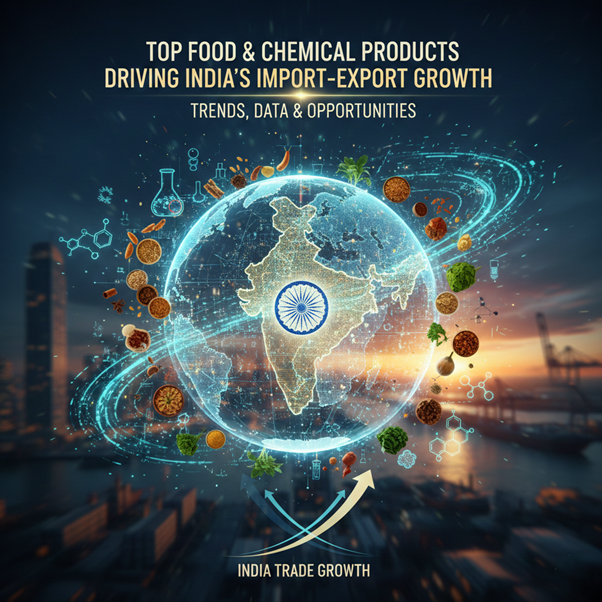

India runs its import-export operations as a crucial economic base which generates growth through the exchange of food and chemical products. The nation pursues international food product and specialty chemical supply reliability by following global market demands and consumer shifts and receiving governmental backing.(Top Food & Chemical Products Driving India’s Import–Export Growth: Trends, Data & Opportunities)
The importation of critical food elements and chemical substances into India allows domestic producers and emerging businesses to create these products through import substitution.
For novel startups, two powerful opportunities emerge in the compelling data(Food & Chemicals):
Read More: List of Profitable Business Ideas in Production of Soy and Soya Based Food Products.
The Ministry of Food Processing Industries (MoFPI) Annual Report 2024–25 shows that India exported USD 46.43 billion worth of food and agri-based products while food-related imports reached USD 31.7 billion. These numbers clearly indicate where trade gaps exist and which products are driving India’s import–export growth between 2025 and 2030.
The article provides an overview of top food and chemical products along with main trade trends and new business prospects for exporters and manufacturers and MSMEs and startups.
1. Snapshot of India’s import and export in the food sector and chemicals-Food & Chemicals
1.1 Food Exports (FY 2023-24)
India exported Agri-food products worth $46.43 billion, contributing 11.93% of the total exports. Of the Exported agri-food processed foods (which was USD 10.88 billion), there is evident worldwide interest in food that is
- ready to cook,
- ready to eat,
- Packaged and shelf-stable food products
1.2 Food Imports (FY 2023-24)-Food & Chemicals
India’s total food imports were USD 31.7 billion, with USD 15 billion comprising edible oils. Other important imports were fruits, nuts, drinks, and cocoa. These categories signify evident opportunities for domestic production(Food & Chemicals).
1.3 Chemicals Import-Export Trends
India has been bringing in specialty chemicals, food emulsifiers, cocoa and oils, and food-grade emulsifiers. On the other hand, the exports being experienced in spices, essential oils, nutraceuticals, and Pharma excipients are very dynamic. Startups can capitalize on both.
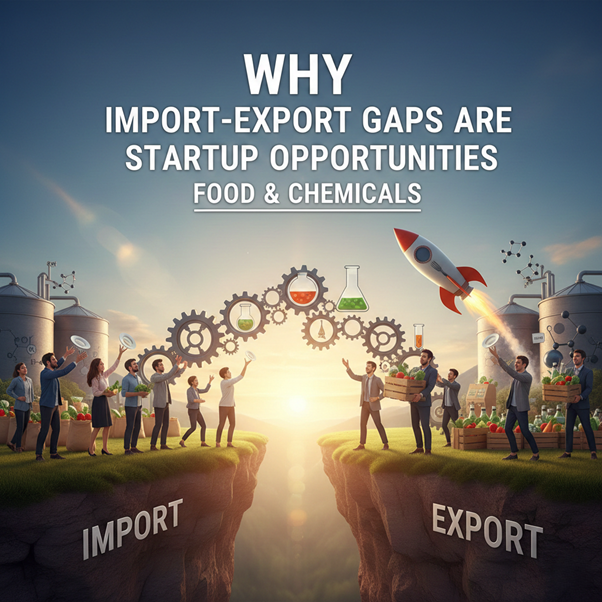
2. Why Import-Export Gaps are Startup Opportunities-Food & Chemicals
India’s heavy imports are evident opportunities for local startups to fill the void left by foreign suppliers-Food & Chemicals. On the other hand, the exports in large volumes indicate sectors with considerable international demand.
1. Edible Oil Dependence
India is over 60% dependent on edible oil imports(Food & Chemicals). Startups are able to establish oilseed processing plants for soybean, mustard, sunflower, and groundnut.
2. Low Food Processing Level-Food & Chemicals
India has very low food processing, with only 10% of the food produced being processed. Startups can work on ready-to-cook foods, dehydrated foods, and fortified foods.
3. Specialty Chemical Demand-Food & Chemicals
There is considerable scope for local production of oleoresins, nutraceuticals, and food-grade chemicals.
4. Increasing Demand for Sustainable Products-Food & Chemicals
There is global demand for live products such as House the innovative startups for clean labels, plant-based ingredients, and eco-friendly packaging products.
Read More: Start a Food Export Business: Top Commodities and Their HS Codes You Need to Know
3. Emerging Business Opportunities in the Food Sector
3.1 Cereal & Grain Processing
India earns an export revenue of 10.9 billion USD from cereals. There is a growing market for startups focused on the production of millet snacks, fortified cereals, and instant rice packages.
3.2 Spices & Oleoresins-Food & Chemicals
India’s spice export revenue is 4.7 billion USD, meaning there are opportunities for startups to create spice oils, oleoresins, and herbal nutraceutical extracts.
3.3 Meat & Seafood Processing
The Gulf and Southeast Asian regions are potential markets for frozen seafood and halal-certified meat products, as these are in high demand(Food & Chemicals).
3.4 Processed Fruits & Vegetables
There is considerable export potential for products like tomato paste, onion powder, banana puree, and tropical-fruit juices.
3.5 Sugar & Confectionery
There is a rapidly growing market for products like organic jaggery, natural sweeteners, and confectionery which are free from added sugars.
Read More: High-Profit Business Opportunities for Indian Startups
4. Emerging Business Opportunities in Chemicals
4.1 Edible Oil Derivatives
Indias enormous expenditure on importing oils could be reduced with units that focus on refining and extracting oils.
4.2 Cocoa & Chocolate Processing
India imports cocoa and cocoa products, which is a 513 million USD market. There is an opportunity for startups to produce chocolate and cocoa butter and powder.
Read Our Book: Click Here
4.3 Food-Grade Chemicals
There is high demand for food-grade preservatives, stabilizers, emulsifiers, and natural colorings from food processors(Food & Chemicals).
4.4 Plant-Based Nutraceuticals
There is a growing demand for oleoresins, herbal powders, and ayurvedic nutraceuticals.
5. Government Support Mechanisms
PMKSY-Food & Chemicals
This programme provides support for Mega Food Parks, Cold Chain, and Agro-Processing units.
PMFME
Provides 35 percent incentives for micro food businesses and one district one product (ODOP) items.
PLISFPI
Provides benefits for processed food sale increase. Best suited for large scale units(Food & Chemicals).
DPIIT & MoCI
Support for the manufacture of chemicals is provided on the basis of Make in India Policy.
6. Startup Success Stories-Food & Chemicals
LT Foods is a global brand (Daawat) following a success model in exports.
- Everest & MDH are world leaders in the spice trade and have packaged spices in the premium segment.
- Paper Boat is an illustration of a Traditional Indian Recipe winning the International Market(Food & Chemicals).
- Godrej Agrovet is one of the few in the world who successfully integrated chemicals with food.
These instances indicate that the addition of value and branding is the winning strategy.
Read Our Project Report: Click Here
7. NPCS: Supporting Your Import–Export Projects
Niir Project Consultancy Services (NPCS) assists aspiring entrepreneurs in establishing profitable food and chemical processing units.
Their Detailed Project Reports (DPRs) contain specifications of the technology for the manufacturing process, the analysis of the market, the machinery, the financials, etc. NPCS ensures that your plan is feasible, scalable and attractive to investors.
8. Roadmap for Entrepreneurs-Food & Chemicals
- Look for opportunities in imports and high-value export products.
- Pick appropriate government schemes.
- Create processing or manufacturing units.
- Get your certifications (FSSAI, HACCP, REACH).
- Develop a strong brand for Indian Origin Products.
- Significantly increase exports to focused markets.
- Leverage NPCS for Detailed Project Reports and feasibility studies.
Find the Best Idea for Yourself With our Startup Selector Tool
Conclusion-Food & Chemicals
The trends in India’s food and chemical product imports and exports indicate several potential areas for new startup businesses. There is an opportunity for growth in the export of cereals, spices, and processed food products.
On the other hand, there is a significant opportunity for import-substitution in edible oils, cocoa, and specialty chemicals, all of which India imports in large quantities(Food & Chemicals).
With the current policies in place, the government encourages the private sector to develop businesses that are exportable and strengthen the industrial future of India.
Frequently Asked Questions-Food & Chemicals
Q1. Which food categories provide the most promising opportunities to export?
A. The export of cereals, spices, seafood, processed fruit, and convenience foods is the most in demand.
Q2. What are the most significant and most needed items that India imports?
A. It is edible oils, cocoa products, specialty chemicals, and food additives.
Q3. What government programs are there to assist food processing start-ups?
A. PMKSY, PMFME, PLISFPI, and the programs to promote exports through APEDA.
Q4. Is there government support for chemical startups?
A. Yes, the support for specialty chemical manufacturing under the Make in India is from the DPIIT and the Ministry of Commerce(Food & Chemicals).
Q5. How can NPCS assist new entrepreneurs?
A. NPCS prepares DPRs, feasibility studies, and financial plans, and provides guidance for establishing a profitable processing unit.