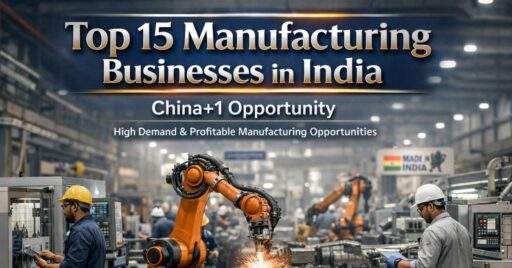


Cold Forging & Thread Rolling: A Bankable MSME Startup Opportunity
High-Tensile Fastener Manufacturing in India is a crucial industrial business. If you have interacted with plant owners, EPC procurement teams, or bank appraisal officers, one fact becomes obvious: fasteners may not look exciting, but nothing industrial works without them.
Every structure, conveyor system, power plant skid, solar mounting frame, warehouse, transmission tower, pump foundation, and machine assembly ultimately depends on bolts, nuts, washers, studs, and threaded rods. This is why fasteners remain one of India’s most boring-but-bankable MSME manufacturing businesses.
Among all production methods, cold forging combined with thread rolling stands out as the most practical, scalable, and bank-approved route—especially for entrepreneurs targeting high-tensile industrial fasteners.
From a feasibility and project-planning perspective, this is not just a manufacturing technique.
It is a repeat-order business model built on process control, predictable costs, and engineering credibility.
Why Cold Forging + Thread Rolling Is the MSME Sweet Spot
Cold forging is a process where metal is transformed at room temperature while using high-speed forming machines. The metal does not get cut off but rather flows into a desired shape. In addition, the process of thread rolling makes the fasteners even stronger by producing the threads through plastic deformation instead of cutting.
The entire process has four main advantages for the business:
- The cost per piece gets lower as the volume gets higher
- The threads are stronger due to the excellent grain flow
- Scrap is hardly produced, and raw materials are utilized very well
- Dimensional consistency is very good, which is a requirement of OEMs and EPCs
Those advantages are not just for the manufacturing companies but mainly for banks and financial institutions.
To them, a cold forging fastener unit is a controlled engineering system rather than a gamble in the stock market. When the output per shift, the rates of rejection, the life of the die, and the capacity of the machine are clearly specified, project financing will be much simpler.(High-Tensile Fastener Manufacturing in India)
Read More: Why 2025–2030 Will Be a Golden Era for Indian Manufacturing Startups
Demand Logic: Why Fasteners Sit at the Core of Industrial India
Fasteners are not dependent on any single sector. They benefit from multiple demand drivers:
- Infrastructure and construction projects
- Power, renewable energy, and transmission lines
- Automotive and industrial manufacturing
- Railways, warehouses, and logistics parks
- Maintenance, repair, and replacement (MRO) demand
Even when new capital expenditure slows, replacement demand never stops. Bolted joints face vibration, fatigue, corrosion, and load cycles—ensuring continuous consumption.(High-Tensile Fastener Manufacturing in India)
Smart MSME Product Strategy
Instead of manufacturing everything, successful MSMEs focus on a high-repeat product basket, such as:
- M8–M12 hex bolts
- Matching nuts and washers
- Fully threaded bolts
- Standard grades used daily by EPCs and OEMs
In fasteners, depth beats width, especially during the initial years.

Profitability Pattern: Why Fasteners Can Deliver Stable Returns
Fastener profitability does not come from one big margin.
It comes from many small decisions executed consistently.
Key Margin Drivers
- Conversion efficiency (cycle time, die life, rejection control)
- Repeat customer qualification (approved vendors are rarely changed)
- Product mix optimization (coatings, lengths, packaging)
- Operational discipline over marketing hype
However, this is an unforgiving business.
If hardness drifts, plating fails, or dimensions slip, vendor approval can be lost overnight.
Read More: FORGING ON OPEN DIE HAMMERS – Manufacturing Plant, Detailed Project Report, Profile, Business Plan, Industry Trends, Market Research, Survey, Manufacturing Process, Machinery, Raw Materials, Feasibility Study, Investment Opportunities, Cost and Revenue
What Banks Evaluate in a Fastener Manufacturing DPR
In serious bank appraisals, enthusiasm does not work—structured clarity does.
A feasibility-driven DPR typically covers:
DPR Area | What It Means for an MSME |
Product standards | Grade roadmap, tolerances, testing |
Market study | OEM, EPC, and import substitution scope |
Machinery | Forming, rolling, heat treatment matching |
Raw materials | Wire rod quality and chemistry control |
Process flow | Traceability, segregation, inspection |
QC & manpower | Gauges, calibration, testing systems |
Plant layout | Smooth flow, low handling losses |
This is where NPCS-style project planning adds value—aligning market demand, machinery selection, process flow, and financial viability into one decision-ready blueprint.
Import Substitution: Where the Real Opportunity Lies
India already produces commodity fasteners.
The real opportunity exists in:
- Consistent high-tensile batches
- Reliable test documentation
- Special coatings and corrosion resistance
- Tight tolerances demanded by OEMs
- Dependable delivery under project pressure
Exports are possible—but only when repeatability and documentation discipline are built from Day One.
International buyers expect:
- Batch traceability
- Mechanical and chemical test reports
- Stable metallurgy
- Transit-ready packaging
Read More: U-BOLTS AND CENTRE BOLTS – Manufacturing Plant, Detailed Project Report, Profile, Business Plan, Industry Trends, Market Research, Survey, Manufacturing Process, Machinery, Raw Materials, Feasibility Study, Investment Opportunities, Cost and Revenue
Lessons from India’s Leading Fastener Companies
Sundram Fasteners (TVS Group)
Lesson: Fasteners are qualified, not sold once.
Systems, metallurgy control, and testing discipline become your brand.
Deepak Fasteners (Unbrako)
Lesson: Start with standard products, but design your factory to climb the value ladder—better grades, coatings, and engineered fasteners.
Global Fastener Models
Lesson: Compete on availability, reliability, and consistency—not just price.
For MSMEs, the message is quite clear:
Control over the processes plus customer trust equals No end to profitability.
Read More: 10 New Manufacturing Business Opportunities in India for Startups and MSMEs
Cold Forging Bankable Project Ideas
1. High-Tensile Hex Bolts & Nuts
The demand is stable coming from EPCs, OEM suppliers, and MRO markets.
2. Solar & Structural Fastener Kits
Selling of bolts, nuts, washers, and anchors packed together for convenience.
3. Coated Fasteners
Higher return by corrosion protection and performance guarantee.
4. Threaded Rods & Studs
They are mainstay items that have steady demand for replacement.
Read More: Startup Selector
Frequently Asked Questions (FAQ)
- Is cold forging better than machining for fasteners?
Yes. For high-volume standard fasteners, cold forging provides higher strength, lower waste, and better economics. Machining suits low-volume specials. - What usually damages fastener MSME profitability?
High rejection rates, poor raw-material control, weak QC systems, and unplanned die failures. - Can first-generation entrepreneurs supply OEMs?
Yes. Many start with EPC or replacement markets while gradually building testing and qualification capability. - Where does real import substitution exist?
In consistent high-tensile fasteners, special coatings, and documentation-driven supply—not in basic commodity bolts. - What should a serious DPR always include?
Product mix logic, capacity calculations, machine matching, QC planning, working capital cycle, and sensitivity analysis.
Final Perspective
Fasteners reward discipline, not drama.
Cold forging and thread rolling convert process control into predictable profits. Entrepreneurs who treat the shop floor as a system—metallurgy, dies, gauges, inspection, and dispatch—build businesses that banks trust, OEMs qualify, and EPC buyers reorder repeatedly.(High-Tensile Fastener Manufacturing in India)
In a noisy startup world, fasteners remain one of the few manufacturing segments where quiet consistency beats hype—and pays well for decades.