
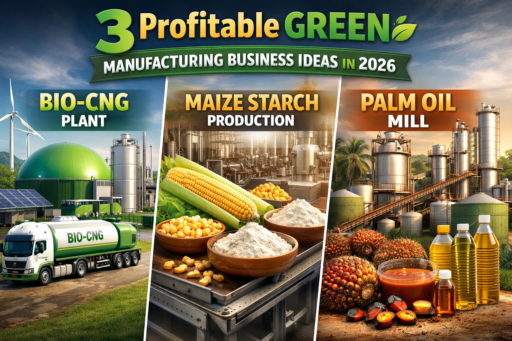


Green Manufacturing 2026 is influencing the future of manufacturing as sustainability, renewable energy and bio-based products are building their way out of the niche and into the mainstream. Governments, corporations and consumers are pressuring industries to implement cleaner production methods that have lower carbon emissions and circular economy models. This shift is causing huge opportunities for entrepreneurs to invest in environmentally-friendly and future-ready manufacturing businesses.
Among the most promising today is Bio-CNG production, maize starch production and palm oil milling. These industries have strong demand fundamentals, positive government policies, and long-term growth potential. This article examines how each business works, what trends are seen in the market, the investment opportunities available, and why they are attractive choices for industrial investors.
Read More: CNG Cylinders – Manufacturing Plant, Detailed Project Report, Profile, Business Plan, Industry Trends, Market Research, Survey, Manufacturing Process, Machinery, Raw Materials, Feasibility Study, Investment Opportunities, Cost and Revenue, Plant Economics
Bio-CNG Making: A Strongly Supported Renewable Fuel
Bio-CNG or compressed biogas is a clean and renewable substitute for traditional natural gas. The production process creates a gas which has the same characteristics as fossil-based CNG and this gas can be used through existing gas systems and CNG vehicles without any changes.
Production Process
Bio-CNG is produced by anaerobic digestion, in which organic feedstock, such as agricultural used residues, animal manure, food waste, municipal solid waste, or sewage sludge, is decomposed by microorganisms in the absence of oxygen (anaerobic digesters). The process generates biogas as its main product which undergoes purification to remove carbon dioxide and hydrogen sulfide and water vapor. The process uses compression to transform the gas, which has a high methane content, into Bio-CNG.(Green Manufacturing 2026)
Applications
Bio-CNG is widely used for:
- Fuelling buses, trucks and commercial vehicles
- Supplying of city gas distribution (CGD) networks
- Captive Power generation to Industries
- Heating: – Industrial heating applications
Read More: Maize (Corn) Products in India (Starch, Glucose, Dextrose, Sorbitol) Trends, Opportunities, Market Analysis and Forecasts (Upto 2017)
Market Outlook
The global Bio-CNG market is experiencing steady growth owing to increasing energy requirements and an increasing carbon emission pressure. In India, government initiatives like the SATAT (Sustainable Alternative Towards Affordable Transportation) scheme, waste-to-energy initiatives and the blending mandates are driving large scale adoption. Similar incentives are available in Europe and North America in the form of low-carbon fuel standards and renewable energy credits.(Green Manufacturing 2026)
Business Potential
Bio-CNG plants provide numerous revenue streams, including:
- Sale of Bio-CNG gas
- Sale of digestate for use as organic fertilizer
- Carbon credits and environmental incentives
However, the business requires careful planning because of high capital investment, feedstock logistics and regulatory approvals. Long-term feedstock supply contracts and offtake agreements for the gas are important for project success.
Maize Starch Manufacturing: An Ubiquitous and Stable Industrial Market
Maize starch is also known as corn starch and is a refined carbohydrate that is derived from the kernels of maize plants. Due to its neutral taste and good functional properties, it is one of the most used ingredients in food, industrial applications.
Manufacturing Process
Maize starch is made in a wet milling process where corn kernels are soaked, ground and separated into starch, fiber, protein (gluten) and germ. The starch slurry is further purified, dewatered and dried to get fine starch powder. Advanced plants also make modified starches and starch derivatives by treatment with enzymes and chemicals.
Read More: Edible Oil Refinery from Crude Palm Oil
Applications
Maize starch has various uses in several industries:
- As a thickener and stabilizer: – Food and beverages
- Pharmaceuticals (binder and disintegrant)
- Paper industry, textile industry
- Adhesives, packaging materials
- Biodegradable plastics, bio-polymers
- Animal feed by-products
Market Outlook
The global maize starch market is showing average growth of about 5% per annum. Growth is driven by a rising consumption of processed foods, increasing demand for gluten-free ingredients and rapid growth of starch-based bioplastics. Asia-Pacific especially India & China, the region of fastest growing market due to industrial growth & population growth.
Business Potential
Maize starch manufacturing provides flexibility in the positioning of the products. Entrepreneurs can focus on:
- Food-grade starch
- Industrial starch
- Modified and specialty starches that have increased margins
While the sector is competitive and margins are not always high, profitability is highly reliant on plant efficiency, scale of operations, energy management, and location in maize growing areas to minimize the costs of raw materials.
Read More: Handbook on Maize (Corn) Processing and Manufacture of Maize Products

Palm Oil Mill Business High Volume with Long Term Global Demand
High per hectare yield and cost efficiency make palm oil the most widely used edible oil in the world. A palm oil mill is used to process fresh fruit bunches (FFB) from oil palm plantations into crude palm oil (CPO) and palm kernel oil (PKO).
Milling Process
The Palm oil milling process entails:
- Sterilization of fresh fruit bunches
- Threshing and digestion
- Mechanical pressing to extract the oil
- Clarification and purification
Someone processes palm kernels separately to make palm kernel oil and palm kernel cake.
Read More: Top 25 Industrial Gas Business Ideas
Products and By-Products
Multiple products are produced in a palm oil mill:
- Crude palm oil (CPO)
- Palm kernel oil (PKO)
- Palm Kernel Cake for Animal Feed
- Shells and fibres for use as boiler fuel
This integrated use of by-products enhances the overall efficiency and sustainability of the plants.
Market Outlook
Palm oil has strong and diversified demand across:
- Food processing, edible oil markets
- Cosmetics and personal care products
- Detergents – oleochemicals
- Biodiesel and renewable energy sectors
Experts/projectors predict that global demand for palm oil will continue to increase steadily for the next decade, aided by population growth and renewable fuel mandates.
Business Potential
Palm oil milling is a capital-intensive business which needs reliable access to plantations and efficient logistics. Environmental regulations and sustainability certifications (RSPO – Roundtable on Sustainable Palm Oil, for example) are becoming more and more important. Mills adopting sustainable and traceable practices have a better access to the markets and long term stability.(Green Manufacturing 2026)
Read More: Tata Chemicals Sodium Bicarbonate Success: Manufacturing Process
Market Trends and General Business Outlook
All three sectors of manufacturing show very good growth fundamentals:
- Bio-CNG and maize starch are growing at a rate of approx. 5% annually
- We know that: – Palm oil grows at a slightly slower pace but from a much larger global base
Some key trends affecting these industries include:
- Strong government support for renewable and bio-based products
- Increasing focus on sustainability models & circular economy
- Adoption of modern processing technology
- Vertical integration for better margins and security of supply
Entrepreneurs who invest in efficient technology, automation, and resource optimization are better placed to have a competitive advantage.
How Niir Project Consultancy Services (NPCS) Aids Entrepreneurs
Niir Project Consultancy Services (NPCS) provides comprehensive Market Survey and Techno-economic feasibility assessments for multiple industrial projects which include Bio-CNG facilities and Maize Starch production plants and Palm oil processing facilities.
NPCS reports cover:
- Detailed manufacturing procedures and technology choice
- Capital investment and operating costs analysis
- Financial projections and profitability evaluation
- Market Demand and Competitive Analysis
- Risks and regulatory considerations
NPCS provides expert guidance to entrepreneurs which helps them to make better investment choices while they build manufacturing projects that will meet their technical requirements and business objectives.
Final Note
The industrial sector experiences its most significant growth when sustainability practices become the primary requirement for development. For instance, Bio-CNG and maize starch and palm oil milling businesses create green manufacturing operations which provide attractive long-term growth potential. Moreover, Proper planning and technology implementation together with expert guidance will work to achieve maximum financial success for these projects while supporting both environmental and economic growth.(Green Manufacturing 2026)
Frequently Asked Questions (FAQs)
What is Bio-CNG & where is it used?
Bio-CNG is renewable methane gas, produced from organic waste. It is used as a clean fuel for vehicles, industries and city gas distribution networks.
Why maize starch is a stable business?
Maize starch has applications in food, pharmaceutical, packaging, and bioplastic industries which ensures steady demand from various industries.
Is palm oil mill profitable despite environment?
Yes. Palm oil mills that adopt sustainable practices and certifications have a strong demand and access to the market.
What business is best for young new entrepreneurs?
The best one depends on location, availability of raw materials, and investment capacity. Bio-CNG is suited for the areas where large organic waste are available, Maize Starch is suits in and around corn belts and palm oil mills are ideal in and around plantations.
How can NPCS assist the project planning?
NPCS provides complete feasibility studies which include process design and cost analysis and financial projections and risk assessment to assist entrepreneurs in creating successful manufacturing projects.


