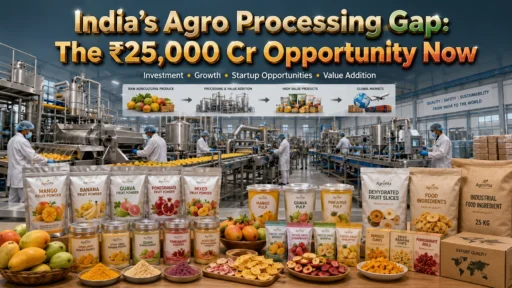


India’s maize-based agro-processing industry is undergoing a structural change as demand for maize-based products changes from traditional food and feed applications to industrial high-value applications. Corn Starch Market India has long been used as poultry feed and food staple, but is increasingly being used in the food industry in the form of starch and starch-based products for the food, pharmaceutical, textile, fermentation and personal care industries.
This transition is being aided by growing urban consumption, expansion of packaged foods, growth in pharmaceutical manufacturing and increased use of bio-based ingredients in all industries. As a result, the Indian corn starch and derivatives market is emerging as a high-potential segment in the agro-industrial ecosystem in the country.
Read More: Maize (Corn) Products in India (Starch, Glucose, Dextrose, Sorbitol) Trends, Opportunities, Market Analysis and Forecasts (Upto 2030-31)
Overview of Production of Maize in India
India is one of the world’s leading producers of maize and produces over 36 million metric tonnes every year. Key maize producing states are Madhya Pradesh, Karnataka, Maharashtra, Telangana and Bihar. Despite strong availability of raw materials, India is not utilizing maize for industrial processing to the extent it should.
Currently, less than 25 per cent of India’s maize production is subjected to value-added industrial processing, like starch, liquid glucose, dextrose and sorbitol. The majority is sold in its raw form as grain or as animal feed – meaning that value addition is limited and there is huge untapped market potential for downstream processing.
This supply-demand imbalance has provided great investment opportunities for maize wet milling and starch derivative manufacturing.
Market Size and Market Growth Trends
Over the past decade, the market of corn starch derivatives in India has experienced stable growth due to the growth of end-use industries. The growing penetration of processed foods, read-to-eat meals, bakery products and confectionery has given a big boost to the domestic consumption of starch-based ingredients.
At the same time, India’s pharmaceutical sector, which is now one of the largest in the world, is highly dependent on starch derivatives for tablet binding, IV fluids, fermentation processes and oral formulations.
Key growth drivers influencing the market are:
- Fast growth of processed food and packaged food industry
- Increasing pharmaceutical manufacturing capacity
- Increased use of starch in textiles, paper and adhesives
- Increases in personal care products, cosmetics and oral hygiene products
Industry estimates put the total processed food consumption in India to be on a growth path of more than 8% CAGR up to 2030, directly translating itself to continued demand for corn starch and its derivatives.
Read More: Maize (Corn) Products in India (Starch, Glucose, Dextrose, Sorbitol) Trends, Opportunities, Market Analysis and Forecasts (Upto 2017)
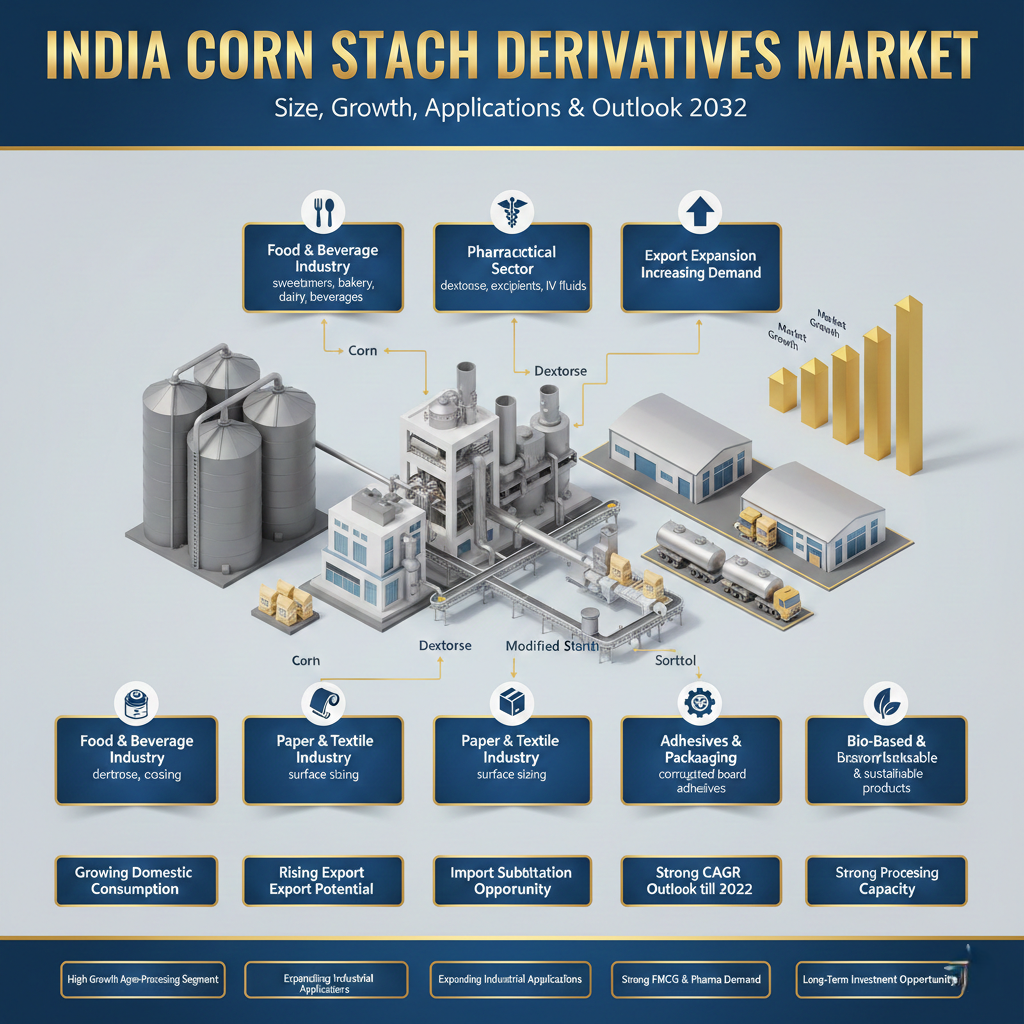
Major Derivatives and Uses of Corn Starch
Maize wet milling yields many different derivatives of starch, which are used in different industrial segments. These products are more and more viewed as essential inputs as opposed to optional additives.
Native Maize Starch
Native starch has found wide application in textile sizing, in paper manufacture, in adhesive formulations and in the binding of pharmaceutical tablets. Its thickening and binding properties make it indispensable in the industrial and consumer sectors.
Liquid Glucose
Produced from starch by the enzymatic hydrolysis of the starch, liquid glucose is an important ingredient in confectionery, fillings in bakery products, jams, ice creams and medicinal syrups. It is also used as a sweetener and viscosity enhancer in the food processing sector.
Dextrose Monohydrate
Dextrose is a key raw material in intravenous fluids, the production of antibiotics by fermentation and moreover, nutraceutical formulations. Consequently, Demand for pharmaceutical-grade dextrose is still increasing along with the growth of the healthcare sector.
Sorbitol Solution
Sorbitol is commonly found in toothpaste, cosmetic creams, vitamin syrups and sugar-free products because of its humectant, stabilization and additionally, sweetening properties. Moreover, Its use in personal care products has increased greatly in recent years.
Import Dependence and domestic supply gap
Despite the rich availability of maize, India still imports starch derivatives of high purity, for example, especially pharmaceutical-grade sorbitol and specialty glucose syrups. This dependence to import is because there is limited domestic refining infrastructure to accommodate stringent food and pharma-grade quality criteria.
Pharmaceutical manufacturing clusters in Gujarat, Telangana, Himachal Pradesh and Andhra Pradesh have often had to rely on imports to guarantee regular quality, which has resulted in:
- Higher procurement costs
- Exposure to fluctuations in international prices
- Volatiles: – Supply chain vulnerabilities
Addressing this gap by investing in modern and quality compliant maize processing units is a very good import substitution opportunity.
Read More: Handbook on Maize (Corn) Processing and Manufacture of Maize Products
Feasibility Studies on Maize Wet Milling Plants
The integrated maize wet milling plants are regarded as technically sound and financially attractive agro-industrial investment projects. Moreover, The process includes steeping of maize kernel, separation of starch and conversion of starch into value added derivatives through enzymatic and hydrogenation processes.
One of the most important benefits of maize wet milling is diversified revenues. Moreover, In addition to starch derivatives, several by-products can be monetized which improves the overall profitability of the project.
Key by-products include:
- For edible oil markets: – Maize germ oil
- Cob mix, 45 lbs. per bushel of corn gluten feed for animal nutrition
- Fiber residues for feed and industrial purposes
Comprehensive feasibility studies – often prepared by Niir Project Consultancy Services – allow investors to assess plant capacity, capital investment, raw material sourcing, operating costs and long term financial viability.
Structure of Organized Industries in India
The organized maize processing industry in India has a small number of large players with integrated plants. For example, Key industry players are Gujarat Ambuja Exports Ltd., Sukhjit Starch & Chemicals Ltd., Riddhi Siddhi Glico Boils Ltd. and Roquette India Pvt. Ltd.
These companies cater almost exclusively to FMCG, pharmaceutical and export markets. However, their geographical concentration has led to regional supply shortages, especially in emerging food processing and pharma clusters.
This scenario provides large possibilities for MSME – scale and mid-size units which are closer to the center of consumption.
Read More: Start a Maize Starch Business in India
Government Policy Support with Incentives
The Government of India has undertaken a number of policy initiatives to promote investment in agro-processing and value-added food infrastructure. Moreover, Financial assistance is available on plant setup, machinery, cold chain linkage and technology up-gradation.
Some basic support mechanisms are:
- Central government schemes on food processing infrastructure
- Capital subsidies at state level and reimbursement for interest
- Incentives for Agro-processing enterprises on the MSME scale
States such as Madhya Pradesh, Gujarat, Karnataka, Maharashtra, have been particularly pro-active in promotion of maize based processing projects.
Market Outlook Till 2032
The corn starch and its derivative products market in India will continue to experience strong growth until the year 2032. Moreover, The market will expand because of increased processed food consumption and the growth of pharmaceutical production and the rising demand for personal care products and the expanding fermentation industry.
For entrepreneurs and investors, integrated maize wet milling offers a compelling long-term opportunity due to:
- Strong domestic maize availability
- Multiple high-growth end-use industries
- Import substitution potential
- Supportive government policies
Therefore, the Indian agricultural sector will achieve its goal of higher value creation through the industrial development of corn starch derivatives which will drive industrial expansion.
Read More: From Farm to Functional food startups: India’s $25B Ingredient Revolution
Final Note
The market offers an exceptional investment opportunity which combines consistent raw material availability with multiple customer needs and moreover, backing from government regulations which makes it one of the top investment opportunities in India’s agro-processing sector.
Frequently Asked Questions (FAQ)
Q1. What is driving growth in India’s corn starch derivatives market?
Growth is primarily driven by processed food demand, pharmaceutical expansion, and increasing use in personal care products.
Q2. How much maize is processed into starch and derivatives in India?
Currently, less than 25% of India’s maize production undergoes industrial processing.
Q3. Is maize wet milling suitable for MSMEs?
Yes, decentralized wet milling units near consumption clusters are well-suited for MSMEs.
Q4. Why does India import sorbitol?
Imports are required due to limited domestic pharmaceutical-grade refining capacity.
Q5. What is the market outlook till 2032?
The market is expected to grow steadily with rising domestic consumption and strong import substitution opportunities.