Data Centre and Semiconductor Business Ideas in India
The world technology scene is experiencing a once in a generation boom in data centres and semiconductor manufacturing. With private investments exceeding $500 billion globally, this surge is fuelled by artificial intelligence (AI) infrastructure, geopolitical realignments of supply chains, and the drive by governments to achieve domestic chip production. For Indian entrepreneurs and MSMEs, this shift in structure is a golden opportunity to participate in a high growth and high demand industrial ecosystem.
India through initiatives such as India Semiconductor Mission, PLI schemes etc. are well positioned to benefit. However, the real entrepreneurial opportunity is not in the construction of huge fabs or hyperscale data centres but in the ecosystem that surrounds them: component suppliers, precision engineering, testing services, specialty materials and cooling solutions.
Why the Semiconductor and Data Centre Sector is an Opportunity of a Generation
1. AI Infrastructure is Driving Demand
Every AI model running autonomous systems, cloud computing or digital assistants require immense computational infrastructure. High-density server clusters used in data centres require powerful cooling, power management and rack systems.
This has a ripple effect throughout supply chains, which creates a lasting demand for suppliers of thermal materials, precision fabrication and energy-efficient solutions. Companies developing AI systems battle hard for power, cooling and rack space, meaning there are guaranteed business opportunities for ecosystem players.
2. Global Semiconductor Supply Chain Reorientation
Previously concentrated in East Asia the semiconductor supply chain is being diversified globally. Programs such as the US CHIPS and Science Act and India’s Semiconductor Mission provide incentives for domestic production. Industry leaders such as TSMC, Intel, Samsung and Micron are investing billions in new fabs around the world.
For Indian entrepreneurs, it means a decade-long opportunity to provide components, special materials, packaging solutions and testing services to these growing facilities.
3. India’s Strategic Advantage
The Indian government has announced a Semiconductor Mission of Rs 76,000 crore, to support fab units, display fabs and production of compound semiconductors. With 50% capital expenditure support and PLI incentives, startups and MSMEs get access to a predictable demand pipeline, to reduce risks in this high-capital-expenditure sector.
India presently imports more semiconductors and data centre equipment than it produces which enables local MSMEs to meet emerging domestic market requirements without depending on foreign goods.(Data Centre and Semiconductor Business)
High Potential Business Ideas for Entrepreneurs
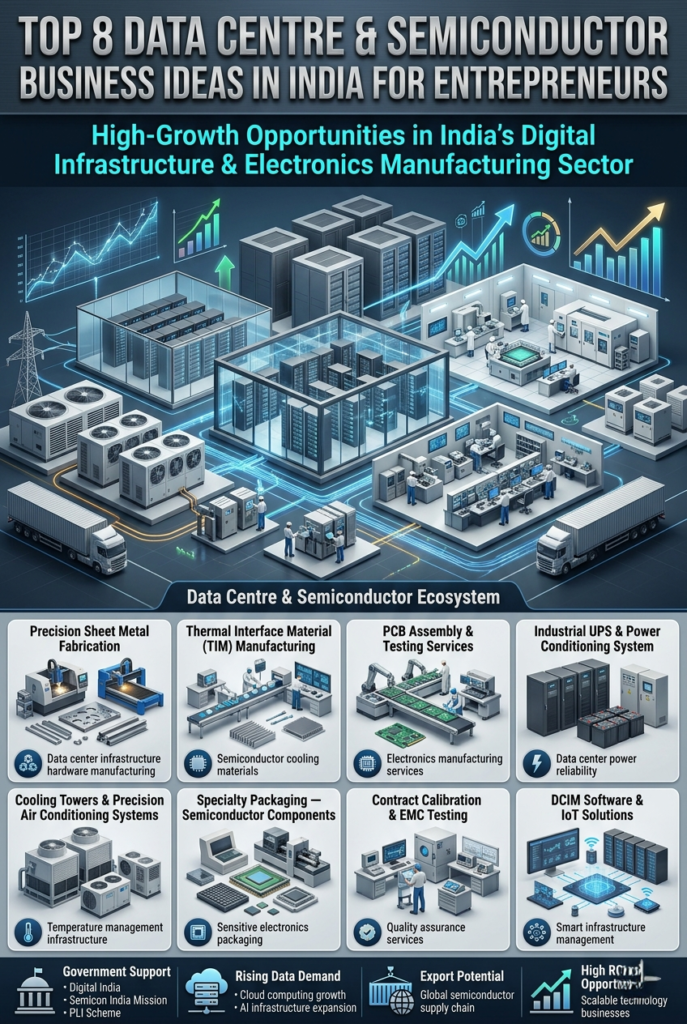
The data centre and semiconductor ecosystem in India provides eight business opportunities which startups and MSMEs can explore:
1. Precision Sheet Metal Fabrication
Data centres need server racks, cable trays, mounting brackets and structural panels with tight tolerances. Entrepreneurs who have the capacity to bend, cut with lasers, and apply powder coating can launch a repeatable volume-based business.
- Investment: ₹80 lakh – ₹2 crore
- Margins: 18–28%
- Government Incentives: PLI, MSME Scheme
Read the Complete Book Here: Handbook on Steel Bars, Wires, Tubes, Pipes, S.S. Sheets Production with Ferrous Metal Casting & Processing
2. Thermal Interface Material (TIM) Manufacturing
With the growing power densities in chips, heat dissipation is important. Products such as thermal pads, phase change compounds, graphene films, and liquid metals are in high demand. Currently, India imports majority of such products and there is a lucrative import substitution opportunity.
- Investment: ₹50 lakh – ₹1.5 crore
- Margins: 35–55%
- Incentives: Startup India, PLI Electronics
3. PCB Assembly & Testing Services
The PCB assembly market exists as a fragmented industry which operates at high capacity. MSMEs can procure bare boards and fill them with components for networking, industrial automation, server OEMs and defence electronics.
- Investment: ₹1.5 crore – ₹4 crore
- Margins: 20–35%
- Incentives: PLI Electronics, Make in India
Access Complete Business Plan: PCB Manufacturing Business Plan and Feasibility
4. Industrial UPS & Power Conditioning System
Data centres are incredibly power hungry and need strong UPS systems and power conditioning. Startups can create customized modular UPS systems together with fast local service to compete effectively against multinational companies that provide these services.
- Investment: ₹1 crore – ₹3 crore
- Margins: 22–32%
- Incentives: Make in India, PLI
5. Cooling Towers & Precision Air conditioning Systems
High-density server racks are also moving towards liquid and immersion cooling methods, creating a need for specialized cooling equipment. Domestic startups can cater to local data centres as well as export markets.
- Investment: ₹2 crore – ₹5 crore
- Margins: 25–40%
- Incentives: PLI, SEZ Benefits
6. Specialty Packaging Semiconductor Components
Protection against electrical discharge requires semiconductors to use ESD safe packaging and dry-pack systems and moisture barrier solutions. The Indian ATMP ecosystem and electronics manufacturing sector have developed this niche market.
- Investment: ₹30 lakh – ₹1 crore
- Margins: 30–45%
- Incentives: MSME, Startup India
7. Contract Calibration And EMC Testing
Electronic devices must complete electromagnetic compatibility testing together with environmental stress assessment. With few accredited labs, startups can offer their high margin testing services for electronics OEMs, defence, and EVs sectors.
- Investment: ₹1.5 crore – ₹3 crore
- Margins: 40–60%
- Incentives: NABL Accreditation, DST Scheme
Related Article: Best Franchise Business in India Under 10 Lakh – Low Investment & High Profit
8. DCIM Software & IoT Solutions
The software known as Data Centre Infrastructure Management (DCIM) enables monitoring of power distribution and cooling systems and rack usage. Software-first entrepreneurs can create high margin and scalable platforms for local and global markets.
- Investment: ₹20 lakh – ₹80 lakh
- Margins: 60–80%
- Incentives: Startup India
Learning with Industrial Leaders
- Kaynes Technology: The company began as a contract manufacturing business but achieved stock market success through its commitment to quality standards and development of strong client relationships.
- Dixon Technologies – The company changed from OEM assembly operations to ODM design services which proved that engineering talent investment combined with large-scale manufacturing capabilities creates sustainable business expansion.
- Rajesh Exports: The company demonstrates vertical integration power by controlling all business operations from raw material acquisition to finished product delivery which serves as a business model for thermal materials and specialty packaging enterprises.
Find high-return business ideas based on your budget & ROI
Final Word: Act with Clarity
The data centre and semiconductor boom is structural, not cyclical. Governments are investing billions, and AI infrastructure ensures sustained demand. For entrepreneurs, the key question is: Which node of the value chain aligns with your capital, expertise, and risk appetite
Through their study of opportunities and creation of DPRs, startups will use available incentives to achieve profitable business results during this historic industrial growth period.
FAQs for Entrepreneurs
Q1. Do I need to have a technical background?
Not always. Some sectors, such as DC IM software, packaging and EMC testing, can be handled using business expertise with technical partners.
Q2. Which government schemes do I need to take advantage of?
Some important schemes are Startup India, PLI Electronics, India Semiconductor Mission, MSME Credit Guarantee and Technology Development Board grants.
Q3. Shall the domestic market be large enough?
Yes. MSME-scale businesses in this sector can have an annual revenue of Rs5 – 50 crores depending on the segment.
Q4. Can MSMEs export?
Yes. Products such as EMC-tested components, TIM, specialty packaging and DCIM software have a global need.
Q5. How to get started with a feasibility study?
The Detailed Project Report (DPR) requires market need assessment together with process mapping, equipment specifications, and supplier identification, and financial projections.