


Chemical startup ideas India
India’s chemical and petrochemical sector is at an inflection point. While downstream sectors such as infrastructure, textiles, packaging, automotive, paints and consumer goods continue to grow steadily, domestic chemical manufacturing capacity has not grown at the same pace. This imbalance has led to large importation volumes of basic chemicals, monomers, polymers and specialty intermediates in India every year.
Government and industry data indicate that many existing chemical plants in India are utilised at 80-95 per cent capacity utilisation, so there is little scope for incremental demand. As a result, imports have become part of the structure of an economy as a permanent gap, rather than a temporary one. This demand-supply mismatch opens up a strong and relatively low-risk opportunity for import substitution – focused chemical startups.
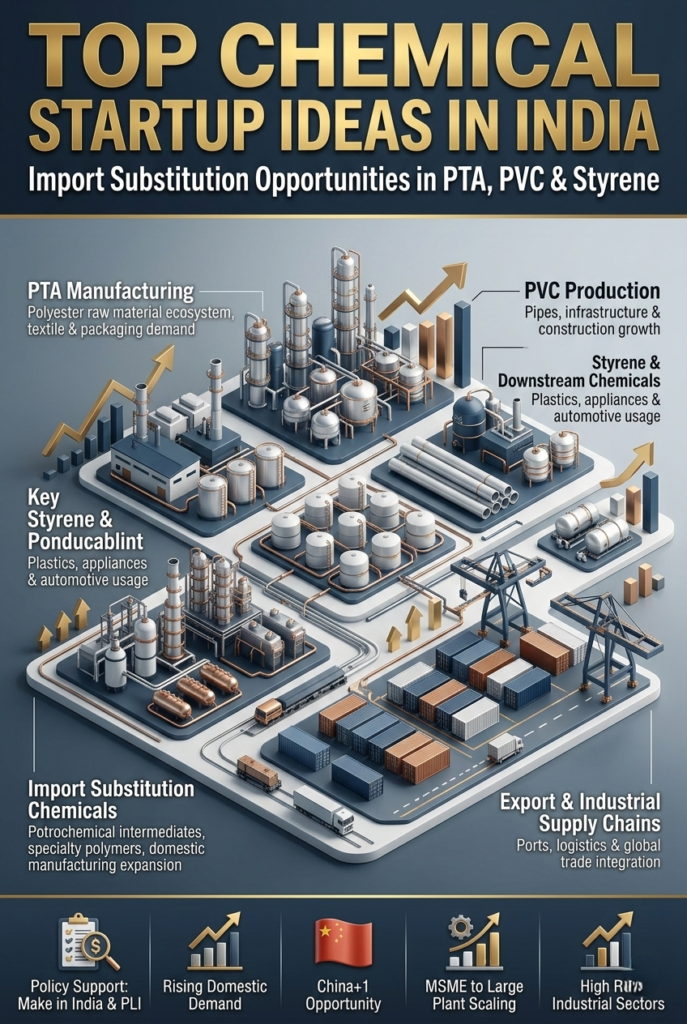
Products like PTA, PVC, styrene and VAM, MEG, synthetic rubbers and specialty intermediates put together are over importing at more than ₹40,000 crore annually. For entrepreneurs, MSMEs and middle-size investors these are not speculations but have domestic assured demand and long-term industrial growth.
Read More: Handbook On Chemical Industries (Alcohol Based)
Why Import Substitution is a Wise Strategy for Chemical Startups in India
Import substitution in chemicals does work especially well because chemical plants have long gestation periods. Even where demand can be seen, new capacities take years to plan, license, finance, and commission. Until then, imports keep filling the gap.
Important factors favouring import substitution are:
- Assured domestic demand from fast growing downstream industries
- High utilisation levels at existing plants indicating unfulfilled demand
- Increasing freight and logistics costs, lowering the cost benefit of imports
- PCPIRs, Plastic Park, Manufacturing incentives by government
- Lower market risk compared to export-dependent chemical projects
Unlike cyclical commodities, many of these chemicals are essential industrial inputs so demand is structurally resilient.
Vinyl’s Value Chain Opportunity: EDC, VCM and PVC
The vinyl’s segment is one of the most import dependent sectors of the Indian petrochemical industry. Polyvinyl Chloride (PVC) is widely used in pipes, fittings, cables, profiles and construction products. Despite good level of domestic demand, India imports quite a substantial percent of Vinyl Chloride Monomer (VCM) requirement.
Major producers of PVC, e.g. Reliance Industries Limited, Chemplast Sanmar Limited, and DCW Limited, depend on imported VCM to some extent or totally. Ethylene Dichloride (EDC), the immediate precursor of VCM, is also import-heavy.(Chemical startup ideas India)
Read More: Modern Technology of Industrial Chemicals
Startup Entry Points in the Vinyl’s Chain
- Domestic PVC producers: – Standalone VCM plants
- Integrated EDC – VCM units to enhance cost efficiency
- Downstream PVC resin, CPVC, specialty grades
Projects near sources of chlorine and ethylene in Gujarat or Tamil Nadu have the advantages of logistics, feedstock availability and ecosystem support.
PTA and MEG: Backbone Polyester and PET Packaging
Purified Terephthalic Acid (PTA) and Mono Ethylene Glycol (MEG) are the basic raw material for polyester fibres, films and PET bottles. India is a significant consumer of polyester in the world, but there are still high imports of PTA and MEG due to capacity constraints.
Domestic production is concentrated in a small number of players, which include Reliance Industries Limited and Indian Oil Corporation Limited. However, continued demand growth has maintained utilisation levels at a high level, which indicates a clear need for new capacity.
Opportunities for Business for New Entrants
- PTA plants combined with paraxylene in PCPIR zones
- MEGs plants, including bio-based MEG using ethanol
- Downstream integration as PET resin/polyester chips
Integrated projects provide enhanced margin stability and accelerated break-even as compared to stand-alone plants.
Styrene: An Opportunity for Strategic Import Substitution
Styrene is another key monomer of which India is nearly dependent wholly on imports. It is used to manufacture polystyrene, ABS plastics, synthetic rubbers and unsaturated polyester resins. Demand is driven by packaging, appliances, automotive parts and construction materials.
Downstream producers such as Supreme Petrochem Limited rely on imported styrene, and are exposed to price volatility and supply risks.(Chemical startup ideas India)
Why Styrene is a Business Sense
- Strong and diversified downstream demand
- Low competition at domestic level
- High integration potential
Styrene projects look much more attractive when used in combination with:
- Polystyrene or ABS resin units
- SBR rubber manufacturing
- Unsaturated plants of polyester resin
Read More: Project Reports & Profiles
Synthetic Rubber and Elastomers: Tyre and Automotive Driven
India’s automotive and tyre industries are still growing and heightening demand for synthetic rubbers such as Styrene – Butadiene Rubber (SBR) and butyl rubber. While there is some domestic capacity, imports still constitute a large proportion of consumption.
The long-term outlook and capacity expansion plans of the tyre sector suggest that there will be continued demand for elastomers. Butyl rubber is an even greater case for import substitution as domestic production is extremely limited.(Chemical startup ideas India)
Segments of elastomer having high potential
- Halobutyl rubber for tubeless tyres
- Specialist elastomers for pharmaceutical and food packaging
- Backward integration by tyre and rubber goods manufacturers
These projects benefit from close linkage to end-use industries reducing market risk.
Specialty Chemicals: VAM, Polyols, MMA and Intermediates
Vinyl Acetate Monomer (VAM) is a major input for paints, adhesives and emulsions and EVA copolymers. Despite increasing demand for it, domestic capacity is limited, and this has resulted in persistent imports. Investments by players such as Asian Paints Limited point to strong long-term fundamentals.
Similarly, products such as polyols for manufacture of polyurethane foams, methyl methacrylate (MMA) and phthalic anhydride continue to operate at high utilization levels amongst existing producers such as IG Petrochemicals Limited and Manali Petrochemicals Limited.(Chemical startup ideas India)
Read More: Best PCPIR for Chemical Manufacturing in India: Dahej, Paradeep or Vizag?
Why Specialty Chemicals Are Appealing to Startups
- Diversified demand among the different industries
- Higher margins than bulk chemicals
- Opportunity for grade differentiation
- Better resilience to economic cycles
Why MSMEs Can Make it in Chemical Manufacturing Today
Chemical manufacturing is no longer a preserve of the big conglomerates. Government-supported industrial clusters have been very effective in lowering barriers to entry. Petroleum, Chemicals and Petrochemicals Investment Regions (PCPIRs) and Plastic Parks offer common utilities, waste effluent treatment and logistics infrastructure.
In many cases, as many as 50 percent of common facility costs are supported through grants. Access to proven technology via global licensors lowers the execution risk further.
With the right feedstock location, scale selection and downstream integration, even mid-scale chemical plants can produce stable, long-term returns.
Read More: Top 15 Chemical Manufacturing Business Ideas in India with Huge Import Substitution Potential
Conclusion
India’s growing chemical import bill is a sure sign of unsatisfied domestic manufacturing demand. For entrepreneurs and MSMEs, this is a rare chance to set up scalable and sustainable businesses with relatively low market risk. Chemical startup ideas of PTA, PVC, Styrene, VAM, Elastomers, and Specialty intermediates are closely aligned with the Industrial growth and policy direction of India.
With the right technology, location, and integration strategy, import substitution – driven chemical start-ups can be long-term value creators in India’s manufacturing ecosystem.
Frequently Asked Questions
What are the best import substitution potential chemical startup ideas in India?
PTA, PVC, styrene, VAM, MEG, synthetic rubbers, and specialty intermediates have the widest demand-supply gaps.
Are these projects appropriate for MSMEs?
Yes. Many projects make sense at mid-scale capacities, primarily in PCPIRs and Plastic Parks.
Does specialty chemicals provide higher returns than bulk chemicals?
Specialty chemicals have a higher margin, but bulk chemicals have the volume. A balanced portfolio is the best route to take.
What is the average payback time?
Well structured import substitution projects usually have a payback in four to six years.


