The Chemical Business Ideas for MSMEs is undergoing a structural shift. Instead of competing only on the volume of production, the technology, consistency and application-specific performance is becoming more of a focus for manufacturers. This transition is especially beneficial for Micro, Small and Medium Enterprises (MSMEs) who until now could not compete with larger players because they lacked the scale advantage but now have the opportunity to compete through optimization of processes and formulation of expertise.
For entrepreneurs and industrial investors, this shift is a clear opportunity to develop technology-driven specialty chemical businesses which will integrate into domestic as well as global supply chains.
Read More: Handbook On Chemical Industries (Alcohol Based)
India’s Chemical Industry Landscape and Chemical Industry Opportunity for MSME
India’s chemical industry is supporting numerous downstream industries, from agriculture to pharmaceuticals, from automotive manufacturing to textiles to electronics and infrastructure. While the total production volume of bulk chemicals is dominant, a large part of the value creation is driven by specialty intermediates and performance chemicals and many of them are produced by MSMEs.
Industrial production statistics show that:
- High-volume segments such as alkali chemicals have the highest output share.
- Smaller segments such as specialty polymers, coatings and additives are more dependent on technology and formulation expertise.
- A second characteristic of music retailing is: – – These lower-volume segments often provide higher margins because of the differential in performances.
For MSMEs, that means precision manufacturing instead of commodity scale.
What Is Making a Chemical Technology MSME Technology Driven?
A technology-driven chemical business is not so much determined by plant size, but more so by a discipline of operation. Such units focus on efficiency, consistency and compliance throughout the manufacturing process.
Some of the key characteristics usually include:
- Optimized energy consumption per batch
- Increased reaction yield and minimum reprocessing
- Reduce waste generation and effluent control
- Conformity with the domestic and international quality standards
In practice, such results are achieved by combining the use of automation in dosing, temperature and quality control. A number of MSMEs that adopt digital process control systems as well as solvent recovery technologies early on, tend to gain better control of costs and gain greater trust from customers, particularly in export markets.(Chemical Business Ideas for MSMEs)
Read More: Modern Technology of Industrial Chemicals
High-Growth Technology Driven Chemical Business Ideas
Specialty Water Treatment Chemicals
Rapid urbanization, industrial growth, and stringent discharge standards are increasing the demand for advanced water treatment chemicals in the long run. MSMEs producing specialty products such as corrosion inhibitors and scale control agents can be in diverse industries from pharmaceuticals to textiles.
There are several advantages of this segment:
- Recurring demand from industrial users
- Long-term supply contracts
- Performance based pricing instead of commodity pricing
Industrial leaders such as Balkrishna Goenka grew their businesses by bringing product portfolios that matched infrastructure-led demand, a strategy that is very similar to the water treatment chemicals opportunity.
Smart Polymer Compounds for Electrical Applications
The electrical and electronics industry is demanding more and more polymer materials with well-defined thermal, mechanical, and flame retardant properties. MSMEs manufacturing smart polymer compounds and reinforced thermoplastics can become important suppliers to the equipment manufacturers.
This segment is good for MSMEs because:
- Production is scalable with the addition of compounding lines
- Capital expenditure is moderate – compared to bulk petrochemicals
- Export demand is high because of standardization
Entrepreneurs like Ashok Chaturvedi have shown the way how material innovation at the downstream level can produce globally competitive enterprises.
Read More: Project Reports & Profiles
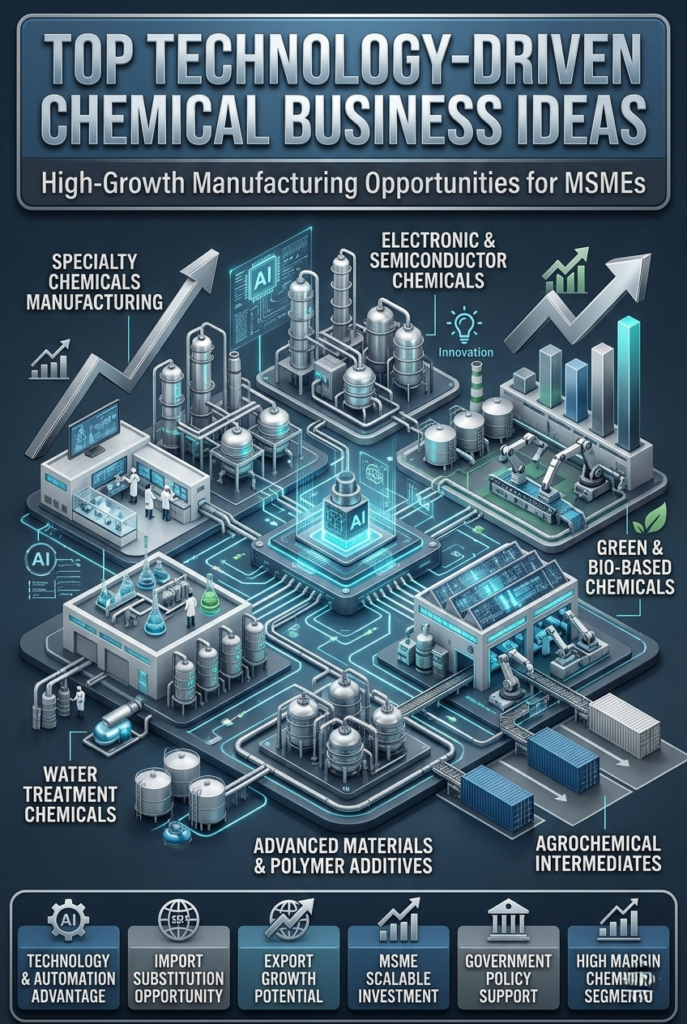
Low VOC Industrial Adhesives
As global emission norms get tightening, industries are fast moving towards low VOC and solvent free adhesive systems. Adhesive manufacture is mostly formulation based and hence fits the needs of MSMEs that are performance driven, not volume driven.
Key benefits of the business include:
- High degree of customization for specific applications
- Manageable plant size and investment
- Better margins: formulation expertise
The growth journey of Karsanbhai Patel is an example of how disciplined formulation and cost optimization can bring basic chemical inputs to scale to turn them into businesses.(Chemical Business Ideas for MSMEs)
High Performance Coating and Surface Treatment Chemicals
Surface treatment and corrosion protection chemicals is essential input for automotive, infrastructure and engineering industries MSMEs operating in this segment enjoy a constant industrial demand and long-term customer relationships.
Technology driven advantages in this segment are:
- Automated mixing to ensure batch consistency
- Real-time quality monitoring,
- Reduced rejection/rework rates
Industrial leaders such as Chandrakant Gorgi expanded their business by specializing in value-added intermediates and not bulk chemical production.
Read More: Top Investment-Ready Petrochemical Manufacturing Projects for MSMEs in India
Cleaning Solutions Based on Enzymes
Sustainability-driven procurement policies are driving more and more industrial cleaners based on enzymes into the food processing, healthcare and logistics sectors. These products are environmentally compliant and are often offered under contract-based models.
From an MSME point of view, it is this segment that offers:
- Predictable consumption cycles
- Reduced regulatory risk over harsh chemicals
- Easy scalability by using blending systems
Export Potential of Technology-driven MSMEs
India’s specialty chemical exports are showing a steady growth due to diversification of sourcing locations by global buyers. MSMEs with good quality and consistent meeting of standards can incorporate into international supply chains.
Export-ready MSMEs usually concentrate on:
- Quality certifications and compliance papers
- Stable formulations and reproducible
- Efficient logistics by industrial clusters
Products like specialty polymers and adhesives, water treatment chemicals and surface treatment formulations are actively traded in global markets.
Feasibility Evaluation Before Investment
Before they make a capital commitment, entrepreneurs need to evaluate feasibility beyond simple cost estimates. A detailed evaluation should take into account:
- Batch yield efficiency and energy consumption
- Waste treatment and environment compliance costs
- Working capital requirements and cash flows cycle
- Scalability through modular expansion
At Niir Project Consultancy Services (NPCS), we prepare Market Survey cum Detailed Techno-Economic Feasibility Report (DPR) which include manufacturing processes, market analysis, machinery details and financial projection. These reports aid in entrepreneurs in validating viability and plan sustainable growth.
Read More: Top 15 Chemical Manufacturing Business Ideas in India with Huge Import Substitution Potential
Final Perspective
India’s MSME sector can achieve significant growth through technology-based chemical manufacturing operations. Companies that establish automated systems to maintain product quality while meeting regulatory standards will achieve success through extended contract relationships and international trade opportunities.(Chemical Business Ideas for MSMEs)
Specialty chemical production serves as a sustainable business model for founders who want to establish manufacturing enterprises that can achieve scalability to generate stable profits.
Frequently Asked Questions (FAQ)
Are technology-driven chemical businesses amenable to MSMEs?
Yes. Formulation based and specialty chemical based projects lend themselves well to MSME-scale investments and operations.
What is the usual range of investments?
Most of the projects will require an investment between 2 crores and 10 crores, based on the degree of automation and capacity.
Is there an export demand for specialty chemicals?
Yes. Automotive, packaging, electronics and infrastructure industries have huge demand around the world.
What are the risks entrepreneurs need to keep in mind?
Compliance costs, raw materials price volatility and process control are the primary risks.
Is capacity easily expandable?
Most batch-processing chemical plants are scaled up efficiently by adding reactors or compounding lines.