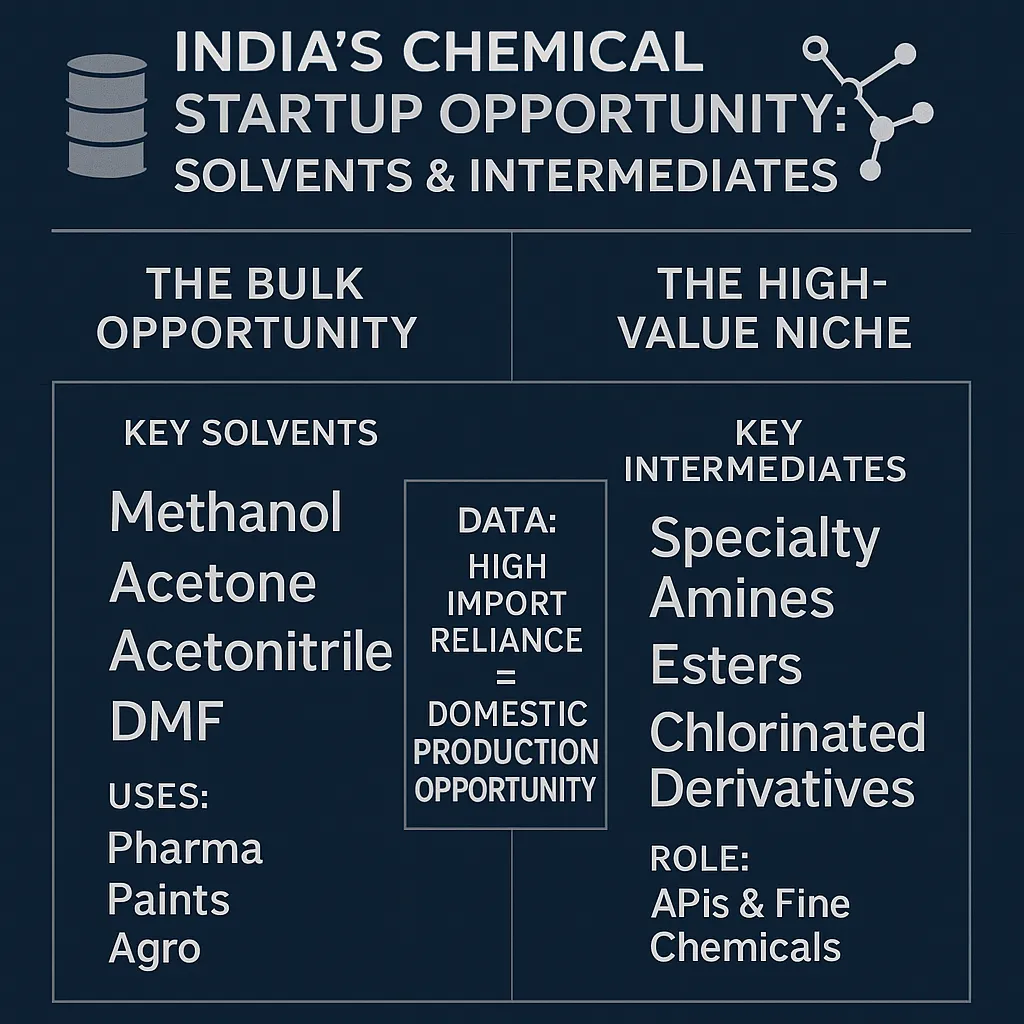
Bulk Solvent & Chemical Intermediates Manufacturing in India is poised for significant growth, driven by rising domestic demand, export opportunities, and the diversification of global supply chains. Manufacturing of bulk solvents such as methanol, acetone, acetonitrile, DMF, along with high-value chemical intermediates, provides startups and entrepreneurs with great business opportunities.
India is one of the largest importers of bulk solvents and specialty intermediates, which points out the necessity for import substitution and export-oriented chemical manufacturing projects. The government is supporting this sector with PLI schemes and chemicals’ and pharmaceuticals’ strong position; thus, industrial investment areas are becoming one of the most attractive ones.
Read More: Top 10 Chemical Import-Export Trends India’s Entrepreneurs Can Capitalize on
Market Overview: Bulk Solvents and Chemical Intermediates in India
Bulk solvents and chemical intermediates are the main raw materials for various industries such as:
- Pharmaceuticals
- Paints & coatings
- Adhesives
- Agrochemicals
- Specialty chemicals
The ports of Kandla, Mumbai, and Vizag are the main points through which India imports methanol, toluene, acetone, acetonitrile, and DMF. Methanol, in particular, is imported in millions of tonnes, and the Middle East is the major supplier.(Bulk Solvent & Chemical Intermediates Manufacturing in India)
The case is no different with intermediates like acrylonitrile, acrylic derivatives, and specialty esters, which are also imported in large quantities. This favorable scenario clearly indicates the huge potential for the Indian manufacturers to compete in the global market and even to export their products.
Key Drivers for Export-Led Growth in Chemical Manufacturing
There are multiple reasons that contribute to the growth of the chemical manufacturing sector in India:
- Global companies adopting the China+1 sourcing strategy
- Pharma, agrochemical, paint, and specialty chemical industries experiencing rapid growth
- Manufacturing cost and skilled labor being lower in India
- Government support through PLI schemes and industrial policies
- Global demand for safe and sustainable solvents and intermediates increasing
Now, Indian manufacturers are well-positioned to sell their bulk solvents and specialty intermediates globally.(
Read More: Export opportunities for Entrepreneurs in Chemical sector
There are the following bulk solvents that can be produced in the country:
- Methanol: produced from natural gas through a reaction with steam.
- Acetonitrile: This compound is a secondary product of acrylonitrile which can be formed through the gas-phase reaction of propylene and ammonia.
- Acetone: is produced by the oxidation of cumene and can be produced along with phenol.
- DMF (Dimethylformamide): This is produced by a reaction between dimethylamine and carbon monoxide in a pressurized environment.
High-Value Intermediates
- Speciality Amines and Esters: Produced via multi-step synthesizing reactions that involve hydrogenation, esterification, and halogenation.
- Chlorinated Derivatives: Utilizes agrochemicals and pharmaceuticals through the controlled chlorination of hydrocarbons.
- Acrylic Derivatives: Produced via esterification of acrylic acid to form acrylates that are used in coatings and adhesives.
To get these compounds one has to use the best catalysts and keep the process under strict quality control, besides complying with environmental regulations so as not to lose the competition in the global market.
Read Our Book: Click Here
Entrepreneurial Opportunities
The Indian new ventures will have the advantage of both domestic and international markets. Import substitution is a prominent opportunity, as domestic production will lessen reliance on methanol, acetonitrile, and DMF. High-value intermediate exports to Africa, Southeast Asia, and Latin America will likely lead to significant profit.(Bulk Solvent & Chemical Intermediates Manufacturing in India)
Another profitable niche is ‘green chemistry, ‘ focusing on the bio-based and eco-friendly intermediates and solvents. There is also the possibility of startups engaging in contract manufacturing, whereby they align with a global MNC to build supply chain diversity.
Moreover, integrating downstream into the production of coatings, adhesives, and pharmaceutical formulations will provide greater profit margins and stability in the long run.
Sector-Wise Opportunities
- Methanol Substitution: Local plants can meet the demand in the paints, adhesives, and formaldehyde industries.
- Pharma Solvents: There is now a domestic opportunity that removes the reliance on imports and creates the opportunity to export with acetonitrile and DMF.
- Agrochemical Intermediates: Chlorinated solvents and acrylates provide a dual domestic and export market.
- Green Solvents: North America and Europe are the main regions where bioethanol derivatives and eco-friendly solvents demand have been increasing and constitute a very attractive market.
- Specialty Intermediates: Niche amines and esters can yield high margins.
NPCS Assistance for Startups
Niir Project Consultancy Services (NPCS) is pleased to assist clients in completing Market Survey and Techno-Economic Detailed DPRs. Some of these services are:
- Manufacturing process detail
- Market and demand assessment
- Process flow schematic
- Product mix and capacity
- Machinery and Raw Materials
- Complete project costing and detailed profitability model
With support of NPCS, startups can better assess project viability, attract funding, and accomplish scaling.
Read Our Project Report: Click Here
Influence of Indian Business Pioneers
- Mukesh Ambani: Petrochemicals to telecoms Reliance Diversified and demonstrated flexibility and foresight.
- Ratan Tata: A worldwide recognition together with local innovations by means of collaboration.
- Kiran Mazumdar-Shaw: Innovations in biotech and pharma industry to position India on the world stage.
- Dilip Shanghvi: Leadership of Sun Pharma in the global market for generic medicines.
Each of these demonstrated long term success stemmed from a combination of vision, global reach, and adaptability.
Find the Best Idea for Yourself With our Startup Selector Tool
Conclusion
For India, export-led growth in chemicals represents both a strategic necessity and an opportunity. Startups in the chemical Industry can make a difference by decreasing import dependence on bulk domestic production solvents while increasing export market penetration on high-value intermediates.
Frequently Asked Questions
1. What are bulk solvents, and why are they important for startups?
A. Bulk solvents are methanol, acetone, and DMF. They are a necessary component of pharmaceuticals, paints, and adhesives, and they also constitute a substantial part of agrochemicals. Startups can locally produce bulk solvents, thus decreasing import dependency while also targeting export opportunities.
2. What are high-value intermediates in the chemical industry?
A. High-value intermediates are more likely specialty amines, esters, and derivatives of acrylics. They are necessary constituents for final production of the more specialized APIs, fine chemicals, and specialty chemicals.
3. How can startups benefit from export-led growth in chemicals?
A. Given the current geopolitical landscape, the ability of startups in many economies to introduce market-competitive products into the market to substitute imports from China coupled with a focus on green specialty products provides a unique opportunity for high-value exports.
4. What government incentives support chemical manufacturing in India?
A. Systems such as the Production Linked Incentive (PLI) scheme provides the necessary financial backing for domestic manufacturing and constitutes the means to scale export-oriented chemical ventures for startups.
5. What kinds of assistance do NPCS provide to chemical startups?
A. NPCS makes available professional DPRs along with analytic assistance on the market, financial planning, and other technical guidance so that startups can assess and analyze the feasibility of a project, obtain funds, and efficiently implement the project.