


Bihar is no longer an agrarian economy searching for its industrial soul. A massive infrastructure-led initiative is creating new opportunities for entrepreneurs, investors, and MSME promoters throughout the state. The Bihar Industrial Area Development Authority (BIADA) is launching 20 new industrial zones across the state. These zones span more than 516 hectares in phases.
In addition to new industrial zones, the state is also looking to upgrade and extend existing manufacturing clusters. These include the Bela and Motipur industrial areas in Muzaffarpur district. They are shaping up to be anchor zones for garment manufacturing, leather processing, food processing, biofuel production, and surgical disposables.
The concentration of new industrial initiatives in North Bihar includes Bettiah, Madhubani, and Muzaffarpur. This suggests that the state is looking to build manufacturing capabilities closer to raw material sources and underutilised labour pools. For entrepreneurs thinking of entering a labour-intensive, policy-supported, and demand-driven manufacturing sector, Bihar’s current industrial trajectory is an opportunity hard to ignore.
This article explores what this development means for businesses. It also examines which manufacturing sectors are most likely to benefit. The article covers the government support available. It also explains how entrepreneurs and MSMEs can practically position themselves to capture this opportunity.
What This Development Means for Indian Businesses
The announcement of 20 new industrial zones, backed by state-level investment and single-window clearance for land — and for entrepreneurs looking to invest in the manufacturing space — represents a significant supply-side shift for manufacturing in Eastern India. Industrial zones eliminate one of the most persistent barriers to manufacturing entry — land acquisition. When BIADA earmarks pre-developed land with available road access, power, and administrative clearances, it can cut the time it takes to begin production by years.
The immediate commercial impact of this development is visible — 11 new manufacturing units have received land allocation in the Bela and Motipur clusters this year alone, spanning from compressed biogas and parboiled rice processing to surgical disposables and paper cups. Several of these units are private backed and currently under construction. BIADA’s Deputy General Manager has confirmed new unit construction is already underway in both clusters.
What this means for entrepreneurs is clear — Bihar offers an infrastructure-ready, policy-incentivised manufacturing destination. For MSMEs in particular, the ability to lease industrial land at a concessional rate (BIADA’s land lease policy provides significant discounts in districts outside the premium zones) changes the capital equation considerably. For exporters, the combination of low labour costs, proximity to raw material and improving logistics make Bihar-based manufacturing increasingly competitive.
The sectors receiving clearest policy and investment signals in this round are: garment manufacturing, leather processing, food processing (biogas, ethanol, parboiled rice), medical disposables, paper products, and paints and surface coatings.
Why These Industries Could See Stronger Growth in Bihar
Several structural drivers have converged to make Bihar’s industrial moment commercially significant — not just politically announced.
Bihar has one of the largest pools of trained and semi-trained garment workers in India. For decades, millions of Bihar workers have been flowing to garment hubs in Ludhiana, Delhi NCR, and Surat. A state-level policy that creates manufacturing in their home districts captures this labour without the need for migration. For garment unit operators, this translates into lower recruitment costs and high retention.
In the food processing space, Bihar’s agricultural base is genuinely under-leveraged. The state is a significant producer of wheat, paddy, maize, makhana, and vegetables. Motipur’s emerging cluster can leverage processing of paddy, ethanol from grain, and compressed biogas from agricultural waste — all of which are high-priority sectors under the central government’s bioenergy and food manufacturing programmes.
For leather processing, Kishanganj’s Panjipara cluster has exported leather to national and international markets without significant value addition. A shift towards finished leather goods (footwear, accessories, industrial gloves) at dedicated industrial zone in Bettiah and Madhubani can substantially increase value realisation per hide.
Import substitution is another pull factor — India continues to import significant quantities of surgical disposable products, processed leather accessories, and food packaging materials. All of these can be manufactured domestically with relatively minor capital investment and available technology. Bihar’s new industrial zones (priced below comparable facilities in Haryana, Tamil Nadu, or Gujarat) offer a cost advantage for import-substitution manufacturing.
Government Policies and Incentives Supporting Investment in Bihar
Entrepreneurs considering manufacturing investment in Bihar can take comfort in a layered policy support architecture at both the state and central level.
The Bihar Industrial Investment Promotion Policy (Textile & Leather), 2022 is perhaps the most directly relevant state-level instrument. Under this policy, investors in textile and garment manufacturing in Bihar are eligible for capital investment subsidies of up to ₹10 crore, employment generation assistance of ₹3,000–₹5,000 per worker per month, power tariff subsidies, interest subvention, stamp duty exemption, and skill development support. This policy is accessible through the Bihar Department of Industries, which also operates a Single Window Clearance Portal for new unit registration.
BIADA — the Bihar Industrial Area Development Authority — is the primary agency through which entrepreneurs access industrial land. The BIADA land allotment system provides 90-year lease arrangements with concessional pricing in emerging industrial areas. For districts categorised as Aspirational or lower-MVR zones, discounts of up to 80% on land lease have been sanctioned. This significantly reduces fixed capital requirements for new manufacturing entrants.
The Mukhyamantri Udyami Yojana provides Bihar residents (SC/ST, OBC, women, youth categories) with up to ₹10 lakh (50% as outright grant, 50% as soft loan at near-zero interest) to establish new manufacturing or service units. Applications are submitted and processed through the Department of Industries’ official portal.
At the central level, two schemes stand out for their relevance to this opportunity:
The CGTMSE Credit Guarantee Scheme — administered jointly by the Ministry of MSME and SIDBI — provides collateral-free credit guarantees of up to ₹10 crore for Micro and Small Enterprises. From April 2025, the ceiling was enhanced to ₹10 crore, making it highly relevant for new garment, leather, and food processing units in Bihar.
For entrepreneurs planning garment or textile units with export ambitions, the Apparel Export Promotion Council (AEPC) — the nodal agency under the Ministry of Textiles — offers market access support, export training, compliance guidance, and participation in international trade fairs. AEPC membership opens doors to market intelligence reports, buyer databases, and direct connections with global sourcing teams.
Entrepreneurs in the food processing and agricultural processing space should be aware of the APEDA Financial Assistance Scheme (Agricultural and Processed Food Products Export Development Authority), which provides targeted export promotion support including infrastructure development, quality certification assistance, and market development funding.
For startups, the Startup Bihar portal offers access to mentors, incubators, and state-level startup incentives. The Bihar Startup Policy 2022 outlines dedicated support structures including seed capital assistance and facilitation for early-stage ventures in manufacturing sectors.

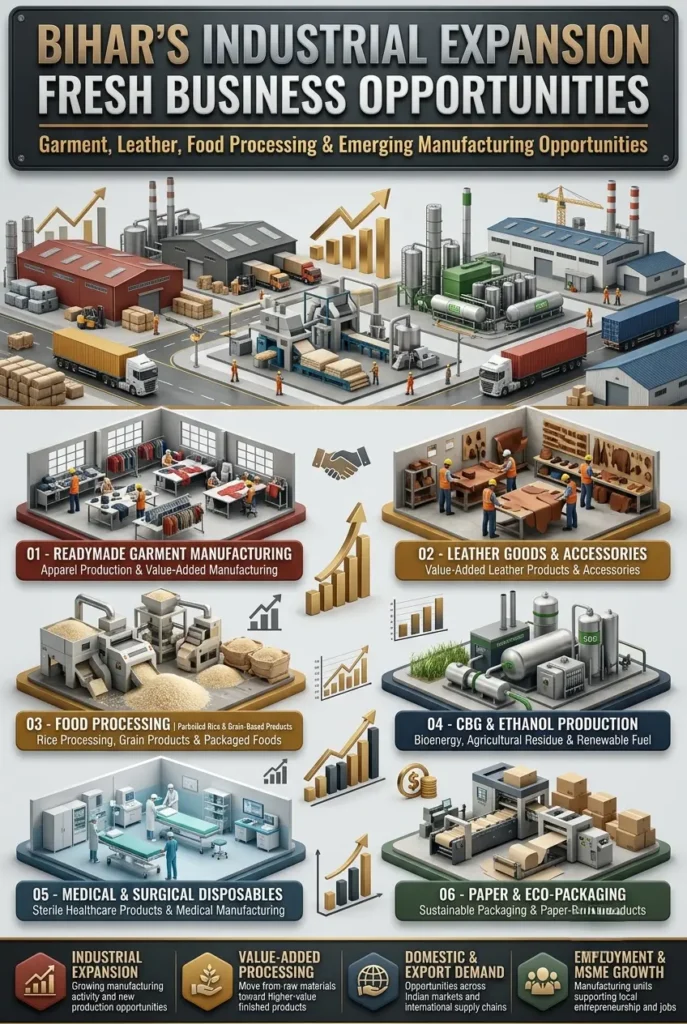
Manufacturing Business Opportunities Emerging From This Development
1. Readymade Garment Manufacturing
The entry of apparel manufacturers — including a Muzaffarpur-based unit planning to produce 5.5 million garments annually — confirm that Bihar’s garment manufacturing capacity is beginning to scale. The state’s policy explicitly designates textiles as a priority sector. The labour arithmetic is very favourable compared to saturated hubs in Ludhiana or Tiruppur. A new garment unit in Bela or Motipur can target both domestic wholesale buyers. These buyers are increasingly sourcing from Tier-2 cities to diversify supply chains. It can also target export markets in South Asia, Africa, and the Middle East. Raw material (fabric and trims) sourcing can be done from established textile hubs via rail. MSMEs can start with shirt-trouser or bottom-wear lines. They can expand into higher-value categories later.
2. Leather Goods and Accessories Manufacturing
Bihar has a legacy in raw and semi-processed leather (particularly from Kishanganj and surrounding areas) but value addition through finished goods manufacturing is relatively low. Industrial zones in Bettiah and Madhubani provide opportunity to establish leather goods units producing footwear, belts, wallets, industrial gloves, and bags. The Council for Leather Exports (CLE) under the Ministry of Commerce actively supports leather goods manufacturers for export facilitation. Domestic demand for leather footwear and accessories continues to grow with urban income expansion. Raw material availability is relatively local; tannery outputs from Bihar and West Bengal can supply finished goods units. The key investment areas are cutting and stitching machinery, finishing equipment, and quality control tooling. MSME units can comfortably enter at ₹40–₹120 lakh depending on product focus.
3. Food Processing — Parboiled Rice and Grain-Based Products
Bihar is one of India’s largest paddy-growing states, yet a disproportionate share of its rice is processed outside the state. Motipur is specifically developing its cluster with food processing as a priority — and Gairo Agro Industries’ entry with a modern parboiled rice processing unit signals the direction. Beyond parboiled rice, grain-based products including rice flour, broken rice starch, poha (flattened rice), and rice bran oil represent logical adjacent manufacturing lines. Export potential to Gulf markets, Southeast Asia, and Africa exist for processed rice products. Entrepreneurs with backgrounds in agro-processing will find the raw material access, policy environment, and export demand all aligned at Motipur. Unit size for a mid-capacity rice processing facility: ₹50–₹200 lakh depending on throughput.
4. Compressed Biogas (CBG) and Ethanol Production
The Motipur cluster is seeing dedicated investment in bioenergy. Muzaffarpur Biofuels is establishing large-scale ethanol production using grain feedstock, while Anvira Green Energy is setting up a Compressed Biogas and CNG plant. The Galvanizing Action Plan for Biogas (GOBARdhan scheme) and the National Policy on Biofuels provide policy tailwinds at the central level. Bihar’s agricultural waste availability (paddy straw, sugarcane press mud, vegetable waste) provides viable feedstock economics for CBG units. Addressable market includes piped gas distribution, CNG blending stations, and industrial customers. Entrepreneurs with moderate technical backgrounds and access to medium-scale capital (₹2–₹10 crore) will find CBG and ethanol production a well-supported, high-demand opportunity.
5. Medical and Surgical Disposables Manufacturing
The establishment of RMS Surgical in Bela for disposable syringe and surgical supply manufacturing is an emerging niche. India remains a net importer of several categories of medical disposables despite having manufacturing capabilities. Bihar’s lower cost base and proximity to eastern India’s hospital catchment area (including major hospital hubs in Patna and Kolkata), provide commercial logic for surgical disposables manufacture. Products that can be targeted: disposable syringes, IV sets, surgical gloves, non-woven surgical masks and drapes, wound dressings. Technology licensing from established producers is feasible. This is a relatively regulated sector (requiring CDSCO approval), but once compliant, it provides stable and growing demand with limited domestic competition in the eastern region.
6. Paper and Eco-Packaging Manufacturing
The entry of Jamuni Food Packaging in Bela for paper cup production is not incidental. India’s ongoing phase-out of single-use plastics is driving sustained demand for paper cups, plates, food containers, and paper bags across quick-service restaurants, canteens, hospitals, and institutional buyers. Bihar’s proximity to pulp and raw paper suppliers in West Bengal and Odisha provides logistics advantage. Paper packaging manufacturing is relatively capital-light at the entry level (₹30–₹80 lakh for a paper cup or plate line), MSME-friendly, and has immediate local B2B demand. Entrepreneurs without technical manufacturing backgrounds can often operate these lines with reasonable training and contract technical support.
Import-Export and International Market Opportunity
Export Opportunity: Furthermore, Bihar-based garment units now being established are targeting both domestic markets and select export corridors. Meanwhile, Indian garment exports — which crossed USD 13 billion in April–January 2024-25 — continue to grow despite global supply chain disruptions, with buyers in the Gulf, Africa, and Southeast Asia actively seeking sources beyond Bangladesh and China. Moreover, Bihar’s extremely competitive labour cost structure, combined with improving rail freight access, create a credible export case for manufacturers willing to invest in quality and compliance systems.
Similarly, leather goods from Bihar — particularly from established hubs in Kishanganj — already reach international markets in raw and semi-processed form. Therefore, converting this into finished goods export through new industrial zone units would substantially increase per-unit realisation and job creation per hectare of industrial land. In addition, the Council for Leather Exports actively supports manufacturers seeking international market access.
Furthermore, food processing exports from eastern India (particularly rice, makhana (fox nuts), and processed spices) have been growing steadily. Notably, Bihar’s own makhana (which holds a Geographical Indication tag), commands premium pricing in European and North American specialty food markets. As a result, processing facilities established near Motipur or Madhubani can tap this export potential with appropriate food safety certification.
Import Substitution: Meanwhile, India continues to import compressed biogas components, certain categories of surgical disposables, specialised leather accessories, and high-margin processed food products that can be manufactured domestically. Therefore, the combination of BIADA’s infrastructure and Bihar’s raw material base makes import-substitution manufacturing commercially viable in these categories.
Indian MSMEs and Startups in Related Industries
SAPL Industries Private Limited (Mumbai/Muzaffarpur)
This Mumbai-based apparel manufacturer has received approval to establish a garments manufacturing facility in Muzaffarpur. The investment is approximately ₹30 crore, with potential to generate around 1,500 direct jobs.
SAPL’s decision to establish production capacity in Bihar demonstrates that established apparel businesses are viewing the state’s policy environment and labour arithmetic as commercially viable — not merely experimental.
Entrepreneurs can learn from this example. Partnering Bihar’s labour and policy advantages with established supply chain connections from mature apparel markets is a replicable strategy.
Gogreen Apparel Limited (Muzaffarpur, Bela Industrial Area)
Gogreen Apparel is building a dedicated garment manufacturing facility in Bela with a planned annual production capacity of 5.5 million garments. The investment demonstrates that capacity-scale manufacturing (not just pilot units) is viable in Bihar’s existing industrial infrastructure. Entrepreneurs considering entry should take note that Gogreen’s model of co-locating production with BIADA infrastructure and state policy support has already cleared all land and administrative hurdles through the single-window system.
Muzaffarpur Biofuels (Motipur Cluster)
Operating within the Motipur cluster, this biofuel company is establishing large-scale ethanol production using grain feedstocks — a model that directly leverages Bihar’s surplus agricultural output. Their presence signals to investors that the bioenergy processing opportunity in Bihar is not theoretical. The key learning for entrepreneurs: grain-surplus states with bioenergy policy backing create the most de-risked environment for new ethanol and CBG ventures.
What Entrepreneurs Should Evaluate Before Investing
Before committing capital to any manufacturing venture in Bihar’s new industrial zones, a structured pre-investment evaluation is essential.
Market Demand: Confirm buyer relationships before production begins. For garment and leather units, identify B2B buyers in domestic wholesale or export markets who have expressed interest in Bihar-origin supply. For food processing, map your target distribution — state government canteens, regional supermarkets, or export intermediaries.
Land and Location: Verify current land availability and pricing at the specific BIADA cluster you are targeting. Some clusters have waitlists; apply early through BIADA’s land allotment process and confirm infrastructure status (power connection, road access, drainage) at the plot level.
Labour and Skill: Bihar’s labour availability is strong, but production-line workers typically require skill training. Budget for initial training either through your own programme or by engaging the state’s Industrial Training Institutes (ITIs), several of which the National Skills Development Programme is upgrading.
Technology and Machinery: For garment manufacturing, high-speed sewing machines, cutting tables, and finishing equipment are widely available from domestic suppliers. For food processing, assess whether Indian-make processing lines (rice mills, drying units, packaging lines) meet your quality and throughput targets. For CBG units, technology is typically licensed from established process companies.
Working Capital: Manufacturing units in new industrial zones typically need 90–120 days of working capital buffer during initial operations. Map your receivables cycle carefully, particularly if supplying to institutional buyers who have extended payment terms.
Regulatory Compliance: For surgical disposables, CDSCO registration is mandatory. For food processing, businesses need to budget for FSSAI certification and relevant export certifications (APEDA registration, BRC, ISO). For garment exports, established international buyers will require buyer-specific social compliance audits (SEDEX, WRAP).
Competitive Landscape: Bihar’s garment and leather manufacturing sectors are early-stage, which means less local competition but also a less developed local supply chain. Entrepreneurs should model their supply chain carefully, accounting for fabric sourcing lead times from hub cities.
How NPCS Can Help Entrepreneurs Evaluate the Opportunity
NPCS — Niir Project Consultancy Services — is one of India’s most established sources of techno-economic feasibility guidance. Moreover, it supports entrepreneurs evaluating new manufacturing ventures. With this in mind, with a multi-decade track record covering virtually every industrial sector in India, NPCS provides foundational research and structured analysis. Therefore, first-time and experienced entrepreneurs alike need this before making a capital commitment.
Furthermore, NPCS services include preparation of Detailed Project Reports (DPRs). These, in turn, cover plant economics, machinery selection, raw material assessment, financial projections (P&L, cash flows, balance sheet), applicable government incentives, and break-even analysis. In addition, NPCS also offers Market Research Reports, Technology Assessments, Pre-Investment Studies, and Manufacturing Feasibility Reports. Moreover, these are tailored to specific investment scales and locations.
For example, for entrepreneurs exploring garment manufacturing, leather processing, food processing, biogas, or related sectors in Bihar’s expanding industrial zones, NPCS project reports and printed reference books provide a structured starting point. As a result, they support investment evaluation.
NPCS has published a comprehensive printed reference book covering textile processing technologies, manufacturing processes, market analysis, and investment parameters in depth. You can access the printed book here: The Complete Technology Book on Textile Processing with Effluent Treatment — a reference covering spinning, weaving, knitting, dyeing, printing, finishing, and sustainable manufacturing processes.
For a detailed techno-economic Project Report on setting up a readymade garments or textile manufacturing business — including plant economics, machinery lists, financial projections, and applicable government incentives — explore the Readymade Garments (T-Shirt) Manufacturing Plant — Detailed Project Report available through NPCS — covering plant capacity, machinery investment, working capital, cost of project, target customers, and return projections.
Business Opportunity Snapshot
| Parameter | Detail |
| Industry | Garment Manufacturing, Leather Processing, Food Processing, Ethanol/Biofuel, Medical Disposables |
| Market Driver | State-led industrial zone expansion; plug-and-play infrastructure; policy incentives for Tier-2 districts |
| Key Development | 20 new industrial zones being developed across Bihar; 516+ hectares earmarked; existing clusters being upgraded |
| MSME Opportunity | Readymade garments, leather accessories, food processing units, paper packaging, surgical disposables |
| Manufacturing Potential | High — labour-intensive sectors with low capital entry barriers for MSMEs |
| Export Potential | Moderate to High — garments, leather goods, processed food, and biogas by-products have export traction |
| Import Substitution | Leather goods, surgical disposables, compressed biogas, processed agricultural produce |
| Government Support | BIADA land allotment, Bihar Textile & Leather Policy 2022, Mukhyamantri Udyami Yojana, CGTMSE |
| Investment Consideration | Infrastructure-ready plots via BIADA; single-window clearances; capital subsidy under state schemes |
| Risk Level | Moderate — logistics remain a work-in-progress; skilled labour pool developing |
| Growth Outlook | Positive — state-wide industrial push, private investment flowing in, policy support well-established |

Conclusion
Bihar’s emergence as a serious manufacturing destination is no longer speculative. Moreover, the combination of 20 new industrial zones and expanding clusters at Bela and Motipur strengthens this position. In addition, active land allotments cover food processing, garment, bioenergy, and medical disposables sectors. Furthermore, Bihar also has a well-structured policy incentive architecture under the Bihar Textile & Leather Policy 2022 and the Mukhyamantri Udyami Yojana. Together, with BIADA’s single-window land allotment system, these factors place Bihar squarely in the consideration set. Therefore, this is relevant for any entrepreneur evaluating affordable, policy-backed manufacturing locations in India.
For example, for garment manufacturers looking for a lower-cost alternative to Ludhiana or Tiruppur, Bihar offers an opportunity. Similarly, leather goods producers can seek domestic value addition. Likewise, food processors can target under-leveraged agricultural produce. Additionally, entrepreneurs can also explore biogas and paper packaging. Overall, the opportunity structure in Bihar’s industrial zones is real and commercially grounded. Moreover, it is also supported at multiple levels of government.
Importantly, the early-mover advantage in these clusters is significant. However, land allocation in the most attractive zones is competitive. Therefore, MSMEs and investors who conduct rigorous market research can improve their position. In addition, they should also prepare a credible DPR. Furthermore, proactive engagement with BIADA and state industry officials is equally important. As a result, this approach can help secure viable plots and access the full range of policy incentives.
Finally, the right approach is systematic: Market Research → Feasibility Study → DPR Preparation → Investment Planning → Application to BIADA. In this way, each step builds the foundation for a manufacturing venture. Ultimately, such a venture can genuinely benefit from Bihar’s industrial moment.
Your Investment Deserves the Right Opportunity
Every serious investment begins with choosing the right sector and the right business model. With hundreds of industrial opportunities available across India’s manufacturing and clean-energy landscape, making the most informed choice is critical. NIIR’s Startup Selector tool helps entrepreneurs, MSMEs, and investors identify the most suitable business opportunities based on their investment capacity, location, and interests — so your capital is directed toward a venture with the strongest fit and potential.