


BHAVYA Scheme Industrial Parks
The Bharat Audyogik Vikas Yojana (BHAVYA) has been an effort by India to roll out one of the strongest initiatives of industrial infrastructure in recent years. The government has 100 modern industrial parks that it intends to develop in the country with a total budget allocation of 33,660 crore. These parks are constructed to offer ready infrastructure to industries to ensure that manufacturing plants can be operational at a short time without experiencing delays in development of land or utilities.
This is a particularly appealing scheme to the private developers and investors since it makes it a lot less risky to the financial side. Rather than incurring the entire expense of developing infrastructure, developers are directly sponsored by the government to install vital infrastructure (roads, drainage, water supply and power connectivity). Industrial parks development is more affordable and lucrative compared to conventional real estate development due to the financial structure.
Get Detailed Insights from This Book: Our Books
Why the BHAVYA Scheme Is a Major Opportunity
The manufacturing industry of India is expanding at a very high rate because of rising exports, government support and the global changes in the supply chain. International companies are currently seeking good places to manufacture their products in India, yet the lack of ready industrial infrastructure is a major challenge. The BHAVYA scheme fills this gap by facilitating the creation of fully serviced industrial parks.
The scheme is based on the success of its previous industrial city projects which the National Industrial Corridor Development Corporation (NICDC) had developed where the amount of industrial space demanded has always surpassed its supply. Through this strategy to go national, the government is set to speed up industrialization and creation of jobs.
Key Financial Benefits of the BHAVYA Industrial Park Scheme
The monetary grant given to the developers is one of the most powerful strengths of the scheme. Infrastructure costs are borne by the government in a significant percentage and the developers are therefore able to invest in revenue generating facilities.
Amongst the huge financial gains, there are:
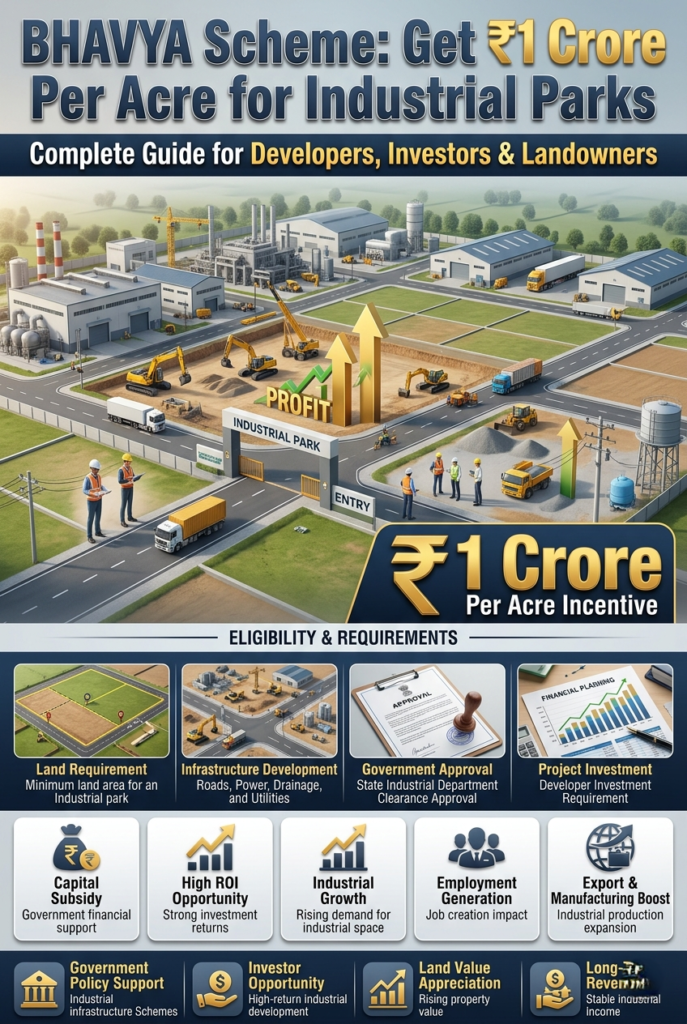
- Funding of up to ₹1 crore per acre for infrastructure
- Additional support up to 25% of cost of project connectivity.
- Less capital requirement to be invested by developers.
- Reduced economic risk as compared to conventional infrastructure project.
- Quicker payback period because of government assistance.
The average industrial park under such a scheme can receive constant revenue in the form of land lease, factory renting as well as utility services. Such sources of income generate a stable cash flow and make the project financially viable in the long run.(BHAVYA Scheme Industrial Parks)
Get Detailed Project Report (DPR): Project Reports & Profiles
Estimated Cost and Revenue Structure for a 200-Acre Industrial Park
The economic formulation of an industrial park is a process that needs to be planned. In the BHAVYA scheme, the project cost is divided between the central government, state government and the developer who is a private.
The financial structure of a typical 200-acre industrial park can be the following:
Total project cost:
₹220 crore to ₹380 crore
Government infrastructure funding:
Up to ₹200 crore
State government contribution:
₹30 crore to ₹60 crore
Developer investment:
₹30 crore to ₹60 crore
When the park is up and running, it can make money through various means including renting out land, renting out warehouses and service fees. Furthermore, Annual revenue is about 18-30 Crores at about 70 percent occupancy, and the payback period is about 4-6 years.
Essential Requirements to Apply for the Scheme
Firstly, The developers should fit particular eligibility requirements to be eligible on funding under the BHAVYA scheme. Moreover, Such requirements make sure that only desirable projects are supported by the government.
Some of the key eligibility conditions are:
- A minimum of 100-acre land area.
- Legal title and ownership of land.
- Availability of basic utilities such as power and water
- Partnership with state industrial development authority.
- Commitment from potential industrial tenants
- Compliance with environmental regulations
The fulfilment of these requirements stands the chances of approval high.(BHAVYA Scheme Industrial Parks)
Turn your budget into a successful business plan
The Role of a Detailed Project Report (DPR)
The most important document in the approval process is the Detailed Project Report or DPR as it is also called. In fact, It shows the technical feasibility, financial viability and sustainability of the project in the long run. Furthermore, The government authorities use this document to assess how well the project will deliver both infrastructure development and job creation.
A well-prepared DPR usually includes:
- Overview of the project and development plan.
- Real estate and legal records.
- Fabrication and design of infrastructure.
- Financial forecasts and funding plan.
- Environmental compliance plan
- Employment generation estimates
Professional DPR preparation tends to result in quicker approvals and reduced regulatory delays by developers who invest in it.
How Professional Consultancy Firms Support Industrial Park Development
The development of industrial parks is a complicated undertaking, requiring planning, adherence to regulations and economic modeling. Therefore, Most developers are using the services of professional consultants in order to take care of these technical requirements and to make sure that their applications are of government standard.
In this context, NIIR Project Consultancy Services (NPCS) is one of the identified organizations in this sphere. NPCS has over 45 years of expertise in planning industrial projects, which have helped businesses, manufacturers, and investors in India.
They usually provide services such as:
- Preparation of Detailed Project Reports.
- Techno-economic feasibility studies
- Market research and demand analysis.
- Financial modelling and investment planning.
- Government approvals support.
- Industrial project documentation
The developers will use experienced consultants to help them reduce project risks while increasing their chances of success.
Related Article: India Government Schemes for Entrepreneurs
Future Demand for Industrial Parks in India
In the coming ten years, India is likely to be one of the major manufacturing centers in the world. Moreover, The demand in industrial infrastructure is being propelled by government policies that promote local production and export. Furthermore, The pharmaceutical industries, electronics, renewable energy, logistics and food processing are growing at a high rate and need to be organized in industrial clusters.
Additionally, The contemporary industrial parks have the facilities required to support efficient production, supply chain management, and workforce. With the industrial space demand continuing to rise, developers who invest in high quality industrial parks at an early stage will most likely enjoy good occupancy rates and predictable long term returns.
Conclusion
The Bharat Audyogik Vikas Yojana (BHAVYA) scheme is an excellent chance to allow developers and investors to be a part of industrial development in India with great government support. Moreover, The scheme lowers infrastructure expenses and offering sure-footed funding assistance, the industrial park development is more financially feasible than ever.
However, This industry requires planning, proper site selection and documentation of the project to succeed. In addition, Strong proposal developers who take early action have higher chances of raising funds and becoming sustainable and profitable.
Frequently Asked Questions (FAQ)
What is the main objective of the BHAVYA scheme?
The initiative is intended to build the contemporary industrial parks in India through funding of infrastructural development.
The extent to which developers can be funded?
Furthermore, Developers will be able to obtain up to 1 crore per acre in funding, and additionally, support external connectivity.
Is there a private sector involvement?
Yes, Moreover, the scheme can be requested by the private developers in collaboration with the state government authorities.
Minimum requirement of land?
To be eligible to fund most projects, at least 100 acres of land are needed.
How many days is the approval period?
The time taken to approve these depends on the documentation and readiness of the project but application that is well prepared is done faster.
Why is professional consultancy important for this project?
Professional consultants assist in the process of making sure that technical, financial and regulatory requirements are addressed, moreover, enhancing the chances of approval and successful implementation.