


Aluminium Manufacturing Business Opportunities in India
India’s aluminium industry is undergoing its biggest transformation in decades. According to the Economic Times, Mukesh Ambani-led Reliance Industries Limited (RIL) is keen to consider aluminium production, thereby setting up a face-off between the two top conglomerates in the metals segment in the country. Adani Enterprises, on the other side, has already invested an audacious $11.5 billion (roughly ₹95,450 crore) in constructing a 2 million tonne per annum (MTPA) aluminium complex in Odisha in collaboration with International Holding Company (IHC) of the UAE.
This is not just a company-to-company contest. The downstream supply chains and ancillary businesses start booming when two of the top two industrial conglomerates of India invest in a single commodity. The unfolding of what is happening in the mineral-rich Kalahandi and Rayagada districts of the state of Odisha today may be the next ten years of industrial wealth creation for MSME founders, manufacturing entrepreneurs, startup investors and exporters.
This wave is not going away unless you stop it. It is already here. The next question is: Do you have the opportunity to ride it?
What the Economic Times Reporting Actually Means for Business
A detailed report in the Economic Times said that RIL had bought the tender documents for the bauxite block, Karlapat-Pollingpadar, in Kalahandi district of Odisha that covers an area of more than 3,100 hectares and has an estimated resource of 207-220 million tonnes. RIL’s entry into the game is a strong sign of its strategic intent, while Vedanta’s subsidiary BALCO came out on top at a record premium.
The significance of the move is the coal gasification tie-up that Reliance is involved with. RIL has proposed an Integrated Underground Coal Gasification Complex of ₹2.73 lakh crore in Andhra Pradesh. The production of aluminium, which consumes a huge amount of energy, would provide the company with a natural offtake market for the synthetic gas it produces and would benefit both projects at the same time. This isn’t a wild guess. It’s economic theory on steroids.
At the same time, the $11.5 billion project of Adani is already underway. It proposes to establish a 4 MTPA alumina refinery in Rayagada district on almost 3200 acres which will have a downstream manufacturing park to lure hundreds of ancillary industries. Around 35,000 jobs are expected to be created during construction and 18,500 jobs in operation, according to estimates.
Why Entrepreneurs Must Pay Attention Now
According to the Economics Times and various industry sources, India has more than 4 million tonnes of the existing aluminium production capacity while importing more than 1.5 million tonnes of value-added aluminium products every year. That import gap is where MSME and opportunity lies for startups to make their mark in the structural shortfall of manufacturing in the country. The 2 MTPA plant of Adani will be coming live and Reliance may expand its capacity, which will lead to a significant increase in primary aluminium supply in India. All downstream converter, fabricator and component manufacturers who get in place now will benefit from the best supply chain positions.
Get Detailed Project Report (DPR): Aluminium & Aluminium Downstream Projects
Why the Indian Aluminium Industry Is Growing at This Speed
India is in a unique position in the world aluminium market. The nation is blessed with some of the world’s biggest reserves of bauxite: deposits in Odisha are found in Kalahandi, Koraput, Rayagada and Bolangir, with an estimated combined reserve of hundreds of millions of tonnes. The industrial relevance of aluminium is growing in all these sectors including construction, aerospace, automotive lightweighting, power transmission, consumer durables and defence manufacturing.
- India is one of the leading producers of aluminium in Asia with the current production of 4.1-4.2 million tonnes per year.
- India’s biggest producer Vedanta Aluminium, with current capacity of 2.5 MTPA, has announced its intention of scaling up to 6 MTPA in 3 years.
- Hindalco is building 360,000 tonnes of smelting capacity per year at its Odisha’s Aditya Aluminium plant.
- Odisha is already the national hub of aluminium smelting with 54% of the country’s capacity.
- The importation of aluminium value-added products is more than 1,500,000 tonnes a year, clearly indicating that downstream manufacturing has not matched the production of the upstream.
The gap between demand and supply has been emphasized in the Economic Times’ metals reports in recent years. The joint investment by Adani, Reliance and key existing expansion plans by Vedanta and Hindalco are said to have created a structural inflection point for India’s aluminium industry.
Related Article: How to Start an Aluminium Billet Plant
Government Policies & Incentives Supporting Aluminium Sector Entrepreneurs
The policy landscape will be one of the most conducive to the entry of new entrepreneurs in the aluminium value chain in recent years in 2026. There are several state and federal government programs that directly encourage manufacturing investment in this sector.
1. Odisha MSME Development Policy 2022
The Odisha MSME Development Policy 2022 explicitly identifies aluminium downstream and ancillary manufacturing as a priority sector. It offers capital investment subsidies, power tariff concessions, land at subsidised rates in industrial parks, and dedicated MSME cluster development support.
2. Invest Odisha — Downstream Aluminium Push:
Invest Odisha actively promotes feedstock commitments from anchor aluminium producers like NALCO, Vedanta, and Hindalco to downstream and ancillary MSME units. An exclusive Aluminium Park in Angul district offers plug-and-play infrastructure for MSME manufacturers.
3. Make in India & PLI Scheme
The Production Linked Incentive (PLI) Scheme has attracted over ₹2.16 lakh crore in investments across 14 sectors. While aluminium does not yet have a standalone PLI, specialty steel and metals components qualify, and downstream aluminium products used in defence, aerospace, and renewables qualify under related schemes.
4. National Mineral Policy 2019
The Ministry of Mines’ National Mineral Policy prioritises auction transparency and end-use conditions for bauxite blocks, encouraging genuine value addition within India rather than raw material export.
5. Ministry of Steel & Metals Support
The Ministry of Steel has launched PLI Scheme 1.1 for specialty steel and continues to push domestic metals processing through infrastructure corridor investments.
6. MSME Ministry Schemes
The Ministry of MSME‘s Credit Guarantee Fund Trust for Micro and Small Enterprises (CGTMSE) and MUDRA loans provide collateral-free financing for manufacturing startups entering the aluminium downstream space.
7. Odisha Industrial Infrastructure Development Corporation (IDCO)
IDCO Odisha provides developed industrial land, sheds, and infrastructure support for new manufacturing units in Odisha’s industrial corridors, directly relevant to entrepreneurs targeting Adani’s and Hindalco’s supply chains.
8. NALCO’s Vendor Development Programme
National Aluminium Company (NALCO) runs structured vendor and ancillary development programmes, helping MSMEs qualify as preferred suppliers to anchor aluminium producers.
9. Export Promotion Council for EOUs & SEZs
EPCES supports aluminium product exporters through duty drawback schemes, market access programmes, and international trade facilitation for downstream aluminium manufacturers.

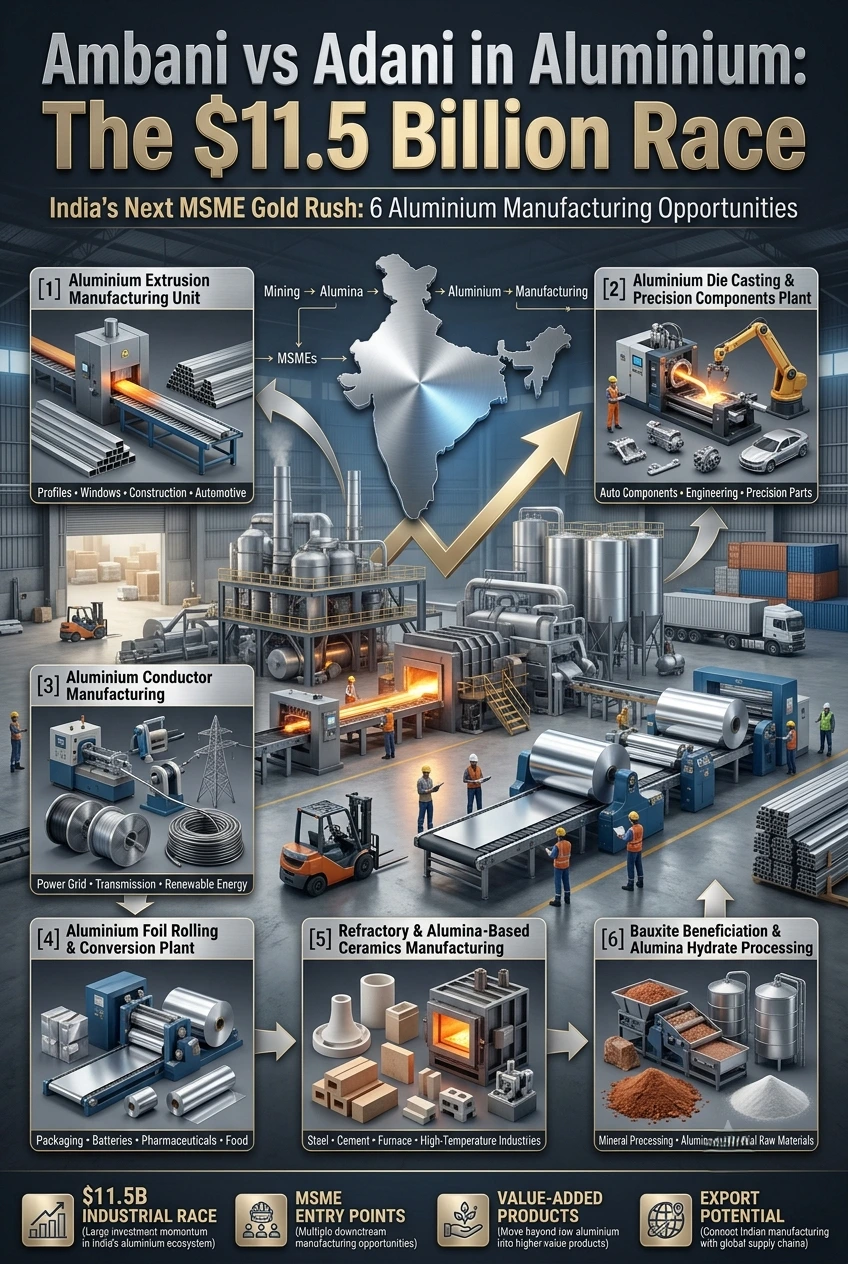
6 Manufacturing Business Opportunities Directly Emerging From This Development
1. Aluminium Extrusion Manufacturing Unit
With the rise in primary aluminium availability, the cost of raw materials for extrusion manufacturers will be directly reduced due to the Odisha project initiated by Adani. One of the fastest growing value-added products are aluminium extrusions in window frames, curtain walls, automotive trims, railway coaches, industrial machinery. India is a large importer from China. The margins for a domestic extrusion plant for the construction, transport and defence markets are 20-30%. Capital investment: Medium scale (₹2 – ₹6 crores).
Access Complete Business Plan: Aluminium Extrusion Plant Project Report
2. Aluminium Die Casting & Precision Components Plant
Precision aluminium castings are witnessing explosive demand due to automotive lightweighting, defence manufacturing under Aatmanirbhar Bharat and aerospace localisation. The downstream park being proposed by Adani will be a hotspot for automotive Tier-1 vendors while MSME foundries and die casting units near Odisha’s industrial corridors will be the ones that will get the opportunities. The investment range of high pressure die casting (HPDC) machines is ₹3-8 crore and can deliver margins of 25-40% on specialty automotive and industrial castings.
3. Aluminium Conductor Manufacturing (ACSR/AAAC Cables)
India’s colossal power sector development and modernization programs, such as electrification of rural areas, modernization of power grid, transmission of renewable energy to the grid etc., demand large quantities of All Aluminium Alloy Conductors (AAAC) and Aluminium Conductor Steel Reinforced (ACSR) cables. With Adani’s and Reliance’s planned capacity, there will be a stream of new aluminium to upstream manufacturers and a consistent supply of quality and cost-effective conductors. Conductor manufacturers will have an assured supply of high quality and competitive cost raw material advantage with the added availability of aluminium from the upstream manufacturers. Investment size: MSME cable conductor units will require an investment in the range of ₹1.5 crore to ₹5 crore.
View Full Project Details: Aluminium Conductors Manufacturing Guide
4. Aluminium Foil Rolling & Conversion Plant
Aluminium foil imports are more than ₹2,000 crore a year for India from China, South Korea and Germany. With the introduction of 60,000 TPA foil plant at Sambalpur, which supplies jumbo rolls to the domestic market, MSME converters can now establish foil to finished product conversion units without relying on imports for pharma-grade lidding foils, household foils, blister pack foils and industrial laminates. Entry price for conversion units: 18 to 35 margins of ₹40 lakh to 1.5 crore.
5. Refractory & Alumina-Based Ceramics Manufacturing
Aluminium smelters are a huge consumer of refractory materials of high alumina bricks, castables, ceramic linings etc. in construction and maintenance of their furnaces. Adani’s 4 MTPA alumina refinery and downstream smelter will require long-term supply of refractories for its years of operation. The stable and long-term order book can be achieved through an MSME refractory unit with these anchor plants. Investment: ₹1–4 crore. Proximity of the raw material is available from the aluminium mineral belt of Odisha.
6. Bauxite Beneficiation & Alumina Hydrate Processing
Not all of the bauxite feed into primary smelters. Growing industrial demand for calcined alumina, aluminium hydroxide and specialty alumina hydrate for chemicals, ceramics, paper, water treatment and flame-retardant applications. The record bauxite premiums in Odisha would allow MSMEs that are able to sign a small-scale mineral offtake agreement or buy from secondary markets to run profitable beneficiation and specialty chemical facilities. Capital investment: ₹2-8 crore with good export potential to South East Asian countries and Middle East countries.
Import–Export Opportunity Analysis
Import Substitution
The most viable import substitution opportunity for India in the aluminium industry is the 1.5 million TPA worth of value-added aluminium products. India imports these products from China, South Korea and Germany. This encompasses aluminium foil, particularly in the pharma and industrial sector, automotive castings, rolled sheets for aerospace use and cable conductors. Indian MSME manufacturers have a limited opportunity to become domestic suppliers. This opportunity may become crowded due to multiple new capacities coming on-line by 2028-2030.
Read the Complete Book Here: The Complete Technology Book on Aluminium and Aluminium Products
Export Markets
Not all aluminium producing countries are great at downstream conversion. India’s manufacturing cost advantage and geographical proximity to the Middle East, South East Asia, and Africa offer tremendous export potential for finished aluminium products. New markets for Indian aluminium extrusions, conductors, and building products are emerging in UAE, Saudi Arabia, Vietnam, Bangladesh, and East Africa. Paradip Port (UP) and Dharma Port in Odisha offer competitive logistics for exportation. This benefits manufacturers set up in the industrial corridors of Odisha.
International Demand
The use of aluminium in the aerospace and defence sector is growing on a global scale, on a per-unit basis. The trend of carbon emission reduction by lightening vehicles is gaining momentum in Europe and North America. As the number of qualities certified raw materials manufactured in India grows, Indian manufacturers, who are certified to international quality standards (AS9100 for aerospace, IATF 16949 for automotive), can now avail of the prospects of being part of the global supply chains.
Indian MSME Success Stories in the Aluminium Ecosystem
Shyam Metalics and Energy Limited — Odisha Downstream Pioneer
The National Aluminium Company, Bhubaneswar, has systematically created hundreds of MSME vendors across Odisha through its vendor development programmes. These small manufacturers supply refractory materials, mechanical parts, electrical spares, packing materials and industrial services. They serve NALCO’s Damanjodi and Angul units. It has a cost advantage in its energy-intensive aluminium rolling because its captive energy production is 467 MW. This model demonstrates the possibility of making good money by the non-primary aluminium producers in the downstream segment.
NALCO’s Vendor Ecosystem — Building MSME Suppliers in Odisha
The National Aluminium Company, Bhubaneswar, has been systematically creating hundreds of MSME vendors across Odisha through its vendor development programmes. The small manufacturers sell refractory materials, mechanical parts, electrical spares, packing materials and industrial services. They supply these to NALCO’s Damanjodi and Angul units. This is a well-established template for a long-term, stable business model between MSMEs and anchor aluminium producers. The expansion programs of NALCO and the introduction of Adani will create a lot more such opportunities for MSMEs.
Aluminium Park, Angul — MSME Cluster Success
The Odisha government promoted Aluminium Park in Angul has achieved success in accommodating various MSME downstream industries. These include products like KWAR, alloy wheels, kitchen utensils, building profiles and industrial components. In this park, several units have established export connections with buyers in Southeast Asian countries and the Gulf. The park model includes captive power, feedstocks pledged by Vedanta and NALCO, and plug-and-play infrastructure. It is a tangible example of how MSME manufacturers can excel in close proximity to aluminium anchor players.
Your investment deserves the right opportunity
About Niir Project Consultancy Services (NPCS)
Niir Project Consultancy Services (NPCS) is one of the most trusted industrial consultancy firms in India that assist entrepreneurs, MSMEs, startups and investors in making informed business decisions. NPCS provides opportunity to the aluminium sector as described in this article:
- Detailed Project Reports (DPR) of aluminium Extrusion and Die casting, Conductor, Aluminium foil and Refractories Projects.
- Techno-economic feasibility studies including plant layout, procurement of machines, raw materials and revenue projection, etc.
- Market research, import-export data, competitive benchmarking reports on downstream aluminium sectors in India.Market research, import-export data, competitive benchmarking reports in India for the downstream aluminium sectors.
- Technology advice on process selection, energy efficiency and quality certification routes.
- Financial Modelling and Bank submission-ready Project reports for CGTMSE, SIDBI & State Financial Institution funding
A credible feasibility study isn’t a luxury in such a fast-moving sector – it’s the basis of a sound investment decision.
Industry Data Snapshot
| Parameter | Details |
| Industry | Aluminium Mining, Smelting & Downstream Manufacturing |
| Market Driver | Adani $11.5B Odisha project + Reliance exploration of coal gasification-linked aluminium production |
| MSME Opportunity | Aluminium extrusions, castings, foils, cable conductors, auto components, refractory materials |
| Export Potential | High — 1.5 million TPA aluminium value-added imports can be substituted; strong demand from UAE, EU, Southeast Asia |
| Government Support | Odisha MSME Policy 2022, Make in India, PLI Scheme (Specialty Steel), National Mineral Policy 2019 |
| Risk Level | Medium (capital-intensive upstream; MSME downstream entry at ₹40 lakh – ₹4 crore is feasible) |
| Growth Outlook | Strong — India aluminium market on expansion path; 2M TPA new capacity from Adani alone by 2030 |

Conclusion: The Window Is Open — For Now
The Reliance-Adani aluminium battle is more than just a business news. It is the first step in India’s biggest industrial revolution in the metal industry. Where two of the world’s most capital power conglomerates unite on one commodity, entrepreneurial wealth is built in the downstream ecosystem.
As reported in the Economic Times (economictimes.indiatimes.com), the aluminium supply chain is undergoing real change. It is shifting from an import-dependent downstream sector to a self-reliant and export-ready manufacturing segment. Investments by Adani, Hindalco, Vedanta, and possibly Reliance could add millions of tonnes of upstream capacity over the next five years.
For entrepreneurs, the opportunity window is widest right now. This is before anchor plants are commissioned, preferred vendor lists are locked, and the downstream supply chain becomes crowded. The capital requirement to establish a credible MSME presence in aluminium extrusion, die casting, conductor manufacturing, or refractory supply is a fraction of what large players are spending. The returns can be significant relative to that investment.
India has consistently underperformed its bauxite and aluminium potential at the downstream manufacturing level. That era is ending. The entrepreneurs who act on the intelligence in this report — supported by rigorous feasibility planning, the right state government incentives, and anchor customer development — will write the next chapter of India’s aluminium success story.