Acetic Acid Manufacturing Opportunity
India’s chemical industry is booming and one area that is being given more and more attention by investors and entrepreneurs is the acetyl chemicals market. These chemicals are the backbone of a number of industries like pharmaceuticals, textiles, food processing, paints, adhesives and agrochemicals. India imports almost all of its acetyl requirements because the country does not have sufficient domestic production capacity to satisfy the growing need for this chemical.
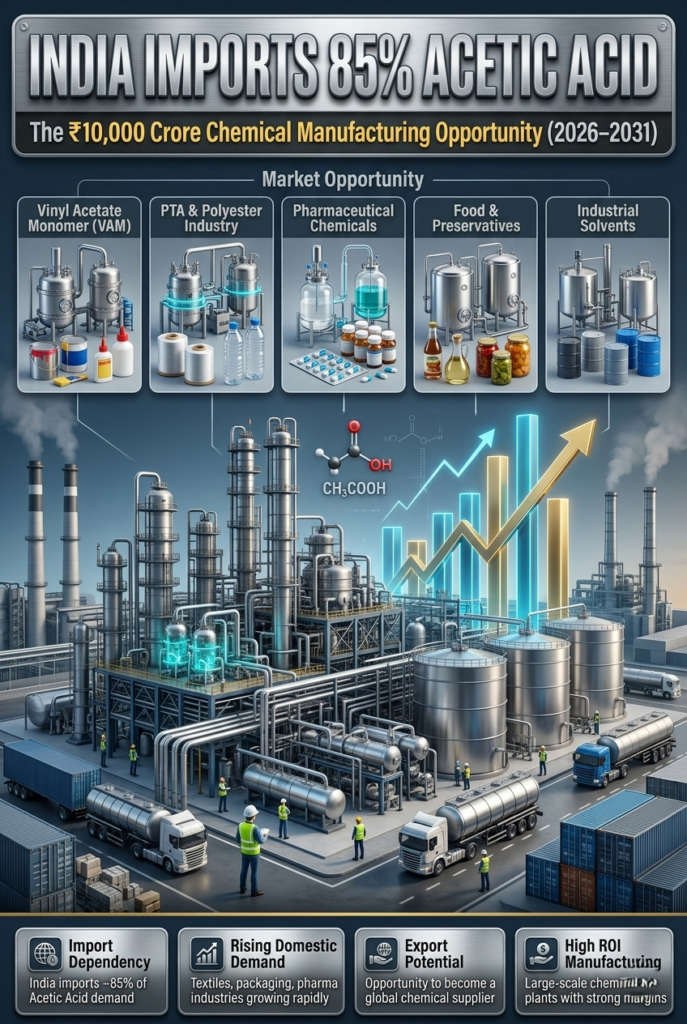
The chemical industry research indicates that India needs to import more than 85 percent of its acetic acid supply which makes this sector one of the most import-dependent chemical industries in India. The existing production facilities cannot meet domestic market needs which enables new manufacturing projects to emerge as a major opportunity.
Between 2026 and 2031, India’s acetyl market is expected to grow at a steady rate due to the expansion of the pharmaceutical manufacturing sector, the growing consumption of polyesters, the increasing packaged food products market, and the increasing demand from the paints and construction industry. For MSMEs, startups and industrial investors, this situation represents a great opportunity to enter a market with a good long-term demand.
Read More: Handbook On Chemical Industries (Alcohol Based)
Understanding the Acetyl Chemical Value Chain
Acetyl chemicals are a class of industrial chemicals that are based mainly on acetic acid (CH3COOH). Industrial processes depend on these chemicals as essential intermediates which various industries use for their manufacturing operations.
Some of the most important acetyl derivatives are:
- Acetic Acid
- Ethyl Acetate
- Vinyl Acetate Monomer (VAM)
- Acetic Anhydride
- Butyl Acetate
- Cellulose Acetate
- Polyvinyl Acetate (PVA)
Industrial processes use these chemicals in multiple ways including solvent production and pharmaceutical synthesis as well as adhesive creation and packaging material development and food preservation. Because the acetyl chain is interconnected, when one chemical is in short supply, it can have effects on a number of industries down the line.
Market Size and Growth for Acetyl Industry in India
India’s acetyl industry has seen steady growth rate over the past decade and the demand is expected to grow further as manufacturing activity is on the rise.
Key market indicators point to the potential for growth:
- Total Market Size: USD 567 million.
- The findings for the potential market value in 2032 were as follow
- Annual Growth Rate: About 5.7%
When the total acetyl derivatives chain is taken in to consideration (including ethyl acetate, acetic anhydride, and vinyl acetate), the total addressable market in India is over USD 1.5 billion.
Globally, the acetyl chemicals industry is also expanding strongly. The global market is worth over USD 30 billion in 2023 and will grow to almost USD 50 billion by 2032. Asia-Pacific is the largest consumption region and India has emerged as one of the fastest growing markets.(Acetic Acid Manufacturing Opportunity)
Read More: Glacial Acetic Acid – Manufacturing Plant, Detailed Project Report, Profile, Business Plan, Industry Trends, Market Research, Survey, Manufacturing Process, Machinery, Raw Materials, Feasibility Study, Investment Opportunities, Cost and Revenue
India’s Demand-Supply Gap: The Core Market Opportunity
The most important factor which characterizes the acetyl sector in India is the vast gap between domestic production and consumption. Industrial demand has been much higher than it was and local manufacturing capacity has not kept up.
India’s current consumption of acetic acid is more than 1.5 million metric tonnes per year, and production only a fraction of the requirement. Countries like China, Singapore and Malaysia import the bulk of the supply.
This import dependence poses a number of challenges for the domestic industries. Fluctuating global prices, currency fluctuations, and supply chain disruption can impact raw material availability. At the same time, the strong dependence on imports shows the huge potential to replace imported products with domestic chemicals for domestic manufacturers.
For entrepreneurs, the benefit is obvious: rather than building new demand, new manufacturing units can simply have a share of the existing import market.
Key Players Operating in Acetyl Market in India
A few organised companies dominate the acetyl sector in India that run huge chemical plants and supply the raw material to several industries.
Some of the key players are:
- GNFC (Gujarat Narmada Valley Fertilizers & Chemicals) – India’s largest merchant producer of acetic acid having a capacity of around 200,000 MT/annum.
- Jubilant Ingrevia – Produces acetic acid, ethyl acetate and acetic anhydride with a strong export presence.
- Laxmi Organic Industries – One of the leading manufacturer of Ethyl Acetate & Acetaldehyde for pharmaceuticals and specialty chemical.
- Reliance Industries – Recently commissioned vast amount of acetic acid unit primarily for captive use in its polyester manufacture.
- SRF Limited and Kanoria Chemicals – Specialty chemicals and niche acetyl derivatives.
Although these companies have set up production facilities, the total output of the companies is still not enough for India’s rapidly increasing demand. This makes the imports still dominating the market.(Acetic Acid Manufacturing Opportunity)
Read More: Project Reports & Profiles
Industries That Drive Acetyl Chemical Demand
Several important industries make use of acetyl derivatives in high quantities and consequently, The demand for the chemicals directly affects their development.
Textile Industry and Polyester Industry
One of the biggest consumers of acetic acid in India is the polyester and textile industry. Acetic acid functions as a vital component in the manufacturing process of purified terephthalic acid (PTA) which is essential for producing polyester fibres. The textile export market and domestic clothing industry of India continue to grow which creates increasing demand for PTA and acetyl chemicals.
Pharmaceutical Manufacturing
India stands as one of the leading worldwide producers of generic pharmaceuticals. Acetyl derivatives such as acetic anhydride are vital in the synthesis of several important drugs such as aspirin and paracetamol. With the government supporting the domestic production of pharmaceutical ingredients, demand from this sector is expected to grow continuously.
Food Processing and Processed Foods
Acetic acid also helps preserve food and produce vinegar. As India’s packaged food industry is growing rapidly on account of urbanization and changing lifestyles, there is an increase in consumption of food-grade acetic acid.
Paints, Coatings, and Adhesives
The production of paints and coatings and glue and building chemicals uses vinyl acetate monomer and ethyl acetate as essential raw materials. The booming infrastructure and housing industries of India are creating demand for these materials.
Recent Investments in Acetyl Industry
The need for acetyl chemicals has stimulated large industrial investments. One of the most important is the joint venture of INEOS Acetyls and GNFC, to construct a new acetic acid plant in Gujarat.
This plant will have a production capacity of 600 000 tonnes per year, and is expected to start operating around 2028. Once done that will go a long way in increasing the domestic production capacity in India and making it less dependent on imports.
However, Experts anticipate that even with this large facility, the overall requirement for acetyl derivatives will continue to exceed domestic supply, leaving room for more manufacturers to enter the market.(Acetic Acid Manufacturing Opportunity)
Read More: Top 15 Emerging Chemical Startup Ideas for MSMEs in India
Opportunities for Entrepreneurs and MSMEs
For entrepreneurs looking at driving into the chemical manufacturing industry, there are several opportunities in the acetyl value chain. While it takes a lot of investment and advanced technology to build a large acetic acid plant, We can manufacture several downstream products on a moderate scale.
A few promising opportunities are:
- Food grade acetic acid and vinegar production
- Ethyl acetate manufacturing for solvents and pharmaceutical
- Specialty acetyl solvents for chemical and pharmaceutical industries
- Downstream processing of vinyl acetate derivatives;
These segments often need smaller investment compared to large petrochemical facilities yet enjoy strong demand.
Moreover, Government initiatives such as Make in India, chemical manufacturing clusters and incentive schemes in the industrial sector are also promoting domestic production in this sector.
Read More: 15 Profitable Chemical Business Ideas in India (Low Investment Manufacturing Guide)
Conclusion
India’s acetyl chemicals market is a great opportunity for industrial investors and entrepreneurs in the next decade. Firstly, Growing pharmaceutical, textiles, food processing and construction industries will continue to drive the consumption of acetyl derivatives.
At the same time, the fact that the country is heavily relying on imports shows the need for more domestic manufacturing capacity. Therefore, Companies with investment in efficient production technology and strategic locations can benefit from good demand and growth potential in the long term.
Furthermore, As India helps build a manufacturing ecosystem and promotes import substitution, Consequently, acetyl is likely to be one of the most significant segments of the chemical industry in India.
Frequently Asked Questions (FAQ)
What is the size of Indian acetic acid market?
The Indian acetic acid market is estimated to be valued at about USD 567 million in 2024 and is forecasted to reach 789 million by the year 2032.
Why does India import bulk of the acetic acid?
Furthermore, Domestic production capacity is limited and demand by industries like textile, pharmaceuticals, paints are increasing at a fast rate.
In which industries acetyl chemicals are used the most?
In addition, Major consumers are textile manufacturing, pharmaceuticals, food processing, paints and coatings, adhesives and agrochemicals.
Who are the top companies of acetyl in India?
Major players are GNFC, Jubilant Ingrevia, Laxmi Organic Industries, Reliance Industries, SRF Limited and Kanoria Chemicals.
Is acetyl chemical industry good business in India?
Yes. Since India imports a significant portion of its acetyl chemicals, new manufacturing projects that replace import have a good long-term growth potential.